
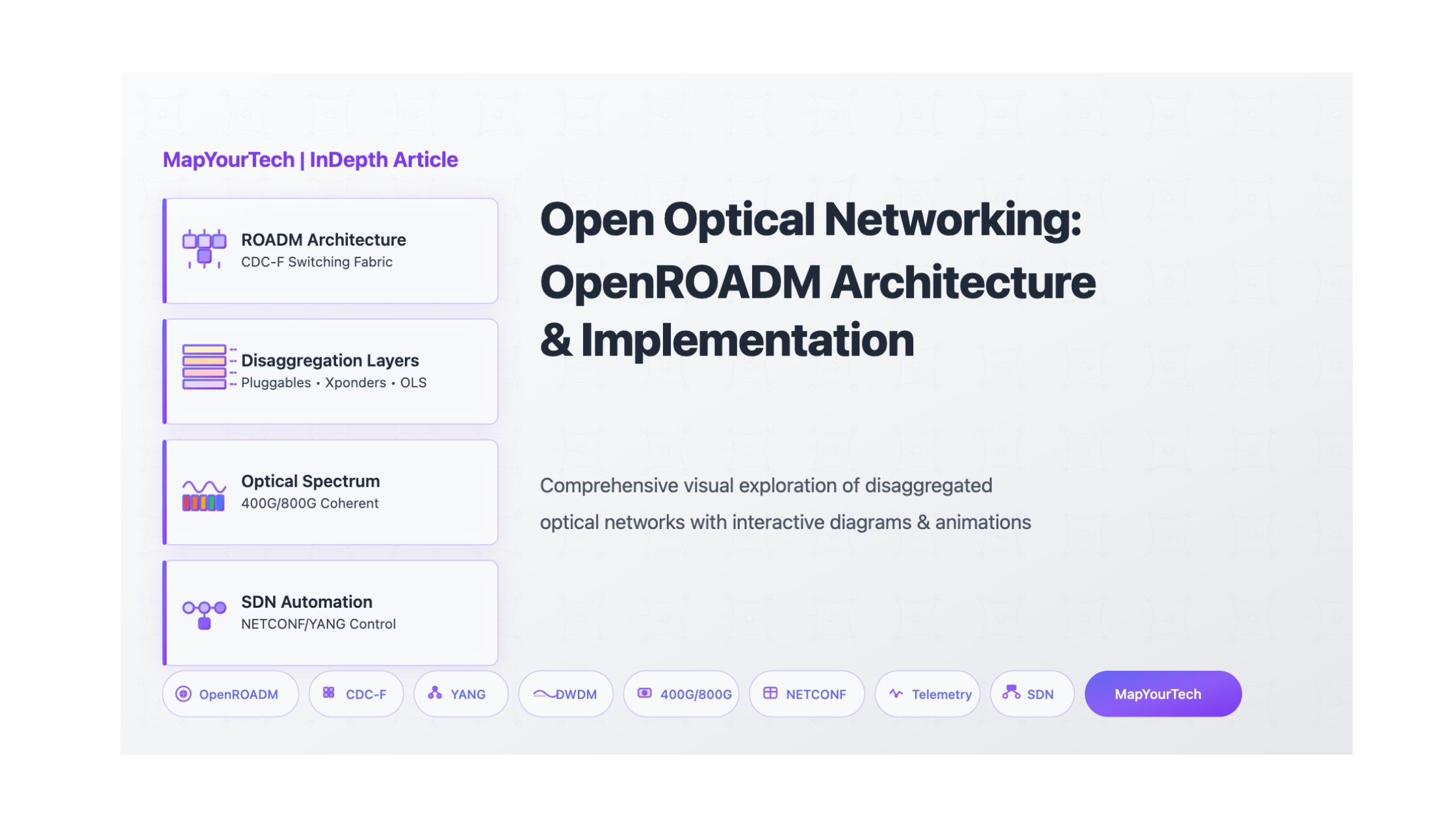

Open Optical Networking
OpenROADM MSA Architecture
All that an Optical Engineer "SHOULD" Know
1. Introduction to Open Optical Networking
Open optical networking represents a fundamental shift in how optical transport networks are designed, deployed, and operated. Traditional ROADM (Reconfigurable Optical Add-Drop Multiplexer) systems have historically been proprietary, closed architectures where hardware and software solutions are tightly coupled to specific vendors. This creates significant challenges in terms of vendor lock-in, limited innovation, and integration complexity.
The Open ROADM Multi-Source Agreement (MSA) addresses these challenges by defining interoperability specifications that enable disaggregation of optical network functions and standardized management interfaces. This revolutionary approach transforms optical networks from monolithic, vendor-specific systems into flexible, software-defined infrastructure that supports multi-vendor interoperability.
Key Insight: OpenROADM enables functional disaggregation of three core optical layers: pluggable optics, transponders, and ROADM switching equipment. These components communicate through standardized YANG data models via NETCONF interfaces, allowing for true software-defined control.
OpenROADM Functional Architecture
Three-layer disaggregated architecture with SDN control
The Problem with Traditional Optical Networks
Before the advent of OpenROADM and similar initiatives, optical transport networks faced several critical challenges that impeded innovation and operational efficiency. Traditional ROADM systems were characterized by tight vendor coupling, where a single vendor provided the entire solution stack including hardware, software, planning tools, and management systems.
This proprietary approach resulted in significant operational overhead. Integration processes were time-consuming and complex, often requiring extensive custom engineering work. The technology lifecycle for ROADMs extended over many years, during which operators were locked into specific vendor ecosystems. This reduced competition, stifled innovation, and created barriers to adopting new technologies and capabilities.
Furthermore, optical Signal-to-Noise Ratio (OSNR) management and Forward Error Correction (FEC) strategies were implemented as proprietary solutions, making it extremely difficult to mix equipment from different vendors within the same optical path. The lack of standardized data models meant that each vendor's equipment required unique management interfaces and operational procedures.
Traditional vs OpenROADM Architecture Comparison
Evolution from vendor-locked systems to disaggregated, open architecture
2. Functional Disaggregation Architecture
The cornerstone of OpenROADM is functional disaggregation, which separates the traditionally monolithic optical transport system into three distinct functional layers, each with well-defined interfaces and responsibilities. This approach differs from physical disaggregation (such as defining common shelves) by focusing on function rather than hardware form factor, providing greater flexibility for vendors while ensuring interoperability.
Layer 1: Pluggable Optics
Standards-based optical modules that provide the physical interface to the fiber. These include CFP, CFP2, QSFP28, QSFP-DD, and OSFP form factors. Pluggable optics handle optical-to-electrical conversion and basic signal conditioning, operating at standardized wavelengths within the DWDM grid.
Key Features: Hot-swappable, vendor-agnostic, power-efficient designs with digital diagnostics for monitoring temperature, optical power, and performance metrics.
Layer 2: Transponder/Muxponder
The transponder layer performs client signal mapping, OTN encapsulation, forward error correction, and digital signal processing. Modern transponders support programmable modulation formats (QPSK, 16QAM, probabilistic constellation shaping) and flexible baud rates to optimize spectral efficiency versus reach.
Key Features: OTUCn signal generation, FlexO interfaces, hitless tuning, and advanced DSP capabilities for 400G to 800G single-wavelength transport.
Layer 3: ROADM Switching
The ROADM provides wavelength routing and optical switching functionality. It consists of wavelength selective switches (WSS), optical amplifiers (EDFA), optical channel monitors (OCM), and optical supervisory channels (OSC). Modern ROADMs support colorless-directionless (CD) or colorless-directionless-contentionless (CDC) architectures.
Read the Full Analysis with Premium
The remaining 89% of this article — the design numbers, trade-offs and field guidance — is part of MapYourTech Premium, along with the full premium library, courses and professional tools.


Course Title
Course description and key highlights
Course Content
Course Details
Celebrating 1,000+ LinkedIn posts
3 hours of Premium Pro, free
The full Premium Pro library, unlocked with one click. The clock starts the moment you check out and runs for 3 full hours - pick a time when you can make the most of it.
- Courses
- Interview preparation content
- Career development posts
- Simulators
- Calculators
- Market research
No card, nothing to cancel. One pass per person. Sign in or create a free account at checkout.
Follow MapYourTech on LinkedIn for regular updates and future promos.
New articles, tool releases and member offers, posted as they go live.
Follow MapYourTech on LinkedIn
Enjoying MapYourTech? Follow us on LinkedIn. One click and this stops appearing.
- New technical articles and tool releases, posted as they go live
- Course launches and member offers before they reach the site
- Standards and industry updates worth an optical engineer's time
New articles, tool releases and member offers, posted as they go live.