
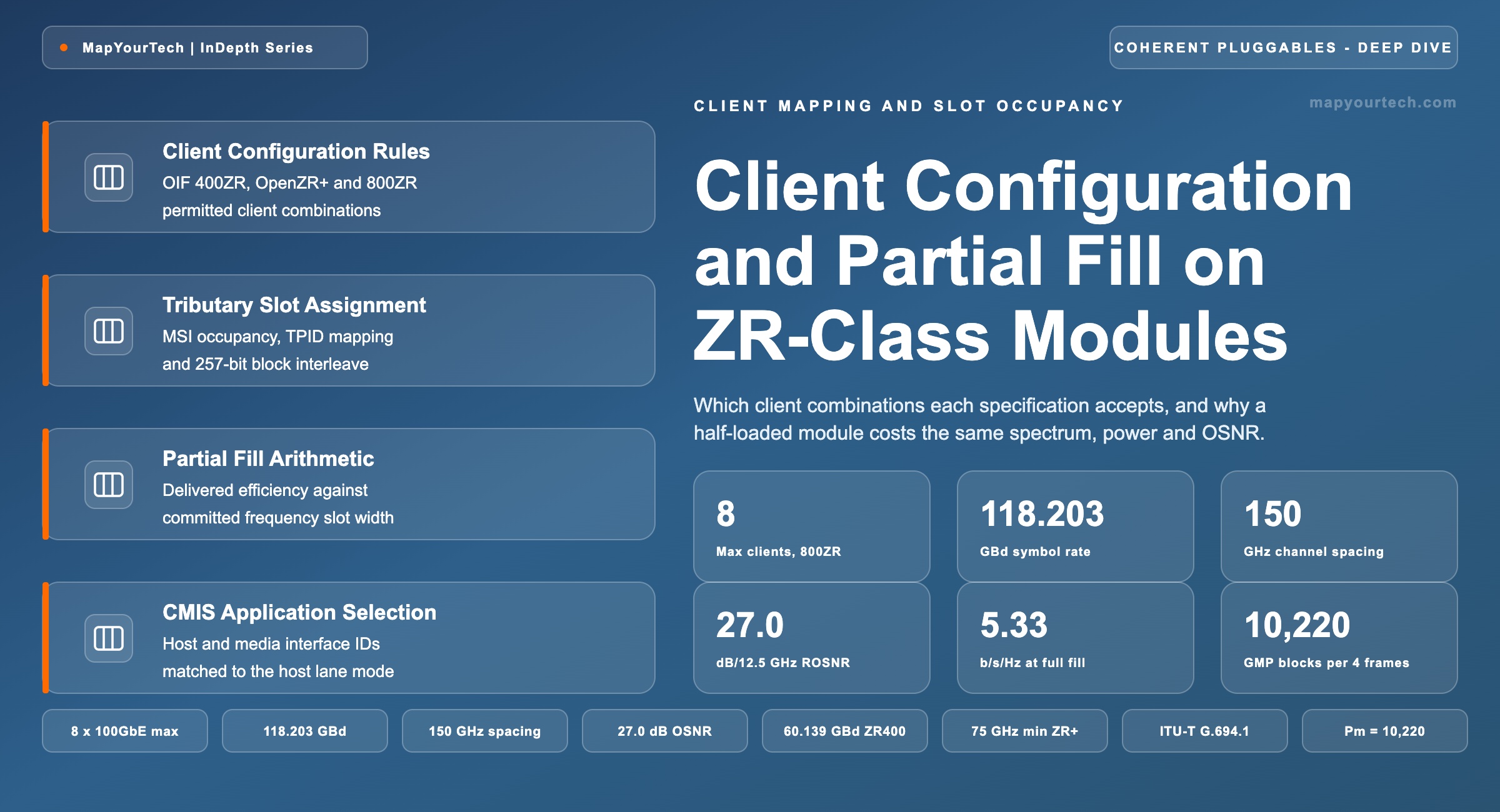
Client Configuration and Partial Fill on ZR-Class Modules
Which client combinations OIF 400ZR, OpenZR+ and OIF 800ZR accept, how those clients land in tributary slots, and why a half-loaded module costs exactly as much spectrum, power and OSNR as a full one.
The slot is fixed by the standard; the occupancy is a choice.
What You Will Learn
- Define client configuration and partial fill in tributary slots rather than bits per second, using the anatomy of Figure 1.
- State the permitted client combinations for OIF 400ZR, the four OpenZR+ formats and OIF 800ZR from Table 1 and Table 2.
- Read an MSI byte and a tributary port identifier to confirm which container slots a client occupies.
- Quantify the cost of partial fill: 2.67 b/s/Hz delivered against 5.33 b/s/Hz available on the same 150 GHz slot.
- Convert a symbol rate to an occupied bandwidth and to the next 12.5 GHz flexible-grid slot per ITU-T G.694.1.
- Select a CMIS application code and match the host lane configuration to it, using the sequence in Figure 5.
- Isolate a client configuration fault to the module, the host or the far end with the Table 6 signature matrix.
- Choose between partial fill, a lower line-rate mode and an external muxponder using the Table 7 criteria.
1. Introduction
A coherent pluggable in a 400 Gb/s router port carries whatever the router hands it, and the number of client ports mapped into that module is a provisioning decision made at turn-up. The Optical Internetworking Forum (OIF) 400ZR Implementation Agreement fixes one client: a single 400GBASE-R interface carried as a 400GBASE-R physical layer device (PHY) across the line (standard-specified, OIF 400ZR Implementation Agreement). The OpenZR+ Multi-Source Agreement (MSA) opens that up, defining four line formats at 100G, 200G, 300G and 400G with one, two, three or four Ethernet clients depending on the format (standard-specified, OpenZR+ MSA). The OIF 800ZR Implementation Agreement carries up to eight, with a minimum client granularity of 100 Gigabit Ethernet (100GbE) and an aggregate ceiling of 800 Gb/s (standard-specified, OIF 800ZR Implementation Agreement).
Those combination rules are short and they are published. The part that reaches operations teams less reliably is what happens when a module runs with fewer clients than its container holds. A module carrying one 100GbE client in a 400G mode transmits the same symbol rate as one carrying four, occupies the same frequency slot on the grid, draws close to the same power, and demands the same optical signal-to-noise ratio (OSNR) at the far-end receiver. The unused tributary slots carry idle. Reducing the traffic load buys no reach and frees no spectrum, because none of the three quantities that set reach and spectrum depend on how much of the container is filled.
That result is not a subtlety of one vendor implementation. It follows from the framing architecture the three specifications share. Client data is adapted into a fixed-rate container by the Generic Mapping Procedure (GMP) defined in ITU-T G.709, and the container is generated from a locally sourced clock independent of the client. The container then feeds a forward error correction (FEC) encoder and a digital signal processing (DSP) frame at a fixed expansion ratio, and the modulator runs at whatever symbol rate that chain produces. Nothing in the chain samples the client load. A partially filled container is a fully rate-adapted container with stuffing and idle where client bits would otherwise sit.
This article states the configuration rules for each specification, works through the container architecture that produces them, and quantifies the cost of partial fill in the units a planner uses: spectral efficiency, capacity per fiber, and cost per delivered bit. It covers the host-side rules that decide whether a configuration will come up at all, the Common Management Interface Specification (CMIS) application mechanism that carries the selection, and the monitoring and fault-isolation behavior that changes when slots sit empty. The boundary of the scope is the client-to-container relationship on a single module pair; line-system design and amplifier engineering are treated only where a fill decision touches them.
Takeaway: Client configuration is a slot assignment inside a fixed-rate container, not a rate negotiation. Every line-side parameter that decides whether a link closes is set by the application code, so the only quantity a partial fill changes is the client traffic delivered for a fixed cost in spectrum, power and OSNR.
2. Client Configuration and Partial Fill: Definitions and Reference Terms
Client configuration is the assignment of Ethernet client ports to the tributary slots of a coherent module's line container, fixed when the host selects an application. Partial fill is the state where the assigned clients occupy fewer tributary slots than the container holds. Both are counted in slots, not in bits per second.
Read the Full Analysis with Premium
The remaining 88% of this article — the design numbers, trade-offs and field guidance — is part of MapYourTech Premium, along with the full premium library, courses and professional tools.
You May Also Like
-
Free
-
September 4, 2026
-
Premium
-
September 4, 2026
-
Premium
-
September 4, 2026