
MapYourTech · InDepth Series
Innovations in DCI Transport Networks: A Comprehensive Engineering Analysis
How data center interconnect went from repurposed telecom gear to the leading consumer of global fiber — and the coherent, open-line-system, and SDN innovations it pushed back into the rest of the optical world.
1. Introduction and Historical Context
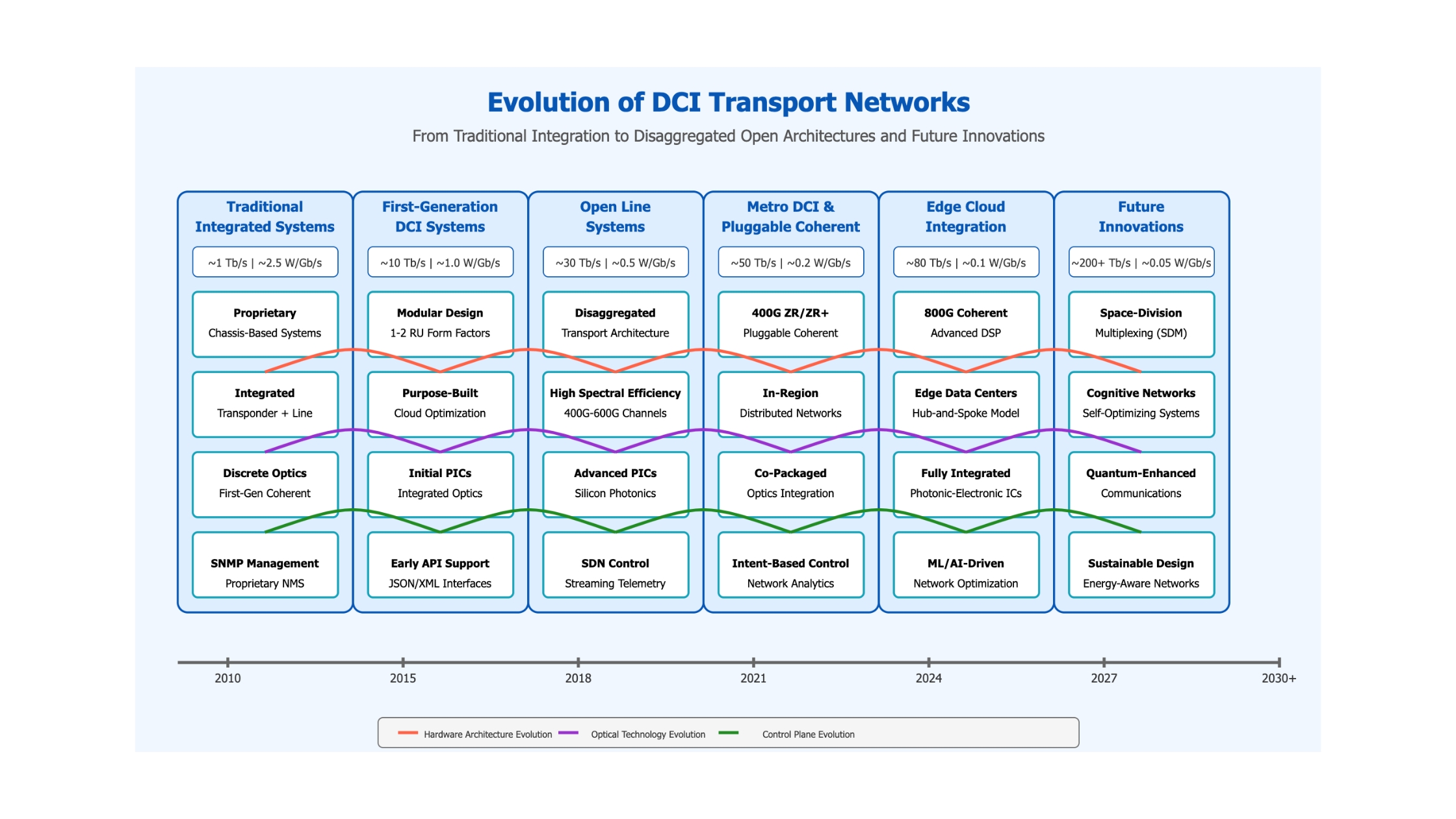
The explosive growth of data center interconnect (DCI) transport networks represents one of the most significant evolutions in optical networking since the transitions from time-division multiplexing (TDM) to IP/MPLS and wavelength-division multiplexing (WDM) technologies in the early 2000s. DCI networks have rapidly grown to dominate global fiber infrastructure, requiring purpose-built transport architectures optimized for the unique demands of interconnecting massive cloud computing facilities. The journey from repurposed telecom equipment to dedicated DCI systems is told in detail in the evolution of optical transmission systems from 10G to Tbps.
1.1 Evolution of DCI Networks
Birth of Cloud Services
August 3, 2006 is widely treated as the "birthday" of modern cloud services with Amazon's announcement of EC2. Early DCI deployments were modest, typically using existing telecom infrastructure with low-speed connectivity (often 1–10 Gbps) and TDM-based technologies.
Emergence of Dedicated DCI
As cloud services gained traction, the first dedicated DCI networks emerged. These networks began using 10G and 40G WDM technology but still largely repurposed telecom-oriented equipment. The industry recognized the need for purpose-built systems as data center traffic patterns differed sharply from traditional telecommunications.
First-Generation DCI Systems
Development of the first dedicated DCI-optimized transport systems, characterized by small form factors (1–2 RU), modular designs, and early coherent 100G technology. These systems departed from traditional telecom equipment, focusing on power efficiency, operational simplicity, and cloud-oriented features.
OLS and SDN Integration
Pioneering of Open Line System (OLS) architectures and extensive adoption of SDN capabilities. Advanced coherent modulation (16QAM) enabled 200G channels. Metro DCI emerged as a critical use case, with synchronous replication requirements driving architectural decisions.
Advanced Coherent Technology
Widespread adoption of advanced coherent technology at 400G–600G per wavelength using 64QAM and constellation shaping. Streaming telemetry and model-driven networking proliferated, and the 400G ZR coherent pluggable standard took shape.
In-Region Distributed Networks
Expansion to In-Region Distributed (IRD) architectures with multiple availability domains. Network analytics and machine learning entered predictive maintenance. 400G ZR/ZR+ pluggables deployed directly in routers, with co-packaged optics and 800G coherent interfaces moving from research into early production.
1.2 Market Drivers and Business Impact
The proliferation of DCI networks has been driven by the economic benefits of centralized compute and storage. Cloud computing's "pay-as-you-go" model transformed capital expenditure into operational expense while enabling elastic resource use. Several market drivers shaped DCI evolution.
Economic Drivers
- Economies of scale: centralized data centers deliver a 3–5× cost advantage through resource pooling, higher utilization, and operational efficiency.
- Virtualization: virtual machines and containers raise infrastructure utilization from a typical 15–20% in traditional IT to 60–80% in cloud environments.
- Fiber scarcity: limited availability of fiber routes incentivized ultra-high spectral-efficiency transport.
- Power constraints: power budgets (often 5–100 MW per data center) increasingly dictate infrastructure decisions, driving power-optimized transport.
Technical Drivers
- East-west traffic growth: intra-cloud traffic can generate up to ~900 bits of DCI traffic per bit of end-user traffic, dramatically increasing backbone capacity needs.
- Availability requirements: business-critical workloads demand 99.999% (five-nines) availability, requiring fault-tolerant multi-site architectures.
- Synchronous replication: consistent data access across distributed locations requires low-latency (<2 ms RTT) interconnections, defining Metro DCI.
- Operational automation: large-scale deployments need advanced automation to manage complexity and reduce operational overhead.
The business impact of DCI extends well beyond the cloud providers themselves. The scale of investment in DCI infrastructure reshaped the optical networking industry, creating a category of purpose-built transport equipment. The innovations pioneered here are increasingly adopted in traditional telecom networks, driving a broader move toward open, programmable, and disaggregated architectures — a transition explored in disaggregated and open optical networks.
1.3 The Architectural Shift in Network Design
DCI networks represent a fundamental shift from traditional telecommunications transport across several dimensions.
- From service-oriented to application-oriented: traditional telecom networks supported multiple service types (voice, data, video) with complex traffic management. DCI networks focus on Ethernet connectivity optimized for application needs.
- From complex mesh to optimized point-to-point: telecom networks feature complex mesh topologies with extensive grooming; DCI often uses simpler point-to-point architectures optimized for throughput.
- From static to programmable: DCI pioneered the extensive programmability, automation, and SDN capabilities now influencing the wider optical industry.
- From proprietary to open: the push toward open line systems, standardized data models, and disaggregated architectures changed the vendor–operator relationship.
- From NEBS-compliant to data-center-optimized: DCI equipment matches data center environmental requirements rather than central-office specifications.
Read the Full Analysis with Premium
The remaining 89% of this article — the design numbers, trade-offs and field guidance — is part of MapYourTech Premium, along with the full premium library, courses and professional tools.
You May Also Like
-
Free
-
September 4, 2026
-
Premium
-
September 4, 2026
-
Premium
-
September 4, 2026