
Generic selectors
Exact matches only
Search in title
Search in content
Post Type Selectors
Articles
lp_course
lp_lesson
Back
HomeCoherent OpticsGain Equalizing Filters (GEF) Deep Dive
Gain Equalizing Filters (GEF) Deep Dive

Gain Equalizing Filters (GEF) Deep Dive

Last Updated: April 2, 2026
11 min read
131
Gain Equalizing Filters (GEF) - Comprehensive Visual Guide | MapYourTech
Gain Equalizing Filters (GEF) Deep Dive - Image 1

Gain Equalizing Filters (GEF) Deep Dive

Practical Information Based on Industry Experience

Introduction

Gain Equalizing Filters (GEF), also commonly known as Gain Flattening Filters (GFF), represent a critical component in modern Dense Wavelength Division Multiplexing (DWDM) optical networks. These filters address one of the fundamental challenges in optical amplification: the non-uniform gain spectrum exhibited by Erbium-Doped Fiber Amplifiers (EDFAs) across different wavelength channels. Without proper gain equalization, the power levels of different wavelength channels would vary significantly after passing through multiple amplifiers, leading to severe degradation in system performance.

In ultra-long-haul (ULH) DWDM systems, optical signals may traverse through 30 to 50 or more EDFAs without electrical regeneration. Each amplifier introduces wavelength-dependent gain variations, which accumulate along the transmission path. For instance, if each EDFA exhibits a gain variation of just 0.5 dB across the C-band spectrum, after cascading 40 amplifiers, the cumulative gain variation could reach 20 dB or more. This creates an unacceptable power difference between channels, where some wavelengths become too weak (suffering from poor optical signal-to-noise ratio) while others become too strong (causing nonlinear effects).

The importance of GEF technology extends beyond simple power equalization. These filters enable longer amplifier cascades in ultra-long-haul networks, support dynamic network reconfiguration by allowing channels to be added or dropped without significant OSNR penalties, and facilitate the use of generic rather than custom-designed filters, thereby reducing time-to-market and development costs. In metropolitan and regional DWDM applications, GEF technology enables efficient distributed amplification to overcome high passive losses associated with optical add-drop multiplexers and reconfigurable optical add-drop multiplexers (ROADMs).

Basic Gain Equalization Concept
Visualization of how GEF compensates for non-uniform EDFA gain spectrum
Input Signal (Uniform Power) EDFA (Non-uniform) Gain Without GEF (Non-uniform) GEF (Inverse Loss) Profile With GEF (Uniform) λ1 λ2 λ3 λ4 λ5 Unequal Gain Equalized Output

Submarine Multi-Tier Gain Equalization Architecture

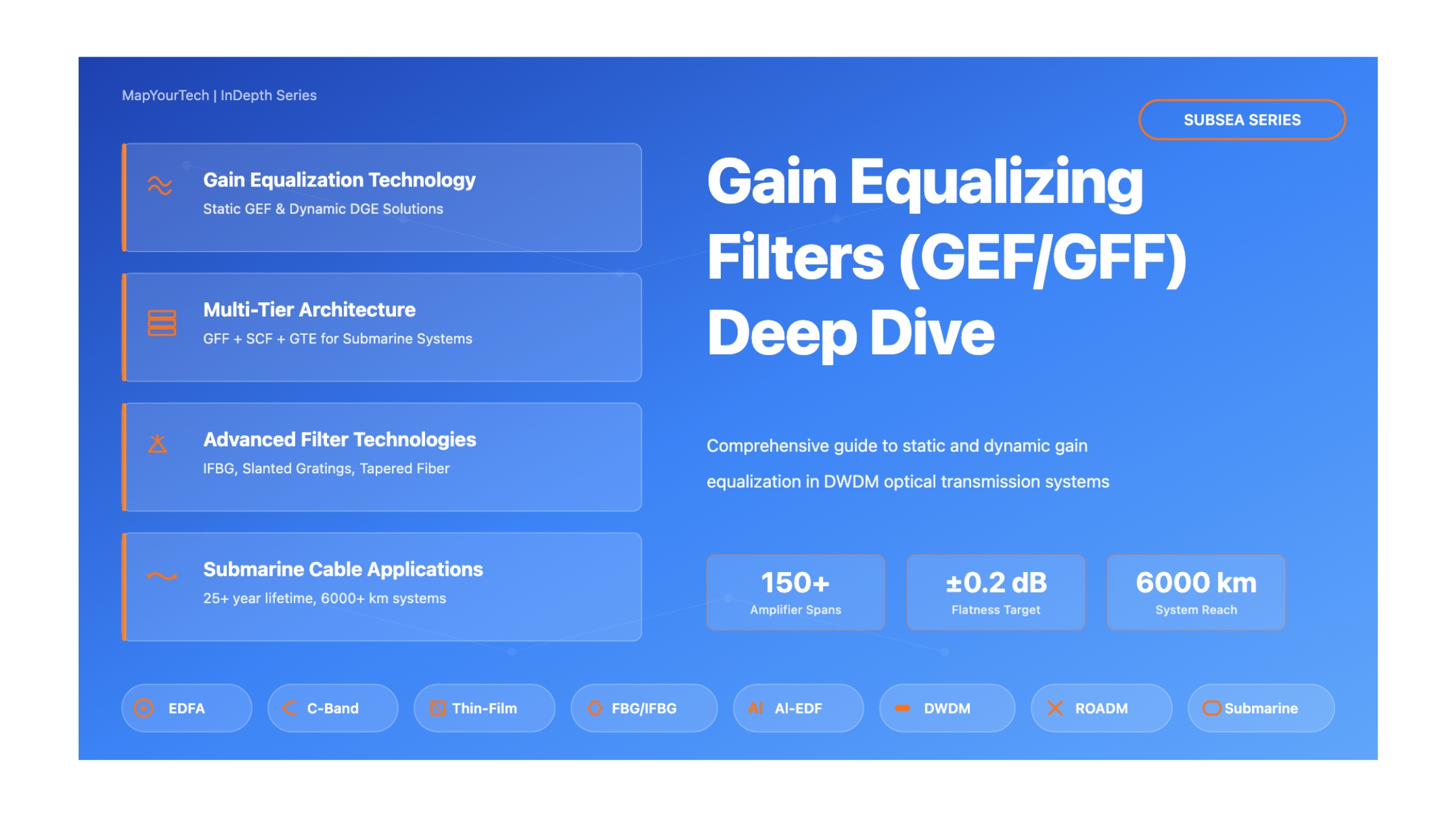
Submarine cable systems employ a sophisticated three-tier gain equalization strategy to manage the extreme accumulation of gain variations over 150+ amplified spans:

Tier 1 - Amplifier-Level GFF: A gain flattening filter (GFF) is installed in each optical amplifier to compensate for the specific EDFA gain shape based on erbium fiber characteristics and operating conditions (gain, output power). This is the primary equalization layer.

Tier 2 - Distributed Shape Control Filters (SCF): Fixed gain shape equalizers, also called shape control filters, are placed approximately every 20 amplifiers to compensate for the residual non-uniform spectral response that accumulates from the amplifier chain despite the individual GFFs.

Tier 3 - Gain Tilt Equalizers (GTE): Fixed gain tilt equalizers are distributed periodically to compensate for spectral linear tilt caused by span loss variations, component aging, and cable repairs over the system lifetime. These may be implemented as tunable optical filters or through Raman amplifier pump power control.

Premium Article — Free 22% Preview

Read the Full Analysis with Premium

The remaining 78% of this article — the design numbers, trade-offs and field guidance — is part of MapYourTech Premium, along with the full premium library, courses and professional tools.
Instant access · Cancel anytime · 48-hour trial available
Sanjay Yadav

Optical Communications & Network Automation Expert | Author of 3 Books for Optical Engineers | Founder, MapYourTech

Optical networking engineer with nearly two decades of experience across DWDM, OTN, coherent optics, submarine systems, and cloud infrastructure. Founder of MapYourTech.

Follow on LinkedIn

You May Also Like

15 min read 14 0 Like Connector Types and Their Loss Budgets: SC, LC, MPO Skip to main content MapYourTech...
  • Free
  • July 11, 2026
16 min read 12 0 Like Cooled vs Uncooled Lasers: The Pluggable Power Trade-off Skip to main content MapYourTech |...
  • Free
  • July 11, 2026
16 min read 18 0 Like Automation Blast Radius: Scoping What a Bad Intent Can Touch Skip to main content...
  • Free
  • July 11, 2026

Course Title

Course description and key highlights

Course Content

Course Details