
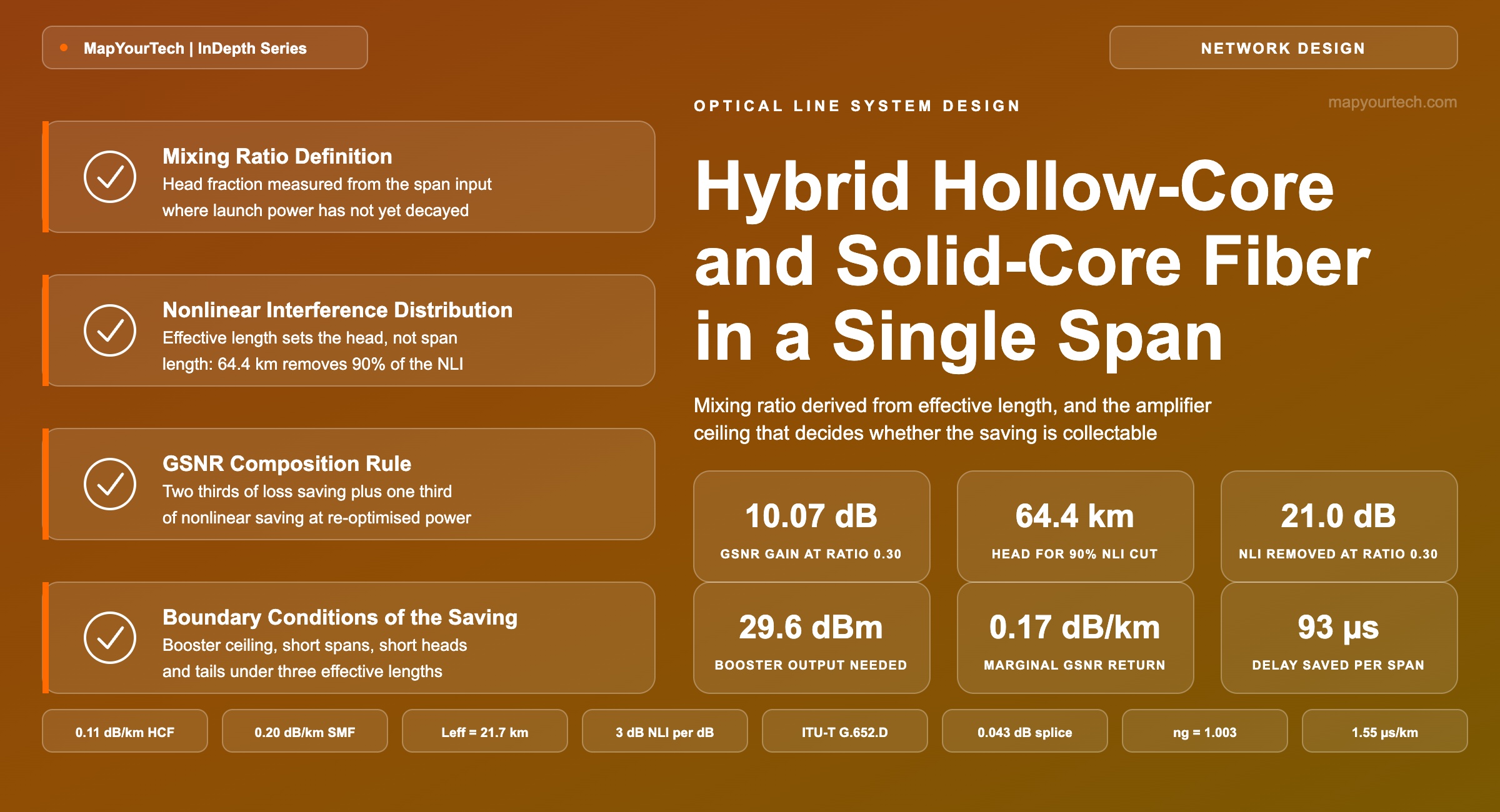
Hybrid Hollow-Core and Solid-Core Span Design
Mixing ratio derived from effective length, the metro and long-haul cases, and the amplifier output ceiling that decides whether the saving is collectable.
The optimum exists because two slopes point in opposite directions.
What You Will Learn
- Define the mixing ratio and separate it from network-level hollow-core share, using the span anatomy of Figure 1 (Section 2).
- Place the head length from effective length rather than span length, and reproduce the result that the first 64.4 km of a 0.20 dB/km span generates 90% of its nonlinear interference (Section 3).
- Apply the three-for-one rule: each decibel of loss taken in the hollow-core head removes 3 dB of nonlinear interference from the solid-core tail (Section 3, Eq. 3).
- Quantify the generalized signal-to-noise ratio gain from the two-thirds and one-third composition rule, and reproduce the 10.07 dB result at a mixing ratio of 0.30 (Section 5, Table 3).
- Convert a mixing ratio into a booster output requirement, from 24.1 dBm total at full solid-core to 36.7 dBm at full hollow-core over 41 channels (Section 5, Table 3).
- Separate the metro case, where transceiver signal-to-noise ratio caps the return, from the long-haul case where it does not (Sections 6 and 7).
- Identify the four boundaries where the saving disappears: amplifier ceiling, short spans, splice accumulation, and tails under three effective lengths (Section 8).
- Build a transition-loss budget from measured field values, and select the monitoring method that survives an air core (Sections 9 and 10).
1. Introduction
Cabled anti-resonant hollow-core fiber sold in low-count production quantities during 2024 and 2025 at roughly $5,000 to $10,000 per kilometre, against $10 to $15 per kilometre for bulk loose-tube G.652.D single-mode fiber (both published techno-economic estimates). A 200 km amplified span built entirely from hollow-core fiber therefore carries between $1.0 million and $2.0 million of fiber against about $2,500 for the same length of solid-core fiber. That ratio is what has kept hollow-core deployments confined to short latency-driven routes, and it is also what makes the composition of a single span an engineering question rather than a procurement formality.
The physical argument for splitting a span is that nonlinear interference is not generated uniformly along it. Kerr-effect nonlinear interference power scales with the cube of the local optical power, and the local power decays exponentially from the amplifier output, so the first few tens of kilometres after the booster produce almost all of the distortion that the span will contribute. Hollow-core fiber guides more than 99.98% of the mode energy in air, which reduces its nonlinear coefficient by three to four orders of magnitude relative to silica (reported fiber measurements), and it removes stimulated Raman scattering between channels along with it. Placing that fiber where the power is high, and reverting to solid-core fiber once the power has decayed, captures most of the benefit for a fraction of the length.
Two results published at the Optical Fiber Communication Conference in 2026 set the boundaries of the approach. A Nokia Bell Labs modelling study found that a single 200 km hybrid span retains its capacity to within 3% of the full hollow-core value when half of the span is replaced with solid-core fiber, that a 400 km two-span system tolerates a 25% replacement, and that a 1,000 km five-span system tolerates none. A companion experiment transmitted 800 Gb/s achievable information rate over 1,113 km using a recirculating 222.7 km span made of 121.7 km of support-tube hollow-core fiber followed by 101 km of standard single-mode fiber, with a 34 dBm doped-fiber amplifier at the head of each span.
This article works the composition problem for one reference case — a 200 km C-band amplified span carrying 41 channels at 87.5 GBd — and states the boundary conditions where the composition stops paying. It defines the mixing ratio from first principles, derives the head length from effective length rather than from span length, gives the closed-form generalized signal-to-noise ratio (GSNR) composition rule for a two-fiber span, converts each mixing ratio into an amplifier output requirement, and covers the interface, monitoring and troubleshooting consequences of putting two fiber types inside one span. Readers new to the fiber itself will find the guiding mechanism covered in the MapYourTech treatment of light guidance in an air core.
Takeaway: Nonlinear interference concentrates in the high-power head of a span, so the fiber that suppresses it only has to occupy the head. The design question is how long that head must be, and what amplifier is needed to collect the benefit.
2. Mixing Ratio Definition and Span Composition Terms
The mixing ratio is the fraction of one amplified span's physical length that is built from hollow-core fiber, measured from the span input where launch power is highest. It is a dimensionless number between 0 and 1, written as the ratio of head length to total span length, and it applies to a single span rather than to a route, a link or a network.
2.1 Distinctions From Adjacent Quantities
Three quantities are routinely conflated with the mixing ratio, and each carries a different design consequence.
Mixing ratio against network hollow-core share. The mixing ratio composes one span; the network hollow-core share is the proportion of spans in a mesh network that are built from hollow-core fiber end to end. An integer-linear-programming placement study presented at the Optical Fiber Communication Conference in 2026 reported that reaching 85% of the maximum feasible path count on a reference transport network required between 25% and 55% of spans to be hollow-core, depending on fiber attenuation and amplifier output power. The two ratios optimize against different constraints and can be applied together.
Head length against effective length. Effective length is the fixed distance scale over which nonlinear interference accumulates, set by attenuation alone and equal to the reciprocal of the attenuation coefficient in nepers per kilometre. Head length is a design choice measured in kilometres of purchased fiber. Section 3 shows that the head length required to remove a stated share of nonlinear interference is a multiple of effective length and does not scale with span length, which is why long spans reach a given benefit at a lower mixing ratio than short ones.
Read the Full Analysis with Premium
The remaining 89% of this article — the design numbers, trade-offs and field guidance — is part of MapYourTech Premium, along with the full premium library, courses and professional tools.
You May Also Like

-
Premium
-
August 27, 2026

-
Premium
-
August 27, 2026
-
Premium
-
August 27, 2026