
Hyperscaler Optical Network Automation
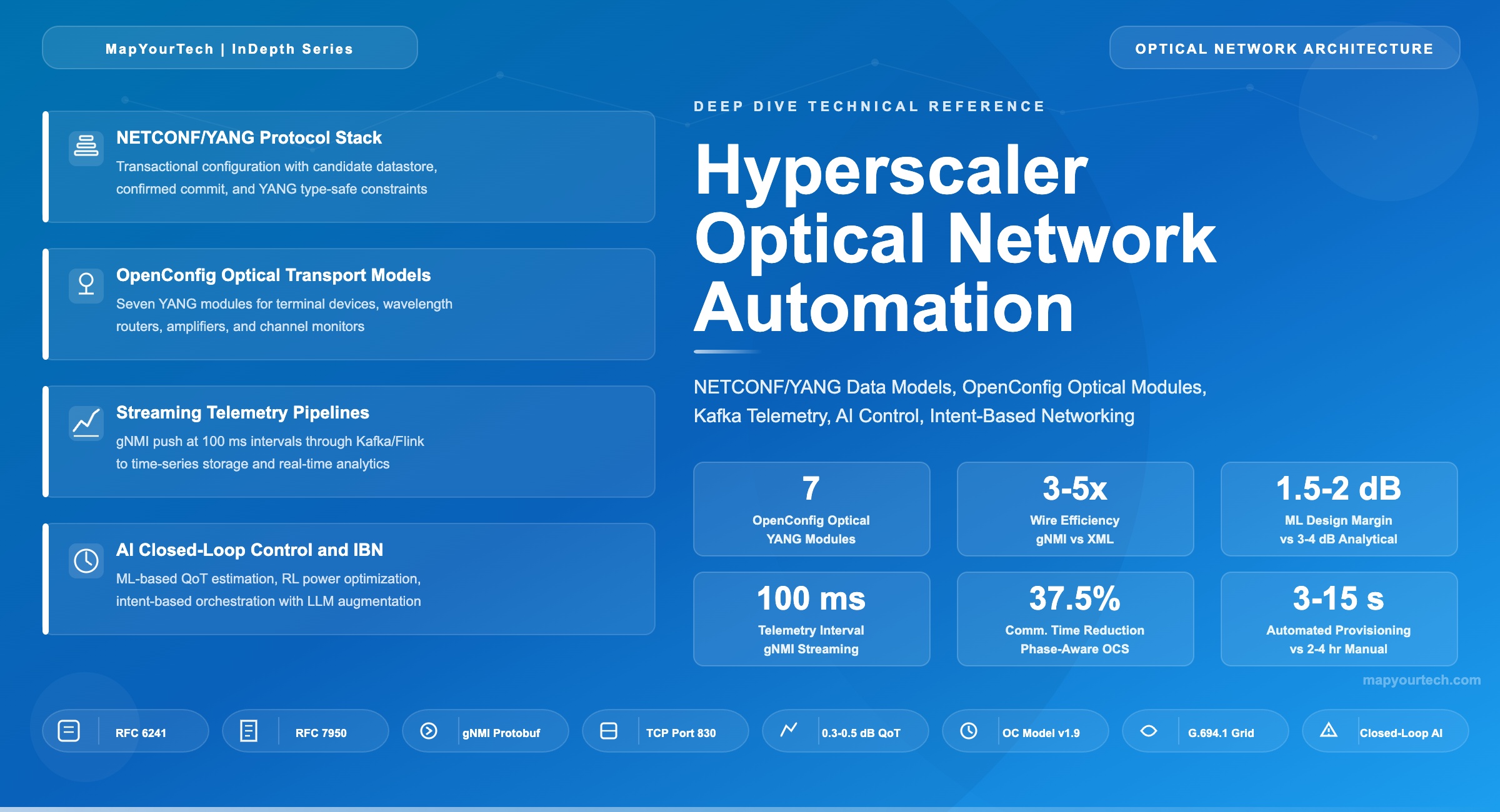
NETCONF/YANG data models, OpenConfig optical modules, streaming telemetry pipelines, closed-loop AI control, and intent-based networking for optical transport
1. Introduction
Optical transport networks at hyperscale operate thousands of DWDM channels across hundreds of ROADM nodes and in-line amplifier (ILA) sites spanning tens of thousands of kilometres. Managing this infrastructure through proprietary network management systems (NMS) with vendor-specific command-line interfaces and SNMP polling is no longer viable when a single configuration change on a wavelength router can cascade into spectral interference on adjacent channels and remote amplifier gain transients that degrade links two spans away.
The automation stack that hyperscale cloud and internet content providers (ICPs) deploy today rests on four distinct but tightly coupled pillars. NETCONF (RFC 6241) provides the transactional configuration protocol. YANG (RFC 7950) defines the data models that describe every configurable and observable parameter on an optical network element. OpenConfig supplies vendor-neutral YANG models specifically engineered for multi-vendor optical transport, with modules covering terminal devices, wavelength routers, optical amplifiers, and channel monitors. Streaming telemetry over gNMI replaces the periodic SNMP polling with sub-second, push-based data feeds that carry per-channel optical power, pre-FEC bit error ratio (BER), dispersion accumulation, and amplifier gain tilt into centralized analytics pipelines.
On top of this data layer, a new generation of AI-assisted control loops consumes telemetry, detects anomalies, predicts failures, and adjusts network parameters without human intervention. Intent-based networking (IBN) abstracts the operational interface further, allowing an operator to state a high-level goal ("provision a 400G protected path from DC-West to DC-East with latency below 5 ms and 3 dB OSNR margin") and have the orchestration stack translate that intent into specific ROADM cross-connects, transponder modulation settings, and amplifier gain targets.
This article covers the complete architecture from protocol wire format to AI inference engine, with emphasis on the physical consequences each layer has on optical signal quality. Every protocol interaction, data model leaf, and control-loop decision ultimately translates into optical power levels, noise figures, and spectral occupancy on real fiber. Understanding that chain from software abstraction to photonic physics is what separates effective optical network automation from generic IT automation applied blindly to the transport domain.
Takeaway: Hyperscale optical automation combines four layers: NETCONF for transactional device configuration, YANG for structured data modeling, OpenConfig for vendor-neutral optical schemas, and streaming telemetry (gNMI) for sub-second observability. AI-based closed-loop control and intent-based orchestration sit above these layers, translating business goals into photonic-layer actions across multi-vendor DWDM infrastructure.
2. NETCONF: Protocol Architecture for Optical Transport
NETCONF (Network Configuration Protocol), defined in RFC 6241, operates over SSH (TCP port 830) and uses XML-encoded remote procedure calls (RPCs) to read and write device configuration. Unlike SNMP, which treats configuration as scattered MIB objects with no transactional semantics, NETCONF provides atomic commit and rollback. A configuration change either applies completely or not at all. For an optical transport element where a partial configuration can leave a ROADM cross-connect half-provisioned and dump unfiltered amplified spontaneous emission (ASE) noise onto active channels, atomicity is not a convenience feature — it is a physical safety mechanism.
2.1 Protocol Layers and Session Lifecycle
NETCONF separates concerns into four layers: transport (SSH or TLS), messages (XML-RPC framing), operations (<get>, <get-config>, <edit-config>, <copy-config>, <lock>, <unlock>, <commit>, <discard-changes>), and content (the YANG-modeled data itself). A session begins with a <hello> exchange where both client and server advertise their supported capabilities, including the YANG modules they implement. The controller inspects these capabilities to determine whether the optical NE supports, for instance, the OpenConfig terminal-device model version 1.9.0 or only version 1.7.0 — a distinction that determines whether 800G ZR+ operational counters are available.
Read the Full Analysis with Premium
The remaining 86% of this article — the design numbers, trade-offs and field guidance — is part of MapYourTech Premium, along with the full premium library, courses and professional tools.