
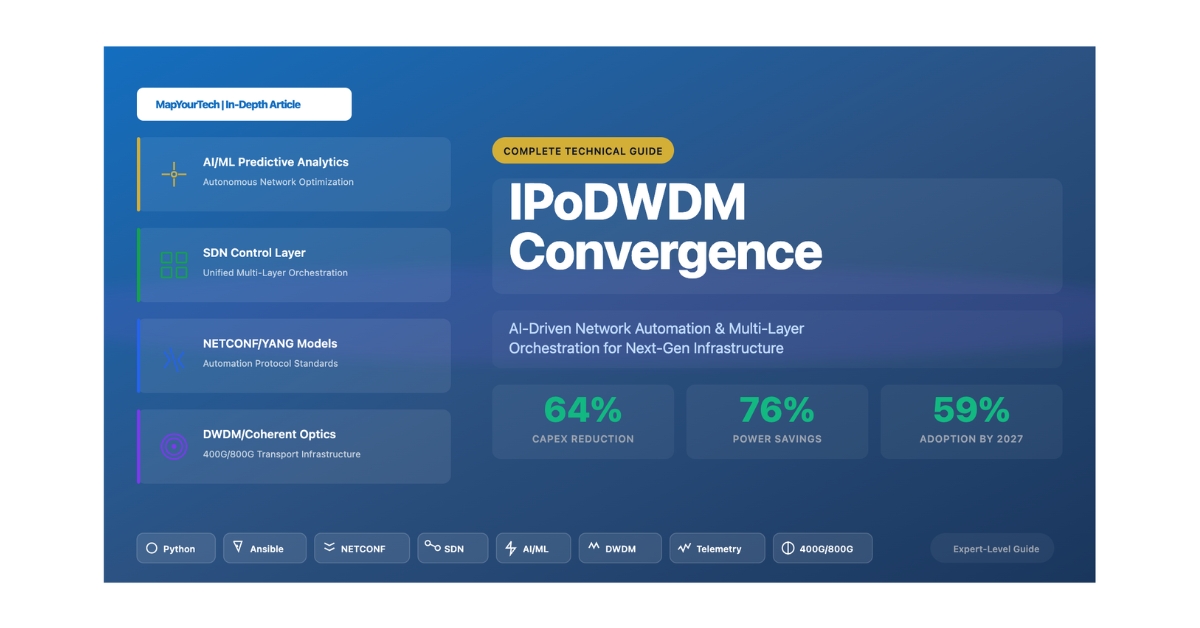
IP over Dense Wavelength Division Multiplexing (IPoDWDM) Convergence
A Comprehensive Technical Analysis of Network Layer Integration and Evolution
Part 1: Executive Summary
1.1 Strategic Overview
The telecommunications industry is witnessing an unprecedented transformation driven by exponential traffic growth, with global IP traffic projected to increase by more than 500% between 2021 and 2027. This explosive demand, fueled by bandwidth-intensive applications including ultra-high-definition video streaming, cloud computing, edge computing, artificial intelligence workloads, and real-time interactive services, has exposed the fundamental limitations of traditional multi-layer network architectures where IP and optical domains operate as independent silos.
IPoDWDM convergence addresses these challenges through physical and logical integration, leveraging breakthrough technologies including 400ZR/ZR+ and emerging 800ZR coherent pluggable optics that conform to Optical Internetworking Forum (OIF) standards. These advancements enable direct integration of coherent Dense Wavelength Division Multiplexing (DWDM) transmission capabilities into standard router and switch form factors (QSFP-DD, OSFP), eliminating the traditional requirement for separate optical transport equipment.
1.2 Key Performance Metrics and Benefits
1.3 Fundamental Value Propositions
- Architectural Simplification: Eliminates external DWDM transponder shelves, back-to-back client optics, and associated infrastructure, consolidating previously siloed IP and optical network layers into a unified mesh architecture.
- Economic Optimization: Delivers substantial Total Cost of Ownership (TCO) improvements through reduced hardware requirements, lower power consumption, decreased real estate footprint, and simplified operational workflows.
- Operational Efficiency: Enables automated topology discovery across all network layers, coordinated multi-layer restoration, optimized resource utilization, and dramatically accelerated service provisioning (from weeks to minutes).
- Scalability Enhancement: Provides flexible capacity expansion through pluggable optics supporting multiple transmission modes, bit rates (100G to 800G and beyond), and reach profiles without forklift equipment upgrades.
- Sustainability Impact: Significantly reduces network power consumption and carbon footprint through elimination of redundant equipment layers and improved power efficiency of integrated solutions.
- Performance Optimization: Facilitates coordinated control over critical network functions including path computation, bandwidth allocation, quality of service (QoS) management, and failure recovery across IP and optical domains.
1.4 Industry Adoption Trajectory
Recent comprehensive industry surveys involving 240 global communications service providers (CSPs) reveal compelling adoption trends. By 2027, operators expect 59% of 400G+ coherent pluggable optical modules to be deployed in IPoDWDM equipment, representing a dramatic reversal from 2022 survey results showing 61% traditional optical transport versus 39% IPoDWDM deployment. This shift demonstrates industry confidence in convergence architectures and validates the maturity of enabling technologies.
The momentum extends beyond metro networks into long-haul and ultra-long-haul applications, with 72% of service providers having deployed or planning to deploy 400G coherent pluggables by 2024. Furthermore, 43% of operators plan to deploy 800G coherent pluggable modules within one year, with 23% planning deployment within two years, indicating rapid technology evolution and market readiness for higher-capacity integration.
1.5 Critical Success Factors
| Factor | Description | Impact |
|---|---|---|
| Standards Maturation | OIF 400ZR, OpenZR+, and OIF 800ZR standards provide interoperability foundation | Enables multi-vendor ecosystems and competitive market dynamics |
| Pluggable Technology | Coherent DSP integration in standard form factors with optimized power profiles | Eliminates "faceplate trade-off" enabling practical router integration |
| Software Coordination | Unified control plane spanning IP and optical layers with open APIs | Delivers operational efficiency and automated multi-layer optimization |
| Performance Evolution | Continuous improvement in transmission distance, spectral efficiency, and power consumption | Expands applicable use cases from metro to long-haul networks |
| Ecosystem Development | Growing vendor participation in pluggable optics, routers, and management systems | Reduces risk, improves economics through competition and innovation |
1.6 Application Domains and Use Cases
IPoDWDM convergence addresses diverse deployment scenarios across the network hierarchy:
Metro and Regional Networks: Primary deployment domain where reach requirements (typically 40-120 km) align well with 400ZR capabilities, enabling simplified point-to-point and ring architectures with substantial equipment consolidation benefits. Metro networks benefit most from CAPEX/OPEX reduction through transponder elimination while supporting high-capacity interconnection of data centers, central offices, and aggregation sites.
Data Center Interconnect (DCI): Hyperscale cloud providers and enterprises leverage IPoDWDM for efficient, scalable interconnection of geographically distributed data centers. Direct router-to-router coherent links eliminate optical-electrical-optical (OEO) conversions, reduce latency, improve power efficiency, and simplify network operations while supporting dynamic capacity allocation.
Core and Long-Haul Networks: Enhanced pluggable technologies (OpenZR+, proprietary high-performance modes) extend IPoDWDM applicability to longer distances (300-1000+ km) with higher output powers, advanced modulation formats, and sophisticated forward error correction (FEC), though with trade-offs between reach, capacity, and spectral efficiency.
5G Transport and Edge Computing: Convergence architectures provide the flexibility, low latency, and dynamic bandwidth allocation required for distributed 5G Radio Access Network (RAN) fronthaul/midhaul/backhaul transport and edge computing applications, supporting network slicing and quality of service differentiation.
2.1 Evolution of Optical Network Architectures
2.1.1 The Genesis of Optical Communication
The foundational breakthrough enabling modern optical networks emerged in 1970 when Corning Incorporated developed the first practical low-loss optical fiber, achieving attenuation below 20 dB/km. This pivotal achievement, building on theoretical work by Charles Kao and George Hockham in the 1960s, demonstrated the viability of light-based communication over significant distances. Subsequent decades witnessed continuous fiber technology refinement, with modern ultra-low-loss fibers achieving attenuation as low as 0.142 dB/km near the 1550 nm wavelength window.
Early optical systems operated at modest data rates (45 Mbps to 2.5 Gbps) using single-wavelength transmission with optical-electrical-optical regeneration at regular intervals. These first-generation systems, while revolutionary compared to copper-based transmission, utilized only a tiny fraction of optical fiber's enormous bandwidth capacity, which theoretically spans tens of terahertz.
2.1.2 The DWDM Revolution
Dense Wavelength Division Multiplexing (DWDM) emerged in the mid-1990s as a transformative technology enabling simultaneous transmission of multiple independent optical channels over a single fiber, each channel operating at a distinct wavelength. This multiplexing technique leveraged the optical fiber's massive bandwidth potential by creating parallel transmission lanes within the same physical medium.
Ciena Corporation pioneered commercial DWDM deployment, fundamentally transforming network capacity economics. Early DWDM systems supported 8-16 channels with 100-200 GHz spacing, but rapid technological advancement enabled channel counts exceeding 80-96 wavelengths with 50 GHz or even 25 GHz channel spacing, all within the C-band (1530-1565 nm) and extended into L-band (1565-1625 nm) for additional capacity.
The introduction of Erbium-Doped Fiber Amplifiers (EDFAs) proved equally critical, enabling transparent optical amplification across multiple wavelength channels simultaneously without optical-to-electrical conversion. EDFAs, combined with sophisticated dispersion management techniques including Dispersion Compensating Fiber (DCF) and advanced modulation formats, enabled ultra-long-haul transmission spanning thousands of kilometers.
2.1.3 Historical Timeline of Convergence Attempts
2.1.4 Key Industry Contributors
| Organization | Primary Contribution | Impact on IPoDWDM |
|---|---|---|
| Corning | Low-loss optical fiber development, ultra-low-loss and bend-insensitive fibers | Foundational medium enabling long-distance optical transmission |
| Ciena | DWDM commercialization, coherent optics, packet-optical platforms | Pioneer in convergence architectures and multi-layer automation |
| Nokia/Alcatel-Lucent | Photonic Service Engines, submarine systems, comprehensive optical transport | Advanced coherent technologies and metro/long-haul solutions |
| Cisco Systems | IP routing integration, packet-optical transport, routers with coherent capabilities | Leading IP-optical convergence with router-integrated coherent pluggables |
| Juniper Networks | Converged Optical Routing Architecture (CORA), MX/PTX platforms with coherent | Comprehensive IPoDWDM solution with integrated control plane |
| Infinera | Photonic Integrated Circuits (PICs), Digital Optical Networks, ICE technology | Advanced integration reducing component count and power consumption |
| Huawei | OTN systems, GPON solutions, integrated optical transport platforms | Global deployment of converged IP-optical infrastructure |
| OIF (Optical Internetworking Forum) | 400ZR, OpenZR+, 800ZR standards development and interoperability specifications | Critical standardization enabling multi-vendor ecosystem |
2.2 Foundational Principles and Theoretical Framework
2.2.1 The Layered Network Model Challenge
Traditional telecommunications network architecture adheres to a strict layered design philosophy aligned with the Open Systems Interconnection (OSI) reference model. This separation of concerns enables independent optimization of each layer but introduces substantial overhead when layers operate in isolation.
Read the Full Analysis with Premium
The remaining 89% of this article — the design numbers, trade-offs and field guidance — is part of MapYourTech Premium, along with the full premium library, courses and professional tools.
You May Also Like
-
Free
-
August 22, 2026

-
Premium
-
August 22, 2026
-
Premium
-
August 22, 2026
Course Title
Course description and key highlights