
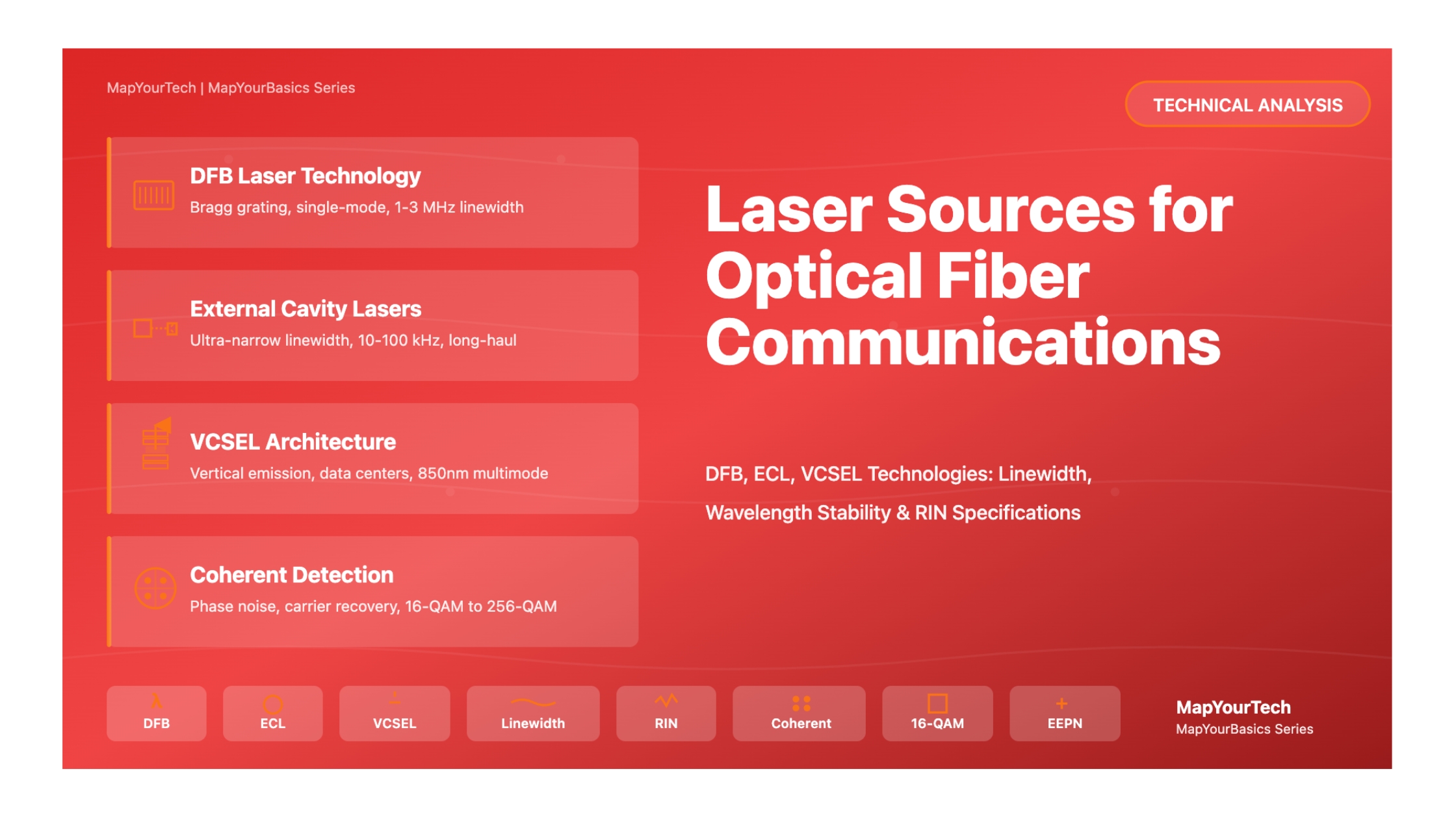

Laser Sources for Optical Fiber Communications
Abstract
Laser sources constitute the fundamental building blocks of modern optical fiber communication systems, serving as the primary optical signal generators that enable high-speed data transmission across global telecommunications networks. This comprehensive research article provides an exhaustive analysis of the three dominant laser technologies deployed in contemporary optical communications: Distributed Feedback (DFB) lasers, External Cavity Lasers (ECL), and Vertical Cavity Surface Emitting Lasers (VCSEL). The investigation encompasses detailed examination of critical performance parameters including spectral linewidth, wavelength stability, relative intensity noise (RIN), modulation bandwidth, and their profound impact on system performance across various modulation formats and transmission distances.
The transition from intensity-modulated direct detection (IMDD) systems to advanced coherent detection architectures has fundamentally transformed the requirements imposed on laser sources. While DFB lasers with typical linewidths of approximately 1 MHz have served adequately for 10 Gb/s systems, the deployment of higher-order modulation formats such as 16-QAM, 64-QAM, and beyond necessitates significantly narrower linewidth sources, typically in the range of 100 kHz or less. This article examines the physical mechanisms governing linewidth, analyzes the interaction between laser phase noise and digital signal processing (DSP) algorithms in coherent receivers, and evaluates the trade-offs between laser performance and system complexity.
Through comprehensive analysis of recent research findings and experimental results from leading optical communications literature, this work establishes quantitative relationships between laser specifications and transmission system performance. Particular emphasis is placed on the equalization-enhanced phase noise (EEPN) phenomenon, where the interaction between long-memory equalizers and laser phase noise creates additional impairments in high-symbol-rate systems. The article demonstrates that for 400 Gb/s systems and beyond, conventional carrier recovery algorithms may prove insufficient, necessitating advanced multi-tap equalization techniques to mitigate these compounded impairments.
Read the Full Analysis with Premium
The remaining 60% of this article — the design numbers, trade-offs and field guidance — is part of MapYourTech Premium, along with the full premium library, courses and professional tools.
Course Title
Course description and key highlights
Course Content
Course Details
Celebrating 1,000+ LinkedIn posts
3 hours of Premium Pro, free
The full Premium Pro library, unlocked with one click. The clock starts the moment you check out and runs for 3 full hours - pick a time when you can make the most of it.
- Courses
- Interview preparation content
- Career development posts
- Simulators
- Calculators
- Market research
No card, nothing to cancel. One pass per person. Sign in or create a free account at checkout.
Follow MapYourTech on LinkedIn for regular updates and future promos.
New articles, tool releases and member offers, posted as they go live.
Follow MapYourTech on LinkedIn
Enjoying MapYourTech? Follow us on LinkedIn. One click and this stops appearing.
- New technical articles and tool releases, posted as they go live
- Course launches and member offers before they reach the site
- Standards and industry updates worth an optical engineer's time
New articles, tool releases and member offers, posted as they go live.