
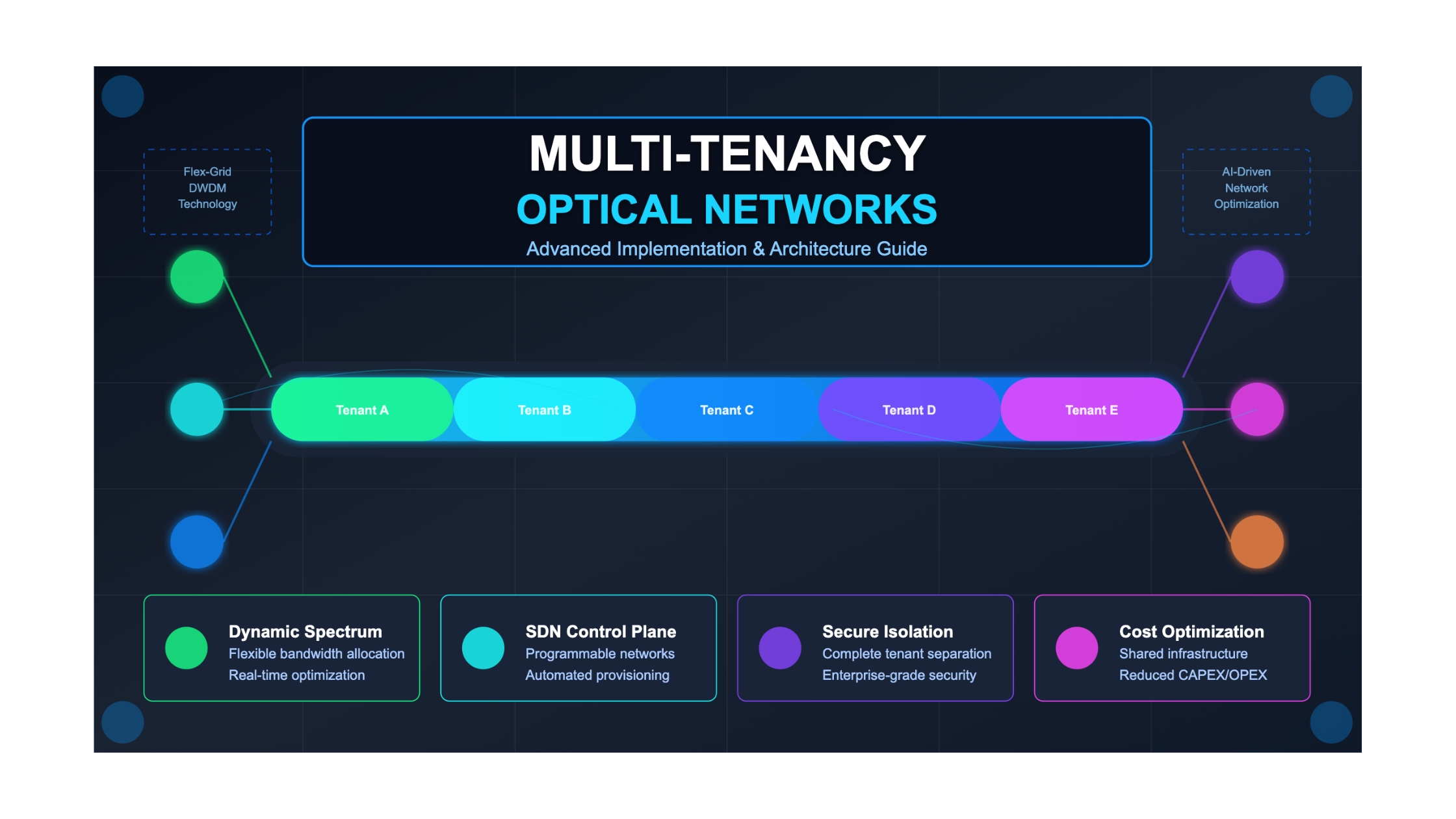
Multi-Tenancy Optical Networks
Comprehensive Technical Analysis and Implementation Guide
Overview and Strategic Context
Multi-Tenancy Optical Networks (MTONs) represent a paradigmatic shift in telecommunications infrastructure, enabling multiple independent service providers, enterprises, or network operators to share physical optical infrastructure while maintaining complete logical isolation, security, and performance guarantees. This transformative approach addresses the exponential growth in bandwidth demand driven by cloud computing, artificial intelligence workloads, 5G/6G deployments, and edge computing applications, while simultaneously reducing capital expenditure requirements and operational complexity.
Market Drivers and Industry Context
The global optical networking market, valued at $18.6 billion in 2024, is experiencing unprecedented transformation driven by several converging factors. Hyperscale data centers now consume over 40% of total optical transport capacity, with AI/ML workloads requiring bandwidth densities exceeding 1.6 Tbps per wavelength. The deployment of 5G networks has created demand for ultra-low latency transport with sub-millisecond requirements, while edge computing applications necessitate distributed optical infrastructure reaching previously underserved locations.
Key Technical Findings
Critical Technical Achievements
- Spectral Efficiency: Elastic Optical Networks achieve 15-30% improvement in spectral efficiency through flexible grid allocation compared to fixed ITU-T grids
- Isolation Mechanisms: Multi-layer isolation combining physical wavelength separation, cryptographic protection (AES-256-GCM), and software-defined policies ensures tenant security
- Dynamic Resource Allocation: AI-enhanced routing and spectrum assignment (RSA) algorithms reduce blocking probability by 20-40% while supporting hitless spectrum defragmentation
- Interoperability: OpenROADM and Transport API (TAPI) standards enable multi-vendor environments with 15-25% cost reduction
- Performance Guarantees: Optical slicing provides deterministic latency and guaranteed bandwidth approaching dedicated fiber performance
Architectural Innovation
The foundational architecture of MTONs leverages three core technological pillars: Elastic Optical Networks (EONs) for flexible spectrum allocation, Software-Defined Optical Networking (SDON) for centralized control and orchestration, and Network Function Virtualization (NFV) for service abstraction. This convergence enables unprecedented granularity in resource allocation, with spectrum partitioning achievable at 12.5 GHz frequency slot increments compared to traditional 50 GHz fixed channels.
Implementation Models and Use Cases
Primary Deployment Scenarios
| Use Case | Technical Requirements | Economic Benefits | Implementation Complexity |
|---|---|---|---|
| Data Center Interconnect (DCI) | 400G-800G interfaces, sub-5ms latency, 99.999% availability | 60-80% cost reduction vs. dedicated fiber | High - requires AI-driven orchestration |
| 5G/6G Transport | Ultra-low latency (<1ms), deterministic networking, network slicing | 40-50% CAPEX savings, faster deployment | Medium - leverages existing protocols |
| Wholesale/Carrier Services | Multi-tenant isolation, SLA enforcement, dynamic bandwidth | New revenue streams, improved asset utilization | Medium - established business models |
| Enterprise Cloud Connectivity | Hybrid cloud support, security compliance, scalable bandwidth | Predictable OpEx, rapid provisioning | Low - mature service interfaces |
| Content Delivery Networks | Burst capacity, geographically distributed, edge integration | Pay-per-use models, global reach | Medium - requires edge orchestration |
Economic Impact Analysis
Multi-tenancy optical networks demonstrate compelling economic advantages across multiple dimensions. Infrastructure providers achieve 30-50% CAPEX reduction through shared deployment costs, while operational expenses decrease 25-35% through automation and economies of scale. The U.S. wholesale optical market reached $5 billion in 2024, with multi-tenant services representing the fastest-growing segment at 38% CAGR.
For tenants, usage-based pricing models enable access to premium infrastructure previously reserved for major carriers. Pricing ranges from $0.10-0.50 per Gbps-km-hour for metro applications to $0.05-0.25 for long-haul transport, with reserved capacity models offering 20-40% discounts for longer-term commitments.
Critical Challenges and Risk Factors
- Performance Isolation: Preventing "noisy neighbor" effects requires sophisticated power management and spectrum guardbands, adding 10-15% overhead to total capacity
- Security Vulnerabilities: Shared infrastructure expands attack surface, necessitating multi-layer security including quantum-resistant encryption
- Orchestration Complexity: Real-time spectrum allocation and defragmentation algorithms scale as O(n³) with network size, requiring AI-enhanced optimization
- Standards Fragmentation: Multiple competing standards (OpenROADM, TIP, OIF) create interoperability challenges and increase integration costs
- Vendor Dependencies: Multi-vendor environments require careful interface management and may impact performance optimization
Risk Mitigation Strategies
Successful MTON implementations employ comprehensive risk mitigation through technical and operational measures. Physical layer security combines AES-256-GCM encryption at wire speeds with quantum key distribution for future-proofing. Performance isolation utilizes hardware-enforced spectrum filtering, automatic power control systems, and AI-driven traffic engineering to maintain SLA compliance across all tenants.
Future Outlook and Strategic Implications
The evolution toward multi-tenancy optical networks represents a fundamental transformation in telecommunications infrastructure, comparable to the virtualization revolution in computing. By 2030, industry analysts project that over 60% of new optical infrastructure will incorporate multi-tenant capabilities, driven by the convergence of 6G networks, quantum networking integration, and the expansion of edge computing to support autonomous systems and Internet of Things applications.
Technology Convergence Trends
Emerging technologies including hollow-core fiber (30% latency reduction), silicon photonics integration, and space-based optical networks will further enhance MTON capabilities. The integration of artificial intelligence for autonomous network operations, quantum networking for unprecedented security, and software-defined everything architectures will create new possibilities for service innovation and operational efficiency.
The successful deployment of multi-tenancy optical networks requires careful attention to technical architecture, business model alignment, and operational transformation. Organizations must balance the compelling economic benefits against the complexity of implementation, ensuring robust security, performance isolation, and scalable management systems.
Evolution of Optical Networking Technologies
The journey toward multi-tenancy optical networks spans five decades of revolutionary innovations, beginning with the first optical fiber transmission experiments in the 1970s and culminating in today's sophisticated software-defined elastic optical networks. Understanding this evolutionary path is crucial for appreciating the technical complexity and strategic significance of contemporary MTON architectures.
The Foundation Era (1970-1990): From Concept to Commercial Reality
The theoretical foundations of optical communications were established by Charles Kao's pioneering work at Standard Telecommunications Laboratories in 1966, where he demonstrated that silica glass fibers could achieve losses below 20 dB/km, making long-distance optical transmission feasible. This breakthrough, recognized with the 2009 Nobel Prize in Physics, established the fundamental principle that optical fibers could carry information more efficiently than copper cables over extended distances.
The commercialization of optical fiber systems began with AT&T's deployment of the first commercial fiber optic system in 1977, connecting two telephone switching offices in Chicago with a 45 Mbps link over 2.4 kilometers. This initial success demonstrated the practical viability of optical transmission and sparked worldwide investment in fiber optic infrastructure development.
During this foundational period, several critical innovations emerged that would later enable multi-tenancy architectures. The development of single-mode fiber by Bell Labs in 1981 eliminated modal dispersion, enabling transmission over distances exceeding 100 kilometers without regeneration. Simultaneously, the invention of the erbium-doped fiber amplifier (EDFA) by David Payne's team at the University of Southampton in 1987 revolutionized optical transmission by providing low-noise amplification directly in the optical domain, eliminating the need for costly optical-to-electrical-to-optical (OEO) conversion.
The Wavelength Division Multiplexing Revolution (1990-2000)
The 1990s witnessed the emergence of Wavelength Division Multiplexing (WDM) as the dominant technique for increasing optical fiber capacity. This period established the fundamental principle of spectrum sharing that underlies modern multi-tenancy optical networks: multiple independent data streams could coexist on the same physical fiber by utilizing different optical wavelengths.
Technical Breakthroughs and Industry Pioneers
The development of Dense Wavelength Division Multiplexing (DWDM) systems transformed optical networking from simple point-to-point links into sophisticated transport networks capable of carrying terabits of data. Ciena Corporation, founded in 1992 by David Huber, played a pivotal role in commercializing DWDM technology with their MultiWave system, which initially supported 16 wavelengths on a single fiber.
| Technology Generation | Channel Count | Per-Channel Rate | Total Capacity | Key Innovation |
|---|---|---|---|---|
| First Generation WDM (1995) | 4-8 channels | 2.5 Gbps (OC-48) | 10-20 Gbps | Coarse wavelength spacing (20 nm) |
| Early DWDM (1998) | 16-32 channels | 10 Gbps (OC-192) | 160-320 Gbps | Dense spacing (1.6 nm/200 GHz) |
| Advanced DWDM (2002) | 80-160 channels | 10 Gbps | 800 Gbps-1.6 Tbps | 50 GHz channel spacing |
| Ultra-Dense DWDM (2008) | 200+ channels | 40-100 Gbps | 8-20 Tbps | 25 GHz spacing, coherent detection |
| Elastic Optical (2015) | Variable slots | 100 Gbps-1 Tbps | 50+ Tbps | Flexible grid (12.5 GHz slots) |
The establishment of ITU-T Recommendation G.694.1 in 1998 standardized the frequency grid for DWDM systems, creating a common framework that enabled interoperability between different vendors' equipment. This standardization was crucial for the development of multi-vendor optical networks and laid the groundwork for the open optical networking principles that enable modern multi-tenancy architectures.
Mathematical Foundations: Shannon's Theorem and Optical Capacity
The theoretical capacity limits of optical fiber systems are governed by Claude Shannon's channel capacity theorem, adapted for the optical domain. The fundamental capacity equation for an optical channel with additive white Gaussian noise is:
For optical fiber systems, the nonlinear Shannon limit, accounting for fiber nonlinearities, is expressed as:
These theoretical limits establish the fundamental constraints that multi-tenancy optical networks must operate within, influencing spectrum allocation algorithms and tenant isolation requirements.
The Internet Explosion and Capacity Crisis (2000-2010)
The dot-com boom and subsequent widespread adoption of internet technologies created unprecedented demand for optical transport capacity. This period saw the emergence of new network architectures and the first conceptual frameworks for resource sharing that would later evolve into multi-tenancy optical networks.
Technological Responses to Capacity Demands
The capacity crisis of the early 2000s drove innovations in modulation formats, with the transition from simple on-off keying (OOK) to advanced modulation schemes like differential phase-shift keying (DPSK) and quadrature phase-shift keying (QPSK). These developments increased spectral efficiency while maintaining acceptable error rates, establishing the technical foundation for the flexible modulation formats used in modern elastic optical networks.
The introduction of Reconfigurable Optical Add-Drop Multiplexers (ROADMs) during this period represented a crucial step toward network flexibility. Early ROADMs, while limited to fixed ITU-T grid channels, demonstrated the feasibility of remotely reconfigurable optical networks, establishing the operational paradigms that would later support multi-tenant service provisioning.
Network Architecture Evolution: From Rings to Mesh
The transition from SONET/SDH ring architectures to mesh-based optical networks created the first opportunities for dynamic resource sharing. Mesh networks provided multiple paths between any two nodes, enabling traffic engineering and load balancing that would later form the basis for tenant-aware resource allocation algorithms in multi-tenancy systems.
The development of Generalized Multi-Protocol Label Switching (GMPLS) during this period established standardized signaling protocols for optical networks. GMPLS introduced the concept of label-switched paths (LSPs) in the optical domain, providing a control plane framework that could potentially support isolated tenant services, though true multi-tenancy remained technologically infeasible due to limitations in optical switching granularity.
The Cloud Computing Catalyst (2010-2020)
The emergence of cloud computing and hyperscale data centers fundamentally transformed optical networking requirements, creating the demand patterns and economic pressures that necessitated multi-tenancy architectures. This period witnessed the convergence of several critical technologies that made practical multi-tenancy optical networks possible.
Software-Defined Networking Revolution
The introduction of Software-Defined Networking (SDN) by Martin Casado, Nick McKeown, and Scott Shenker at Stanford University revolutionized network architecture by separating the control plane from the data plane. The seminal OpenFlow protocol, first published in 2008, established the foundation for centralized network control that is essential for multi-tenant resource management.
Read the Full Analysis with Premium
The remaining 89% of this article — the design numbers, trade-offs and field guidance — is part of MapYourTech Premium, along with the full premium library, courses and professional tools.
You May Also Like

-
Premium
-
August 18, 2026
-
Free
-
August 18, 2026
-
Free
-
August 18, 2026