
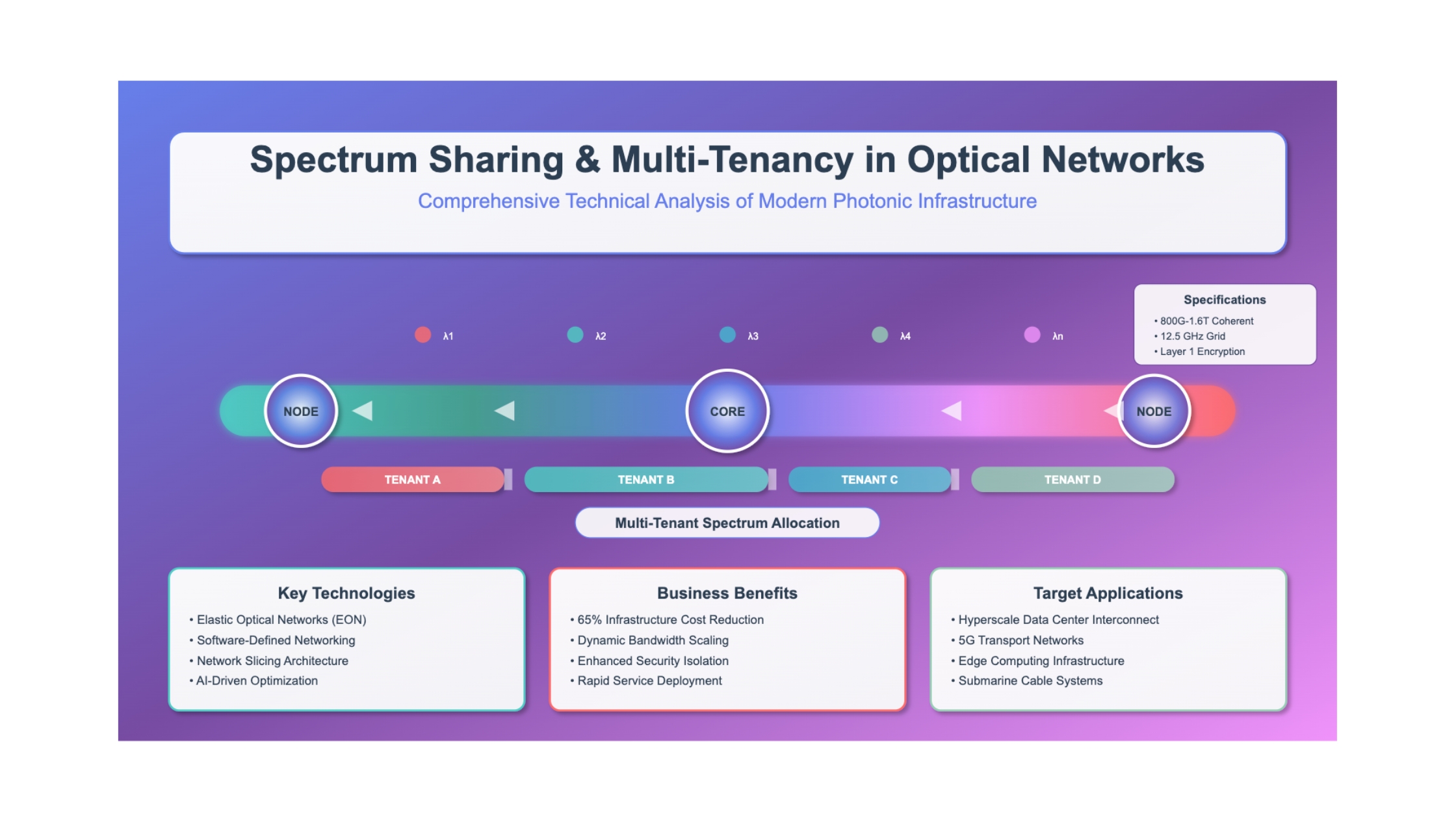
Executive Summary
The optical networking industry is experiencing a fundamental paradigm shift from rigid, dedicated infrastructure toward flexible, virtualized, and shared architectures. This transformation is driven by the convergence of spectrum sharing (logical partitioning of fiber's physical capacity) and multi-tenancy (architectural principle serving multiple distinct customers on common infrastructure).
- Global optical networking market: $18.6 billion with 9.2% CAGR
- Hyperscaler infrastructure investment: $250+ billion collectively
- Multi-tenant deployments show 30-50% CAPEX reduction
- Spectral efficiency improvements: 15-30% over fixed-grid systems
This comprehensive analysis examines the technological underpinnings, strategic implications, and operational challenges of shared optical networks, focusing on Service Providers (SPs) and Hyperscalers as primary stakeholders.
Historical Context & Evolution
From Wireless Origins to Optical Reality
Spectrum sharing originated in wireless communications as a solution to optimize crowded electromagnetic spectrum usage. The wireless paradigm focused on managing interference in open broadcast media, developing frameworks like:
- Tiered Access Systems: Hierarchical user priorities (CBRS model)
- Coexistence Mechanisms: Interference avoidance techniques
- Dynamic Spectrum Access: Real-time frequency allocation
When adapted to optical networks, the challenge transforms from interference management to precise resource allocation and virtualization of the photonic layer.
Technical Architecture Framework
Core Enabling Technologies Triad
The shared optical layer rests on three interdependent technological pillars:
| Technology Component | Primary Function | Key Benefits | Implementation Challenges |
|---|---|---|---|
| Elastic Optical Networks (EON) | Granular spectrum allocation using flexible frequency slots (12.5 GHz units) | 15-30% spectral efficiency improvement, dynamic bandwidth allocation | Spectrum fragmentation, complex ROADM requirements |
| Software-Defined Networking (SDN) | Centralized control plane separation from data plane | Network-wide optimization, automated provisioning, multi-vendor support | Controller scalability, vendor interoperability limitations |
| Network Slicing | End-to-end logical network isolation on shared infrastructure | Strong tenant isolation, guaranteed SLAs, resource optimization | Complex orchestration, performance monitoring across slices |
Fundamental Architecture Comparison
Traditional vs. Shared Optical Models
| Architecture Characteristic | Dedicated Fiber | Traditional Wavelength | Multi-Tenant Spectrum Sharing |
|---|---|---|---|
| Bandwidth Guarantee | Absolute (full fiber capacity) | Fixed per wavelength (e.g., 100 Gbps) | Guaranteed per allocated spectrum slice |
| Cost Model | Highest CapEx/OpEx | High, fixed recurring cost | Shared costs, consumption-based pricing |
| Scalability | Inelastic (requires new fiber) | Step-function (wavelength increments) | Highly elastic (software-defined scaling) |
| Security Model | Physical isolation | Wavelength-level isolation | Layer 1 encryption + logical isolation |
| Management Complexity | Highest (full tenant responsibility) | Moderate (shared infrastructure) | Lowest (API-driven tenant control) |
Performance Metrics Analysis
Mathematical Foundations
Spectral Efficiency Optimization
The fundamental optimization problem in elastic optical networks involves maximizing spectral efficiency while minimizing blocking probability:
Maximize: η = Σ(Ri × di) / Σ(Si × di)
Where:
- η = Overall spectral efficiency (bits/s/Hz)
- Ri = Data rate of connection i
- di = Distance of connection i
- Si = Spectrum allocation for connection i
Routing and Spectrum Assignment (RSA) Problem
The RSA problem in EONs must satisfy continuity and contiguity constraints:
∀ link l ∈ path p: spectrum[l] = spectrum[p]
Contiguity Constraint:
∀ connection i: slots assigned must be adjacent
Non-Overlapping Constraint:
∀ link l: Σ spectrum_usage[l] ≤ total_spectrum[l]
- First-Fit Spectrum Assignment: O(S) complexity for S spectrum slots
- Best-Fit with Fragmentation Awareness: Considers future allocation patterns
- Machine Learning-Enhanced RSA: Deep reinforcement learning with 92% accuracy in traffic prediction
Implementation Architectures
Disaggregated Optical Transport
Modern implementations separate optical line systems from transponders, enabling multi-vendor, multi-tenant deployments:
Key Implementation Standards
- OpenROADM: Multi-vendor ROADM interoperability (28+ member companies)
- Transport API (TAPI) v2.6: Technology-agnostic photonic/OTN/Ethernet interfaces
- 400ZR/800ZR: Coherent pluggable optics for hyperscaler DCI (3.8M ports projected 2024)
- ONF ODTN: Open Disaggregated Transport Network framework
Advanced Optimization Techniques
AI-Driven Network Optimization
Modern optical networks leverage artificial intelligence and machine learning to optimize performance, predict failures, and automate complex operations. The integration of AI transforms reactive network management into proactive, predictive systems.
AI Performance Metrics in Production Deployments
Spectrum Defragmentation Algorithms
As dynamic spectrum allocation creates fragmentation, advanced algorithms are required to maintain network efficiency:
FI = (N_gaps × Average_gap_size) / Total_spectrum
Defragmentation Benefit:
DB = (Blocked_requests_before - Blocked_requests_after) / Total_requests
Hitless Spectrum Defragmentation Techniques:
- Make-Before-Break: Establish new path before tearing down old path
- Push-Pull Retuning: Coordinated frequency shifting of multiple channels
- Spectrum Compaction: Moving all allocated slots to one end of spectrum
| Defragmentation Algorithm | Complexity | Provisioning Gain | Service Disruption |
|---|---|---|---|
| Hitless Optical Path Shift | O(n²) | Up to 98% | Zero (hitless) |
| First-Last-Exact-Fit | O(n log n) | 85-90% | Minimal |
| Genetic Algorithm-Based | O(n³) | 95-98% | Controllable |
Testing & Validation Methodologies
Multi-Tenant Performance Isolation Validation
Ensuring robust performance isolation in multi-tenant environments requires comprehensive testing across multiple dimensions:
Performance Benchmarking Methodology
| Test Category | Key Metrics | Acceptable Thresholds | Testing Tools |
|---|---|---|---|
| Latency Performance | Round-trip time, jitter variance | <1ms metro, <100μs fronthaul | High-precision timestamping, hardware probes |
| Throughput Validation | Sustained data rate, burst handling | 99.9% of contracted bandwidth | RFC 2544, Y.1564 testing |
| Isolation Verification | Cross-tenant interference | <0.01% performance degradation | Multi-tenant traffic generators |
| Security Compliance | Encryption strength, key rotation | AES-256, <24hr key refresh | Cryptographic validation tools |
Read the Full Analysis with Premium
The remaining 89% of this article — the design numbers, trade-offs and field guidance — is part of MapYourTech Premium, along with the full premium library, courses and professional tools.
You May Also Like
-
Free
-
September 4, 2026
-
Premium
-
September 4, 2026
-
Premium
-
September 4, 2026