Generic selectors
Exact matches only
Search in title
Search in content
Post Type Selectors
Articles
lp_course
lp_lesson
Back
HomeAnalysisMulti-Vendor Automation in Optical Networks: A Comprehensive Technical Analysis
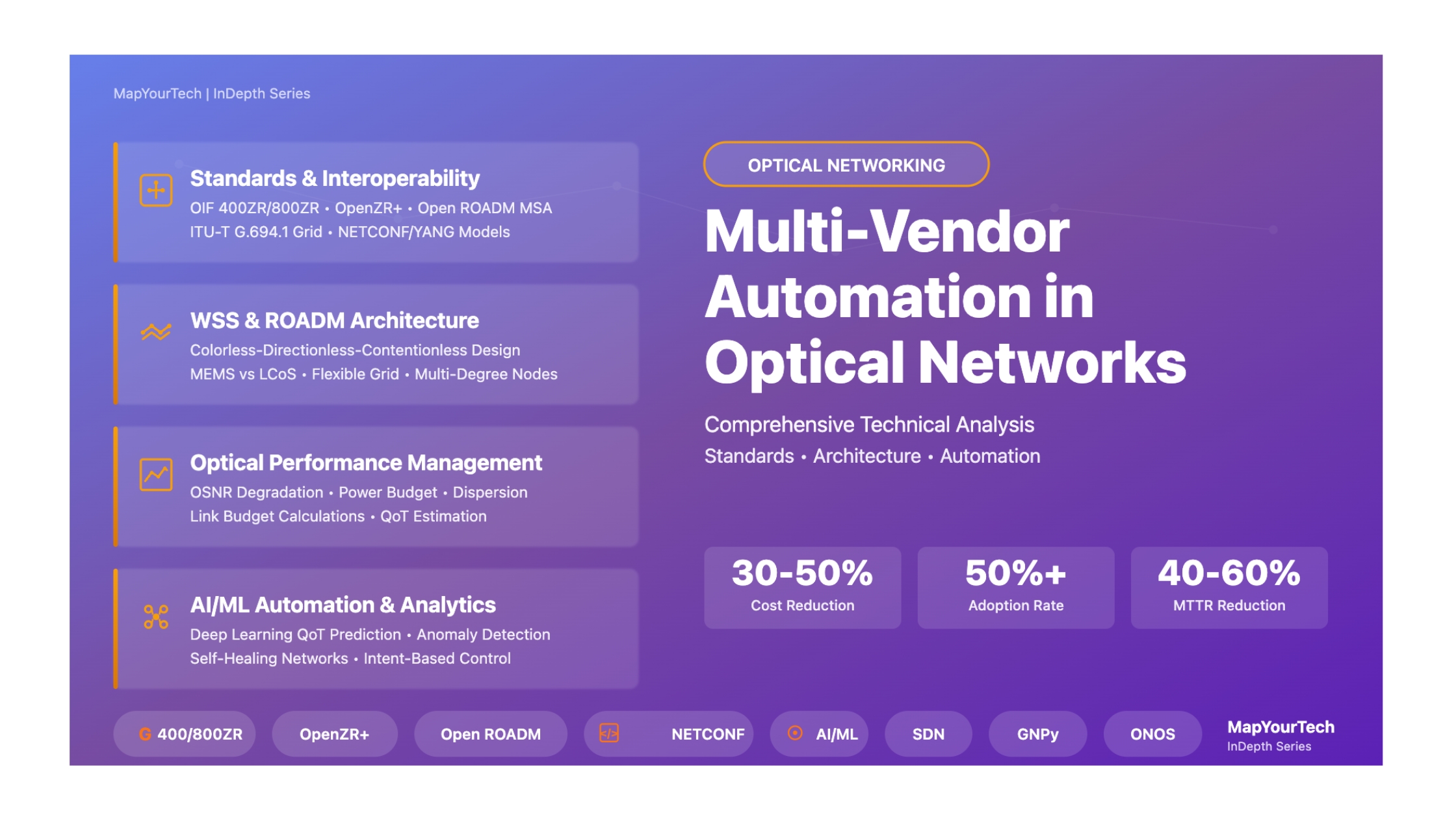
Multi-Vendor Automation in Optical Networks: A Comprehensive Technical Analysis

Multi-Vendor Automation in Optical Networks: A Comprehensive Technical Analysis

Last Updated: April 2, 2026
39 min read
72
Multi-Vendor Integration in Optical Networks: A Comprehensive Technical Analysis

Multi-Vendor Automation in Optical Networks: A Comprehensive Technical Analysis

Introduction

The landscape of optical networking has undergone a fundamental transformation over the past decade, evolving from proprietary, single-vendor ecosystems to open, disaggregated, multi-vendor architectures. This paradigm shift represents one of the most significant developments in telecommunications infrastructure, driven by the relentless demand for bandwidth, economic pressures, and the strategic imperative to avoid vendor lock-in. Multi-vendor integration in optical line systems, particularly those incorporating Wavelength Selective Switches (WSS) and Reconfigurable Optical Add-Drop Multiplexers (ROADMs), has matured from an experimental concept to operational reality, with approximately 50% of network operators planning or deploying disaggregated optical systems as of 2025.

The convergence of several technological and market forces has accelerated this transition. The exponential growth of data traffic driven by artificial intelligence workloads, cloud computing, 5G networks, and edge computing applications has pushed optical networks toward their physical capacity limits. Simultaneously, the standardization efforts by organizations such as the Optical Internetworking Forum (OIF), Open ROADM Multi-Source Agreement, and OpenZR+ MSA have matured sufficiently to enable practical interoperability across equipment from different manufacturers. The emergence of software-defined networking (SDN) controllers, model-driven management frameworks using YANG/NETCONF protocols, and AI-driven network automation has provided the control plane sophistication necessary to manage the complexity inherent in multi-vendor environments.

This comprehensive technical analysis examines the complete ecosystem of multi-vendor optical networking, from fundamental principles through practical implementation strategies. The article addresses the critical challenges that have historically impeded multi-vendor deployments—including WSS interoperability, optical performance management across vendor boundaries, operational complexity, and unified network management—while presenting proven solutions and emerging best practices. By 2025, the industry has accumulated substantial practical experience, with major carriers successfully deploying multi-vendor optical networks at scale, achieving cost reductions of 30-50% while maintaining carrier-grade reliability.

1. Historical Context and Evolution of Multi-Vendor Optical Networks

1.1 The Era of Proprietary Optical Systems (1990s-2010)

The first generation of commercial Dense Wavelength Division Multiplexing (DWDM) systems emerged in the mid-1990s, representing a revolutionary advancement in fiber capacity utilization. These early systems were fundamentally proprietary in nature, with each manufacturer implementing unique optical supervisory channel (OSC) protocols, wavelength locking mechanisms, and management interfaces. The vertical integration approach, where a single vendor provided all components from transponders to amplifiers to management software, offered certain advantages including optimized performance through proprietary algorithms, simplified operations with unified management systems, and clear accountability for end-to-end network performance.

However, this single-vendor paradigm imposed significant limitations on network operators. The most critical constraint was vendor lock-in, which effectively eliminated competitive pricing dynamics once initial deployment decisions were made. Operators found themselves constrained by their chosen vendor's technology roadmap and innovation cycles, unable to selectively adopt superior technologies from alternative suppliers. The economic impact was substantial, with capital expenditure leverage severely limited and operational flexibility constrained. Furthermore, single-vendor dependencies created supply chain vulnerabilities that became particularly evident during global disruptions in the 2020s.

1.2 Emergence of Standardization and Open Optical Systems (2010-2020)

The second decade of the 21st century witnessed growing momentum toward standardization and disaggregation in optical networking. The formation of the Open ROADM Multi-Source Agreement in 2016 marked a critical inflection point, bringing together major network operators and equipment vendors to define open specifications for ROADM-based optical line systems. Simultaneously, the Optical Internetworking Forum advanced interoperable coherent transmission standards, culminating in the 400ZR specification completed in 2020.

These standardization efforts were catalyzed by several technological developments. The maturation of digital signal processing (DSP) for coherent detection enabled flexible, software-configurable optical transceivers that could adapt to varying link conditions. The emergence of pluggable coherent optics in standard form factors (QSFP-DD, OSFP) fundamentally changed network economics by commoditizing transponder functionality. Software-defined networking concepts, proven successful in data center environments, began extending into the optical domain through initiatives like ONOS (Open Network Operating System) and OpenDaylight.

1990s-2010 Proprietary Systems Single-Vendor Lock-in Proprietary OSC 2010-2020 Standardization Era Open ROADM MSA 400ZR Standard SDN Controllers Coherent Pluggables 2020-2025 Multi-Vendor Reality 50% Adoption 800ZR/1.6T AI-Driven Mgmt IPoDWDM Evolution of Optical Network Architectures

1.3 Multi-Vendor Operational Reality (2020-2025)

The period from 2020 to 2025 has seen multi-vendor optical networking transition from trial deployments to mainstream operational reality. The market dynamics driving this acceleration have been profound and multifaceted. The optical transport network market reached USD 27 billion in 2025, with projections to grow at 8.42% CAGR to USD 40.44 billion by 2030. This growth is fueled primarily by hyperscaler data center buildouts, with companies channeling over USD 215 billion into digital infrastructure in 2025 alone. The commercialization of 400ZR and 800ZR coherent pluggables has enabled direct router-to-router connections without standalone transponders, fundamentally reshaping network architectures.

Several landmark deployments have validated the multi-vendor approach at carrier scale. Major operators have successfully demonstrated 1.6 Tbps single-wavelength connections across distances exceeding 1,590 kilometers using equipment from multiple manufacturers, proving that standards-based multi-vendor implementations can achieve carrier-grade reliability and performance. The successful completion of major acquisitions, such as the Nokia-Infinera merger for USD 2.3 billion in early 2025, indicates market consolidation is occurring simultaneously with ecosystem expansion, creating larger integrated vendors alongside innovative specialized suppliers.

Key Milestone: Industry Maturity Indicators

Standardization Completeness: OpenZR+ MSA specifications now cover 400G and 800G coherent interfaces with demonstrated interoperability across major vendors. The Open ROADM MSA has defined comprehensive optical specifications including wavelength grids, power levels, and control plane interfaces.

Commercial Availability: All major optical equipment manufacturers now offer standards-compliant products, with demonstrated interoperability through independent testing by organizations such as EANTC (European Advanced Networking Test Center).

Operational Experience: Multiple tier-1 carriers have accumulated years of operational experience with multi-vendor deployments, developing proven methodologies for planning, deployment, and lifecycle management.

1.4 Technology Drivers and Market Forces

The rapid adoption of multi-vendor architectures has been propelled by several converging technology drivers. The emergence of artificial intelligence as a dominant workload has created unprecedented demand for network capacity, with AI clusters requiring massive GPU interconnection bandwidth both within data centers and across geographically distributed facilities. The shift toward edge computing and 5G network densification has multiplied the number of connection points requiring optical infrastructure, favoring flexible, cost-optimized deployment models.

Multi-Vendor Optical Network Architecture SDN Controller / Orchestration Layer NETCONF/YANG • OpenROADM • T-API Unified Management & Control Plane Vendor A Equipment ROADM/WSS • Wavelength Switching • Flexible Grid • CDC Architecture Vendor B Equipment Optical Amplifiers • EDFA/Raman • Dynamic Gain Control • C+L Band Support Vendor C Equipment Coherent Transponders • 400G/800G ZR+ • Pluggable Optics • Adaptive Modulation Fiber Fiber Physical Layer - Standardized Interfaces ITU-T G.694.1 Grid • Power Levels • Optical Reach Specifications Standards Bodies • OIF (400ZR/800ZR) • OpenROADM MSA • ITU-T Standards Key Benefits • 30-50% Cost Savings • Best-of-Breed Access • Supply Chain Resilience Challenges • Complex Integration • Operational Overhead • Performance Tuning

From a supply chain perspective, geopolitical considerations and global disruptions have elevated resilience as a primary design criterion. Multi-vendor strategies provide geographic and supplier diversification, protecting against both supply chain failures and regulatory restrictions. The total cost of ownership analysis increasingly favors multi-vendor approaches, with documented capital expenditure reductions of 30-50% compared to single-vendor solutions, while operational expenditure trends depend heavily on automation maturity and organizational capabilities.

Multi-Vendor Ecosystem and Value Chain Network Operators Equipment Vendors ROADMs, Amplifiers, Transponders Standards Bodies OIF, OpenROADM, ITU-T Component Suppliers (Optics, DSP) SDN Controllers ONOS, OpenDaylight System Integrators Professional Services Testing Labs EANTC, Interop Events Collaborative Ecosystem Model Standards-Based Interoperability
Driver Category Specific Factors Impact on Multi-Vendor Adoption
Economic CapEx reduction, competitive pricing, TCO optimization 30-50% cost reduction in equipment procurement; improved negotiating leverage
Technological Coherent pluggables, SDN maturity, AI/ML automation Enables practical disaggregation; reduces operational complexity
Strategic Vendor lock-in avoidance, innovation access, flexibility Access to best-of-breed technologies; accelerated feature adoption
Operational Supply chain resilience, geographic diversity, risk mitigation Protection against supply disruptions; regulatory compliance flexibility
Market AI infrastructure buildout, hyperscaler demand, 5G/edge expansion Massive capacity requirements favor flexible, cost-effective solutions
Multi-Vendor Integration - Part 2

2. Foundational Principles of Wavelength Selective Switches (WSS)

2.1 WSS Technology Fundamentals

Wavelength Selective Switches represent the cornerstone technology enabling flexible optical networking and multi-vendor integration. A WSS is an optical component that can independently route individual wavelength channels from one or multiple input fibers to one or multiple output fibers. Unlike traditional fixed optical add-drop multiplexers (OADMs), WSS devices provide software-configurable wavelength routing, enabling dynamic network reconfiguration without physical intervention. This programmability is essential for multi-vendor architectures, as it allows operators to provision bandwidth on-demand and adapt to changing traffic patterns in real-time.

The fundamental operation of a WSS involves three key processes: wavelength demultiplexing, spatial switching, and wavelength multiplexing. An incoming DWDM signal containing multiple wavelength channels is first separated into individual wavelengths using a dispersive element such as a diffraction grating or arrayed waveguide grating. Each wavelength is then independently steered to a selected output port using either micro-electro-mechanical systems (MEMS) mirrors or liquid crystal on silicon (LCoS) technology. Finally, the wavelengths destined for the same output port are recombined into a single fiber. The switching granularity can be as fine as 6.25 GHz or 12.5 GHz channel spacing, enabling flexible grid DWDM systems that optimize spectral efficiency.

Premium Article — Free 20% Preview

Read the Full Analysis with Premium

The remaining 80% of this article — the design numbers, trade-offs and field guidance — is part of MapYourTech Premium, along with the full premium library, courses and professional tools.

Instant access · Cancel anytime · 48-hour trial available
Sanjay Yadav

Optical Communications & Network Automation Expert | Author of 3 Books for Optical Engineers | Founder, MapYourTech

Optical networking engineer with nearly two decades of experience across DWDM, OTN, coherent optics, submarine systems, and cloud infrastructure. Founder of MapYourTech.

Follow on LinkedIn
Share:

You May Also Like

15 min read 6 0 Like Connector Types and Their Loss Budgets: SC, LC, MPO Skip to main content MapYourTech...
  • Free
  • July 11, 2026
16 min read 6 0 Like Cooled vs Uncooled Lasers: The Pluggable Power Trade-off Skip to main content MapYourTech |...
  • Free
  • July 11, 2026
16 min read 8 0 Like Automation Blast Radius: Scoping What a Bad Intent Can Touch Skip to main content...
  • Free
  • July 11, 2026

Course Title

Course description and key highlights

Course Content

Course Details