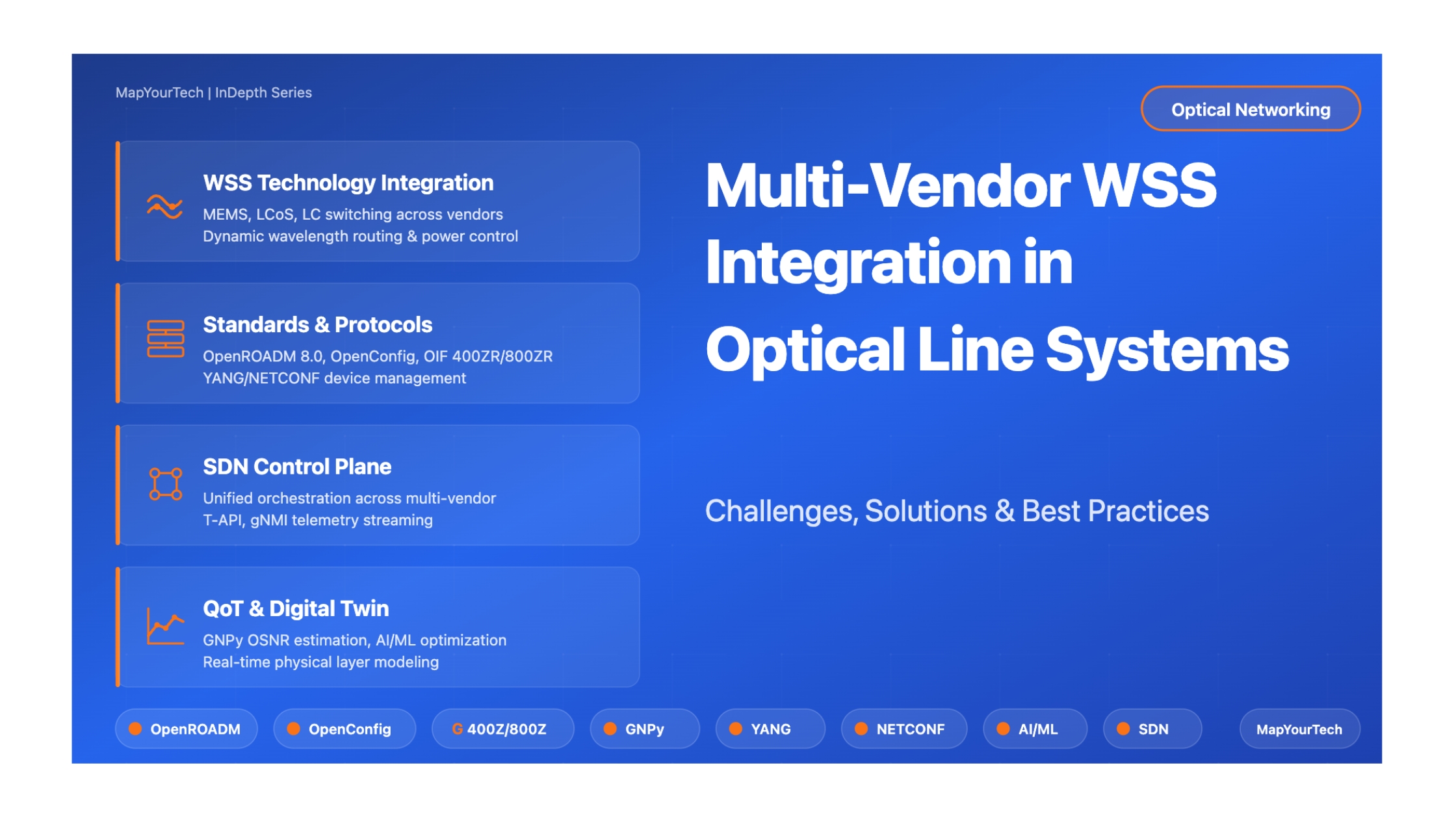

Multi-Vendor WSS Integration in Optical Line Systems
Comprehensive Technical Guide: Challenges, Solutions, and Best Practices for Open Optical Networks
Practical Information Based on Industry Experience and RequirementsIntroduction
The telecommunications industry is undergoing a transformative shift from traditional, monolithic network architectures to open, disaggregated models. This evolution is particularly pronounced in optical networks, where the integration of Wavelength Selective Switches (WSS) from multiple vendors within Optical Line Systems (OLS) has become a strategic imperative. Multi-vendor WSS integration represents not merely a technical upgrade, but a fundamental change in how optical networks are designed, deployed, and managed.
By 2023, approximately 50% of network operators planned to deploy disaggregated, multi-vendor optical line systems, signaling a fundamental shift in network architecture philosophy. This adoption is driven by compelling business cases including 30-50% capital expenditure savings, vendor lock-in avoidance, supply chain resilience, and access to best-of-breed technologies from multiple vendors.
This comprehensive guide examines the technical challenges, standardization efforts, operational considerations, and real-world implementations of multi-vendor WSS integration. Drawing from industry standards, deployment experiences, and collaborative research, it provides network professionals with the knowledge needed to successfully navigate the complexities of open optical networking.
Multi-Vendor Optical Network Architecture Overview
Complete ecosystem showing integration of WSS, ROADMs, transponders, and amplifiers from multiple vendors with unified SDN control
Key Challenges in Multi-Vendor Integration
WSS Technology Differences: MEMS-based WSS devices offer proven reliability but typically support fewer ports than LCoS alternatives. Different switching speeds and port counts complicate network planning.
Control Interface Standardization: While wavelength switching follows ITU grid specifications, WSS management interfaces vary significantly between vendors, requiring middleware or controllers capable of translating between different command sets.
Performance Optimization: Multi-vendor networks typically require conservative margin allocation compared to single-vendor solutions. Different amplifiers have varying gain profiles and noise characteristics, necessitating per-channel power adjustments.
Operational Complexity: Network planners must understand multiple vendors' capabilities and limitations, while operations teams need expertise across diverse platforms. Training requirements increase substantially.
Historical Context & Evolution of Optical Networks
The journey from closed, proprietary optical systems to open, multi-vendor architectures spans several decades and represents a fundamental shift in telecommunications infrastructure design. Understanding this evolution provides context for the current challenges and opportunities in multi-vendor WSS integration.
Era of Proprietary Closed Systems (1990s-2010s)
Historically, Dense Wavelength Division Multiplexing (DWDM) optical systems were procured as "closed solutions." This traditional model dictated that network operators acquired all components—terminal equipment, transmission equipment, and management systems—from a single supplier. The primary advantage was system integration: the vendor guaranteed end-to-end performance and simplified troubleshooting since all components were designed and tested to work together.
However, this approach created significant challenges. Operators faced vendor lock-in, limiting their ability to adopt new technologies or negotiate favorable terms. The lack of competition at the component level often resulted in higher costs. Supply chain dependencies on a single vendor created vulnerability to disruptions, and innovation was constrained by what a single vendor could develop.
Emergence of Open Standards (2010s)
The push toward disaggregation began with recognition that optical networks could benefit from the same principles driving software-defined networking in other domains. Key milestones included the formation of the OpenROADM Multi-Source Agreement (MSA), which defined optical and API specifications for building physically interoperable, disaggregated ROADM networks. The Optical Internetworking Forum (OIF) developed standards for coherent pluggables including 400ZR and OpenZR+. The OpenConfig initiative emerged from major operators to create vendor-neutral YANG data models for network management.
These efforts established the foundational frameworks that make multi-vendor integration technically feasible. ITU-T recommendations like G.698.x specifications defined optical interface parameters ensuring signals from different vendors could traverse common infrastructure.
Read the Full Analysis with Premium
The remaining 89% of this article — the design numbers, trade-offs and field guidance — is part of MapYourTech Premium, along with the full premium library, courses and professional tools.