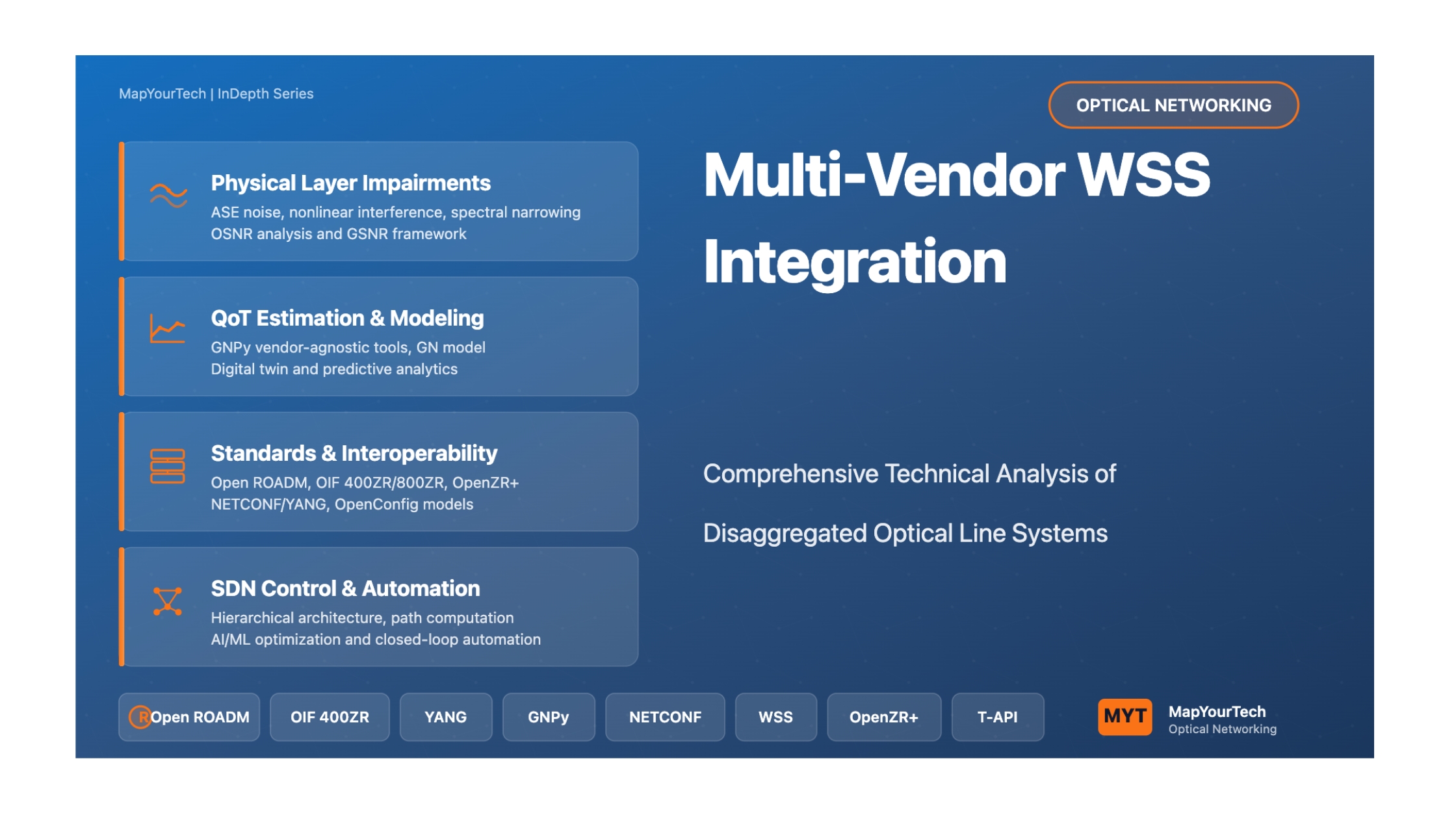

Multi-Vendor WSS Integration in Optical Line Systems
Comprehensive Technical Analysis of Challenges, Solutions, and Future Directions in Disaggregated Optical Networks
Introduction
The telecommunications industry is experiencing a fundamental transformation in optical network architecture, moving from monolithic, single-vendor solutions toward open, disaggregated, and software-defined infrastructures. This evolution is particularly evident in the deployment of Wavelength Selective Switches (WSS) within multi-vendor Optical Line Systems (OLS), representing a strategic shift that promises increased competition, enhanced network resilience, greater cost-efficiency, and liberation from vendor lock-in.
Multi-vendor WSS integration enables network operators to construct flexible optical transport layers by selecting best-of-breed components from different manufacturers while maintaining interoperability across the entire system. This disaggregation approach allows operators to optimize their networks for specific performance requirements, geographic conditions, and economic constraints, rather than being constrained by the capabilities and pricing of a single vendor's product portfolio.
The dynamic capabilities of WSS technology, particularly within flexible-grid Reconfigurable Optical Add-Drop Multiplexers (ROADMs), are enabling advanced use cases such as IP-over-DWDM convergence, coherent pluggable transceiver integration, and Optical-Spectrum-as-a-Service (OSaaS) models. These capabilities fundamentally change how bandwidth is provisioned and managed, transitioning from static network provisioning to highly programmable, on-demand optical resource allocation.
This comprehensive technical analysis examines the multi-faceted challenges, standardization efforts, technological solutions, and operational considerations involved in deploying multi-vendor WSS-based optical networks. The document addresses physical layer interoperability, control plane integration, performance optimization, quality of transmission estimation, and the critical role of software-defined networking in managing heterogeneous optical infrastructure.
The Strategic Imperative for Multi-Vendor Integration
The drive toward multi-vendor optical networks is motivated by several compelling strategic and operational factors that extend beyond simple cost reduction. Network operators face unprecedented demands for bandwidth capacity, driven by the explosive growth of cloud computing, 5G mobile networks, video streaming, and emerging applications in artificial intelligence and machine learning. Single-vendor solutions, while offering integrated management and predictable performance, constrain operators' ability to rapidly adopt innovative technologies, optimize capital expenditure, and maintain competitive positioning.
Vendor lock-in represents one of the most significant concerns for network operators. Traditional proprietary optical systems create dependencies that limit operators' negotiating leverage, restrict technology choices, and often result in premium pricing for upgrades and expansions. By adopting multi-vendor strategies, operators can introduce competitive pressure into procurement processes, accelerate the adoption of emerging technologies, and maintain architectural flexibility as network requirements evolve.
Furthermore, multi-vendor approaches enhance network resilience through diversification. Reliance on a single vendor creates systemic risk—supply chain disruptions, vendor financial instability, or discontinuation of product lines can severely impact network operations. Multi-vendor architectures distribute this risk across multiple suppliers while providing fallback options for critical components.
1. Fundamental Concepts: Optical Line Systems and Wavelength Selective Switches
1.1 Optical Line System Architecture
An Optical Line System (OLS) serves as the fundamental transport infrastructure for modern telecommunications networks, enabling the transmission of massive data volumes as light signals through fiber optic cables. The core operational principle of OLS is total internal reflection, which ensures light signals propagate through the fiber core with minimal degradation over extended distances. This inherent efficiency enables OLS to support data capacities reaching several terabits per second, making them indispensable for both long-haul and metropolitan network deployments.
The typical OLS architecture comprises several critical functional elements that work synergistically to achieve reliable, high-capacity data transport:
| Component | Function | Key Characteristics |
|---|---|---|
| Fiber Infrastructure | Physical transmission medium | Single-mode fiber with low attenuation (0.2 dB/km at 1550nm), supports C-band and L-band operation |
| Optical Amplifiers | Signal power regeneration | EDFA (Erbium-Doped Fiber Amplifier), Raman amplifiers, typical gain 15-25 dB, noise figure 4-6 dB |
| ROADMs | Dynamic wavelength routing and add/drop | Colorless, directionless, contentionless (CDC) architecture, flex-grid support, 96+ channel capacity |
| WSS Modules | Wavelength-selective switching core | MEMS or LCoS technology, 12.5 GHz to 75 GHz granularity, sub-millisecond switching |
| Transponders/Muxponders | Signal generation and coherent detection | 400G/800G coherent, advanced modulation (16QAM, 64QAM), programmable DSP |
| Monitoring Equipment | Performance surveillance and diagnostics | OCM (Optical Channel Monitor), OTDR, OSA (Optical Spectrum Analyzer), real-time telemetry |
1.2 Wavelength Selective Switch Technology
Wavelength Selective Switches represent the technological cornerstone enabling flexible, dynamic optical networks. WSS devices provide the capability to independently route individual wavelength channels on a sub-millisecond timescale without disrupting other channels in the same fiber. This granular control transforms traditional static optical networks into software-programmable infrastructure capable of responding to real-time traffic demands.
Modern WSS implementations employ two primary technological approaches, each with distinct characteristics affecting multi-vendor integration:
MEMS-based WSS devices utilize arrays of microscopic mirrors that can be individually positioned to direct specific wavelengths to designated output ports. The mechanical nature of MEMS provides several advantages: proven reliability with millions of switching cycles, low insertion loss (typically 4-6 dB), excellent wavelength isolation (>30 dB adjacent channel), and mature manufacturing processes. However, MEMS technology faces limitations in port count scalability (typically 9x9 or smaller), slower switching speeds compared to liquid crystal alternatives (several milliseconds), and mechanical wear considerations over extended operational lifetimes.
LCoS-based WSS devices employ liquid crystal arrays as programmable diffraction gratings, offering distinct advantages for high-port-count applications. LCoS technology enables higher port configurations (1x20 or greater), faster switching times (sub-millisecond), finer spectral resolution for flexible-grid applications (12.5 GHz spacing), and absence of mechanical wear. The trade-offs include higher insertion loss (typically 6-9 dB), more complex polarization management requirements, temperature sensitivity affecting spectral characteristics, and higher manufacturing complexity.
Read the Full Analysis with Premium
The remaining 89% of this article — the design numbers, trade-offs and field guidance — is part of MapYourTech Premium, along with the full premium library, courses and professional tools.