
OpenROADM in Detail: Architecture, Models, Interoperability
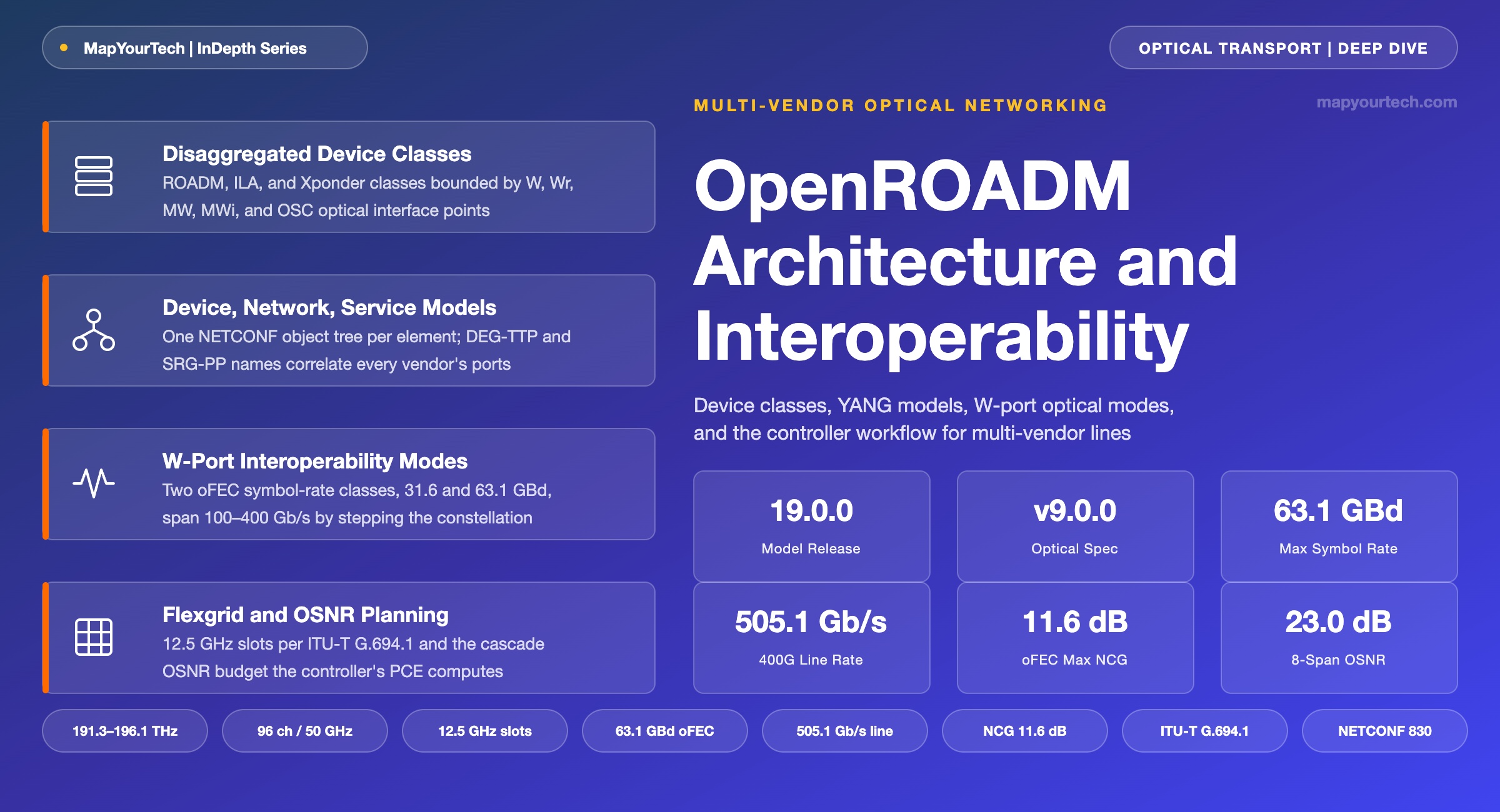
A working reference on the Open ROADM Multi-Source Agreement: the disaggregated device classes and their interface points, the device, network, and service YANG models, the interoperable optical specifications from 100 Gb/s staircase-FEC modes to 63.1 GBd oFEC modes, and the controller workflow that turns them into multi-vendor services.
Integration is not just connecting systems; it's making them work as one.
What You Will Learn
- Define the three Open ROADM device classes of Figure 2 (ROADM, ILA, Xponder) and place the W, Wr, MW, MWi, and OSC interface points on a multi-vendor line.
- Map the device YANG model's objects (circuit-packs, degrees, shared-risk-groups, connection map) to the DEG1-TTP and SRG1-PP7 logical connection points a controller correlates.
- Select W-port modes from Table 3, from DP-QPSK at about 28 GBd with staircase FEC for 100 Gb/s up to DP-16QAM at 63.1 GBd with oFEC and a 505.1 Gb/s line rate.
- Quantify oFEC against staircase FEC: 11.1–11.6 dB net coding gain at a 2.0 × 10⁻² pre-FEC threshold versus 9.38 dB at 10−15 output error rate.
- Compute flexible-grid assignments per ITU-T G.694.1 (6.25 GHz center-frequency granularity, 12.5 GHz slot-width steps) and derive the 75 GHz slot a 63.1 GBd carrier occupies.
- Build the OSNR budget of Section 6's worked example: 23.0 dB delivered over eight spans of 22 dB at +1 dBm per-channel launch and a 5 dB noise figure.
- Sequence a TransportPCE service turn-up through Service Handler, PCE, Renderer, and OLM, including the power-to-gainLoss control-mode transition of Figure 6.
- Anchor the current status as of 2026: model release 19.0.0, optical specification v9.0.0, and OFC 2026 multi-domain demonstrations carrying 25G–800G wave services.
1. Introduction
The Open ROADM Multi-Source Agreement (MSA) is a set of published interoperability specifications that lets Reconfigurable Optical Add-Drop Multiplexers (ROADMs), transponders, in-line amplifiers, and pluggable optics from different vendors operate as one network under a single Software-Defined Networking (SDN) controller. It does this with two coupled deliverables: optical interoperability specifications that fix the transmit and receive behavior at defined interface points, and open YANG data models that fix how a controller configures, monitors, and provisions each device over the Network Configuration Protocol (NETCONF). AT&T initiated the work in 2015, the group validated its first specifications at a plugfest in February 2016, and the MSA launched publicly at the Optical Fiber Communication Conference (OFC) that spring; trade coverage of the founding period names Ciena, Fujitsu, Nokia, and Orange among the earliest members alongside AT&T. As of 2026 the effort remains active, with model release 19.0.0 published in May 2026 and optical specification v9.0.0 published in November 2025, both recorded in the MSA's public repository.
The problem the MSA addresses is structural rather than cosmetic. A traditional DWDM deployment welded the transponder, the line system, and the management software into one vendor's closed appliance, so a second supplier's wavelength could not enter the same fiber and a second supplier's controller could not touch the same node. The Open ROADM answer partitions the network into three interchangeable device classes with fully specified boundaries, then abstracts every class behind a common NETCONF and YANG interface, so procurement, capacity growth, and software control each decouple from any single vendor's release schedule. That partition is the same architectural move that produced open line systems across the wider industry, and Open ROADM remains the most complete published version of it because it standardizes the device models and the optics together.
This reference covers the MSA end to end at working-engineer depth: the release structure and 2026 status, the device classes and their W, Wr, MW, MWi, and OSC interface points, the device, network, and service YANG models with their logical connection points, the interoperable W-port modes and their FEC parameters, the flexible-grid and OSNR arithmetic a planner runs against them, commissioning and TransportPCE provisioning sequences, performance monitoring, troubleshooting, and a comparison against OpenConfig, the Open Networking Foundation (ONF) Transport API (TAPI), and OpenZR+. Every figure in the text carries its evidence class, standard-specified, measured, vendor claim, or derived, in the sentence where it appears.
Takeaway: Open ROADM pairs optical interoperability specifications with open YANG models so multi-vendor ROADMs, amplifiers, and transponders operate under one controller; as of 2026 the current baselines are model release 19.0.0 and optical specification v9.0.0.
2. Multi-Source Agreement Structure and Release History
The MSA publishes three interlocking artifact families, and knowing which family governs a question saves hours of misdirected reading. The optical and digital specifications, distributed as a versioned workbook on openroadm.org and the public repository, define transmit and receive parameters, alarm and performance-monitoring behavior, supervisory-channel behavior, and laser-safety shutoff at each interface point; v9.0.0 of this workbook was published in November 2025 (repository record). The YANG model set, versioned separately, carries the device model, the network model, and the service model that controllers compile against; releases 18.0.0, 18.1.0, and 19.0.0 landed in November 2025, January 2026, and May 2026 respectively (repository record). White papers for the device, network, and service models, most recently issued for the 13.1 model generation, explain intent and worked controller sequences that the raw YANG cannot.
Release cadence has held near one model release per quarter, ten releases between 14.1 in January 2024 and 19.0.0 in May 2026 in a major-then-minor pattern (15.0 followed by 15.1, 16.0 by 16.1), and Figure 1 places both release tracks, model and optical specification, on one time axis (repository record). Backward compatibility is handled operationally rather than by freezing the models: at OFC 2025 the member demonstration ran ROADM, muxponder, OTN switch, transponder, and regenerator equipment spanning model versions 2.2.1, 7.1, and 12.0 in one interoperable network reaching 1.2 Tb/s, which included the first multi-vendor 800G pluggable ROADM link (demonstrated). A production controller therefore needs to mount and manage several model generations at once, and Section 7 returns to the design consequences.
Read the Full Analysis with Premium
The remaining 88% of this article — the design numbers, trade-offs and field guidance — is part of MapYourTech Premium, along with the full premium library, courses and professional tools.
You May Also Like
-
Free
-
September 4, 2026
-
Premium
-
September 4, 2026
-
Premium
-
September 4, 2026