
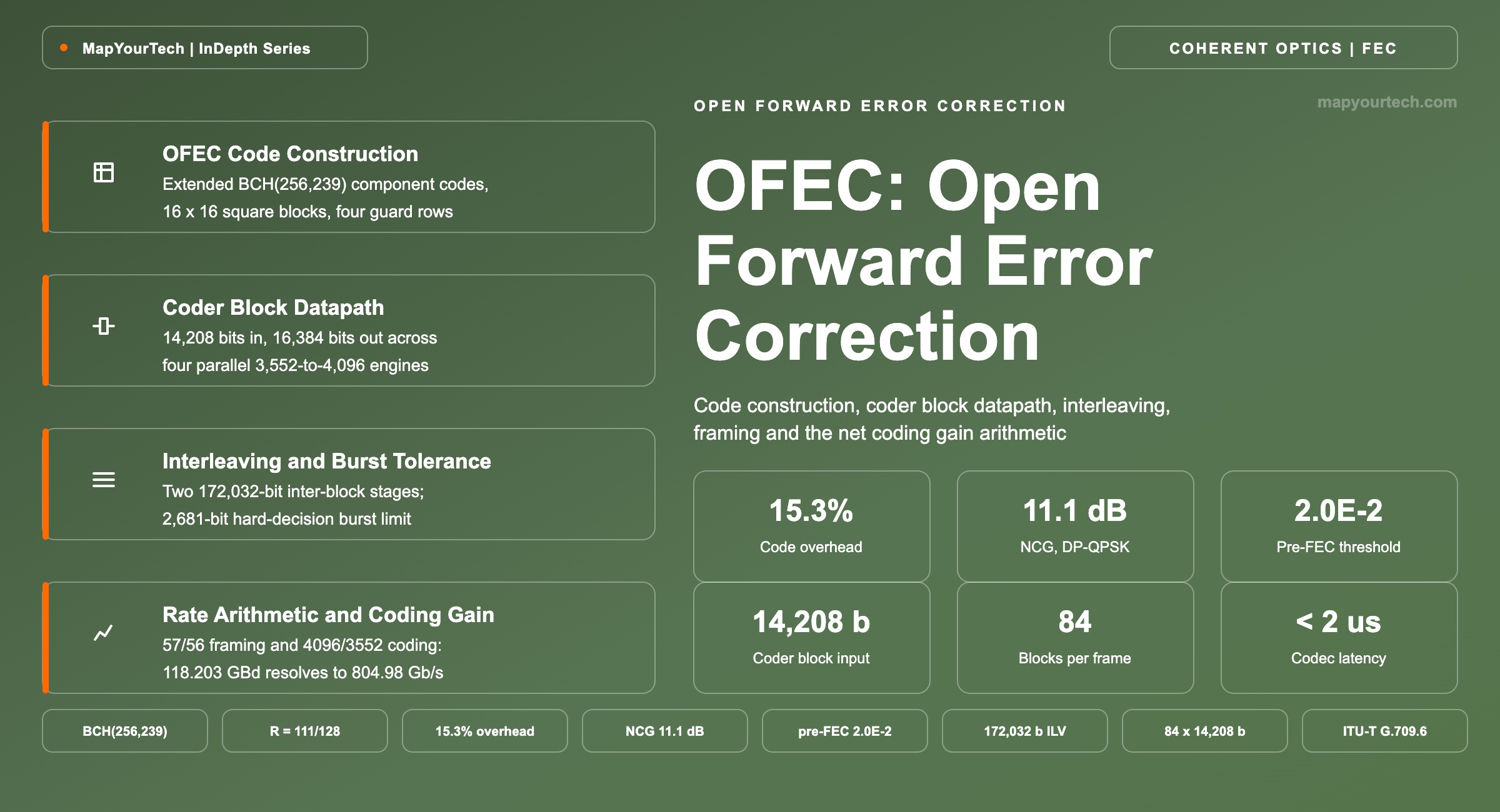
OFEC: Open Forward Error Correction in Coherent Transport
The code construction, coder block datapath, interleaving, framing and rate arithmetic behind the 11.1 dB and 11.6 dB net coding gain figures that OpenZR+, Open ROADM and OIF 800ZR modules are built on.
Every bit matters, but how you transmit them matters more.
What You Will Learn
- Define the OFEC code exactly: extended BCH(256,239) component codes, code rate 111/128 = 0.867, 15.3% overhead and a minimum Hamming distance of at least 42.
- Trace one coder block end to end: 14,208 information bits in, four parallel 3,552-to-4,096-bit encoders, 16,384 bits out, 84 blocks per DSP frame.
- Reproduce the 11.1 dB net coding gain from the ITU-T G.Sup39 definition, using a pre-FEC BER of 2.0 x 10⁻² and a reference BER of 1 x 10-15.
- Convert 118.203350603 GBd of DP-16QAM into 804.98 Gb/s of client-side FlexO capacity through the 57/56 framing and 4096/3552 coding factors.
- Size the interleaver correctly: two 172,032-bit inter-block interleavers and a 2,681-bit maximum correctable burst under hard decision.
- Place the probabilistic constellation shaping modes against plain OFEC: shaping rates of 5.71%, 11.0% and 33.7%, and net spectral efficiencies of 3.281, 3.125 and 2.594 bit/symbol per polarization.
- Build a monitoring baseline on pre-FEC BER and effective SNR, anchored to the 12.71 dB required eSNR at the theoretical DP-16QAM OFEC threshold.
- Select between concatenated FEC, OFEC and vendor soft-decision codes using overhead, gain, latency and interoperability as the four decision axes.
1. Introduction
Open Forward Error Correction (OFEC) is a block-convolutional code built from extended Bose-Chaudhuri-Hocquenghem BCH(256,239) component codewords, decoded by an iterative soft-decision decoder, and specified identically in ITU-T G.709.6, the Open ROADM Multi-Source Agreement (MSA) W-Port digital specification, the OpenZR+ MSA and the OIF 800ZR Implementation Agreement. With three soft-decision iterations it delivers a net coding gain of 11.1 dB at a post-FEC bit error ratio (BER) of 10-15 for dual-polarization quadrature phase shift keying (DP-QPSK) and 11.6 dB for dual-polarization 16-state quadrature amplitude modulation (DP-16QAM), correcting a pre-FEC BER threshold of 2.0 x 10⁻² (standard-specified, Open ROADM MSA W-Port B400G digital specification).
That single paragraph carries the two facts an operator buys. The first is the gain: 11.1 dB of net coding gain is roughly the difference between a 400 Gb/s wavelength that stops at a data-centre campus and one that crosses a regional network. The second is the word identical. Before OFEC, every vendor's soft-decision code was proprietary, which meant a line-side wavelength terminated on the same vendor's card at the far end. OFEC is published in full — parity check matrix, interleaver tables, scrambler seed, frame alignment word, and a normative set of test vectors — so a module from one supplier decodes a wavelength launched by another.
The code sits in a specific place in the transmit chain. A Flexible Optical Transport Network (FlexO) information structure arrives from the client mapping layer, a 32-bit cyclic redundancy check (CRC32) and all-zero padding align it to the coder block group boundary, a frame-synchronous scrambler removes payload patterns, four parallel encoders add parity, two stages of interleaving spread burst errors, and a symbol mapper places the coded bits onto the in-phase and quadrature rails of both polarizations. Each of those stages has exact bit counts in the specification, and this article works through them rather than around them. The coherent DSP architecture walkthrough covers the receive-side blocks that feed soft information into the decoder.
Three audiences get different value from what follows. An engineer new to coherent transport can read sections 2 through 4 as a definition of what an FEC block actually contains. A transport designer will use sections 9 and 10, where the rate arithmetic and the reach and margin trade-offs live. An operations engineer will find sections 11 and 12 most directly useful, because that is where pre-FEC BER thresholds, effective signal-to-noise ratio (eSNR) reporting, error marking and link degrade signalling are set against real specification values. For a shorter orientation to the same subject, the earlier MapYourTech treatment of Open Forward Error Correction fundamentals is a good starting point.
Takeaway: OFEC is one code with one set of published constants, reused across ITU-T G.709.6, Open ROADM, OpenZR+ and OIF 800ZR. Its value is the pairing of 11.1 dB to 11.6 dB net coding gain with bit-exact multi-vendor reproducibility, and every number in that claim is traceable to a clause in a public specification.
2. Coding Terminology and Net Coding Gain
Net coding gain (NCG) is the reduction in required signal-to-noise ratio at a stated reference output BER, corrected for the noise increase caused by the bandwidth expansion that the FEC parity bits force. Coding gain without that correction overstates an out-of-band code, because the added parity widens the receiver noise bandwidth. ITU-T G.Sup39 defines both terms and gives the closed-form expression used throughout this article.
2.1 The Four Quantities That Define a Code
A coherent FEC is fully described, for planning purposes, by four numbers. Code rate R is the ratio of information bits to total transmitted bits; for OFEC it is 111/128 = 0.867, which is stated as 15.3% overhead when expressed as parity relative to information (17/111). Pre-FEC BER threshold is the input error ratio at which the decoder still reaches the reference output BER; for OFEC that is 2.0 x 10⁻². Reference output BER is the post-decoder target, 10-15 for the OFEC figures. Net coding gain then follows from the first three.
Two further properties matter in operation but do not appear in the headline figure. Latency is set by the block size and the interleaver depth; the Open ROADM specification bounds combined encoder and decoder latency at less than 2 microseconds at 800G. Burst tolerance is set by the interleaver, and is quoted as a maximum correctable burst length of 2,681 bits with a hard decoder.
2.2 Hard-Decision and Soft-Decision Decoding
Hard-decision decoding quantizes each received bit to one or zero before the decoder sees it. Soft-decision decoding passes a multi-level confidence value — in practice a log-likelihood ratio — so the decoder knows which decisions were marginal. On an additive white Gaussian noise (AWGN) channel the difference is worth more than 1 dB at the same redundancy: at 15% redundancy and a reference BER of 10-15, ITU-T G.Sup39 gives a theoretical hard-decision bound of 11.0 dB and a soft-decision bound of 12.2 dB. OFEC is a soft-decision code and reaches 11.1 dB in the DP-QPSK case, which places it about 1.1 dB from the soft-decision bound at its own redundancy.
That gap is not waste. It is the price of a decoder that fits inside the power and area budget of a quad small form-factor pluggable double density (QSFP-DD) module. Closing the last decibel would need a longer iteration schedule, more soft bits per sample, and more memory, all of which cost milliwatts on a faceplate that has none to spare on a faceplate whose thermal envelope is already fixed by the host line card.
Read the Full Analysis with Premium
The remaining 88% of this article — the design numbers, trade-offs and field guidance — is part of MapYourTech Premium, along with the full premium library, courses and professional tools.
You May Also Like
-
Free
-
September 4, 2026
-
Premium
-
September 4, 2026
-
Premium
-
September 4, 2026