
Generic selectors
Exact matches only
Search in title
Search in content
Post Type Selectors
Articles
lp_course
lp_lesson
Back
HomeFundamentalsOptical Network Protection and Restoration Strategies
Optical Network Protection and Restoration Strategies

Optical Network Protection and Restoration Strategies

3 min read
121
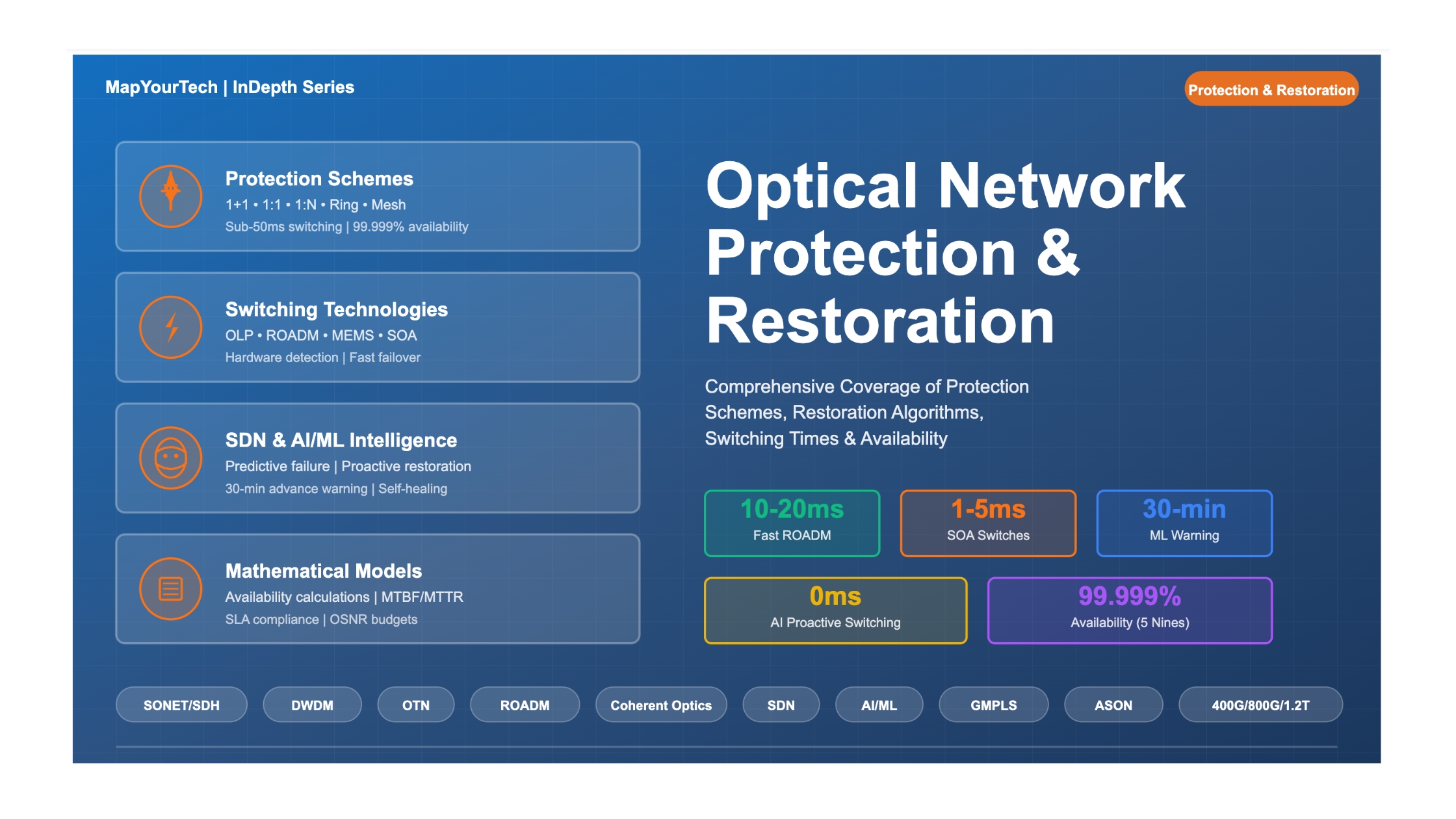
Optical Network Protection and Restoration Strategies - Comprehensive Visual Guide
Optical Network Protection and Restoration Strategies - Image 1

Optical Network Protection and Restoration Strategies

Comprehensive Coverage of Protection Schemes (1+1, Ring, Mesh), Restoration Algorithms, Switching Times, and Availability Calculations

Practical Information Based on Experience and Industry Requirements

Introduction

In the modern era of digital communication, optical networks form the backbone of global connectivity, carrying vast amounts of data across continents at the speed of light. From financial transactions and emergency services to video streaming and cloud computing, our world depends on the uninterrupted flow of information through these networks. However, optical networks face constant threats from fiber cuts, equipment failures, natural disasters, and human errors. A single fiber break can disrupt services for thousands of users and cause significant financial losses.

Network protection and restoration mechanisms are essential safeguards that ensure service continuity despite these inevitable failures. Protection refers to pre-configured backup paths that activate instantly when the primary path fails, while restoration involves dynamically computing alternate routes after a failure is detected. Together, these strategies form a comprehensive resilience framework that balances speed, efficiency, and cost.

This comprehensive guide explores the complete spectrum of optical network protection and restoration strategies, from basic 1+1 protection schemes to sophisticated mesh restoration algorithms. We examine the technical principles, performance metrics, implementation considerations, and emerging trends that are shaping the future of network resilience. Whether you're designing a metro network, managing a long-haul system, or planning submarine cable protection, this guide provides the knowledge needed to make informed decisions.

Why Network Protection and Restoration Matter

The importance of network protection cannot be overstated. Consider these real-world scenarios:

  • Financial Services: A stock exchange requires 99.999% availability (less than 5 minutes downtime per year). Even a 50-millisecond outage can result in failed trades worth millions of dollars.
  • Healthcare: Telemedicine and remote surgery depend on continuous connectivity. Network failures can literally be matters of life and death.
  • Emergency Services: 911 or 000 systems, disaster response networks, and public safety communications must remain operational during crises.
  • Data Centers: Cloud providers guarantee uptime through Service Level Agreements (SLAs). Downtime penalties and reputation damage make protection critical.
  • Submarine Cables: These cables carry 99% of international data traffic. With repair costs exceeding $1 million and weeks of downtime, protection is essential.

Beyond immediate service continuity, effective protection strategies provide several business advantages: reduced operational costs through automated recovery, improved customer satisfaction, competitive differentiation in service offerings, regulatory compliance for critical infrastructure, and insurance against catastrophic network failures.

Evolution of Protection Strategies

Protection mechanisms have evolved dramatically over the past three decades. Early SONET/SDH networks in the 1990s introduced ring protection with 50ms switching times. The 2000s brought mesh restoration and GMPLS control planes. Today's networks integrate SDN-based restoration, AI-driven fault prediction, and dynamic resource allocation. The next frontier includes quantum-safe protection and machine learning-based proactive failure prevention.

Protection vs. Restoration: Fundamental Concepts

Comparison of protection and restoration approaches with timing and resource characteristics

Protection vs. Restoration Architecture PROTECTION (Pre-Configured) Source Node A Destination Node B Working Path (Active) Protection Path (Pre-configured) ⚡ Switching: <50ms Advantages: • Fast switching (<50ms) • No traffic loss Trade-offs: • High resource usage (50-100%) • Higher cost RESTORATION (Dynamic) Source Node A Destination Node B ✗ Failed Path Dynamically Computed Alternate Path ⏱ Restoration: 200ms-2s Advantages: • Efficient resource use • Lower cost Trade-offs: • Slower recovery (seconds) • Possible traffic loss Key Comparison Metrics Switching/Recovery Time: • Protection: <50ms (near-instantaneous) • Restoration: 200ms-2s (requires computation) Resource Utilization: • Protection: 50-100% capacity reserved • Restoration: Shared capacity (10-30% overhead) Implementation Complexity: • Protection: Low (pre-configured paths) • Restoration: High (dynamic computation) Typical Applications: • Protection: Financial services, healthcare, emergency services, critical infrastructure • Restoration: Best-effort traffic, large-scale carrier networks, non-critical services Cost Considerations: • Protection: High CAPEX, lower OPEX • Restoration: Low CAPEX, potentially higher OPEX 💡 Best Practice: Hybrid approaches combine both for optimal resilience

2. Historical Context & Evolution

The evolution of optical network protection mechanisms spans more than three decades, driven by increasing bandwidth demands, emerging technologies, and lessons learned from network failures. Understanding this historical progression provides valuable context for current architectures and hints at future directions.

The SONET/SDH Era (1990-2000)

The first generation of protection mechanisms emerged with SONET (Synchronous Optical Network) and SDH (Synchronous Digital Hierarchy) standards in the early 1990s. These synchronous networks introduced structured protection architectures that established many principles still in use today.

Linear Protection (1990-1995): The simplest form was 1+1 linear protection, where traffic was duplicated on working and protection fibers. The receiver continuously monitored both signals and selected the better one. This provided sub-50ms switching but at the cost of 100% capacity overhead. Bellcore (now Telcordia) standardized these mechanisms in GR-253-CORE, which became the foundation for SONET protection switching protocols.

Ring Protection (1995-2000): To improve efficiency, ring architectures were developed. Unidirectional Path-Switched Rings (UPSR) provided dedicated protection with working and protection paths traveling in opposite directions around the ring. Bidirectional Line-Switched Rings (BLSR) offered better capacity efficiency by using the protection bandwidth for working traffic during normal operations.

The ITU-T standardized SDH ring protection in G.841 (1998), which defined 2-fiber and 4-fiber BLSR architectures. Major telecommunications providers deployed extensive SONET/SDH networks with ring protection, establishing 50ms as the industry standard for protection switching time—a benchmark that remains relevant in 2025.

The WDM and Optical Layer Protection Era (2000-2010)

The explosive growth of internet traffic in the early 2000s drove the adoption of Dense Wavelength Division Multiplexing (DWDM), which multiplexed dozens of wavelengths onto a single fiber. This paradigm shift required new protection approaches that could handle multiple wavelengths simultaneously.

Optical Line Protection (2000-2005): OLP systems protected entire DWDM line systems at the optical layer, independent of client protocols. This protocol-agnostic approach allowed protection of any service type—SONET, Ethernet, IP—using the same optical infrastructure. OLP switches could handle 40, 80, or more wavelengths simultaneously, providing wavelength-level or line-level protection with sub-50ms switching times.

OTN Protection Mechanisms (2006-2010): The ITU-T G.709 Optical Transport Network standard introduced structured protection at the OTN layer. ODU (Optical Data Unit) connections could be protected using Sub-Network Connection Protection (SNCP), providing path-level protection with comprehensive monitoring and management capabilities. OTN's tandem connection monitoring allowed protection across multiple network segments, enabling end-to-end service assurance.

GMPLS Control Plane (2003-2010): Generalized Multi-Protocol Label Switching (GMPLS) brought IP-style control planes to optical networks. GMPLS enabled dynamic path computation, signaling, and restoration capabilities. The IETF developed GMPLS RSVP-TE extensions for protection and restoration, allowing networks to automatically compute backup paths while considering constraints like shared risk link groups (SRLGs) and optical reach limitations.

The Mesh Restoration and ASON Era (2010-2015)

As networks grew larger and more complex, mesh topologies became dominant in core networks, requiring sophisticated restoration algorithms that could optimize resource utilization while maintaining fast recovery times.

Shared Mesh Protection: Unlike dedicated ring protection, mesh protection allowed multiple connections to share backup capacity. This dramatically improved efficiency—instead of dedicating 50-100% of capacity for protection, networks could achieve high availability with only 10-30% overhead. However, this required complex algorithms to ensure non-conflicting protection paths and proper resource allocation.

Automatically Switched Optical Network (ASON): ITU-T G.8080/G.8081 defined ASON architecture, providing discovery, routing, signaling, and protection capabilities for optical networks. ASON supported both protection and restoration, with operator-configurable policies for different service classes. This enabled service providers to offer tiered protection levels based on customer requirements and willingness to pay.

Path Computation Element (PCE): IETF developed PCE architecture (RFC 4655) to offload complex path computation from network elements to centralized or distributed computation engines. PCE could compute protection paths considering multiple constraints: available bandwidth, optical reach, OSNR requirements, latency, and SRLG diversity. This separation of computation and forwarding enabled more sophisticated optimization algorithms.

The SDN and Programmable Networks Era (2015-2020)

Software-Defined Networking revolutionized optical network control, enabling new protection and restoration paradigms that were impossible with traditional distributed control planes.

Centralized Control: SDN controllers provided a global network view, enabling intelligent protection decisions based on real-time network state. Controllers could monitor all network resources—spectrum, fiber paths, transponder capacity—and make holistic restoration decisions impossible with distributed protocols. This centralization reduced signaling overhead and enabled faster, more optimal restoration path computation.

Disaggregated Networks: The move toward open line systems and IPoDWDM (IP over DWDM) changed protection requirements. With coherent pluggables inserted directly into routers, protection needed to coordinate across optical and IP layers. SDN controllers provided the framework for this multi-layer coordination, enabling protection decisions that considered both IP routing and optical path availability.

The AI/ML and Automation Era (2020-Present)

Current-generation networks integrate artificial intelligence and machine learning for proactive protection, moving beyond reactive failure recovery to predictive failure prevention.

Predictive Failure Detection: Machine learning models analyze optical telemetry data to detect early signs of impending failures. Degrading OSNR, increasing bit errors, or fiber vibrations can trigger proactive restoration before actual service disruption. Nokia's research demonstrated AI-based detection of fiber cuts from excavation activities up to 30 minutes before the actual break, enabling preemptive traffic rerouting with zero service impact.

Digital Twins: Network digital twins—real-time simulations of the physical network—allow operators to test protection scenarios and optimize configurations without impacting production traffic. What-if analysis can predict the impact of multiple failures and validate protection adequacy before deployment.

Self-Healing Networks: Advanced automation enables fully autonomous protection, where networks detect, isolate, and recover from failures without human intervention. Systems can even learn optimal recovery strategies from experience, continuously improving restoration success rates and recovery times.

3. Core Concepts & Fundamentals

Understanding the fundamental concepts of network protection and restoration is essential for designing resilient optical networks. This section explores the key principles, terminology, and architectural considerations that form the foundation of all protection strategies.

Protection Layers and Hierarchies

Optical networks implement protection at multiple layers, each with distinct characteristics and use cases:

Physical Layer (Layer 0) Protection

Protection at the optical/physical layer switches optical signals without electrical conversion. This includes Optical Line Protection (OLP) systems that switch between working and protection fibers, and ROADM-based protection that reroutes wavelengths at the optical layer. Physical layer protection is protocol-agnostic, meaning it protects all client signals regardless of their format—10G Ethernet, 100G coherent, or 400G ZR all receive the same protection. The key advantage is speed: optical switches can achieve sub-10ms switching times. However, physical layer protection requires dedicated optical infrastructure and careful power budget management.

OTN Layer (Layer 1) Protection

OTN provides structured protection at the ODU level, enabling granular protection for individual client services. Sub-Network Connection Protection (SNCP) creates end-to-end protected paths through the OTN network. OTN protection includes comprehensive monitoring via TCM (Tandem Connection Monitoring) bytes, enabling operators to track protection path quality across multiple network segments. OTN's layered architecture allows protection at different ODU levels: ODU0 (1.25Gbps), ODU1 (2.5Gbps), ODU2 (10Gbps), ODU3 (40Gbps), ODU4 (100Gbps), and ODUCn (flexible rate containers for beyond 100G). This flexibility enables efficient protection resource allocation based on service requirements.

Packet Layer (Layer 2/3) Protection

Ethernet and IP layers implement their own protection mechanisms: Link Aggregation Groups (LAG) for Ethernet, Rapid Spanning Tree Protocol (RSTP) for layer 2, and routing protocols like OSPF/IS-IS for layer 3. While packet layer protection is highly flexible, it typically has longer convergence times (seconds to tens of seconds) compared to optical protection. Modern networks often implement multi-layer protection, where fast optical protection handles physical failures while packet layer protection manages link/node failures and provides load balancing.

Premium Article — Free 20% Preview

Read the Full Analysis with Premium

The remaining 80% of this article — the design numbers, trade-offs and field guidance — is part of MapYourTech Premium, along with the full premium library, courses and professional tools.

Instant access · Cancel anytime · 48-hour trial available
Sanjay Yadav

Optical Communications & Network Automation Expert | Author of 3 Books for Optical Engineers | Founder, MapYourTech

Optical networking engineer with nearly two decades of experience across DWDM, OTN, coherent optics, submarine systems, and cloud infrastructure. Founder of MapYourTech.

Follow on LinkedIn

You May Also Like

15 min read 6 0 Like Connector Types and Their Loss Budgets: SC, LC, MPO Skip to main content MapYourTech...
  • Free
  • July 11, 2026
16 min read 6 0 Like Cooled vs Uncooled Lasers: The Pluggable Power Trade-off Skip to main content MapYourTech |...
  • Free
  • July 11, 2026
16 min read 8 0 Like Automation Blast Radius: Scoping What a Bad Intent Can Touch Skip to main content...
  • Free
  • July 11, 2026

Course Title

Course description and key highlights

Course Content

Course Details