
Multi-Span Link Design Methodology
Introduction
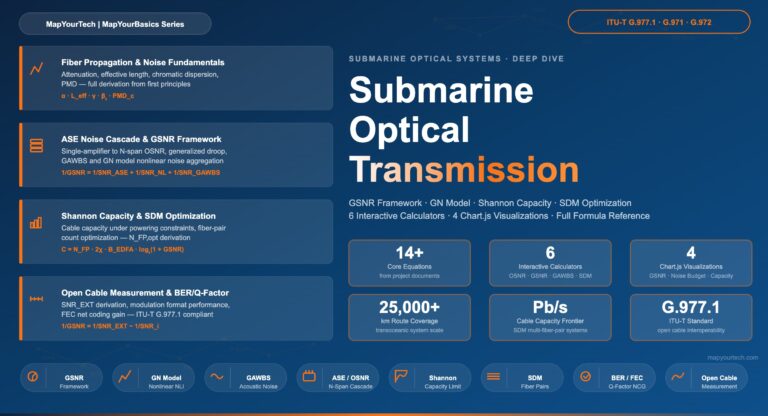
Multi-span optical transmission systems represent the backbone of global telecommunications infrastructure, enabling the reliable transmission of terabits per second across transoceanic distances spanning thousands of kilometers. The design methodology for these systems demands rigorous engineering analysis, balancing numerous competing parameters including optical signal-to-noise ratio (OSNR), nonlinear impairments, power management, amplifier spacing, and economic constraints.
Modern submarine cable systems face unprecedented capacity demands driven by cloud computing, video streaming, and emerging 5G/6G applications. A typical trans-Pacific cable system may traverse 10,000 kilometers with 200+ optical amplifiers, each introducing amplified spontaneous emission (ASE) noise while simultaneously enabling signal regeneration. The accumulated noise, combined with fiber nonlinearities such as self-phase modulation (SPM), cross-phase modulation (XPM), and four-wave mixing (FWM), creates a complex optimization landscape that determines ultimate system performance.
This deep dive examines the advanced engineering principles underlying multi-span link design, focusing on the mathematical frameworks, physical phenomena, and practical optimization strategies that enable modern submarine systems to achieve capacities exceeding 20 Tb/s per fiber pair over transoceanic distances. We explore the evolution from traditional OSNR-based design to generalized signal-to-noise ratio (GSNR) methodologies that account for all signal impairments in a unified framework.
Figure 1: Multi-Span Submarine Cable System Architecture
Complete system showing transmitter, multiple fiber spans with repeaters, and receiver across transoceanic distance
Why Multi-Span Design is Critical
In submarine systems, the cumulative effect of 200+ amplifiers means that a 0.5 dB improvement in amplifier noise figure translates to 0.5 dB better end-to-end OSNR, potentially enabling 10-15% higher spectral efficiency and representing hundreds of millions of dollars in additional capacity revenue over the cable's 25-year lifespan.
1. Mathematical Foundations of Multi-Span Design
1.1 Classical OSNR Accumulation Model
The fundamental equation governing OSNR evolution in a multi-span amplified system derives from the additive nature of amplified spontaneous emission (ASE) noise. For a cascade of N identical amplifiers, each with gain G compensating for span loss and noise figure NF, the output OSNR can be expressed in the canonical form that has guided submarine system design for decades.
OSNR Calculation for Multi-Amplifier Cascades
The classical OSNR formula for a chain of N identical amplifiers:
// OSNR in dB at reference bandwidth Bref = 0.1 nm (12.5 GHz)
OSNRout,dB = Pin,dBm − NFdB − 10 log10(N) − 10 log10(h ν Bref) + 58 dB
Where:
Pin = Input signal power per channel at each amplifier (dBm)
NF = Amplifier noise figure (dB), typically 4-6 dB for submarine EDFAs
N = Number of amplifiers in cascade
h = Planck's constant (6.626 × 10⁻³⁴ J·s)
ν = Optical frequency (~194 THz for 1550 nm)
Bref = Reference bandwidth (0.1 nm or 12.5 GHz)
// Alternative formulation showing noise accumulation:
1 / OSNRout = 1 / OSNRin + Σi=1N (ΔPASE,i / Pout,i)
This shows that inverse OSNR adds linearly, with each amplifier contributing noise
proportional to its ASE power divided by signal power.Read the Full Analysis with Premium
The remaining 80% of this article — the design numbers, trade-offs and field guidance — is part of MapYourTech Premium, along with the full premium library, courses and professional tools.
Optical Communications & Network Automation Expert | Author of 3 Books for Optical Engineers | Founder, MapYourTech
Optical networking engineer with nearly two decades of experience across DWDM, OTN, coherent optics, submarine systems, and cloud infrastructure. Founder of MapYourTech. Read full bio →
Follow on LinkedInRelated Articles on MapYourTech
You May Also Like
-
Free
-
July 11, 2026
-
Free
-
July 11, 2026
-
Free
-
July 11, 2026
Course Title
Course description and key highlights