
ROADMs Explained: Wavelength Flexibility and Network Reconfigurability
A Comprehensive Visual Guide to Reconfigurable Optical Add-Drop Multiplexers, Wavelength Selective Switches (WSS), and Dynamic Network Management
1. Introduction to ROADMs and Wavelength Flexibility
Modern optical networks face unprecedented demands for bandwidth, flexibility, and rapid service provisioning. As data traffic continues to grow exponentially driven by cloud computing, 5G services, video streaming, and emerging AI applications, network operators require solutions that can adapt dynamically to changing traffic patterns without manual intervention or service disruption. Reconfigurable Optical Add-Drop Multiplexers (ROADMs) have emerged as the cornerstone technology enabling this network agility.
A ROADM is a critical component in Dense Wavelength Division Multiplexing (DWDM) networks that provides the capability to dynamically add, drop, or pass through individual wavelengths at network nodes without requiring optical-electrical-optical (OEO) conversion. This flexibility represents a fundamental shift from fixed optical networks to programmable photonic infrastructures that can adapt in real-time to network demands.
Why ROADMs are critical in 2025
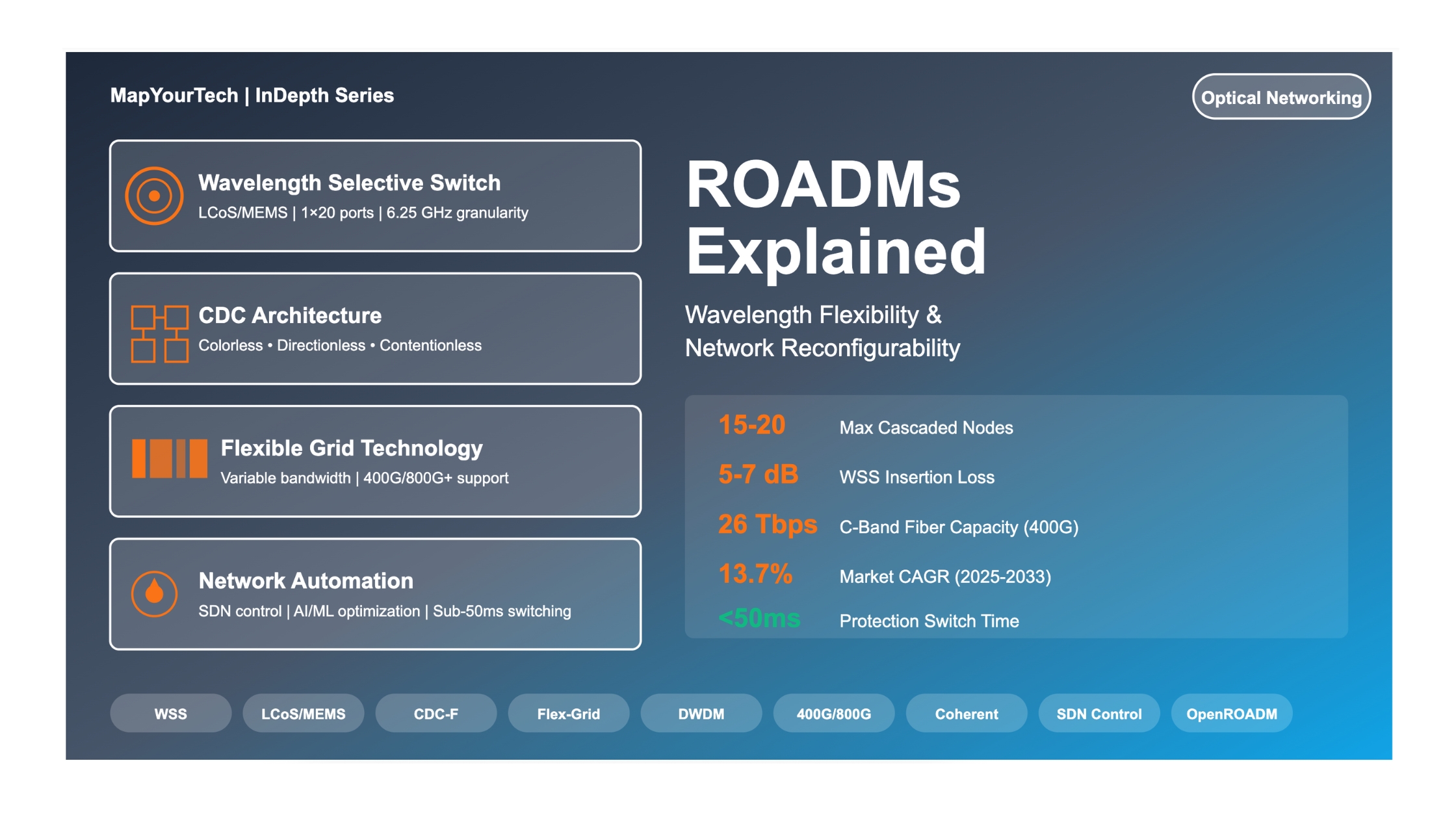
The global ROADM WSS component market is projected to grow from USD 1.08 billion in 2025 to USD 3.02 billion by 2033, at a CAGR of 13.7%. This growth is driven by increasing demand for high-capacity data center interconnects, 5G backhaul/fronthaul networks, metro/long-haul optical transport, and cloud service expansion. ROADMs enable network operators to reduce operational expenses, accelerate service delivery, and build resilient, scalable networks that can accommodate future technology upgrades.
ROADM System Overview: Dynamic Wavelength Management
This diagram illustrates how a ROADM enables flexible wavelength routing at network nodes, allowing dynamic add/drop of specific wavelengths without affecting pass-through traffic.
Read the Full Analysis with Premium
The remaining 83% of this article — the design numbers, trade-offs and field guidance — is part of MapYourTech Premium, along with the full premium library, courses and professional tools.