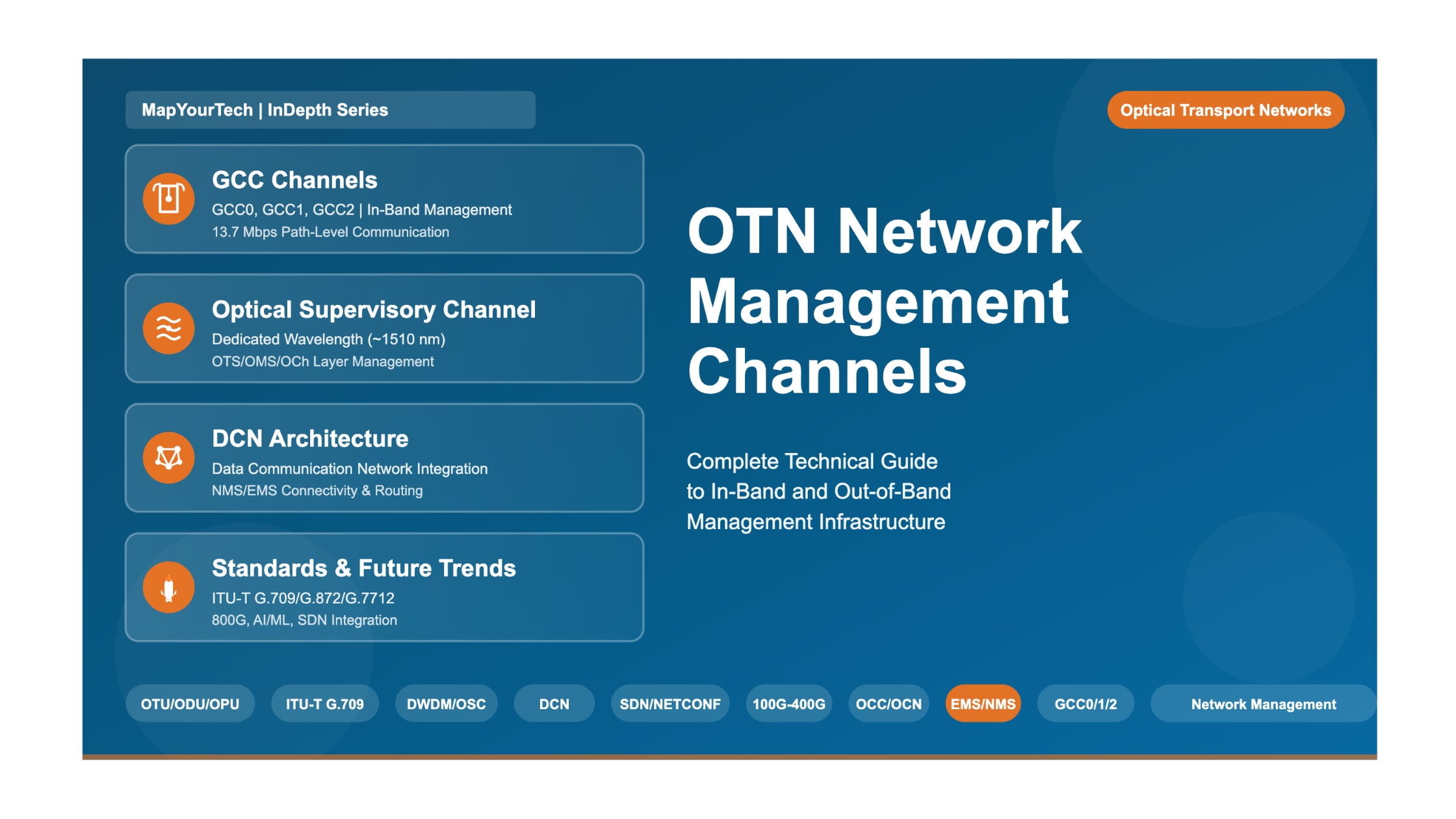

OTN Network Management Channels
Complete Technical Guide for Optical Network Professionals
Introduction
In modern optical transport networks, the ability to effectively manage, monitor, and control network elements is fundamental to ensuring reliable service delivery and optimal network performance. OTN (Optical Transport Network) provides a sophisticated framework for network management through dedicated communication channels embedded within the transport infrastructure itself.
Network management channels in OTN serve as the nervous system of the optical transport network, enabling critical functions such as performance monitoring, fault detection, configuration management, and protection switching coordination. These in-band and out-of-band communication pathways ensure that network operators maintain complete visibility and control over their optical infrastructure, from individual network elements to end-to-end service paths.
This comprehensive guide explores the architecture, functionality, and practical implementation of OTN network management channels, including General Communication Channels (GCC0, GCC1, GCC2), the Optical Supervisory Channel (OSC), Overhead Communication Channels (OCC), and their integration with Data Communication Networks (DCN). Understanding these management mechanisms is essential for network engineers, architects, and operations personnel involved in designing, deploying, and maintaining modern optical transport networks.
Importance of Network Management Channels
Network management channels provide the foundation for automated network operations, rapid fault isolation, and dynamic service provisioning. They enable carrier-grade reliability metrics such as 99.999% availability while supporting diverse client services ranging from enterprise Ethernet to data center interconnect and 5G mobile backhaul.
OTN Network Management Architecture Overview
Comprehensive view of management channels across OTN layers
Historical Context & Evolution
The evolution of network management channels in optical transport networks reflects the broader transformation of telecommunications from circuit-switched voice networks to packet-based data networks supporting diverse applications and services.
From SONET/SDH to OTN
Traditional SONET/SDH networks utilized Data Communication Channels (DCC) embedded in the Section Overhead (SOH) bytes for element management and protection switching coordination. The D1-D3 bytes in Regenerator Section Overhead and D4-D12 bytes in Multiplex Section Overhead provided approximately 192 Kbps and 576 Kbps bandwidth respectively for management purposes.
While adequate for synchronous TDM networks, these DCC channels faced limitations as networks evolved:
- Insufficient bandwidth for managing higher-capacity wavelengths (40G, 100G, 400G)
- Limited scalability in DWDM environments with multiple wavelengths per fiber
- Lack of flexibility for packet-based service management
- No provisions for multi-layer optical networking (OCh, OMS, OTS)
OTN Standardization (2001-Present)
The ITU-T developed the OTN standards (G.709 series) starting in 2001 to address the requirements of next-generation optical networks. Key standardization milestones include:
| Year | Standard/Event | Management Channel Impact |
|---|---|---|
| 2001 | ITU-T G.872 - OTN Architecture | Defined optical layer management framework (OCh, OMS, OTS) |
| 2003 | ITU-T G.709 v1.0 | Introduced GCC0, GCC1, GCC2 channels; OTU1/2/3 rates |
| 2009 | ITU-T G.709 Amendment 3 | Enhanced TCM support (6 levels); APS/PCC improvements |
| 2012 | ITU-T G.709 v3.0 | OTU4 (100G) support; ODUflex for sub-wavelength services |
| 2016 | ITU-T G.709 v5.0 | Beyond 100G (OTUCn); FlexO interfaces |
| 2020 | ITU-T G.709 v6.0 | 400G support (OTUC4); enhanced OSMC for timing |
| 2024-2025 | Ongoing Evolution | 800G standardization; AI/ML integration for network automation |
Modern Trends and Future Directions
As of 2024-2025, OTN network management channels continue to evolve to support emerging requirements:
AI-Driven Network Operations
Machine learning algorithms leverage management channel data for predictive maintenance, automated fault diagnosis, and intelligent traffic optimization.
Enhanced Security
Management channel encryption, authentication enhancements, and protection against cyber threats targeting network control plane.
Sub-Millisecond Coordination
Ultra-low latency protection switching and real-time telemetry for mission-critical applications including 5G transport and financial services.
SDN Integration
Seamless integration with Software-Defined Networking controllers via standard interfaces (OpenFlow, NETCONF, gNMI) for programmable optical networks.
Legacy Network Migration
Many operators face the challenge of migrating SDH/SONET management systems to OTN while maintaining backward compatibility. Cross-vendor DCC passthrough capabilities (demonstrated by ZTE and China Mobile in 2022) enable phased migration strategies that preserve existing management infrastructure during OTN deployment.
Core Concepts & Fundamentals
OTN Frame Structure and Overhead
The OTN frame structure provides a hierarchical organization of overhead bytes dedicated to network management and monitoring. Understanding this structure is fundamental to comprehending how management channels operate.
An OTN frame consists of 4 rows and 4080 columns, organized into distinct areas:
- Frame Alignment Signal (FAS): 6 bytes for frame synchronization (pattern: F6F6F6282828 hex)
- Multi-Frame Alignment Signal (MFAS): 1 byte providing a 256-frame counter
- Section Monitoring (SM): 3 bytes for OTU-level BIP-8, TTI, BEI, BDI
- General Communication Channels: GCC0 (2 bytes), GCC1/GCC2 (4 bytes total)
- Path Monitoring (PM): 3 bytes for ODU-level error detection and performance
- Tandem Connection Monitoring (TCM): 27 bytes across 6 TCM levels
Read the Full Analysis with Premium
The remaining 80% of this article — the design numbers, trade-offs and field guidance — is part of MapYourTech Premium, along with the full premium library, courses and professional tools.

Optical Communications & Network Automation Expert | Author of 3 Books for Optical Engineers | Founder, MapYourTech
Optical networking engineer with nearly two decades of experience across DWDM, OTN, coherent optics, submarine systems, and cloud infrastructure. Founder of MapYourTech. Read full bio →
Follow on LinkedInRelated Articles on MapYourTech
You May Also Like
-
Free
-
July 11, 2026
-
Free
-
July 11, 2026
-
Free
-
July 11, 2026