
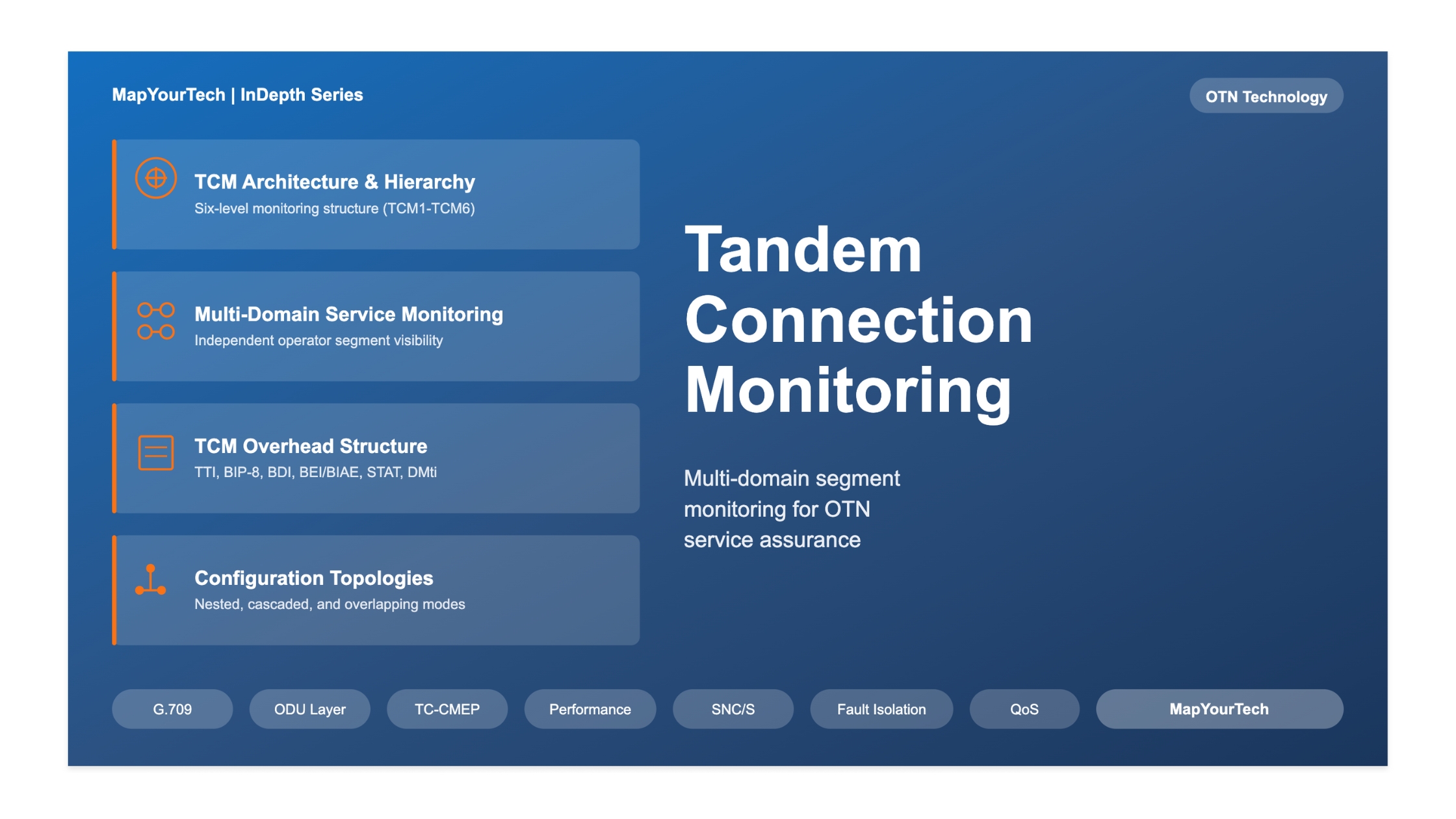
Tandem Connection Monitoring in Optical Transport Networks
Introduction
Modern optical transport networks frequently span multiple administrative domains, with end-to-end services traversing networks operated by different carriers, service providers, and enterprise organizations. This multi-domain reality creates significant operational challenges for service assurance, fault localization, and quality of service verification. When a service spans three network operators and a service provider, determining which segment is responsible for performance degradation becomes a complex task without proper monitoring mechanisms.
Tandem Connection Monitoring (TCM) addresses this fundamental challenge by enabling independent performance monitoring of specific segments within an end-to-end Optical Data Unit (ODU) connection. TCM provides each operator with the ability to monitor their network segment's performance without interfering with other operators' monitoring activities or with the end-to-end path monitoring. This capability is essential for multi-operator service delivery, service level agreement enforcement, and rapid fault isolation in complex network topologies.
Important: TCM is defined in ITU-T G.709 as part of the OTN ODU overhead structure. It provides up to six independent monitoring levels (TCM1 through TCM6), each capable of monitoring a distinct segment of an ODU connection. This hierarchical monitoring structure supports nested, cascaded, and overlapping monitoring configurations to accommodate diverse operational requirements.
Background and Context
The Optical Transport Network (OTN) provides a comprehensive digital wrapper around client signals, enabling efficient multiplexing, switching, and transport across optical infrastructure. Within the OTN hierarchy, the ODU layer serves as the path layer where electrical switching and cross-connection occur. While the ODU path monitoring (PM) overhead provides end-to-end performance monitoring from source to destination, real-world service delivery often requires monitoring specific segments within this end-to-end path.
The Need for Segment Monitoring
Several operational scenarios drive the requirement for segment-level monitoring beyond end-to-end path monitoring. In wholesale optical services, a service provider leases capacity from multiple network operators to deliver end-to-end connectivity. Each operator needs visibility into their network segment's performance to meet their contractual obligations, while the service provider requires visibility across operator boundaries. Similarly, when enterprises connect geographically distributed data centers through services from multiple carriers, they need to monitor their contracted service quality independently of how carriers monitor their internal network segments.
Protection switching mechanisms add another dimension to monitoring requirements. ODU subnetwork connection protection (SNC) schemes require monitoring at the sublayer level to detect signal fail and signal degrade conditions that trigger protection switches. TCM provides the monitoring infrastructure for these protection mechanisms, enabling rapid detection of fault conditions within specific network segments.
OTN Frame Structure Context
TCM functionality is embedded within the ODU overhead structure. The ODU frame consists of a 4-row by 3824-column structure, with the first 14 columns dedicated to overhead. TCM overhead occupies specific locations within rows 2 and 3 of this overhead area. This placement ensures that TCM monitoring occurs at the ODU layer, independent of the underlying optical channel transport unit (OTU) section monitoring and the client payload type.
TCM Architecture and Design
TCM Hierarchical Structure
The OTN standard defines six TCM levels numbered TCM1 through TCM6. Each level provides a complete set of monitoring capabilities equivalent to path monitoring, including trail trace identification, error detection, defect indication, and performance monitoring. This six-level hierarchy enables monitoring of up to six independent segments along a single ODU connection.
Read the Full Analysis with Premium
The remaining 88% of this article — the design numbers, trade-offs and field guidance — is part of MapYourTech Premium, along with the full premium library, courses and professional tools.
You May Also Like
-
Free
-
September 4, 2026
-
Premium
-
September 4, 2026
-
Premium
-
September 4, 2026