SMART Cable Architecture:
Sensors, Repeaters, and Data Links
A Comprehensive Visual Guide to Science Monitoring And Reliable Telecommunications Systems
Introduction
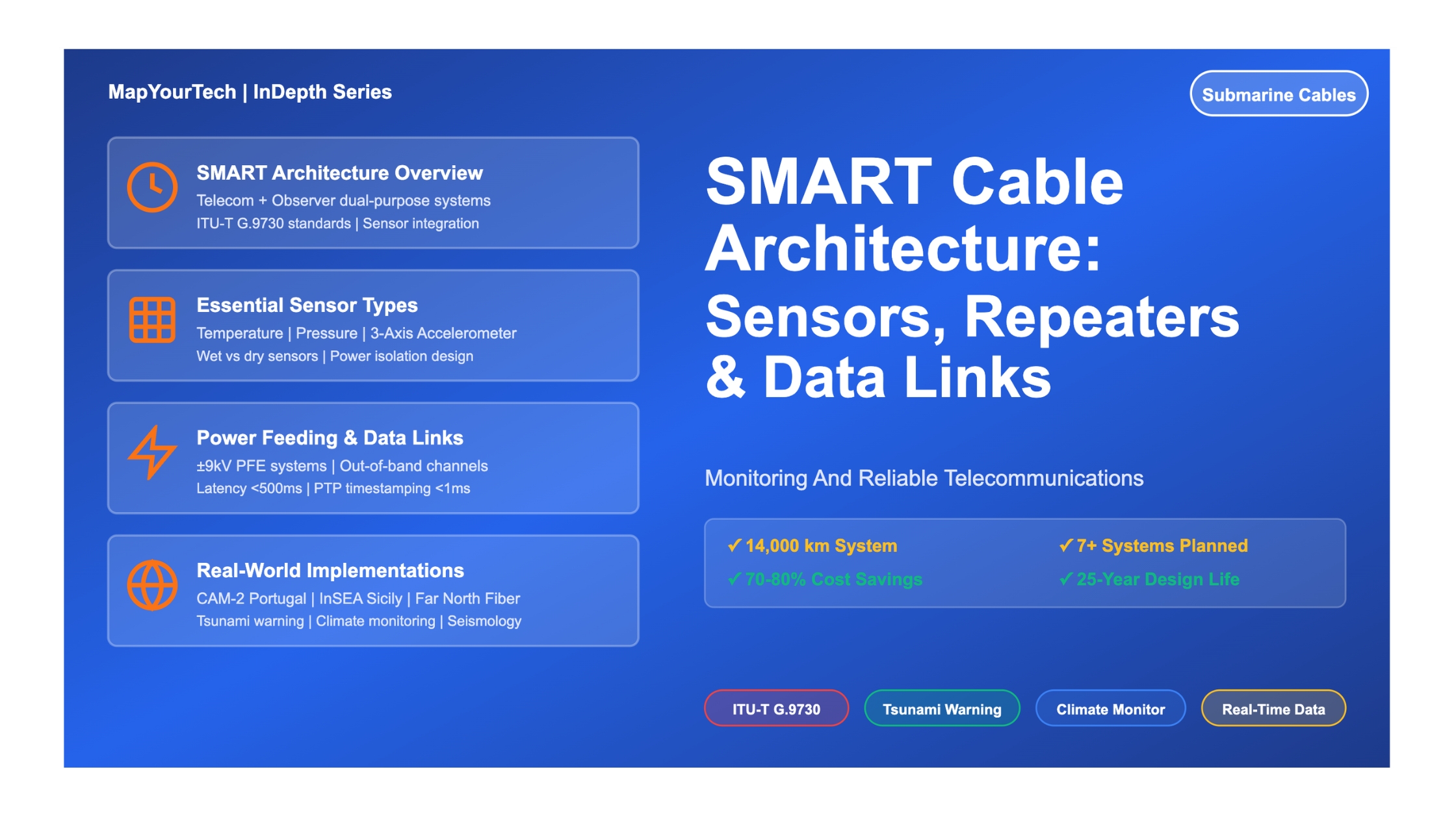
SMART (Science Monitoring And Reliable Telecommunications) cables represent a transformative approach to submarine cable infrastructure, integrating environmental sensors into commercial telecommunications systems. This dual-purpose architecture combines the robust, globe-spanning telecommunication networks with critical scientific monitoring capabilities, enabling real-time observation of seismic events, tsunamis, ocean temperature, and sea level changes.
As of latest , SMART cable technology has advanced from concept to reality, with multiple systems deployed and operational worldwide. The initiative, led by a Joint Task Force (JTF) comprising the International Telecommunications Union (ITU), World Meteorological Organization (WMO), and the Intergovernmental Oceanographic Commission (IOC) of UNESCO, is revolutionizing deep ocean observing at a modest incremental cost compared to dedicated scientific cable systems.
Why SMART Cables Are Important
The ocean plays a vital role in regulating Earth's climate and supporting life, yet it remains largely unmonitored. SMART cables address this gap by:
- Climate Monitoring: Continuous measurement of ocean heat content, circulation patterns, and temperature profiles to better understand climate change
- Tsunami Early Warning: Real-time pressure and seismic data enable faster, more accurate tsunami detection and warning, potentially saving thousands of lives
- Earthquake Detection: Three-axis accelerometers detect seismic activity in the deep ocean, extending global seismic networks where land-based stations cannot reach
- Sea Level Rise Monitoring: Precise pressure measurements track long-term sea level changes, crucial for coastal planning and climate adaptation
- Cost Efficiency: Leveraging existing telecommunications infrastructure reduces costs by 70-80% compared to dedicated scientific observatories
Real-World Impact: The InSEA Wet Demonstration Project, deployed in December 2023 off Sicily, Italy, has successfully validated SMART cable technology with 21 km of cable carrying accelerometers, seismometers, temperature, and pressure sensors, providing real-time data for earthquake and volcanic monitoring.
SMART Cable System Overview
Complete architecture showing sensors, repeaters, data links, and shore infrastructure
Historical Context & Evolution
The concept of using submarine telecommunications cables for scientific monitoring emerged in the late 1990s, with early projects demonstrating feasibility using retired analog coaxial cable systems. The evolution toward modern SMART cables reflects decades of technological innovation, international collaboration, and growing recognition of the ocean's role in climate and hazard monitoring.
SMART Cable Technology Timeline
Key milestones from concept to worldwide deployment (1997-2025)
Key Evolutionary Milestones
- 1997-2003: Early demonstrations using retired coaxial cables (GeO-TOC, H2O, ACO) proved technical feasibility but faced funding limitations
- 2010: Yuzhu You's Nature paper "Harnessing telecoms cables for science" catalyzed international interest and led to UN engagement
- 2012-2019: UN Joint Task Force established framework, standards development began with ITU-T G.9730 series recommendations
- 2020-2023: First commercial SMART systems approved with government funding, technical specifications finalized
- 2023-2025: InSEA wet demonstration validates sensor performance, CAM-2 system enters service, Far North Fiber (14,000 km with 150 repeaters) begins marine survey
- 2025-2030: Projected expansion to 7+ systems in planning, integration with Argo floats and DART buoys for comprehensive ocean observing network
Read the Full Analysis with Premium
The remaining 88% of this article — the design numbers, trade-offs and field guidance — is part of MapYourTech Premium, along with the full premium library, courses and professional tools.