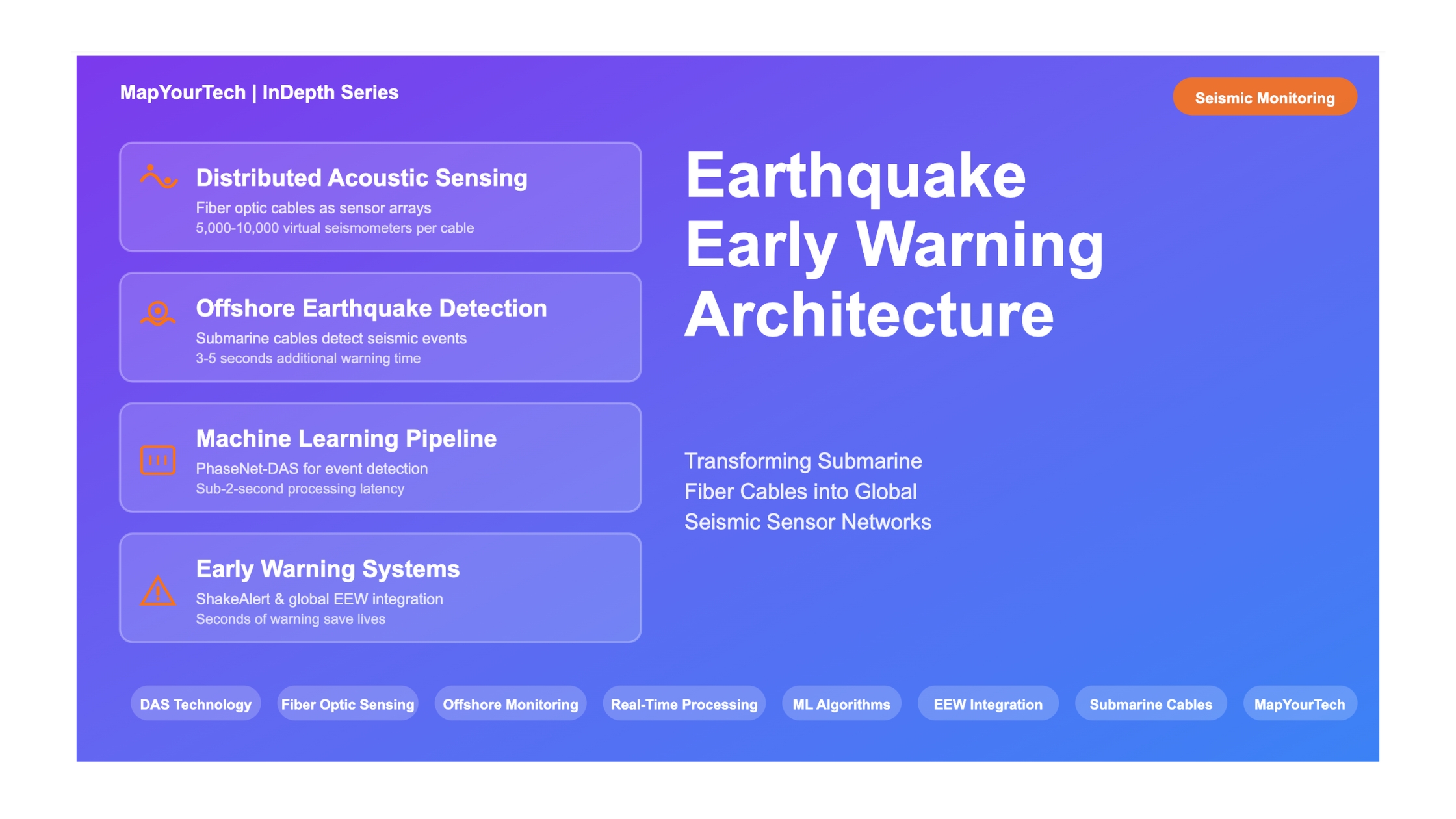
Earthquake Early Warning System Architecture
Transforming Submarine Fiber Optic Cables into Global Seismic Sensor Networks using Distributed Acoustic Sensing (DAS) Technology
Introduction
Earthquake Early Warning (EEW) systems represent one of the most critical advances in seismic hazard mitigation, providing precious seconds to tens of seconds of warning before destructive seismic waves arrive. However, a fundamental challenge has persisted: the vast majority of the world's most seismically active regions lie offshore along subduction zones and oceanic plate boundaries, where traditional seismometer networks cannot be economically deployed. This infrastructure gap leaves coastal populations vulnerable to earthquakes that originate beneath the ocean floor, with no advance warning before waves reach land-based sensors.
The convergence of telecommunications infrastructure and seismological innovation has produced a transformative solution. Submarine fiber optic cables, which form the backbone of global internet connectivity, can be converted into dense arrays of seismic sensors using Distributed Acoustic Sensing (DAS) technology. This approach leverages existing telecommunications infrastructure to create what amounts to thousands of virtual seismometers along a single cable, dramatically expanding offshore earthquake monitoring capabilities without requiring expensive dedicated deployments.
This comprehensive guide explores the architecture, technology, and implementation of fiber-optic-based earthquake early warning systems. From the fundamental physics of how light pulses in optical fibers detect ground motion, to the sophisticated algorithms that process terabytes of data in real-time, we examine every aspect of this revolutionary approach to seismic monitoring. The guide synthesizes recent research breakthroughs from 2023-2025, including the deployment of operational EEW systems using submarine cables in Chile, California's Monterey Bay, and other seismically active regions.
Earthquake Early Warning System Overview
Comprehensive system architecture showing submarine cable, DAS interrogator, and alert dissemination
The Offshore Monitoring Challenge
Traditional earthquake early warning systems rely on dense networks of seismometers deployed on land. While these systems have proven effective for onshore earthquakes, they face fundamental limitations when earthquake epicenters lie offshore. Consider the Cascadia subduction zone along the Pacific Northwest coast of North America, the South American subduction zone where the largest recorded earthquake (magnitude 9.4-9.6) occurred in 1960, or the Japan Trench where the devastating 2011 Tohoku earthquake originated. In all these cases, the seismic source lies tens to hundreds of kilometers offshore, and seismic waves must travel through the ocean to reach land-based sensors before an alert can be issued.
The time lost waiting for seismic waves to reach land-based sensors is critical. For coastal cities near offshore faults, this delay can consume most or all of the potential warning time. A magnitude 7.0 earthquake occurring 50 kilometers offshore might generate only 5-10 seconds of warning time with land-based sensors, whereas offshore sensors could provide 15-20 seconds—enough time for automated systems to shut down critical infrastructure, stop trains, and alert populations through mobile devices.
The Fiber Optic Solution
Submarine fiber optic cables already connect continents and islands, forming a global network of more than 1.4 million kilometers of underwater cables with over 1,500 cable landing stations worldwide. These cables, deployed primarily for telecommunications, traverse precisely the offshore regions where earthquake monitoring is most needed. Distributed Acoustic Sensing transforms each fiber into an array of thousands of virtual sensors, detecting ground motion through minute changes in light scattering patterns within the fiber.
Read the Full Analysis with Premium
The remaining 88% of this article — the design numbers, trade-offs and field guidance — is part of MapYourTech Premium, along with the full premium library, courses and professional tools.