
Generic selectors
Exact matches only
Search in title
Search in content
Post Type Selectors
Articles
lp_course
lp_lesson
Back
HomeCoherent OpticsAdvanced Deep Dive: SDM Fiber Types
Advanced Deep Dive: SDM Fiber Types

Advanced Deep Dive: SDM Fiber Types

Last Updated: April 2, 2026
22 min read
123
Advanced Deep Dive: SDM Fiber Types - MCF, FMF, and Hollow-Core Comparison | MapYourTech
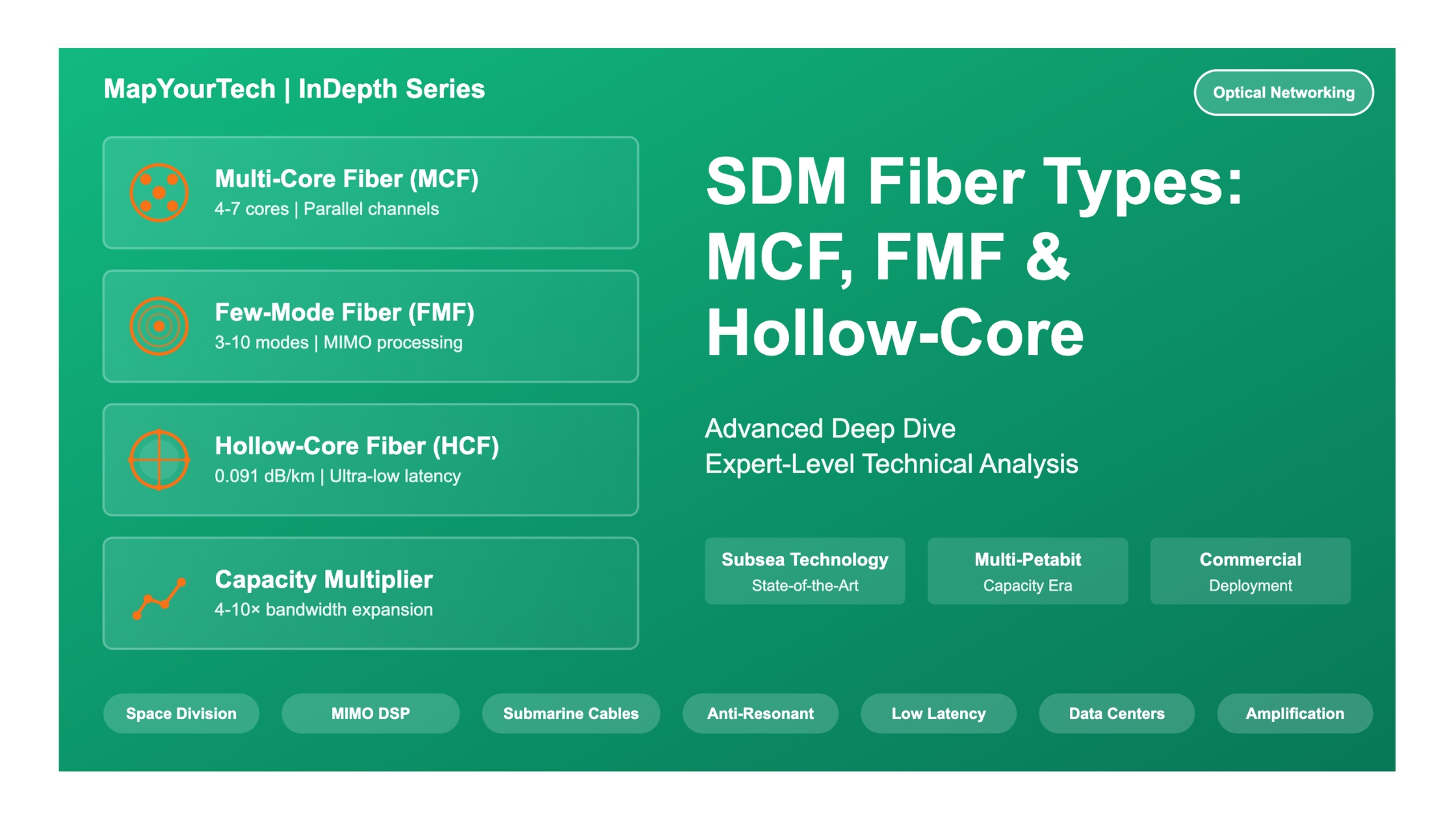
Advanced Deep Dive: SDM Fiber Types - Image 1

Advanced Deep Dive: SDM Fiber Types

Multi-Core Fiber (MCF), Few-Mode Fiber (FMF), and Hollow-Core Fiber (HCF) Comprehensive Technical Analysis

1. Introduction

The exponential growth of global data traffic, driven by cloud computing, artificial intelligence, 5G/6G networks, and ultra-high-definition content distribution, has pushed conventional single-mode fiber (SMF) technology to its fundamental capacity limits. According to Cisco's projections, global IP traffic reached 3.3 zettabytes per year in 2023, with an annual growth rate of 29%. This relentless demand has catalyzed intensive research into Space Division Multiplexing (SDM) as the next frontier in optical fiber communications.

Space Division Multiplexing represents a fundamental shift in optical network architecture by exploiting the spatial dimension of optical fibers to create multiple parallel transmission channels within a single fiber structure. Unlike traditional multiplexing techniques that exhausted temporal (TDM), spectral (WDM), polarization (PDM), and phase/amplitude domains, SDM offers a path to multiply fiber capacity by factors ranging from 4× to over 100× depending on the implementation approach.

This advanced technical analysis examines three primary SDM fiber technologies that have matured from laboratory demonstrations to field deployment consideration: Multi-Core Fiber (MCF), Few-Mode Fiber (FMF), and Hollow-Core Fiber (HCF). Each technology offers distinct advantages and faces unique engineering challenges in terms of manufacturing complexity, crosstalk management, amplification strategies, and integration with existing optical infrastructure.

The Capacity Crisis and Shannon Limit Approaching

Standard single-mode fiber has served as the backbone of global telecommunications for over four decades, with continuous improvements in digital signal processing (DSP), modulation formats, and wavelength division multiplexing (WDM) extending its capacity. However, fundamental physical limitations are now being approached. The Shannon-Hartley theorem dictates that channel capacity is bounded by the signal-to-noise ratio (SNR) and available bandwidth. With C-band and L-band DWDM systems already deployed extensively, and nonlinear effects limiting launch power, the industry faces what researchers term the "capacity crunch."

Modern submarine cable systems deploying 24 fiber pairs with state-of-the-art 400G/800G transponders achieve 500-600 Tb/s capacity on transatlantic routes and 300-400 Tb/s on transpacific links. However, forecasts for AI-driven applications demand 1 Petabit/s cables by 2030 and multi-Petabit systems by 2035. This 2-3× capacity gap within five years cannot be bridged by incremental improvements to existing fiber technology alone.

Why Space Division Multiplexing Now?

SDM was initially proposed in the early 1980s but remained largely unexplored because single-mode fiber easily met network capacity requirements in a cost-efficient manner. Several factors have converged to make SDM viable and necessary in 2025:

  • Power Efficiency Crisis: Increasing fiber count requires proportionally more electrical power for amplification. SDM systems operating at lower spectral efficiencies but with massive parallelism offer better watts-per-bit performance.
  • Manufacturing Maturity: Advances in fiber drawing, core positioning accuracy, and cladding structure control have made complex fiber geometries commercially producible.
  • DSP Capabilities: Modern ASICs can perform real-time MIMO processing for coupled-mode SDM systems at multi-terabit aggregate data rates.
  • Economic Pressure: Cable installation and maintenance costs dominate submarine systems. Maximizing bits-per-cable justifies higher per-fiber costs.

Figure 1.1: Space Division Multiplexing Concept Overview

Comparison of traditional single-mode fiber vs. three SDM approaches

Standard SMF Single Core 125μm Cladding Multi-Core Fiber 4-7 Cores 125μm Cladding Few-Mode Fiber 3-10 Modes Larger Core Hollow-Core Fiber Air Core Anti-Resonant Capacity Multiplier: 4-7× 3-10× 1× (faster) Key Advantage: Established Technology Parallel Channels MIMO Processing Low Latency Low Loss Main Challenge: Limited Crosstalk Mode Coupling Manufacturing

2. Historical Context and Evolution of SDM Technologies

Early Concepts (1979-2000)

The conceptual foundation for space division multiplexing emerged surprisingly early in the history of optical fiber communications. In 1979, Iano et al. at OFC (Optical Fiber Communication) first proposed multi-core optical fibers, recognizing that multiple cores within a single cladding could theoretically multiply transmission capacity. Shortly thereafter, in 1982, Berdagué and Facq published seminal work on mode division multiplexing in optical fibers in Applied Optics, demonstrating that higher-order spatial modes could serve as independent information channels.

However, these pioneering concepts remained largely theoretical for two decades. The telecommunications industry in the 1980s and 1990s was focused on perfecting single-mode fiber transmission, which offered sufficient capacity headroom through wavelength division multiplexing (WDM) expansion. The manufacturing complexity and lack of supporting component ecosystem made SDM economically unviable during this period.

Research Revival (2000-2010)

Interest in SDM rekindled in the early 2000s as researchers began projecting capacity exhaustion timelines for conventional fiber. Several factors converged to make SDM investigation practical:

  • Coherent Detection Renaissance: The commercialization of coherent detection around 2007 provided full field recovery capabilities necessary for MIMO processing.
  • DSP Advancement: Moore's Law progression enabled real-time multi-channel signal processing that was computationally infeasible in the 1980s.
  • Fabrication Improvements: Chemical vapor deposition (CVD) and modified chemical vapor deposition (MCVD) techniques achieved micron-level core positioning accuracy.

In 2009, Kokubun and Koshiba published influential work on multicore fiber design principles, establishing theoretical frameworks for mode coupling suppression and crosstalk management. This period saw initial transmission experiments demonstrating SDM feasibility over distances of a few kilometers.

Breakthrough Demonstrations (2010-2015)

The decade beginning in 2010 witnessed remarkable progress in SDM transmission experiments:

Premium Article — Free 20% Preview

Read the Full Analysis with Premium

The remaining 80% of this article — the design numbers, trade-offs and field guidance — is part of MapYourTech Premium, along with the full premium library, courses and professional tools.


Instant access · Cancel anytime · 48-hour trial available
Sanjay Yadav

Optical Communications & Network Automation Expert | Author of 3 Books for Optical Engineers | Founder, MapYourTech

Optical networking engineer with nearly two decades of experience across DWDM, OTN, coherent optics, submarine systems, and cloud infrastructure. Founder of MapYourTech.

Follow on LinkedIn

You May Also Like

15 min read 6 0 Like Connector Types and Their Loss Budgets: SC, LC, MPO Skip to main content MapYourTech...
  • Free
  • July 11, 2026
16 min read 6 0 Like Cooled vs Uncooled Lasers: The Pluggable Power Trade-off Skip to main content MapYourTech |...
  • Free
  • July 11, 2026
16 min read 8 0 Like Automation Blast Radius: Scoping What a Bad Intent Can Touch Skip to main content...
  • Free
  • July 11, 2026

Course Title

Course description and key highlights

Course Content

Course Details