
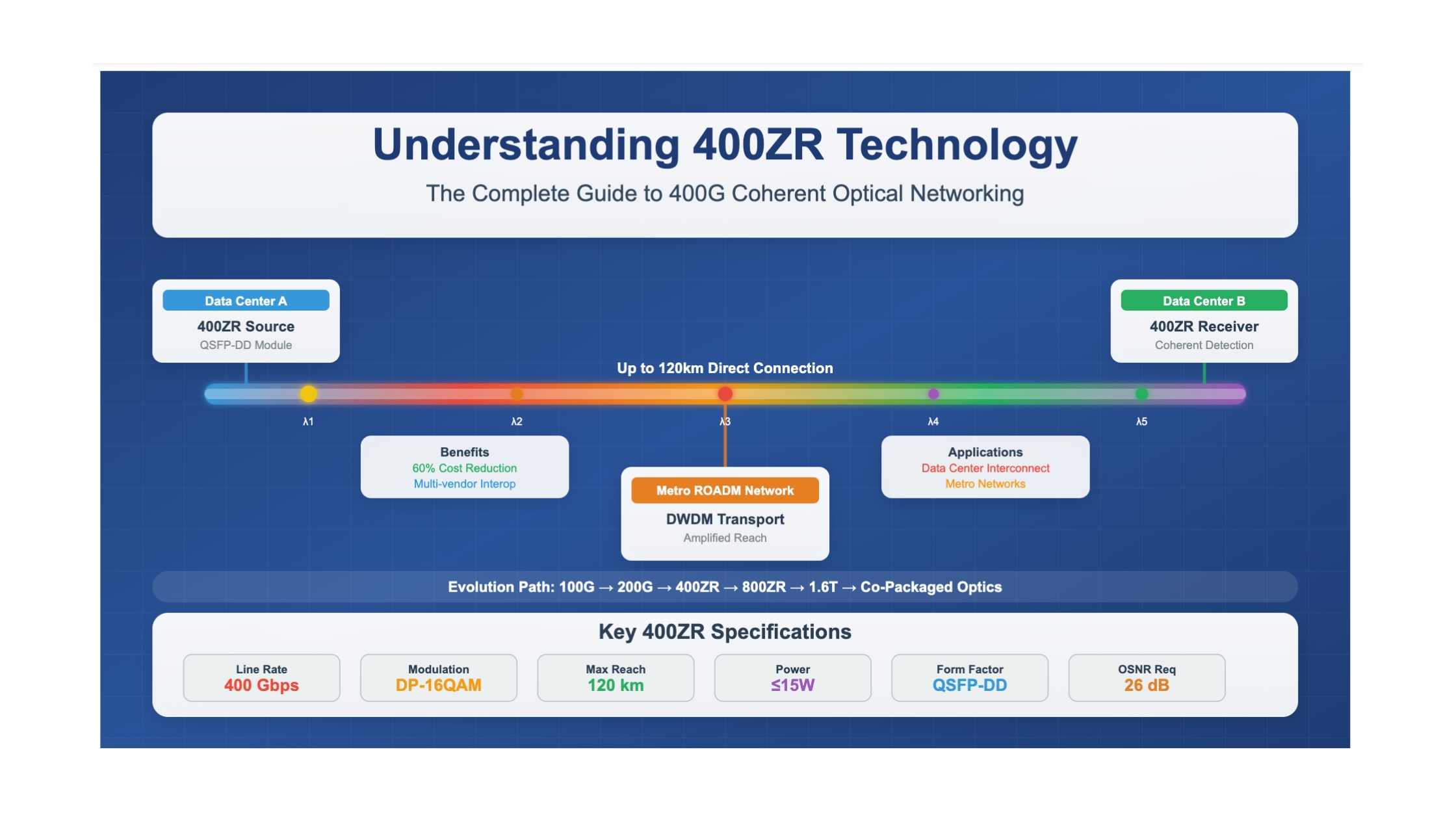
Executive Summary
400ZR represents a paradigm shift in optical networking, achieving 400 Gbps transmission over distances up to 120 km in compact, pluggable form factors. Market adoption has exceeded projections, with 400ZR becoming the most widely adopted coherent technology in history, driving significant cost reductions and enabling new network architectures.
The emergence of 400ZR coherent optical technology marks a transformative moment in telecommunications infrastructure, fundamentally altering how data centers interconnect and metro networks scale. Developed by the Optical Internetworking Forum (OIF) and standardized in March 2020, 400ZR addresses the critical need for high-capacity, cost-effective, and interoperable optical solutions in an era of exponential data growth.
This comprehensive analysis reveals that 400ZR's success stems from its unique positioning at the intersection of performance, cost, and operational simplicity. Unlike traditional coherent solutions requiring separate line systems, 400ZR integrates directly into router and switch platforms using standard QSFP-DD and OSFP form factors, eliminating architectural complexity while enabling IP over DWDM (IPoDWDM) implementations.
Market Impact and Adoption Trends
Market research indicates 400ZR and related ZR+ technologies accounted for over 50% of coherent optical deployments in 2024, with shipments growing at a compound annual growth rate exceeding 60%. Hyperscale operators including Microsoft, Google, and Meta have deployed thousands of 400ZR modules, demonstrating multi-vendor interoperability and validating the standard's commercial viability.
| Market Segment | 2024 Revenue | 2025 Projection | Growth Rate | Key Drivers |
|---|---|---|---|---|
| Data Center Interconnect | $600M | $960M | 60% | AI workloads, multi-site computing |
| Metro Networks | $240M | $360M | 50% | 5G backhaul, edge computing |
| Enterprise | $120M | $180M | 50% | Hybrid cloud adoption |
Read the Full Analysis with Premium
The remaining 80% of this article — the design numbers, trade-offs and field guidance — is part of MapYourTech Premium, along with the full premium library, courses and professional tools.
You May Also Like
-
Free
-
September 4, 2026
-
Premium
-
September 4, 2026
-
Premium
-
September 4, 2026