
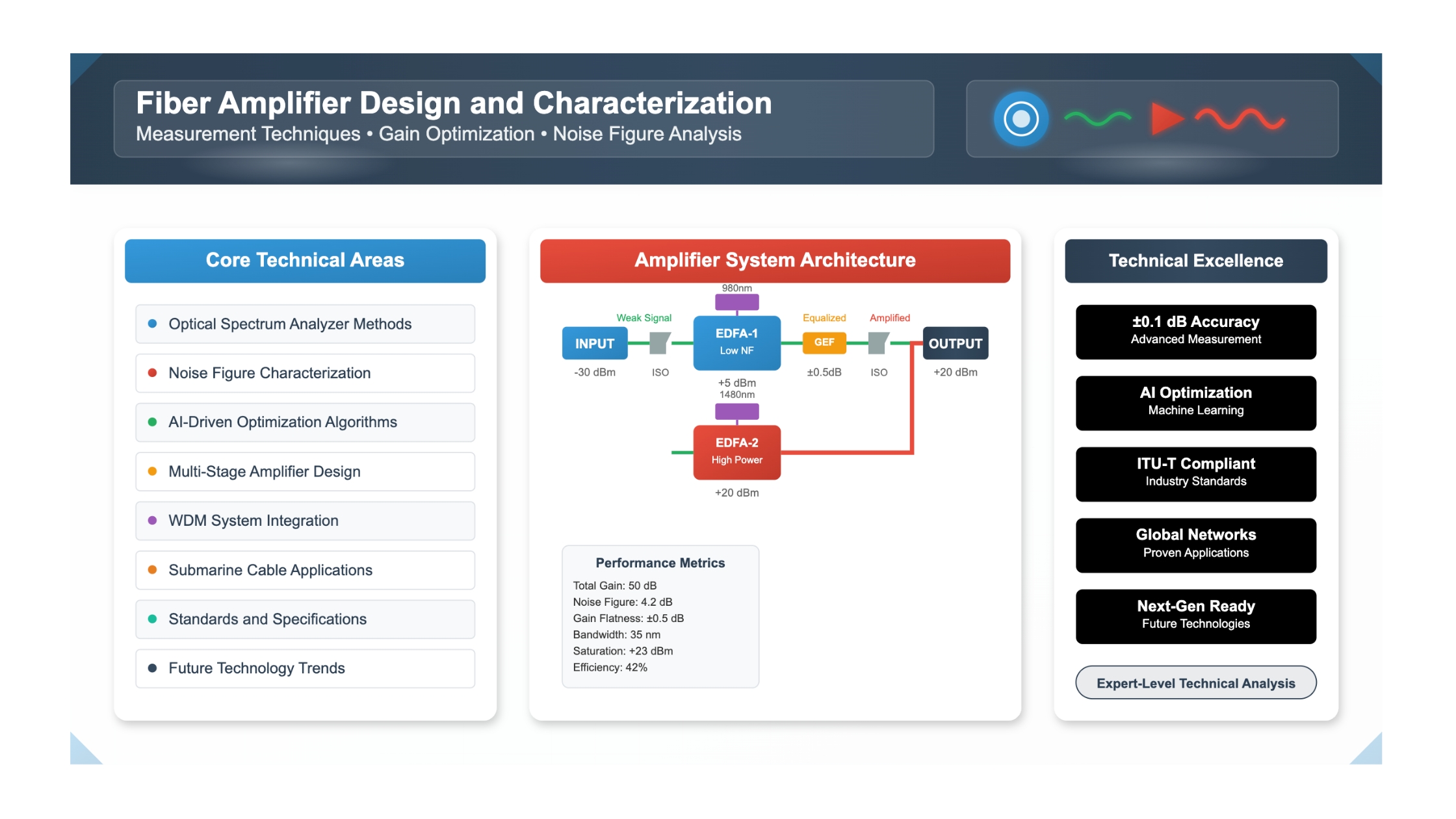
Fiber Amplifier Design and Characterization: Measurement Techniques, Gain Optimization, Noise Figure Analysis
Executive Summary
Fiber amplifiers, particularly erbium-doped fiber amplifiers (EDFAs), form the backbone of modern optical communication systems by enabling long-distance signal transmission with minimal degradation. Accurate characterization through precise gain and noise figure measurements is critical for optimal system performance, with emerging machine learning techniques revolutionizing traditional design optimization approaches.
This comprehensive technical analysis examines the fundamental principles, measurement methodologies, and optimization strategies for fiber amplifier design and characterization. [1-3] Key topics include spectral gain measurement techniques achieving ±0.3 dB accuracy, noise figure characterization methods spanning optical and electrical domains, and advanced optimization algorithms incorporating artificial intelligence for multi-parameter design spaces. The integration of machine learning approaches has demonstrated significant improvements in gain prediction accuracy, with recent studies achieving mean absolute errors below 0.1 dB across diverse operating conditions.
Historical Evolution and Foundational Principles
Development Timeline and Key Milestones
The development of fiber amplifiers represents one of the most transformative advances in optical communications technology. The journey began in the 1960s with early investigations into rare-earth-doped glass systems, but practical fiber amplifiers emerged only in the late 1980s when researchers demonstrated the first practical erbium-doped fiber amplifier (EDFA). This breakthrough coincided with the development of low-loss silica fibers and reliable semiconductor pump sources, creating the foundation for modern optical communication systems.
The critical insight was recognizing that erbium ions in silica glass exhibit an optical transition at 1.55 μm wavelength, precisely matching the minimum attenuation window of standard single-mode fiber. This fortuitous alignment enabled direct optical amplification without wavelength conversion, dramatically simplifying system architecture while enabling unprecedented transmission distances. [4,5]
Physics of Optical Amplification
Fiber amplifiers operate on the principle of stimulated emission within rare-earth-doped glass matrices. The amplification process involves three fundamental steps: pump absorption, population inversion, and stimulated emission. In erbium-doped systems, pump light at 980 nm or 1480 nm wavelengths excites erbium ions from the ground state (4I15/2) to higher energy levels, creating population inversion necessary for optical gain.
G(λ) = exp[∫₀ᴸ {g(λ,z) - α(λ)} dz]
Where:
• G(λ) = wavelength-dependent gain
• g(λ,z) = position and wavelength-dependent gain coefficient
• α(λ) = background fiber loss
• L = fiber length
The gain coefficient depends on the population inversion parameter n₂/(n₁ + n₂), where n₁ and n₂ represent the population densities of the ground and excited states, respectively. This relationship directly connects the microscopic quantum mechanical properties of erbium ions to the macroscopic amplifier performance.
Read the Full Analysis with Premium
The remaining 89% of this article — the design numbers, trade-offs and field guidance — is part of MapYourTech Premium, along with the full premium library, courses and professional tools.
You May Also Like

-
Free
-
September 4, 2026

-
Premium
-
September 4, 2026

-
Premium
-
September 4, 2026