 In-Depth Comparison Article
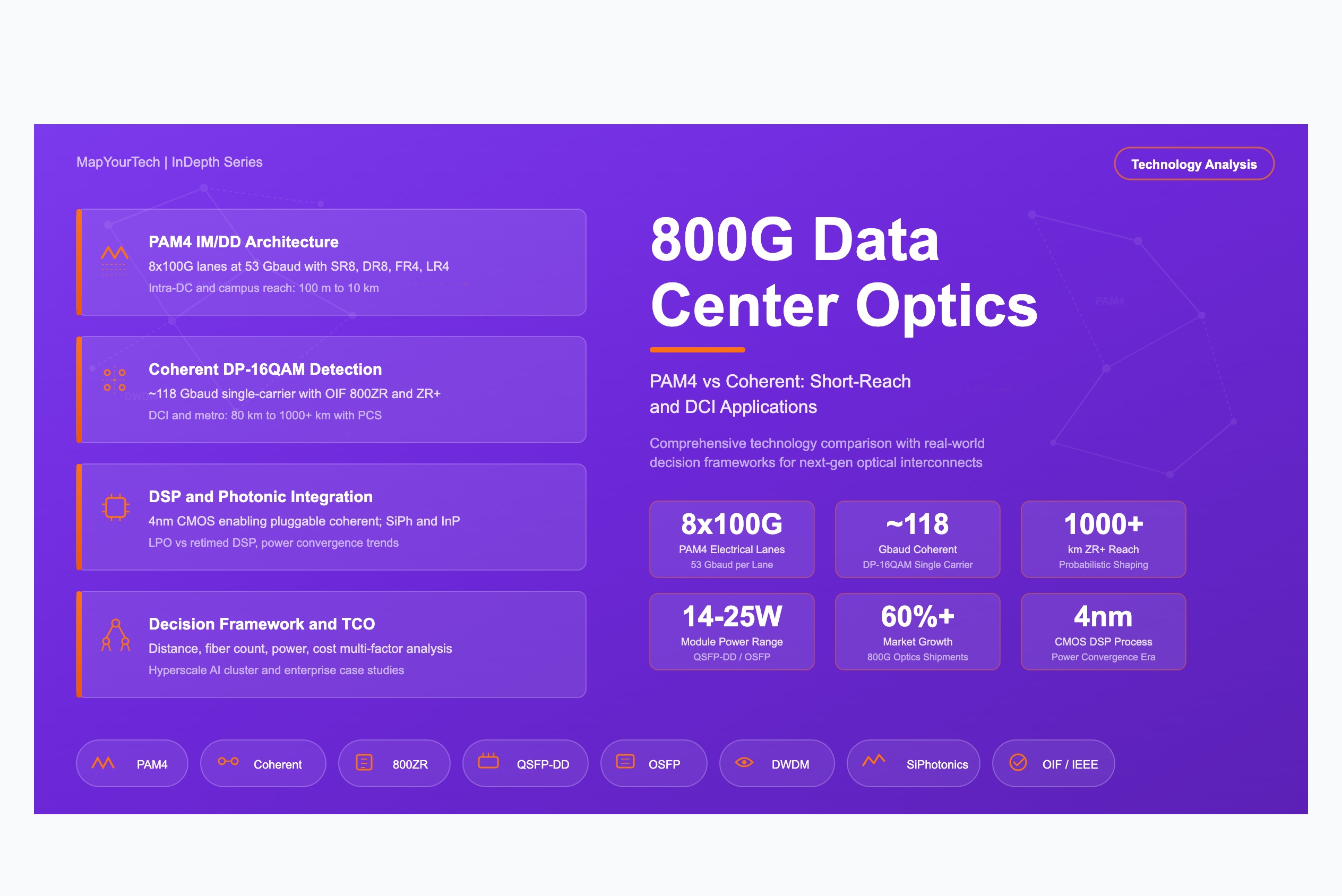
800G Data Center Optics: PAM4 vs Coherent for Short-Reach and DCI Applications
A comprehensive technical analysis of intensity-modulation and coherent detection technologies competing for dominance across data center interconnect distance regimes, from intra-rack to extended metro DCI
1. Introduction
The data center industry stands at a critical inflection point in optical interconnect technology. With 800G Ethernet emerging as the dominant speed grade for next-generation switch platforms and AI training fabrics, network architects face a fundamental decision: which modulation technology best serves their specific reach requirements, power budgets, and cost targets? The answer is no longer straightforward, as the traditional boundary between Pulse Amplitude Modulation 4-level (PAM4) intensity-modulation/direct-detection (IM/DD) and coherent detection continues to blur at the 800G generation.
Historically, PAM4 and coherent optics occupied distinctly separate application domains. PAM4-based transceivers dominated intra-data-center connectivity at distances up to 10 km, offering simplicity, low power consumption, and aggressive cost scaling. Coherent optics, with their sophisticated digital signal processing (DSP) and modulation of amplitude, phase, and polarization, owned the long-haul and metro transport segments where fiber impairment compensation and spectral efficiency were non-negotiable. However, the development of 400ZR pluggable coherent optics starting in 2020 fundamentally changed this landscape by bringing coherent technology into compact QSFP-DD and OSFP form factors suitable for data center routers and switches. As of 2025, with the OIF 800ZR Implementation Agreement released in October 2024 and multiple vendors shipping 800G coherent pluggables, the overlap between PAM4 and coherent reach envelopes has grown significantly.
This article provides a comprehensive, research-grade comparison of 800G PAM4 and 800G coherent technologies across all relevant data center application regimes. It examines the physics and engineering trade-offs behind each approach, analyzes real-world deployment considerations including power consumption, cost structures, fiber utilization, and scalability, and provides decision frameworks for architects planning next-generation data center networks. The analysis draws on the latest industry standards (IEEE 802.3ck/cu/df, OIF 800ZR, Open ROADM MSA v8.0), market data, and deployment experience from hyperscale and enterprise environments.
Scope of Analysis: This article covers 800G optical transceivers in QSFP-DD800, QSFP-DD, and OSFP form factors, examining PAM4 variants (SR8, DR8, FR8, 2xFR4, 2xLR4) and coherent variants (800ZR, 800G ZR+) across distances from 100 m to over 1000 km. Co-packaged optics (CPO) and linear-drive/LPO architectures are discussed as emerging alternatives that may influence future decisions.
2. Evolution of Data Center Optics: From 100G to 800G
2.1 The Journey to 800G: Standards and Industry Milestones
Understanding the current 800G landscape requires tracing the evolution of data center optical interconnects over the past decade. The transition from 100G to 400G, and now to 800G, was driven by successive doublings in switch ASIC SerDes lane rates, which in turn enabled higher aggregate port speeds without proportionally increasing lane counts or module complexity.
At 100G, the industry primarily relied on four-lane solutions using 25G NRZ (Non-Return-to-Zero) signaling per lane. The 100G-SR4, DR4, FR4, and LR4 standards represented a mature ecosystem with well-understood cost and power profiles. The transition to 400G introduced PAM4 modulation as a necessity: rather than scaling to 16 lanes of 25G NRZ, the IEEE 802.3bs standard defined 400G-DR4 and 400G-FR4 using four lanes of 100G PAM4 (53 Gbaud x 2 bits/symbol). This was the first mass-market adoption of PAM4 in data center optics, and it proved that multi-level signaling could work reliably at scale inside the data center.
Simultaneously, the 400G era saw the birth of pluggable coherent for data center interconnect (DCI). The OIF 400ZR Implementation Agreement, finalized in March 2020, defined a single-wavelength 400G coherent interface using DP-16QAM at approximately 60 Gbaud, targeting 80-120 km amplified DWDM links in QSFP-DD and OSFP form factors. This was transformative: for the first time, coherent optics could be plugged directly into routers and switches without requiring dedicated transport equipment. The Open ZR+ Multi-Source Agreement (MSA) extended this concept, enabling flexible rate operation (100G/200G/300G/400G) with adaptive modulation for reaches up to 1000+ km over ROADM-equipped line systems.
Read the Full Analysis with Premium
The remaining 87% of this article — the design numbers, trade-offs and field guidance — is part of MapYourTech Premium, along with the full premium library, courses and professional tools.