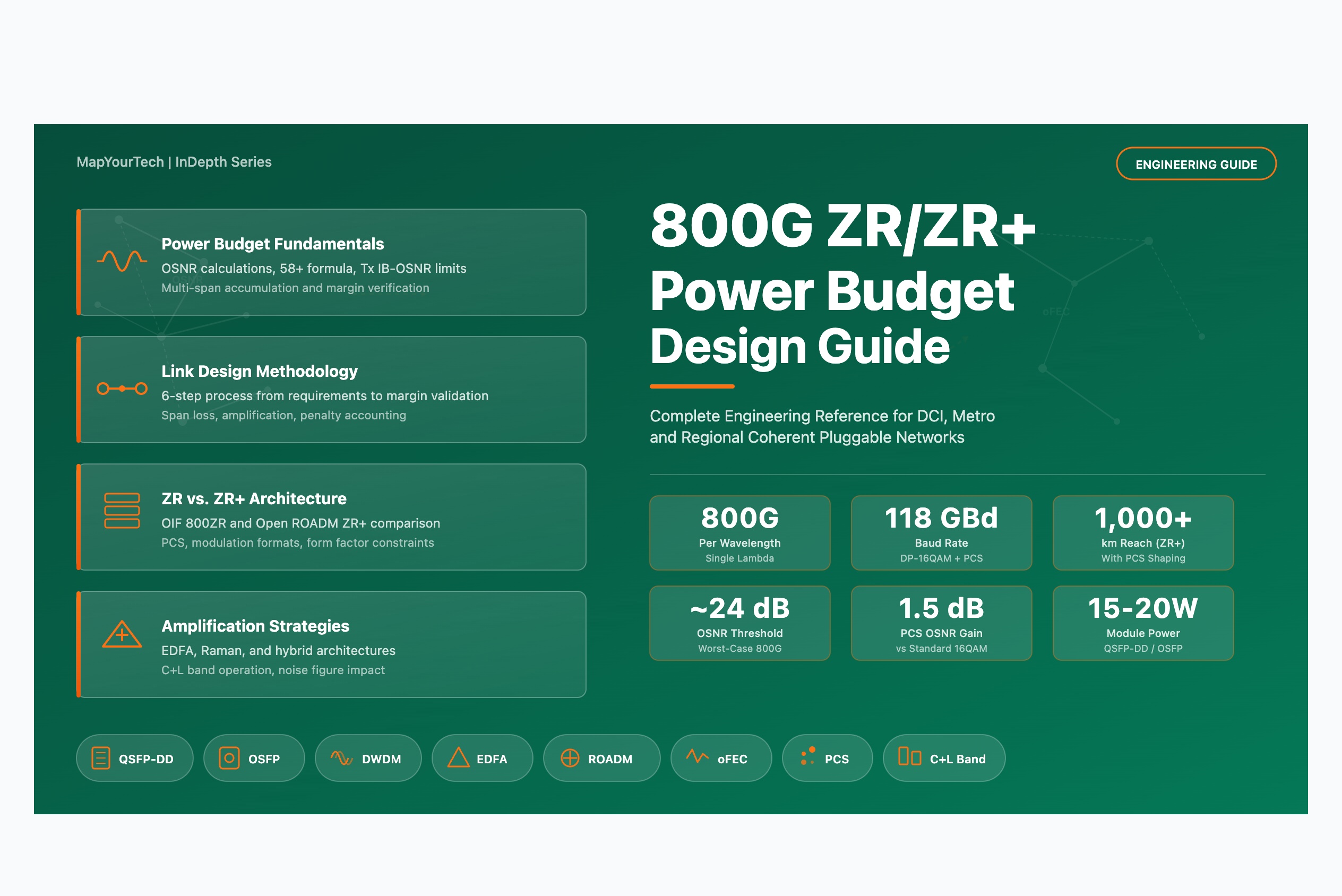

800G ZR/ZR+ Power Budget Design: Complete Engineering Guide
A comprehensive reference for optical link engineers designing, validating, and optimizing 800G coherent pluggable DWDM connections from DCI to regional networks
1. Introduction
The transition to 800G per wavelength marks the most significant capacity increase in pluggable coherent optics since the introduction of 400ZR in 2020. With the OIF releasing the 800ZR Implementation Agreement in October 2024 and multiple vendors achieving general availability of 800G ZR/ZR+ QSFP-DD and OSFP transceivers throughout 2025, network engineers face a new set of power budget design challenges. Higher baud rates around 118-131 GBaud, tighter Optical Signal-to-Noise Ratio (OSNR) requirements, and the thermal constraints of pluggable form factors all demand careful link engineering to ensure reliable operation.
This guide provides a complete engineering framework for designing optical power budgets for 800G ZR and ZR+ links. It covers the fundamental physics driving power budget calculations, walks through detailed worked examples for Data Center Interconnect (DCI), metro, and regional applications, and addresses the practical penalties that separate theoretical performance from real-world deployments. Engineers who read this guide will understand how to select the right operating mode, calculate end-of-life system margins, and avoid the common design mistakes that cause link failures.
The scope of this article spans single-span unamplified DCI links through multi-span amplified ROADM networks reaching beyond 1,000 km. Where applicable, vendor-neutral data from industry specifications is used alongside generalized performance parameters representative of the current generation of 800G pluggable modules based on 3nm DSP technology.
2. 800G ZR vs. ZR+: Architectural Fundamentals
2.1 OIF 800ZR: The DCI Baseline
OIF 800ZR defines a single-lambda 800 Gbps coherent interface optimized for point-to-point amplified links up to approximately 120 km. The standard specifies DP-16QAM (Dual-Polarization 16-state Quadrature Amplitude Modulation) operating at approximately 118-120 GBaud with open Forward Error Correction (oFEC) providing approximately 15% overhead. The fixed modulation format simplifies interoperability: any OIF-compliant 800ZR module from any vendor should work with any other.
The transmit output power for 800ZR is specified in two classes. Class A modules provide typical output power around -7 dBm to -10 dBm, designed for short single-span links where an EDFA boosts the signal at the transmitter output. Class B (or high-power) modules target 0 dBm or higher, enabling unamplified reaches up to approximately 40 km or simplified amplified architectures without a booster amplifier on the transmit side.
2.2 800G ZR+: Extended Performance with PCS
800G ZR+, defined through the Open ROADM Multi-Source Agreement (MSA), extends 800ZR capabilities with Probabilistic Constellation Shaping (PCS). PCS adjusts the probability distribution of transmitted symbols so that lower-amplitude symbols (which are more noise-resistant) are transmitted more frequently. This provides a 0.5 to 1.5 dB OSNR improvement at the same data rate, translating to roughly 50-150 km of additional reach depending on span loss and amplifier noise figures.
Key 800G ZR+ enhancements include support for multiple modulation formats (QPSK, 8QAM, 16QAM with PCS), flexible baud rates up to 131 GBaud, multi-rate operation (400G, 600G, 800G per wavelength), enhanced chromatic dispersion tolerance, ROADM compatibility with higher transmit output power (typically 0 to +1 dBm), and compatibility with OTN framing for carrier-grade management. The higher transmit power is critical for ROADM-based networks where the signal must traverse wavelength-selective switches, multiplexers, and potentially multiple ROADM express passes, each introducing 6-12 dB of additional loss compared to a simple point-to-point link.
Read the Full Analysis with Premium
The remaining 87% of this article — the design numbers, trade-offs and field guidance — is part of MapYourTech Premium, along with the full premium library, courses and professional tools.