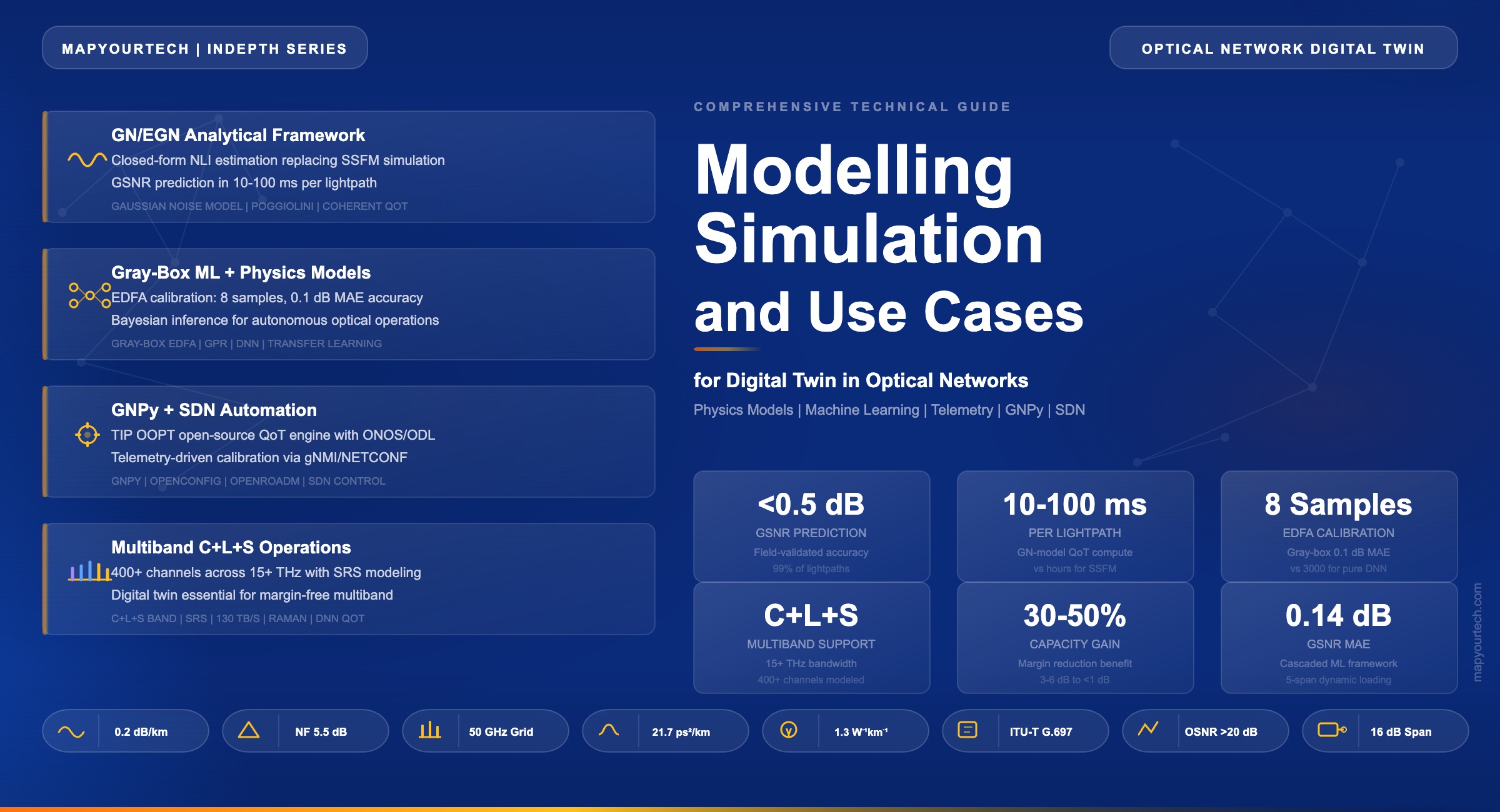

Modelling, Simulation and Use Cases for Digital Twin in Optical Networks
A comprehensive technical exploration of how digital twin technology is transforming optical network planning, operations, and optimization through physics-based models, machine learning, and real-time telemetry integration.
Table of Contents
- Introduction
- Foundations and Historical Context
- Theoretical Framework: The GN Model and QoT Estimation
- Technical Architecture and Component Models
- Machine Learning in Optical Digital Twins
- Implementation: GNPy and Open-Source Platforms
- Use Cases and Applications
- Performance Validation and Benchmarking
- Challenges, Limitations, and Future Directions
- Conclusion
- References
1. Introduction
1.1 The Case for Digital Twins in Optical Networking
Optical transport networks form the backbone of global communications infrastructure, carrying over 95% of intercontinental data traffic across submarine cables and terrestrial fiber routes. As these networks evolve to support 400G, 800G, and beyond-terabit per-channel line rates, the complexity of managing the physical layer has grown dramatically. Operators must contend with a growing list of interacting impairments including amplified spontaneous emission (ASE) noise, chromatic dispersion (CD), polarization mode dispersion (PMD), polarization-dependent loss (PDL), fiber Kerr nonlinearities such as self-phase modulation (SPM), cross-phase modulation (XPM), and four-wave mixing (FWM), as well as stimulated Raman scattering (SRS) in wideband systems.
Traditional network planning tools rely on worst-case design margins, often allocating 3 to 6 dB of excess optical signal-to-noise ratio (OSNR) beyond the minimum required by the forward error correction (FEC) threshold. While these margins protect against unexpected degradation, they also waste significant capacity. A network that allocates 3 dB of unnecessary margin is effectively using only half of its potential throughput on each lightpath. With the cost of deploying new fiber routes measured in millions of dollars per kilometer for submarine cables and tens of thousands per kilometer for terrestrial routes, squeezing maximum capacity from existing infrastructure is a major economic driver.
A digital twin of an optical network addresses this challenge by creating a comprehensive virtual replica of the physical network. This replica incorporates models of every network element -- fiber span, amplifier, reconfigurable optical add-drop multiplexer (ROADM), and transponder -- and computes the expected signal quality for any configuration of wavelengths, power levels, and routing paths. Unlike static planning tools that compute worst-case scenarios, a network digital twin (NDT) continuously assimilates monitoring telemetry from the live network to refine its models and provide increasingly accurate predictions over time.
Definition: An Optical Network Digital Twin (ONDT) is a software-based analytical model of an optical transport network that replicates the physical layer behavior with sufficient fidelity to predict the quality of transmission (QoT) for any lightpath under any feasible configuration. It is continuously synchronized with the physical network through telemetry data and serves as the decision-support engine for planning, provisioning, optimization, and fault management operations.
The concept of digital twins originated in manufacturing and aerospace, where virtual replicas of physical assets have been used for decades to predict wear, simulate performance, and optimize maintenance schedules. The application to optical networking presents unique challenges. Unlike mechanical systems where finite element analysis on static structures provides high accuracy, optical networks involve the propagation of electromagnetic fields through hundreds of kilometers of fiber, with nonlinear interactions between tens or hundreds of wavelength channels simultaneously. The accuracy of the digital twin depends on the fidelity of models for each individual component and on how those models compose when cascaded across a network path.
1.2 Scope and Organization
This article provides a comprehensive technical treatment of digital twin technology for optical networks. It covers the historical evolution from static planning tools to dynamic digital twins, the theoretical framework based on the Gaussian Noise (GN) model and its extensions, the architecture and component models that comprise a practical optical NDT, machine learning techniques that enhance model accuracy, open-source implementations such as GNPy, and the integration of digital twins with software-defined networking (SDN) controllers and real-time telemetry systems. Practical use cases demonstrated in field trials and research testbeds are analyzed, followed by a quantitative discussion of accuracy benchmarks and computational performance. The article concludes with an assessment of current challenges and a forward-looking perspective on how digital twin technology will evolve alongside multiband transmission, autonomous network operation, and AI-driven optimization.
2. Foundations and Historical Context
2.1 Evolution of Network Planning Tools
The history of optical network design tools mirrors the evolution of optical transmission technology itself. In the early days of wavelength-division multiplexing (WDM) systems in the mid-1990s, network planning was performed using spreadsheet-based link budget calculations. Engineers would sum the losses from fiber attenuation, connector losses, splice losses, and ROADM insertion losses, then verify that the received OSNR met the requirements for the chosen modulation format -- typically non-return-to-zero on-off keying (NRZ-OOK) at 2.5 or 10 Gb/s. These calculations assumed worst-case parameters for every component and treated each span independently.
As transmission rates moved to 40 Gb/s and then 100 Gb/s with the introduction of coherent detection and polarization-multiplexed quadrature phase-shift keying (PM-QPSK), the limitations of simple link budget analysis became apparent. The removal of inline dispersion compensation fiber (DCF) changed the nonlinear propagation regime, and fiber nonlinearities became the primary capacity-limiting factor. Network planning now required simulation of the nonlinear Schrodinger equation (NLSE) or its approximations to predict signal quality accurately. Commercial planning tools from equipment vendors emerged but struggled with multi-vendor interoperability and were designed primarily for offline, pre-deployment planning rather than real-time operational use.
2.2 From Static Simulation to Dynamic Digital Twins
The transition from static simulation tools to dynamic digital twins was driven by several converging trends. First, coherent transponders equipped with powerful DSP chips provided a rich source of physical layer telemetry -- pre-FEC BER, OSNR estimates, CD measurements, differential group delay, and nonlinear noise estimates. Second, the SDN movement brought programmable control planes and open interfaces. Protocols such as NETCONF/YANG and OpenConfig provided standardized access to device configuration and operational state data. The open line system (OLS) concept, promoted by the Telecom Infra Project (TIP), disaggregated the optical line system from transponders. Third, advances in analytical models for fiber propagation, particularly the GN model and its Enhanced variant (EGN model), provided computationally efficient alternatives to split-step Fourier method (SSFM) simulations -- reducing computation from hours to milliseconds.
2.3 Industry Standards and Frameworks
Several industry organizations have contributed to defining the role of digital twins in optical networking. TIP, through its OOPT working group, developed GNPy as an open-source QoT estimation engine that has become the de facto reference implementation. The Innovative Optical and Wireless Network Global Forum (IOWN GF) published a comprehensive Network Digital Twin use case classification in 2024, identifying applications including failure detection, capacity planning, green twin for energy optimization, and multi-layer management. Within ITU-T, the G.698-series recommendations for DWDM, G.697 for optical monitoring, and G.sup39 for optical system design provide foundational frameworks. The OpenConfig consortium and OpenROADM MSA have developed YANG data models for optical network elements that define the telemetry interface for digital twin synchronization.
Figure 1: The evolution of optical network design from spreadsheet-based link budgets through simulation to modern AI-enhanced digital twins.
3. Theoretical Framework: The GN Model and QoT Estimation
3.1 What Defines an Optical Network Digital Twin
Three characteristics differentiate an NDT from a traditional planning simulation. First, a digital twin maintains persistent state reflecting the current configuration and condition of the physical network -- inventory of all network elements, current wavelength assignments, amplifier gain settings, and latest telemetry. Second, it provides predictive capability for hypothetical scenarios: adding a new lightpath, adjusting an amplifier's gain, or rerouting traffic after a fiber cut. Third, it supports continuous refinement through a feedback loop with the physical network -- discrepancies between predicted and measured performance trigger model parameter updates.
Read the Full Analysis with Premium
The remaining 79% of this article — the design numbers, trade-offs and field guidance — is part of MapYourTech Premium, along with the full premium library, courses and professional tools.

Optical Communications & Network Automation Expert | Author of 3 Books for Optical Engineers | Founder, MapYourTech
Optical networking engineer with nearly two decades of experience across DWDM, OTN, coherent optics, submarine systems, and cloud infrastructure. Founder of MapYourTech. Read full bio →
Follow on LinkedInRelated Articles on MapYourTech