Automation Blast Radius: Scoping What a Bad Intent Can Touch
A method for bounding the worst case of any automated change before granting it write access, and the scoping patterns that keep one wrong intent from becoming a network event.
1. Introduction
An automated system that can write to a network element can, in the worst case, write to every network element it holds credentials for, as fast as its execution engine can issue calls, for as long as nobody notices. That worst case is the blast radius of the automation, and it is a property of the access scope, the execution mechanism, and the detection window — not a property of whether the intent that triggered the change was correct. A well-formed intent scoped to one interface behaves identically to a malformed one until the moment the scope boundary is actually tested; the boundary is what decides whether a bad intent stays contained to one port or reaches an entire ring.
Operators have run automated provisioning, closed-loop fault recovery, and policy-driven closed-loop control at increasing levels of autonomy for years, mostly through pipelines that resolve a declared intent into device-level changes over NETCONF or a vendor API. What has changed by 2026 is who, or what, originates the intent. Nokia and AWS demonstrated live agentic AI-driven 5G-Advanced network slicing with operators du and Orange in February 2026, in which an AI agent — not a scripted workflow — reads real-time network and contextual data and adjusts radio access network policy on its own initiative. The OWASP GenAI Security Project's Top 10 for Agentic Applications, released in December 2025, added a dedicated category for the failure mode this creates: ASI08, cascading failures, describing how a single faulty decision fans out across agents, tools, and workflows before anyone intervenes.
This article works through how to bound that fan-out before it happens: the three variables that set the size of the boundary, the standards-based mechanisms that constrain each one, and the scoping patterns that keep a wrong intent — human-authored or agent-authored — contained to the smallest defensible piece of the network. The mechanisms are not new; NETCONF's confirmed-commit and path-scoped access control both predate agentic automation by more than a decade. What is new is how often they need to be exercised, and how little time is left to notice when they are missing.
2. What Blast Radius Means for a Network Change
"Blast radius" is borrowed from high-availability data center design, where an availability domain is defined as the largest group of infrastructure that can fail as a single unit — sized so that a power, cooling, or fire event in one domain cannot propagate to the next. Applying the same question to automation reframes the sizing problem: instead of asking what fails together physically, ask what one automated action is capable of touching, correctly or not, before something stops it.
Every automated change carries two scopes that can diverge over time. The declared scope is the target list written into the intent — three named ROADM add/drop ports, for instance. The actual scope is everything the identity issuing that intent is authorized to reach, combined with whatever the target-resolution logic matches at execution time. A selector written as "all nodes tagged role=edge-metro" is accurate on the day it is written; six months and forty newly commissioned nodes later, the same selector reaches forty more elements than the engineer who approved it ever reviewed. The intent did not change. The actual scope did, silently, as the network grew around it.
This gap is not a new problem introduced by AI agents — it already shows up in optical and IP operations under a familiar shape: alarm-correlation-triggered remediation that resets more line cards than the underlying fault warranted, because the automation's target selection matched an entire correlation group rather than the specific card that raised the primary alarm. Treating optical configuration as reviewed, version-controlled code rather than a one-off craft session closes part of this gap by making the declared scope explicit and auditable before it ever reaches a device, but declared scope alone does not bound what an over-privileged identity can still reach if the declaration is wrong.
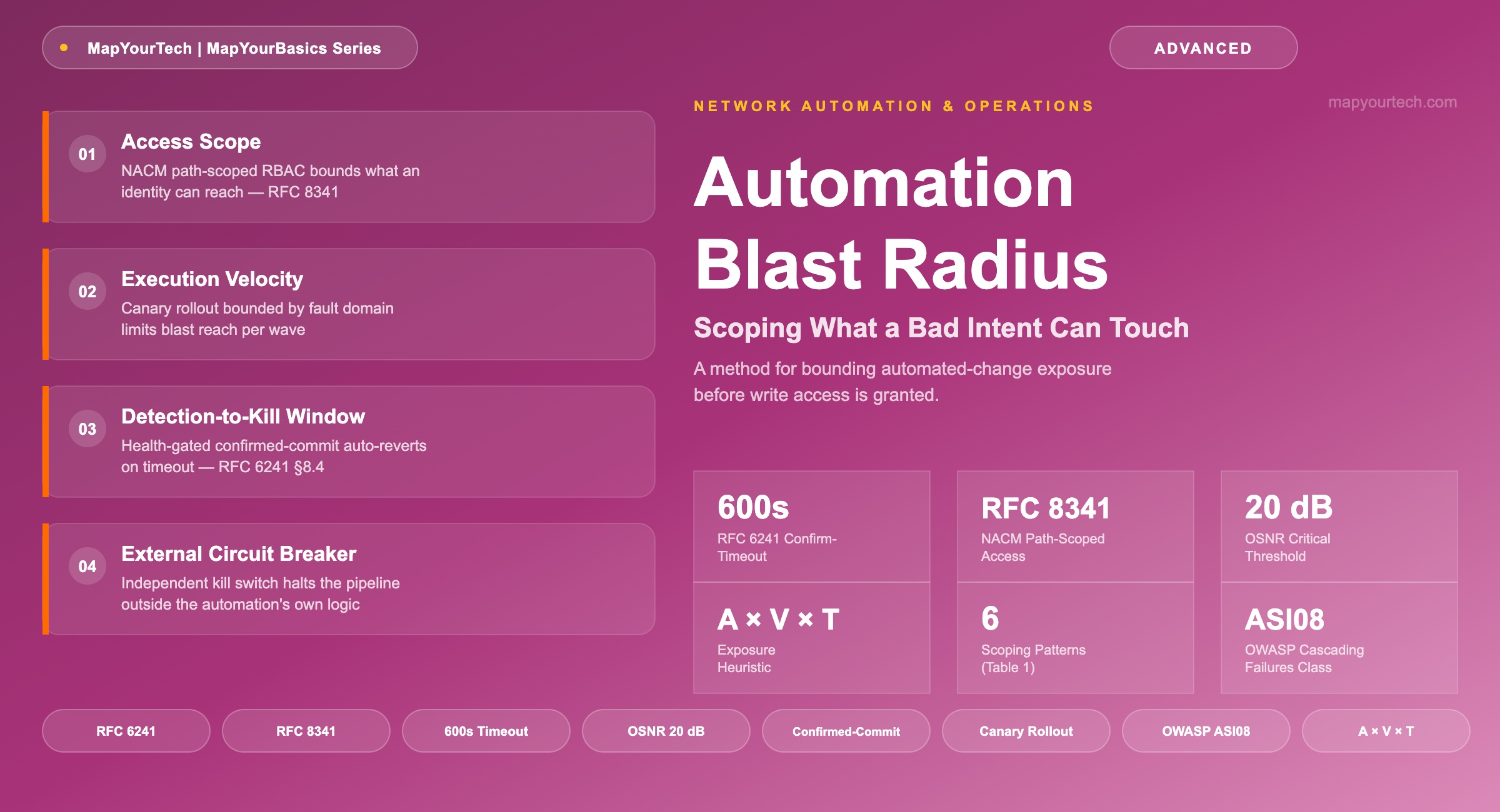
Three variables set the size of that boundary, and each has a standards-based or operational mechanism that constrains it: access scope (what the identity is authorized to reach, at the protocol and data-node level), execution velocity (how fast the automation can act across everything it is authorized to touch), and the detection-to-kill window (how long a bad action can run before something — human or automated — stops it). Section 3 works through the mechanism that bounds each one, and a practical way to reason about how they combine.
Takeaway: Blast radius is a property of what an automated identity can reach and how long a mistake is allowed to run — not a property of whether the triggering intent was correct. Scoping the reach bounds the damage even when the intent turns out to be wrong.
3. The Three Variables That Set the Boundary
3.1 Access Scope
IETF RFC 8341, the Network Configuration Access Control Model (NACM), enforces access control at three points inside a NETCONF or RESTCONF session: which protocol operations an identity may invoke, which specific data nodes within a datastore it may read or write, and which notification event types it may receive. Rules are attached to groups, not individual users, and are matched against a data-node path rather than a blanket "operator" or "admin" label. A YANG module can additionally tag a subtree with the nacm:default-deny-write or nacm:default-deny-all extension, so that even a broadly scoped role cannot touch that subtree without an explicit rule granting access to it by name.
The practical effect is that access scope stops being a single yes/no permission and becomes a list of specific paths — for example, write access to /interfaces/optical-channel/config/target-power and nothing else, rather than write access to the device. The YANG data models that NETCONF configuration operations depend on make this path-level scoping possible in the first place, because the access-control rule and the configuration leaf it protects share the same addressable tree.
3.2 Execution Velocity
Access scope bounds what the automation is allowed to touch; execution velocity bounds how much of that permitted surface it can act on per unit of time. A pipeline that pushes a change to every authorized node in a single commit cycle has effectively no velocity limit — the blast radius equals the access scope. A pipeline that stages the same change through a canary wave of one node, waits for a health signal, and only then proceeds to the rest, has converted an instantaneous exposure into a metered one. The canary boundary should track the same fault-domain logic used for physical redundancy: the first wave should never cross into a second availability domain, so a bad canary result never has the chance to contaminate the domain that is supposed to remain healthy while the first one recovers.
3.3 Detection-to-Kill Window
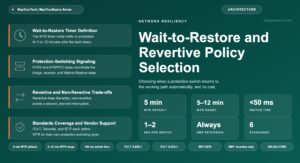
RFC 6241 defines a :confirmed-commit capability at NETCONF's protocol level: a commit can be marked "to be confirmed," and if a matching confirming commit is not issued within a timeout — 600 seconds by default, though a server may accept a shorter value — the device automatically reverts the running configuration to its state before the change. The same section (§8.4) defines <cancel-commit> for aborting early, and §8.5 defines a separate rollback-on-error capability that reverts an <edit-config> in progress the moment the server raises an error-severity <rpc-error>. None of this evaluates whether the change was a good idea — it only bounds how long an unconfirmed or erroring change can persist. The detection-to-kill window only closes early if the confirming commit itself is gated on a health check, not issued unconditionally the instant the timer starts.
The illustrative contrast in the formula card is a reasoning tool, not a measured statistic — the actual numbers for any given network come from its own fault-domain size and telemetry polling cadence. What the heuristic makes visible is that the three variables multiply rather than add: halving the canary wave size or shortening the confirm-timeout has the same order-of-magnitude effect on exposure as tightening access scope by the same factor, and a design that only tightens one of the three still leaves the other two able to dominate the result.
Takeaway: Access scope, execution velocity, and the detection-to-kill window each need their own bound. Tightening only one — a narrow role with an unbounded rollout, or a fast canary with no confirm-timeout — still leaves the other two free to set the actual blast radius.
4. Scoping Patterns That Bound the Worst Case
Each variable from Section 3 has a corresponding design pattern that keeps it bounded in practice rather than only on paper. None of these require exotic tooling — they are configuration choices layered on top of NETCONF, NACM, and an operator's existing staged-deployment discipline.
Explicit target enumeration over wildcard selectors. A declarative intent should name network elements by identifier, not by a tag or role match that resolves differently as the fleet changes shape. A multi-vendor automation strategy makes this harder to skip, because a selector that silently expands across vendors is far more likely to reach a data node the automation was never validated against.
Default-deny, path-scoped access control. RFC 8341's default-deny-write extension inverts the usual failure direction: an unrecognized data node is unreachable by default rather than reachable by default. A rule-list scoped to /interfaces/optical-channel/config/target-power cannot touch protection-switching state even if the identity holding it is compromised or the automation logic contains a bug, because the datastore access check happens independently of what the application layer intended to do.
Dry-run and diff-before-apply. Comparing the candidate datastore against the running configuration before committing catches the case where a template renders correctly for ninety-nine devices and incorrectly for the hundredth. Running the proposed change through a planning and simulation stage before it reaches physical devices extends this same principle one layer earlier, validating the routing and modulation decision itself before the diff check validates the resulting configuration.
Health-gated confirmed-commit. RFC 6241's confirm-timeout bounds how long an unconfirmed change can persist, but the confirming commit still has to be issued by something. Wiring that confirmation to a telemetry threshold — G-OSNR, pre-FEC bit error rate, or protection-switch state staying nominal — turns a timer that only catches session loss into one that also catches a change that technically committed but degraded the service it touched.
Canary rollout bounded by fault domain. The first wave of any staged change should stay inside one availability domain, never spanning into the domain that provides redundancy for it. Automation frameworks designed for fleets of hundreds of thousands of devices depend on this discipline structurally — at that scale, an unstaged push is not a hypothetical risk, it is the default outcome of not staging.
An external circuit breaker. Current agentic-security guidance is explicit that in-pipeline safety logic is not sufficient on its own, because a compromised or looping automation can suppress its own safety reporting; the halt mechanism needs to run in a separate process that the automation cannot influence. A 2026 industry risk survey found that a majority of organizations running autonomous agents could not actually terminate a misbehaving one on demand — the containment gap was not the detection, it was the absence of a tested, independent kill switch.
| Mechanism | What It Bounds | Standard / Basis | Failure Mode Without It |
|---|---|---|---|
| Path-scoped RBAC, default-deny-write | Access scope | IETF RFC 8341 (NACM) | Overbroad role reaches data nodes never intended for automation |
| Explicit target enumeration | Declared vs. actual scope gap | Declarative intent design practice | Wildcard selector silently expands as the fleet grows |
| Dry-run / diff-before-apply | Execution correctness | NETCONF candidate datastore, RFC 6241 | Template bug or config drift applies unintended lines |
| Health-gated confirmed-commit | Detection-to-kill window | RFC 6241 §8.4, :confirmed-commit | Bad state persists indefinitely with no automatic revert |
| Fault-domain-bounded canary | Execution velocity, propagation | Operational practice, availability-domain design | One wrong push reaches every element in one wave |
| External circuit breaker / tested kill switch | Containment when in-pipeline logic fails | Operational practice, agentic-system governance | Compromised or looping automation suppresses its own halt signal |
Takeaway: No single pattern in Table 1 substitutes for another. Path-scoped RBAC does nothing if the target list is a wildcard; a health-gated confirm-timeout does nothing if the circuit breaker that should override it lives inside the same process it is meant to check.
5. Practical Example — Bounding an OSNR-Triggered Power Adjustment
Scenario: A closed-loop optical automation platform monitors OSNR across a metro ring built on ROADM add/drop nodes and is authorized to make small corrections to per-channel launch power when drift is detected, before the margin above the FEC threshold closes.
Implementation: The target scope is the three ROADM nodes on that specific ring, named explicitly by network-element identifier rather than a "ring=X" tag that would silently absorb any node added to the ring later. The access scope is a single NACM rule-list granting write access only to the per-channel target-power leaf that drives the node's variable optical attenuator stage, with default-deny-write on every other data node, including protection-switching state. Execution proceeds as a canary wave of one node first, with OSNR polled every 30 seconds; the confirmed-commit carries a 300-second confirm-timeout, and the confirming commit is issued programmatically only if OSNR stayed above a 20 dB critical threshold throughout the wave. If it did not, the confirm timer lapses and RFC 6241 §8.4 reverts that node automatically, with no human action required to trigger the rollback. Only after the canary node confirms healthy does the same bounded change proceed to the remaining two nodes in a second wave.
Outcome: If the power-adjustment logic has a defect that pushes launch power the wrong direction, the worst case is one node, running at a degraded OSNR for at most five minutes, on a ring where 20 dB is already the documented critical action point rather than an unfamiliar number discovered during the incident. It is not a ring-wide OSNR event, and it does not reach an adjacent ring that a stale wildcard selector might otherwise have absorbed.
| KPI | Normal | Warning | Critical — Block Confirmation |
|---|---|---|---|
| OSNR | > 23 dB | 20–23 dB | < 20 dB |
| Q-factor | > 7 | 6–7 | < 6 |
| Post-FEC BER | < 10-12 | 10-9 | 10-6 |
Table 2 reflects typical operational thresholds used in DWDM performance monitoring; exact values vary by system design, modulation format, and FEC implementation, and should be validated against the deployed platform's own specification before use as a confirming-commit gate.
6. Summary
Scoping a network automation is not a one-time access review; it is a design decision made every time a new intent, role, or agent is added to a platform that can write configuration. As more of that intent originates from an AI agent reasoning over live telemetry rather than a script reviewed in a change-management ticket, the access-scope, execution-velocity, and detection-window boundaries stop being a compliance checkbox and become the actual control surface standing between a wrong decision and a network event. The mechanisms already exist on the standards track: NACM's path-scoped access control and NETCONF's confirmed-commit predate agentic automation by well over a decade, and fault-domain-bounded staged rollout predates automation of any kind. What 2026 changes is how often those mechanisms get exercised, and how little time is left to notice when one of them is missing.
References
- IETF, RFC 6241 — Network Configuration Protocol (NETCONF), Internet Engineering Task Force.
- IETF, RFC 8341 — Network Configuration Access Control Model (NACM), Internet Engineering Task Force.
- OWASP GenAI Security Project, OWASP Top 10 for Agentic Applications 2026.
Sanjay Yadav, "Optical Network Communications: An Engineer's Perspective" — Bridge the Gap Between Theory and Practice in Optical Networking.
Related Articles on MapYourTech