
Variable Optical Attenuators (VOAs) in DWDM Systems
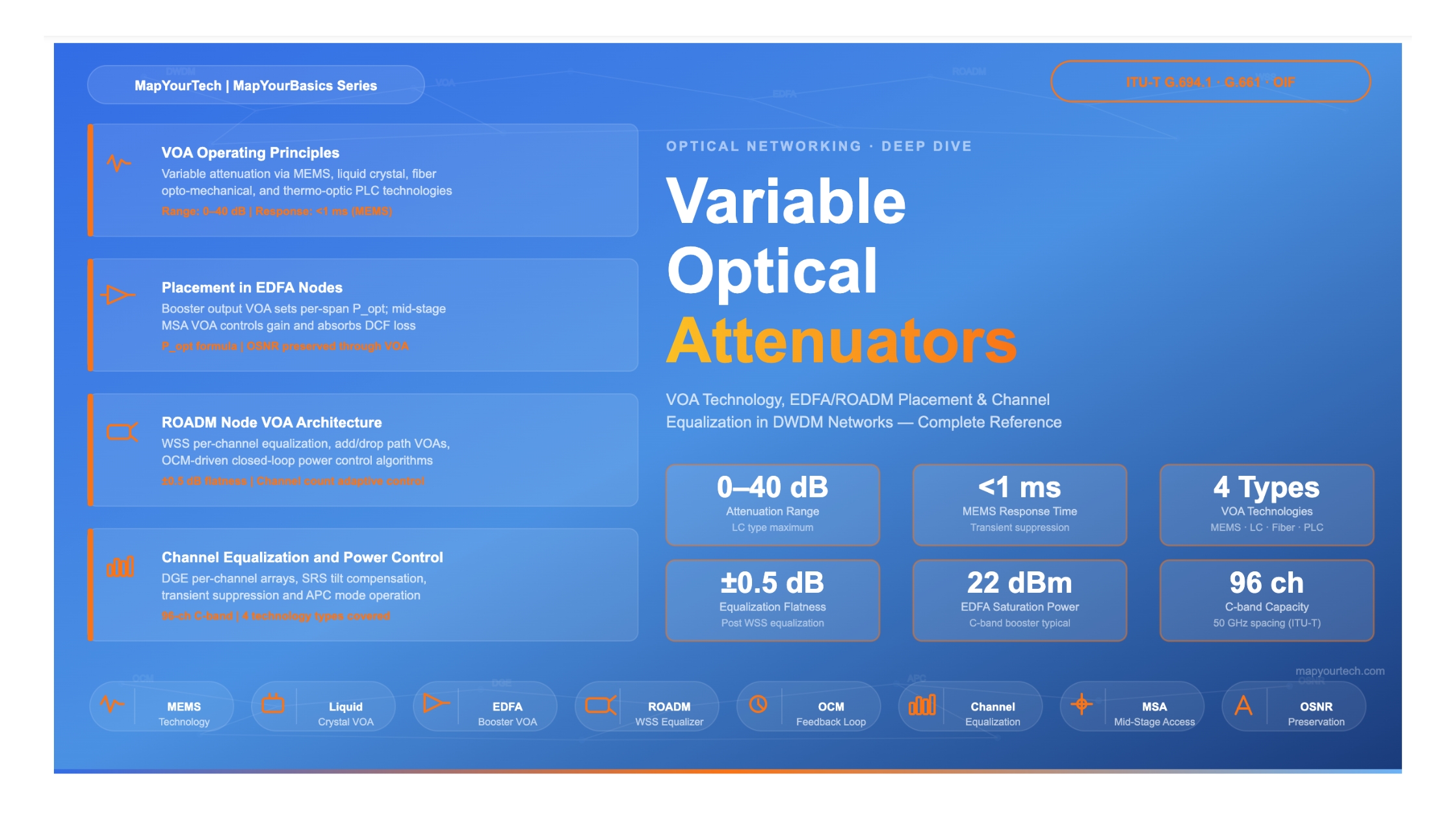
A comprehensive technical reference covering VOA operating principles, technology types, placement in EDFA and ROADM nodes, channel equalization mechanisms, and performance specifications for modern high-capacity optical networks.
1 Introduction
Dense Wavelength Division Multiplexing (DWDM) has become the dominant transport technology for high-capacity optical networks, multiplexing tens to hundreds of wavelengths onto a single fiber pair. Each channel operates independently across the optical spectrum, typically within the C-band (1530–1565 nm) or L-band (1565–1625 nm), and may carry 10 Gbps, 100 Gbps, 400 Gbps, or even higher data rates using advanced coherent modulation.
Managing optical power is a fundamental challenge in these systems. Every optical component — fiber spans, amplifiers, multiplexers, demultiplexers, connectors, and switches — contributes some amount of gain or loss to the signal. When many channels propagate simultaneously, unequal power levels cause a cascade of performance problems: channels with too much power drive nonlinear impairments such as self-phase modulation (SPM), cross-phase modulation (XPM), and four-wave mixing (FWM); channels with too little power suffer excessive optical signal-to-noise ratio (OSNR) degradation. Achieving a flat, controlled power profile across all channels at every node in the network is not optional — it is a requirement for the system to function within its design margins.
The Variable Optical Attenuator (VOA) is the primary tool for managing optical power at the component and node level. A VOA introduces a controllable, precise amount of attenuation into an optical path. By adjusting its attenuation setting — under manual command or automatic control — the network element can set per-channel launch power to the optimal level, compensate for span-to-span loss variations, equalize channel power after amplification, and protect downstream components from excessive power.
This article provides a thorough technical examination of VOAs: their operating principles, the distinct technology families used in deployed systems, where VOAs are placed within EDFA amplifier modules and ROADM nodes, how they participate in automatic gain control and channel equalization, and the key performance parameters that govern their selection and deployment.
Scope of This Article
This article addresses VOAs as used in long-haul, metro, and regional DWDM transport systems operating over single-mode fiber. It covers C-band and L-band operation across all mainstream VOA technology platforms — MEMS, liquid crystal, fiber-based opto-mechanical, and thermo-optic waveguide types.
2 Fundamental Principles of Optical Attenuation
2.1 What a VOA Does
An optical attenuator reduces optical power by a defined amount. A Variable Optical Attenuator differs from a fixed attenuator in that its attenuation level can be adjusted, either in discrete steps or continuously, under electrical control. The most basic description of VOA behavior is captured in the insertion loss equation:
  IL(dB) = -10 × log10( P_out / P_in )

  Equivalently, in linear terms:

  P_out = P_in × 10( -IL / 10 )
IL = insertion loss / attenuation in dB (positive value = loss)
P_out = optical power at the VOA output (mW or dBm)
P_in = optical power at the VOA input (mW or dBm)
Example: IL = 10 dB means output power is one-tenth of input power
When a VOA is set to a specific attenuation value — for example, 6 dB — it reduces the optical power by a factor of 4 (100.6 ≈ 4). At 20 dB, power is reduced by a factor of 100. This logarithmic relationship is why dB is the natural unit for describing attenuation in optical systems, and why even small errors in attenuation translate to meaningful power differences as the number of cascaded components accumulates along the optical path.
2.2 Attenuation Mechanisms
VOAs achieve variable attenuation through one of several physical mechanisms. The technology family determines which mechanism is employed, but in all cases the goal is the same: to divert, absorb, or reflect a controllable fraction of the incident optical power so that the transmitted fraction matches the desired output level.
The four primary mechanisms are spatial beam displacement (moving a lens or mirror so that part of the beam misses the output fiber), polarization-dependent loss modulation (rotating a polarization-sensitive element to vary transmission), evanescent coupling variation (changing waveguide coupling efficiency via refractive index adjustment), and fiber-to-fiber coupling loss control (adjusting the alignment between two fiber ends mechanically or via index-matching fluid).
2.3 Key Performance Parameters
Every VOA used in a DWDM network is evaluated against a set of standard performance parameters. Understanding these parameters is essential for selecting the right VOA type for a given application and for interpreting datasheet specifications.
| Parameter | Definition | Typical Range / Target | Why It Matters |
|---|---|---|---|
| Attenuation Range | Maximum controllable insertion loss (dB) | 0 – 30 dB to 0 – 40 dB | Sets the dynamic power control range available to the node |
| Insertion Loss (IL) | Minimum attenuation (penalty at lowest setting) | 0.5 – 2.0 dB (at 0 dB attenuation) | Adds to system loss budget even when VOA is "wide open" |
| Attenuation Accuracy | Error between commanded and actual attenuation | ±0.1 – ±0.3 dB | Determines precision of automated power control |
| Repeatability | Variation across multiple setting cycles | ±0.05 – ±0.1 dB | Critical for closed-loop automatic control stability |
| PDL (Polarization Dependent Loss) | Attenuation variation with polarization state | < 0.2 – 0.5 dB | Higher PDL causes OSNR penalty, especially over cascaded nodes |
| WDL (Wavelength Dependent Loss) | Variation of attenuation across wavelength range | < 0.3 – 0.5 dB across C-band | Unequal attenuation per channel causes spectral tilt |
| Response Time | Time from command to stable attenuation | <1 ms (MEMS) to <10 ms (LC/fiber) | Governs how fast the node can respond to transients |
| Return Loss | Optical power reflected back toward the source | > 45 dB | High return loss prevents reflected signals degrading upstream transmitters |
| Optical Power Handling | Maximum input power without damage | +23 to +30 dBm (type dependent) | Must exceed maximum power levels seen at the VOA input in all loading conditions |
Table 1: Key VOA performance parameters and their significance in DWDM deployments
3 VOA Technology Types
Several distinct technology platforms have been developed for VOAs used in DWDM systems. Each has different fabrication approaches, attenuation mechanisms, performance profiles, and suitability for specific deployment contexts. The major types in widespread use are MEMS-based, liquid crystal-based, fiber opto-mechanical, and thermo-optic planar waveguide. Understanding how each works explains why different VOA types appear in different parts of the network.
MEMS-Based VOAs
Micro-Electro-Mechanical Systems (MEMS) VOAs use microfabricated movable mirrors or beam-steering elements to deflect a controlled fraction of the optical beam away from the output fiber. Electrostatic actuation moves the mirror by a precise angle, varying the coupling efficiency and therefore the transmitted power.
Liquid Crystal (LC) VOAs
Liquid crystal VOAs use a nematic or twisted-nematic LC cell sandwiched between polarizers. Applying a voltage across the cell changes the orientation of the LC molecules, rotating the polarization of the light passing through. The second polarizer then transmits more or less of the light depending on polarization alignment, achieving the desired attenuation.
Fiber Opto-Mechanical VOAs
These VOAs introduce lateral, angular, or gap displacement between two fiber ends using a precision mechanical actuator — typically a stepper motor or piezoelectric element. The displacement moves the output fiber out of the center of the Gaussian beam profile from the input fiber, reducing coupling efficiency and therefore output power. While inherently bulkier than MEMS or LC types, fiber opto-mechanical VOAs are well suited to high-power applications.
Thermo-Optic Waveguide VOAs
Integrated planar lightwave circuit (PLC) VOAs exploit the thermo-optic effect: heating a waveguide changes its refractive index, which can be used in a Mach-Zehnder interferometer (MZI) configuration to control the phase difference between two arms, and therefore the output power through constructive or destructive interference. These devices integrate naturally with other PLC components such as AWG multiplexers.
3.1 Technology Comparison
| Attribute | MEMS | Liquid Crystal | Fiber Opto-Mech. | Thermo-Optic PLC |
|---|---|---|---|---|
| Attenuation Range | 0–30+ dB | 0–40 dB | 0–30 dB | 0–20 dB |
| Min. Insertion Loss | 0.5–1.5 dB | 1.0–2.5 dB | 0.5–1.5 dB | 1.0–3.0 dB |
| PDL | < 0.2 dB | < 0.3 dB | < 0.1 dB | < 0.2 dB |
| Response Time | < 1 ms | 1–10 ms | 5–50 ms | 1–5 ms |
| Power Handling | Moderate | Low–Moderate | High | Low |
| Reliability / MTTF | Very high | High | High | Very high |
| Integration | Discrete / array | Discrete / array | Discrete | PLC integrated |
| Primary Use Cases | EDFA output, ROADM booster, per-channel | WSS integration, per-channel equalizer | High-power booster, test instruments | Integrated mux/VOA arrays, metro PLC modules |
Table 2: Comparative summary of VOA technology families — all values are typical; actual specifications vary by product and manufacturer
Figure 1: Attenuation Range vs. Minimum Insertion Loss — VOA Technology Comparison
Figure 1: Trade-off between achievable attenuation range (dB) and minimum insertion loss (dB) across VOA technology types. Lower IL at high attenuation range is preferred.
3.2 MEMS VOA: Operating Detail
A MEMS VOA is fabricated using semiconductor photolithography processes on a silicon wafer. The mirror or beam-steering plate is etched as a separate element suspended on thin flexural hinges. When a voltage is applied to a comb-drive or parallel-plate electrostatic actuator alongside the mirror, electrostatic attraction deflects the mirror by a precisely controlled angle. Since the fiber output is fixed, this angular deflection changes what fraction of the optical beam is coupled into the output fiber — more deflection means more power is lost to the free-space gap, increasing attenuation.
MEMS VOAs offer several important advantages: the silicon substrate is mechanically stable, enabling highly repeatable attenuation settings; the absence of moving parts contacting each other means wear is negligible over service lives of many years; and the compact die size allows arrays of per-channel VOAs to be fabricated on a single chip, supporting per-wavelength power equalization in densely integrated line cards.
3.3 Liquid Crystal VOA: Operating Detail
In a liquid crystal VOA, linearly polarized light enters the LC cell. The LC molecules, which are elongated and birefringent, are normally aligned at a specific orientation by surface treatment of the cell walls. When no voltage is applied, the cell rotates the polarization by 90 degrees (twisted-nematic configuration). As voltage increases, the molecules re-orient along the electric field direction, and the polarization rotation decreases. A second polarizer at the output passes only one polarization component. By controlling the voltage, the fraction of light transmitted is varied continuously from near zero to the maximum transmittance.
One important characteristic of LC VOAs is their temperature dependence. The clearing temperature of the liquid crystal — above which it transitions from the ordered liquid crystal phase to an isotropic liquid — limits the operating temperature range. In typical telecommunications-grade LC VOAs, this is managed through thermal stabilization within the module. Additionally, because the attenuation mechanism is intrinsically polarization-based, careful design is required to achieve acceptably low PDL across the full attenuation range.
4 VOA Placement in EDFA Amplifier Nodes
Erbium-Doped Fiber Amplifiers (EDFAs) are the most widely deployed optical amplifiers in DWDM systems, providing gain in the C-band (1530–1565 nm) and L-band (1565–1625 nm). A fundamental property of EDFAs is that their gain is not uniform across the amplification bandwidth — gain is inherently shaped by the energy structure of the erbium ion transitions. Without compensation, this non-flat gain profile accumulates across cascaded amplifier spans, causing severe power imbalance between channels at long-haul distances. VOAs are placed within and around EDFA modules to address this problem.
4.1 EDFA Gain Tilt and Channel Power Variation
An EDFA operating in C-band typically has higher gain at longer wavelengths (around 1558–1562 nm) than at shorter wavelengths (around 1530–1535 nm). This gain tilt, expressed in dB across the band, accumulates span by span. In a system with 20 amplifier spans, even 0.5 dB of gain tilt per amplifier results in 10 dB of cumulative tilt — far exceeding the ±1 dB channel power flatness target required for acceptable system performance. Additionally, the gain of an EDFA varies with input power: as channels are added or dropped at ROADMs, the total input power changes, which shifts the gain saturation point and can cause transient power excursions on surviving channels — a phenomenon known as the gain transient problem.
4.2 Output VOA — Booster EDFA
The most common VOA placement in an EDFA node is at the amplifier output, in the booster configuration. The booster EDFA amplifies the multi-channel signal from the ROADM or OXC switching fabric to the correct launch power level for the downstream fiber span. The VOA follows the EDFA output and adjusts the total aggregate power to achieve the per-channel optimum launch power (Popt) for that specific span.
The optimum power per channel depends on the downstream fiber type and span loss. For a G.652 fiber span, Popt depends on span loss according to:
  P_opt(dBm) = min{ A + IL1 + 0.36 × ASL ,  P_sat - 10·log₁₀(N_ch,max) }

  Where:
  ASL = Expected_Span_Loss + 2 dB   (adds 2 dB aging margin)
P_opt = optimum average power per channel at the line output (dBm)
A = fiber-type constant: G.652 → -6.7 dBm, LEAF → -8.6 dBm, TW-Reach → -8.9 dBm, G.654 → -5.5 dBm
IL1 = insertion loss from amplifier output to transmission fiber (dBm)
ASL = adjusted span loss including 2 dB aging margin (dB)
P_sat = EDFA saturation power (dBm)
N_ch,max = maximum number of channels in system
The VOA attenuation at the booster output is then set to bring the per-channel power from the EDFA's saturation-limited output down to Popt:
VOA_att(dB) = max{ P_sat(dBm) - 10·log₁₀(N_ch) - P_opt(dBm) , 0 }
VOA_att = required VOA attenuation (dB; floored at 0 — cannot create gain)
P_sat = EDFA saturation output power (dBm); e.g., 22 dBm for C-band booster
N_ch = current number of active channels
P_opt = target optimum power per channel at line output (dBm)
Note: Both OSNR and ASE noise at the EDFA output should be attenuated by VOA_att, preserving OSNR and GOSNR through the node.
This is the fundamental power control loop in a DWDM booster node. The EDFA runs at saturation for best noise figure, and the VOA following it sets the exact launch power for the downstream span. As the number of active channels changes — for example, as ROADMs add and drop wavelengths — the VOA attenuation is recalculated and updated to maintain Popt per channel.
VOA Control Loop Behavior
In automatic mode, the VOA attenuation is updated whenever the channel count changes or when the EDFA gain or tilt setting changes. The control algorithm checks the current VOA setting against the required value, and only adjusts the VOA hardware if the difference exceeds a defined threshold — typically 0.15 dB for minor adjustments and 0.2 dB for significant changes — to avoid unnecessary actuations and hunting. A deviation greater than 0.5 dB without a corresponding commanded change triggers a minor alarm; deviations beyond the tracking range trigger a major alarm.
4.3 Mid-Stage VOA — Pre-Amplifier EDFA
Pre-amplifier EDFAs, which boost the received signal before it enters the ROADM switching fabric, often include a VOA in the mid-stage position — between two stages of the EDFA gain medium. This location is called the Mid-Stage Access (MSA) point. The VOA at the MSA position serves two purposes.
First, it allows insertion of a Dispersion Compensating Fiber (DCF) module between the two EDFA stages. The DCF introduces significant insertion loss (typically 5–10 dB), which the second EDFA stage re-amplifies. The MSA VOA adjusts the power entering the DCF to keep the signal within the acceptable power range for the DCF and for the second EDFA stage input.
Second, the MSA VOA provides gain control for the overall pre-amplifier. By varying the VOA attenuation, the total gain of the two-stage pre-amplifier is adjusted without moving the operating point of either EDFA gain stage significantly, preserving the noise figure performance of the first stage.
4.4 Per-Channel VOA Arrays in EDFA Nodes
More sophisticated EDFA nodes include Dynamic Gain Equalizer (DGE) functionality, in which an array of per-channel VOAs equalize the power of all channels to a target flatness. These arrays are commonly implemented using WSS-based attenuation in combination with OCM (Optical Channel Monitor) feedback, or using dedicated per-channel VOA chips placed at a midstage access port.
In this configuration, the equalization algorithm measures the power of each individual channel, computes the deviation from the target power Pgoal(fj) at each frequency, and applies per-channel attenuation accordingly:
  P_goal(f_j) = P_sat - 10·log₁₀(96) + Fiber_Tilt × [f_j - f_mid] / 4.8
               + 10·log₁₀(BW_j / 50) + offset(f_j)

  Per-channel attenuation applied by DGE:

  Att(j) = min{ P_actual(f_j) - P_goal(f_j) ,  +1.5 dB }  when P_actual ≥ P_goal
  Att(j) = max{ P_actual(f_j) - P_goal(f_j) , -1.5 dB }  when P_actual < P_goal
P_goal(f_j) = target power for channel at frequency f_j (dBm)
P_sat = EDFA saturation output power (dBm)
Fiber_Tilt = downstream fiber spectral tilt to be pre-compensated (dB/4.8 THz)
f_j = channel frequency (THz); f_mid = 193.735 THz for C-band
BW_j = channel bandwidth (GHz); reference = 50 GHz
offset(f_j) = per-channel power offset (typically 0 dB)
Att(j) = per-channel attenuation; limited to ±1.5 dB per equalization cycle
The ±1.5 dB limit per equalization step prevents overshoot and allows the control loop to converge stably even when multiple simultaneous channel power deviations exist. The equalization is performed iteratively until all channels fall within the flatness specification — typically ±0.5 dB across the loaded band.
Section Summary — VOA in EDFA Nodes
- The output VOA of a booster EDFA sets aggregate launch power for the downstream span, computed from fiber type, span loss, and channel count.
- The EDFA always runs at saturation for best noise figure; the VOA controls the power delivered to the line without disturbing the amplifier operating point.
- Mid-stage VOAs at the MSA port provide gain control for two-stage pre-amplifiers and enable insertion of DCF without noise figure compromise.
- Per-channel DGE arrays apply individual per-channel equalization within ±1.5 dB steps per cycle, with OCM feedback enabling convergence to ±0.5 dB flatness.
- Both OSNR and ASE noise components are attenuated by VOA_att, ensuring OSNR and GOSNR metrics are preserved through the node.
5 VOA Placement in ROADM Nodes
A Reconfigurable Optical Add-Drop Multiplexer (ROADM) node is the core switching element in modern DWDM networks. ROADMs route wavelengths between line ports (connected to transmission spans) and degree ports (connected to other ROADM nodes or local clients). They also add and drop wavelengths at the node site. VOAs appear at several distinct points within a ROADM node architecture, each serving a different power control function.
5.1 ROADM Node Architecture Overview
A typical ROADM node contains one or more Wavelength Selective Switches (WSSs) for line-to-degree switching, a booster EDFA on each line output, a pre-amplifier EDFA on each line input, and add/drop interfaces for client connections. The booster EDFA → output VOA combination at each line output controls the per-span launch power. The WSS itself also performs per-channel attenuation as part of its switching function — this is sometimes referred to as the WSS acting as a per-channel VOA.
5.2 Booster Output VOA in a ROADM Node
As described in Section 4.2, the output VOA of the ROADM booster sets the optimum per-channel launch power for the downstream span. In the ROADM context, this VOA operates in auto mode, continuously tracking the current channel count and span characteristics. The VOA attenuation setting is re-evaluated when OCM reports a change in channel loading, when the EDFA gain or tilt setting is updated, or when an operator-configured "extra VOA attenuation" offset is applied for commissioning or protection purposes.
5.3 WSS as a Per-Channel Power Equalizer
The WSS in a ROADM node combines routing and per-channel attenuation. When the WSS routes channel j from the line input to a degree output port, it can apply an independent attenuation to that channel as part of the switching operation. This per-channel WSS attenuation is the mechanism by which the ROADM equalizes channel powers after amplification — compensating for the EDFA gain shape and any accumulated spectral tilt from previous spans.
The OCM (Optical Channel Monitor) in the node measures per-channel power after the booster EDFA output. The ROADM control software compares each channel's measured power against Ptarget, then commands the WSS to apply the necessary per-channel attenuation offset to bring each channel to its target. The WSS then maintains constant insertion loss uniformity across all ports by normalizing to a reference total insertion loss — for example, 8 dB total from line input to degree output.
  OCM measures per-channel power P_j at line output (after VOA):

  P_shifted(j) = P_j + VOA_att + (TiltFactor / 4.8) × (f_j - f_mid)

  WSS applies per-channel attenuation to equalize P_shifted(j) → P_target(j)

  For pass-through to OTS degree k:
  WSS_att(j,k) = 8 - IL(line → Degree_k) dB
  (Total IL from line input to degree output = 8 dB)

  If IL(Line→Degree) > 8 dB: attenuation = 0 dB (minimum; no gain possible)
P_shifted(j) = effective channel power at EDFA output, accounting for VOA and tilt calibration
TiltFactor = calibration factor that maps OCM tilt reading to EDFA output tilt
WSS_att(j,k) = WSS attenuation for channel j routed to degree port k
IL(line→Degree) = actual insertion loss from WSS line input to selected degree port
8 dB = target total IL for pass-through port connectivity (normalizes port uniformity)
5.4 Drop Path VOA — Degree Port Equalization
When channels are dropped from the ROADM node to local client interfaces, per-channel power may need to be adjusted to meet the input power specification of the receiver or the connected client transponder. The drop path may include a fixed or variable attenuator between the WSS drop port and the client interface. In multi-degree ROADMs where channels can arrive from any direction, the drop-path power varies depending on which line port the channel arrived on and the span loss it experienced. A per-degree or per-channel VOA at the drop port normalizes this variation.
5.5 Add Path Power Setting
Channels added at the ROADM node originate from local transponders or client interfaces. Their launch power into the ROADM switching fabric must be controlled so that after the booster EDFA, the added channel has the same target power as all pass-through channels. A VOA on each add port — or within the add-path optical circuit — adjusts the transponder output power to the correct level before it enters the WSS add port.
Add VOA
Sets transponder launch power entering WSS add port to match target channel power level.
WSS
Applies per-channel equalization attenuation during switching; normalizes port IL to target.
Booster EDFA
Amplifies all channels to saturation output power. Runs at constant gain/power mode.
Output VOA
Reduces aggregate power from EDFA saturation to P_opt for downstream span; updated with channel count.
Fiber Span
0.2 dB/km attenuation propagates to next node's pre-amp input at target power level.
Figure 2: Signal flow and VOA placement across a ROADM booster output path — from WSS to transmission fiber
6 Role in Channel Equalization
Channel equalization is the process of bringing all active DWDM channels to a target power level — or to a target spectral shape — at a defined reference point in the network. VOAs are the primary actuators that implement equalization decisions in both automated control systems and manually configured networks. Understanding the equalization mechanisms and how VOAs participate in each level of the hierarchy is central to DWDM system engineering.
6.1 Why Equalization Is Needed
Several sources of power non-uniformity accumulate as channels propagate through a DWDM network. The EDFA gain spectrum is inherently non-flat, with variations of several dB across the C-band that depend on the erbium doping, pump power, and input signal power. Gain tilt — the slope of power versus wavelength — compounds span by span. Fiber Stimulated Raman Scattering (SRS) causes power transfer from shorter-wavelength channels to longer-wavelength channels over long spans, amplifying the spectral imbalance. Component-level wavelength-dependent loss (WDL) in multiplexers, connectors, and splices adds further channel-to-channel variation.
The cumulative effect is that without active equalization, a DWDM system carrying 96 channels over 20 amplifier spans will have a power spread of many dB across channels — far beyond the operational range of any coherent receiver. Equalization brings all channels within a ±0.5 to ±1 dB window, enabling each channel's OSNR to be maintained within its design margin.
6.2 Gain Tilt Pre-Compensation
Modern EDFA control algorithms pre-compensate the downstream fiber's expected spectral tilt by intentionally tilting the EDFA output spectrum in the opposite direction. If the fiber span introduces a gain tilt of T dB (longer wavelengths arriving with higher power due to SRS), the EDFA is programmed to apply –T dB of tilt at its output. The output VOA attenuation formula (Section 4.2) incorporates the Fiber_Tilt parameter, which modifies the per-channel target power as a function of frequency.
In the C-band with 96 channels at 50 GHz spacing, the reference mid-band frequency is 193.735 THz. The tilt compensation term scales linearly with channel frequency offset from mid-band, divided by the 4.8 THz half-width of the C-band grid. This ensures that channels at both band edges receive the correct power adjustment for the expected downstream tilt.
6.3 OCM-Driven Equalization Loop
Closed-loop channel equalization uses the OCM as a measurement instrument to observe actual per-channel power, computes correction values, and commands the WSS and/or VOA arrays to apply those corrections. The OCM typically sweeps the full wavelength range in a time of several hundred milliseconds to seconds, measuring the optical power in each channel. The control loop then operates in the "slow" domain — it is not intended for transient protection but for steady-state power management.
The OCM reading is compared to the per-channel target power. The WSS attenuation for each channel is updated to bring the channel to its target. The loop is considered converged when all channels are within the specified flatness window — typically ±0.5 dB — for a defined number of consecutive OCM scans.
Figure 3: Channel Power Equalization — Before and After VOA/WSS Correction
Figure 3: Per-channel power deviation from target (dB) — before (blue) and after (green) VOA/WSS equalization across a representative 16-channel C-band subset. The EDFA gain shape creates a mid-band dip while SRS tilt raises power at longer wavelengths. After equalization all channels fall within the ±0.5 dB target window (shaded green band). Values are illustrative for a 96-channel C-band system at typical multi-span reach.
6.4 Transient Control — Fast VOA Response
When channels are added or dropped at a ROADM, the total input power to the downstream EDFA changes suddenly. Because EDFAs respond to changes in total input power with fast gain transients — changes in per-surviving-channel gain on a time scale of microseconds to milliseconds — uncontrolled transients can cause momentary power excursions that exceed the OSNR margin of surviving channels or saturate receivers.
Fast VOA response (sub-millisecond, as available from MEMS VOAs) allows the booster output VOA to preemptively reduce or increase power to compensate for the predicted transient as soon as a channel add/drop event is detected. This works in combination with EDFA gain-clamping schemes and the automatic power control (APC) loop to limit surviving channel power excursions to acceptable levels — typically less than ±1 dB during a transient event.
7 Typical Attenuation Ranges and Specification Guidance
Different deployment contexts impose different requirements on VOA attenuation range. Understanding the attenuation budget needed at each location guides proper VOA selection.
7.1 Booster Output VOA Range Requirements
The booster output VOA must cover the range from zero attenuation (maximum channel loading, highest span loss, highest Popt) to a maximum value determined by the lightest channel loading and lowest span loss condition. For a typical 96-channel system with booster saturation at 22 dBm and a minimum per-channel Popt of approximately –5 dBm (for a short span with low loss), the maximum VOA attenuation required is:
  Scenario: 1-channel loading on a short, low-loss span

  EDFA P_sat       = 22 dBm  (for a 96-channel maximum capacity EDFA)
  N_ch             = 1  (single channel loaded)
  P_per_ch at EDFA = 22 - 10·log₁₀(1) = 22 dBm

  Target P_opt per channel for short span = -2 dBm

  VOA_att = 22 - (-2) = 24 dB

  Scenario: 96-channel loading on a long, high-loss span
  P_per_ch at EDFA = 22 - 10·log₁₀(96) ≈ 2.2 dBm
  Target P_opt (long span, G.652) ≈ 1.5 dBm

  VOA_att = max{ 2.2 - 1.5 , 0 } = 0.7 dB  → essentially no attenuation needed
Conclusion: Booster VOAs must handle attenuation ranges up to ~20–25 dB in low-load conditions. A VOA rated 0–30 dB is standard for long-haul ROADM booster positions.
7.2 Per-Channel WSS VOA Range
WSS-integrated per-channel attenuation typically operates in the 0–20 dB range for equalization purposes. The bulk of this range (0–15 dB) covers the realistic power non-uniformity that accumulates across multi-span DWDM systems under all loading conditions. An additional 5 dB margin allows for intentional channel dimming, protection switching, and commissioning headroom.
7.3 Summary Specification Table
| VOA Location / Function | Required Range | Response Time | PDL Requirement | Typical Technology |
|---|---|---|---|---|
| Booster output VOA (aggregate power control) | 0 – 30 dB | < 5 ms (APC) / < 1 ms (transient) | < 0.3 dB | MEMS or fiber opto-mech. |
| Mid-stage VOA in pre-amplifier | 0 – 20 dB | < 10 ms | < 0.3 dB | MEMS or LC |
| WSS per-channel attenuation (equalization) | 0 – 20 dB | < 20 ms (OCM loop) | < 0.5 dB | Integrated (LC-on-Silicon / LCoS) |
| Add-port VOA (transponder power set) | 0 – 15 dB | < 100 ms (commissioning) | < 0.3 dB | MEMS or thermo-optic PLC |
| Drop-port VOA (receiver power leveling) | 0 – 15 dB | < 100 ms | < 0.3 dB | MEMS or fixed/adjustable |
| DGE per-channel array (mid-EDFA) | 0 – 10 dB | < 5 ms | < 0.2 dB | MEMS array or thermo-optic PLC |
Table 3: VOA location, typical attenuation range, response time, and technology selection guide for DWDM EDFA/ROADM nodes
8 VOA Architecture in a Complete DWDM Node — SVG Block Diagram
The following diagram illustrates a complete DWDM ROADM node, showing where VOAs appear at each functional point — booster output, pre-amplifier mid-stage, WSS per-channel, add port, and drop port — and how they interact with the OCM feedback loop.
Figure 2: Complete DWDM ROADM node showing all VOA placements — MSA mid-stage, WSS per-channel, add/drop path, booster output, and OCM feedback loop. Vendor-confidential labels omitted in accordance with publication standards.
9 Performance Optimization and Operational Considerations
9.1 OSNR Preservation Through VOA Placement
A VOA placed after an EDFA does not degrade the OSNR of the signal, provided that the OSNR is calculated at a point after the VOA. Both the signal power and the ASE noise from the EDFA are attenuated equally by the VOA. The ratio Psignal/PASE is therefore unchanged. This is the fundamental reason why placing the VOA after the EDFA (rather than before) is the correct design: attenuation before the EDFA would increase the effective noise figure of the amplifier, worsening OSNR.
The generalized OSNR (GOSNR), which accounts for both ASE noise and nonlinear noise, is also preserved through the output VOA. The nonlinear noise generated by the EDFA output power is proportional to the signal power, and since the VOA attenuates both equally, the GOSNR ratio is maintained. This is explicitly accounted for in the EDFA control algorithms, which specify that both ASE and nonlinear noise components must be attenuated by VOA_att when computing the downstream GOSNR budget.
9.2 Wavelength-Dependent Loss Compensation
A non-ideal VOA exhibits slightly different attenuation at different wavelengths — this is the wavelength-dependent loss (WDL) specification. For a VOA used at a per-aggregate output position (booster VOA), a small WDL of 0.3–0.5 dB adds a slight tilt to the channel power profile at the fiber launch point. This residual tilt is partially compensated by the EDFA tilt compensation algorithm, and the remainder is corrected by the WSS per-channel equalization at the next ROADM node.
For per-channel VOA arrays (DGE or WSS-integrated), the WDL specification becomes less critical because each channel is individually controlled. What matters more is the accuracy and repeatability of the per-channel attenuation command — the device must reliably achieve the commanded attenuation value within ±0.1 dB to keep the equalized channel power within the ±0.5 dB flatness target.
9.3 Automatic Power Control (APC) Modes
Modern DWDM nodes implement several APC modes that use VOAs as actuators. In automatic mode, the VOA attenuation is continuously computed from the EDFA gain, channel count, and span parameters — with no operator involvement required after commissioning. In semi-automatic mode, the operator sets a per-channel target power (Preq), and the VOA is set to achieve that target. A manual mode allows direct attenuation setting for test and commissioning purposes.
The transition between APC modes — for example, from auto to semi-auto — is designed to be non-traffic-affecting. The VOA hardware is not adjusted during the mode transition; only the control algorithm changes. Traffic-affecting changes (those that alter VOA attenuation by more than a threshold) require explicit operator confirmation in well-designed systems.
9.4 Commissioning and Troubleshooting
During DWDM system commissioning, VOA settings are validated by comparing the OCM-reported per-channel power against the expected Popt values for each span. A deviation larger than ±1 dB at commissioning typically indicates a fiber connection issue, amplifier gain misconfiguration, or incorrect span loss parameter. VOA settings outside their expected range — for example, a booster VOA at maximum attenuation when many channels are loaded — may indicate a span loss higher than configured, or an EDFA operating above its target gain.
Common VOA-related troubleshooting scenarios include power alarms on individual channels (which may indicate WSS port attenuation drift or VOA calibration error), gradual OSNR degradation on one channel (which may indicate increased VOA insertion loss due to contamination), and oscillating channel power (which indicates an APC loop stability issue, often caused by incorrect span loss parameters or excessive OCM measurement noise).
10 Future Directions
VOA technology continues to evolve alongside the broader DWDM ecosystem. Several trends are shaping the next generation of optical attenuation solutions.
Photonic integrated circuit (PIC) integration is bringing VOA functionality onto the same substrate as modulators, detectors, and amplifiers. Silicon photonics and InP platforms enable per-channel VOA arrays with sub-millisecond response and sub-microwatt control power, integrated directly into transceiver PICs and line card assemblies. This eliminates discrete VOA components and reduces system insertion loss and package size significantly.
As optical networks transition to 800 Gbps and 1.6 Tbps per channel with wideband operation spanning both C and L bands — and potentially S band — VOAs must maintain flat attenuation characteristics across increasingly wide spectral windows. Current C-band VOAs with WDL below 0.3 dB are being extended to cover 1530–1625 nm (C+L combined) with the same or better WDL.
Open and disaggregated networks, where hardware from multiple vendors is combined in a single optical line system, place new demands on VOA calibration and interoperability. Standardized interfaces for VOA control — including optical channel power targets communicated through open APIs aligned with OpenConfig and YANG data models — are becoming requirements rather than options, enabling multi-vendor gain equalization across multi-domain optical transport.
11 Conclusion
The Variable Optical Attenuator is one of the most consequential components in a DWDM transport system. Despite its apparent simplicity — a device that reduces optical power by a controllable amount — the VOA's role spans every critical power management function in the network: setting per-span launch power at booster outputs, providing gain control at pre-amplifier mid-stage access points, enabling per-channel equalization within WSS-based ROADMs, conditioning add and drop port power levels, and acting as the fast-response actuator in transient suppression schemes.
Technology selection among MEMS, liquid crystal, fiber opto-mechanical, and thermo-optic waveguide VOAs depends on the specific requirements of the deployment position: attenuation range, response speed, insertion loss, PDL, power handling, and integration density. MEMS VOAs dominate high-performance applications where speed, low IL, and long-term reliability are paramount. Liquid crystal types are well suited to applications requiring wide attenuation range with moderate response speed. Fiber opto-mechanical designs remain preferred at high-power positions. Thermo-optic PLC VOAs enable cost-effective per-channel arrays in metro and access contexts.
The formulas governing VOA control — optimum launch power calculation, DGE equalization targets, and OCM-driven WSS correction — are directly grounded in the physics of EDFA gain saturation, fiber nonlinearity, and SRS-induced spectral tilt. Engineers designing or operating DWDM systems need a solid understanding of these relationships to configure control algorithms correctly, interpret monitoring data accurately, and resolve power management issues efficiently.
12 Glossary
- APC (Automatic Power Control)
- Closed-loop control system that continuously adjusts EDFA gain and VOA attenuation to maintain per-channel power at target levels.
- ASE (Amplified Spontaneous Emission)
- Noise generated by the EDFA when spontaneous emission from excited erbium ions is amplified along the gain medium.
- C-band
- Conventional wavelength band for optical amplification: 1530–1565 nm, corresponding to the gain peak of erbium-doped fiber.
- DCF (Dispersion Compensating Fiber)
- Fiber with large negative dispersion used to compensate the positive chromatic dispersion accumulated along standard single-mode fiber spans.
- DGE (Dynamic Gain Equalizer)
- An optical element or array that applies per-channel attenuation to equalize the EDFA gain spectrum and maintain channel power flatness.
- DWDM (Dense Wavelength Division Multiplexing)
- Technique for multiplexing many optical channels onto a single fiber using closely spaced wavelengths, typically on a 50 GHz or 100 GHz ITU-T grid.
- EDFA (Erbium-Doped Fiber Amplifier)
- Optical amplifier using erbium-doped silica fiber pumped at 980 nm or 1480 nm to provide gain in the C-band and L-band.
- GOSNR (Generalized OSNR)
- Extended OSNR metric that includes both ASE noise and nonlinear noise contributions, providing a more complete characterization of signal quality over a fiber link.
- L-band
- Long wavelength band for optical amplification: 1565–1625 nm, providing additional capacity beyond the C-band.
- MEMS (Micro-Electro-Mechanical Systems)
- Technology platform using microfabricated movable mechanical elements — mirrors, levers, membranes — on silicon substrates for optical switching and attenuation.
- MSA (Mid-Stage Access)
- Access port between two stages of a multi-stage EDFA, enabling insertion of DCF modules, VOAs, or monitoring equipment with minimal noise figure impact.
- OCM (Optical Channel Monitor)
- Device that measures optical power as a function of wavelength, enabling per-channel power monitoring for closed-loop equalization control.
- OSNR (Optical Signal-to-Noise Ratio)
- Ratio of signal optical power to in-band noise power, measured in a 0.1 nm reference bandwidth. The primary signal quality metric in DWDM systems.
- PDL (Polarization Dependent Loss)
- The difference in insertion loss between the maximum and minimum transmission polarization states. PDL accumulates across cascaded components and degrades OSNR.
- ROADM (Reconfigurable Optical Add-Drop Multiplexer)
- Network node that dynamically routes, adds, and drops DWDM wavelengths using WSS technology under software control.
- SRS (Stimulated Raman Scattering)
- Nonlinear effect in optical fiber where optical power is transferred from shorter-wavelength channels to longer-wavelength channels, causing spectral tilt in DWDM systems.
- VOA (Variable Optical Attenuator)
- Optical component that introduces a controllable, electrically adjustable amount of attenuation into an optical path, used for power management and equalization in DWDM networks.
- WDL (Wavelength Dependent Loss)
- Variation of insertion loss with wavelength across the operating band, a key VOA quality metric affecting per-channel power flatness.
- WSS (Wavelength Selective Switch)
- Optical switching element that independently routes each wavelength from an input fiber to selected output ports, with per-channel attenuation capability.
References
- ITU-T Recommendation G.694.1 – Spectral grids for WDM applications: DWDM frequency grid.
- ITU-T Recommendation G.652 – Characteristics of a single-mode optical fibre and cable.
- ITU-T Recommendation G.661 – Definition and test methods for the relevant generic parameters of optical amplifier devices and subsystems.
- ITU-T Recommendation G.680 – Physical transfer functions of optical network elements.
- OIF (Optical Internetworking Forum) – Implementation Agreement OIF-WDM-CONTROL – Optical parameter requirements for open DWDM systems.
- IEEE 802.3ba – 40 Gb/s and 100 Gb/s Ethernet.
- Sanjay Yadav, "Optical Network Communications: An Engineer's Perspective" – Bridge the Gap Between Theory and Practice in Optical Networking.
Developed by MapYourTech Team
For educational purposes in Optical Networking Communications Technologies
Note: This guide is based on industry standards, best practices, and real-world implementation experiences. Specific implementations may vary based on equipment vendors, network topology, and regulatory requirements. Always consult with qualified network engineers and follow vendor documentation for actual deployments.
Feedback Welcome: If you have any suggestions, corrections, or improvements to propose, please feel free to write to us.
[email protected]