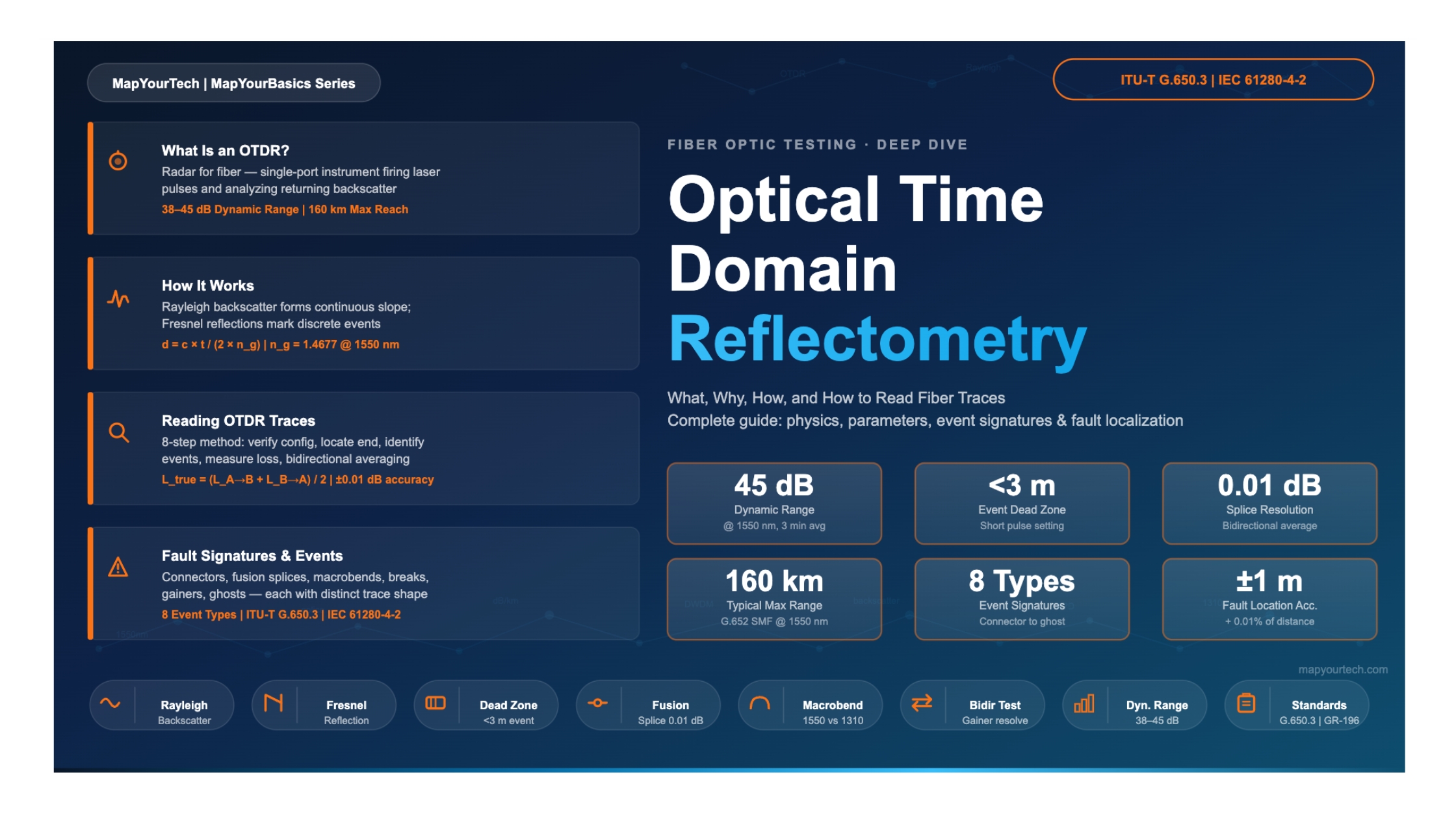
Optical Time Domain
Reflectometry: Complete Guide
What OTDR is, why it matters, how the technology works, and exactly how to read a fiber trace — with real event signatures explained.
Table of Contents
- Introduction
- What Is an OTDR?
- Why OTDR Is Used
- How OTDR Works
- Key OTDR Parameters
- Anatomy of an OTDR Trace
- Event Signatures in Detail
- How to Read OTDR Traces Step by Step
- What It Looks Like for Real Fiber
- Advanced Testing Techniques
- Fault Localization and Troubleshooting
- Standards and Compliance
- Conclusion
- References
1. Introduction
Fiber optic cables form the physical backbone of every modern communications network, from submarine cables crossing ocean floors to the last-mile drop connecting a household to a broadband exchange. Unlike copper infrastructure where continuity testers and simple ohm meters can locate a fault, optical fiber demands a fundamentally different approach. Light traveling through glass at speeds approaching 200,000 kilometers per second leaves no electrical signature, produces no voltage, and cannot be traced by conventional instruments. The Optical Time Domain Reflectometer (OTDR) was developed precisely for this environment.
An OTDR works on a principle analogous to radar: it fires a carefully controlled pulse of laser light into one end of the fiber, then listens for the faint echoes that return. Every imperfection in the glass — a splice, a connector, a bend, a crack — scatters or reflects a measurable fraction of that light back toward the instrument. By timing the delay between the outgoing pulse and each returning echo, and by measuring the intensity of those echoes, the OTDR builds a precise picture of the fiber link: where every event sits, how much loss it introduces, and whether the fiber terminates cleanly or catastrophically.
This article covers the full arc of OTDR knowledge: what the instrument is and why it was developed, the underlying physics that make it work, the key parameters that govern its performance, and — most practically — a detailed walkthrough of how to read a trace and recognize the distinct signature that every type of fiber event produces. Real-world scenarios from installation acceptance to fault repair are addressed throughout.
2. What Is an OTDR?
An Optical Time Domain Reflectometer is an optoelectronic instrument that characterizes an optical fiber by injecting a repetitive series of narrow laser pulses and measuring, as a function of time, the intensity of the light that is backscattered and reflected back to the instrument's input port. The measurement is displayed as a two-dimensional plot — commonly called an OTDR trace or OTDR signature — with distance along the fiber on the horizontal axis and accumulated optical loss in decibels on the vertical axis.
The underlying concept was first demonstrated in 1976 by Barnoski and Jensen, who showed that backscattering from a step-index optical fiber could be measured in the time domain to characterize fiber attenuation and locate defects. Commercial instruments became available in the early 1980s and have since evolved from large bench-top units into compact handheld field instruments that can store hundreds of traces, perform automated event analysis, and communicate wirelessly with asset management databases.
Modern OTDRs are single-port instruments: the laser source and the photodetector share the same optical port through a directional coupler. They do not require access to the far end of the fiber under test; a single technician at one cable end can characterize the entire link, locate faults to within a meter, and document the complete event table with loss values, reflectances, and cumulative insertion loss. This single-ended access capability is one of the principal reasons the OTDR became the dominant tool for fiber plant certification and maintenance.
2.1 OTDR Variants
Several specialized variants of the basic OTDR have been developed to meet specific application requirements. The Coherent OTDR (COTDR) uses optical heterodyne detection to achieve dramatically higher sensitivity, enabling measurement of ultra-long submarine fiber routes exceeding 10,000 km. The Polarization OTDR (P-OTDR) uses polarized test pulses to measure polarization mode dispersion (PMD) along the fiber. The Photon Counting OTDR (PC-OTDR or PhOTDR) uses single-photon avalanche detectors to push the noise floor down to single-photon levels, enabling characterization of extremely high-loss or ultra-long links. Distributed sensing variants — such as Brillouin OTDR (B-OTDR) — exploit the frequency shift of backscattered light to measure temperature and strain as distributed physical quantities rather than optical loss. For standard network certification and troubleshooting, the conventional pulsed OTDR remains the universal tool of choice.
3. Why OTDR Is Used
The OTDR serves three fundamental roles in the lifecycle of fiber optic infrastructure: installation acceptance, routine maintenance, and fault localization. Each role exploits a different capability of the instrument.
3.1 Installation Acceptance
When a new fiber cable is installed — whether as a direct-buried outside plant link, a blown-in data center backbone, or a building riser — every splice, connector, and segment of fiber must be documented before the cable is accepted from a contractor or placed into service. The OTDR provides this documentation in a standardized, auditable form. A trace file recorded at the time of installation becomes the baseline against which all future measurements are compared. Standards such as ITU-T G.650.3 and IEC 61280-4-2 define the measurement procedures and pass/fail thresholds that apply during acceptance testing.
3.2 Routine Maintenance and Performance Monitoring
Over the operational lifetime of a fiber plant — typically 20 to 25 years for outside plant infrastructure — individual events degrade. Connectors become contaminated or damaged. Splice closures admit moisture or experience differential thermal expansion. Cable sections are damaged by dig-ups, rodent activity, or freeze-thaw cycles. By performing periodic OTDR sweeps and comparing the results against the acceptance baseline, network operations teams can detect gradual degradation before it crosses the threshold that would cause a service outage. This predictive approach is especially valuable on submarine and long-haul terrestrial routes where repair costs are exceptionally high.
3.3 Fault Localization
When a fiber link fails — a cable cut, a connector failure, a splice that opens due to mechanical stress — the OTDR provides the fastest path to locating the fault. The instrument displays the distance to the anomalous event on the trace, and the technician can convert that distance into a physical location using cable route records, drum markers, and GPS coordinates. For a break in a buried cable, the OTDR measurement can direct the excavation crew to within one to two meters of the fault in a link spanning tens of kilometers, minimizing both excavation cost and restoration time.
4. How OTDR Works
The operating principle of an OTDR can be described in four interconnected stages: pulse generation, propagation and interaction with the fiber, backscatter collection and detection, and signal processing to produce the trace display.
4.1 Pulse Generation
A semiconductor laser — typically a distributed feedback (DFB) laser for single-mode OTDRs — is driven by a precision current pulse that switches the laser on and off with rise and fall times on the order of nanoseconds or faster. The pulse width can be selected by the operator over a range spanning from less than 1 ns to several microseconds, with the choice governing the trade-off between spatial resolution and dynamic range. The peak optical power launched into the fiber is typically in the range of 1 mW to 10 mW (0 to +10 dBm), though some instruments launch higher powers through optical amplifiers to extend their reach.
4.2 Rayleigh Backscattering
As the pulse propagates through the fiber core, it continuously encounters microscopic inhomogeneities in the silica glass — random density fluctuations frozen into the material during the fiber drawing process. These inhomogeneities scatter the light in all directions via Rayleigh scattering. A small but predictable fraction of this scattered light is captured within the fiber's numerical aperture and travels back toward the OTDR in the direction opposite to the original pulse. This continuous Rayleigh backscatter forms the sloped baseline of the OTDR trace: as the pulse travels deeper into the fiber, the returning backscatter is weaker both because the pulse has lost energy through attenuation and because the backscatter from more distant points must also travel back through the attenuating fiber. The result is a slope on the trace that directly encodes the fiber's attenuation coefficient in dB/km.
The Rayleigh backscatter coefficient S is approximately −78 dB for standard single-mode fiber at 1550 nm (relative to the guided power at that point), meaning that at any given position along the fiber, the power returning to the OTDR from the backscatter in a 1-ns window is about 78 dB below the instantaneous power of the pulse at that position. This low signal level is the fundamental challenge in OTDR design: the instrument must detect signals that are many orders of magnitude weaker than the outgoing pulse while the same detector is still recovering from the blinding reflection at the launch connector.
4.3 Fresnel Reflections
At any abrupt change in refractive index along the fiber path — an air gap at a connector interface, a cleaved fiber end, a mechanical splice with index-matching gel, or a fiber break — a fraction of the propagating power is reflected back toward the source as a discrete Fresnel reflection. The reflected power fraction at a glass-air interface is approximately 4%, or −14 dB relative to the incident power. APC (angled physical contact) connectors reduce this by tilting the end face at 8 degrees, scattering the Fresnel reflection out of the guided mode and reducing the reflected power to less than −60 dB. Fresnel reflections appear on the OTDR trace as sharp upward spikes superimposed on the background Rayleigh slope, and their peak height above the background is the event's reflectance in dB.
4.4 Time-of-Flight Distance Measurement
The OTDR measures distance by timing the round-trip travel of light between the instrument and each event. The speed of light in the fiber core is not the vacuum speed c but is reduced by the fiber's group refractive index ng, typically 1.4677 for standard G.652 single-mode fiber at 1550 nm and 1.4681 at 1310 nm. The operator must enter this value accurately, because distance is computed directly from it.
4.5 Signal Detection and Averaging
The returning backscattered signal is captured by the same optical port as the outgoing pulse, routed to a photodetector through a directional coupler (either a beam splitter or a circulator). The photodetector — typically a silicon avalanche photodiode (APD) for wavelengths below 1000 nm or an InGaAs APD for the 1300–1650 nm window — converts the optical signal to an electrical current that is then amplified and digitized. Because the Rayleigh backscatter signal is extremely weak, the OTDR acquires the waveform many thousands of times and averages the results coherently. Random noise averages toward zero while the deterministic backscatter signal is preserved. A doubling of the number of averages reduces the noise floor by 1.5 dB (3 dB SNR improvement), but beyond approximately 3 minutes of averaging the return on investment becomes marginal for most field measurements.
Figure 1: OTDR operating principle — the laser pulse travels along the fiber while continuous Rayleigh backscatter and discrete Fresnel reflections return to the detector. The resulting trace (lower-left) correctly shows increasing accumulated loss (upward) with distance, with all event types labelled.
5. Key OTDR Parameters
Understanding OTDR specifications requires familiarity with several interrelated parameters. A poorly configured OTDR — regardless of its intrinsic quality — will produce misleading or incomplete results. These are the parameters that most directly govern measurement quality.
5.1 Dynamic Range
Dynamic range is the most important figure of merit for an OTDR when testing long or high-loss links. It is defined as the difference in dB between the Rayleigh backscatter level at the fiber's input end (the top of the trace) and the noise floor of the instrument after a specified averaging time — commonly stated for a 3-minute acquisition. Modern field OTDRs achieve dynamic ranges of 38 to 45 dB at 1550 nm with a 3-minute acquisition. A 40 dB dynamic range, combined with G.652 fiber attenuation of 0.20 dB/km at 1550 nm, gives a theoretical maximum fiber reach of 200 km before the noise floor is reached; practical reach is somewhat shorter due to splices, connectors, and the need to maintain measurement accuracy above the noise floor.
5.2 Pulse Width
The pulse width is the duration of the laser pulse injected into the fiber, and it governs one of the OTDR's most fundamental trade-offs: spatial resolution versus dynamic range. A shorter pulse illuminates a shorter fiber segment at any given instant, concentrating the backscatter in time and therefore improving the OTDR's ability to resolve closely spaced events. A longer pulse carries more total energy into the fiber, increasing the strength of the returning signal and extending the instrument's reach. Typical selectable pulse widths range from 2.5 ns (corresponding to a spatial extent of approximately 25 cm in the fiber) to 20 µs (approximately 2 km). For link acceptance testing in data centers, pulse widths of 3 to 10 ns are typical. For long-haul backbone fiber testing at 1550 nm, pulse widths of 1 to 10 µs are commonly used.
5.3 Dead Zones
A dead zone is the stretch of fiber immediately following a reflective event where the OTDR detector is temporarily saturated or the event's pulse dominates the received signal, preventing reliable measurement. Two distinct dead zone definitions are used.
The event dead zone is the minimum distance between two reflective events such that the OTDR can detect the presence of a second event as a separate occurrence. It is measured from the peak of the first reflection to the point where the trace recovers to within 1.5 dB of the pre-event Rayleigh level. For modern instruments and short pulse widths, this can be less than 1 to 3 meters.
The attenuation dead zone is the distance following a reflective event required before the OTDR can make an accurate loss measurement. It is always longer than the event dead zone — typically 5 to 30 meters depending on the pulse width and reflectance level. A highly reflective connector (-14 dB) creates a much longer attenuation dead zone than a low-reflectance APC connector (-65 dB). This is why launch cables (also called pulse suppressors) are placed between the OTDR and the first connector of the link under test: they physically move the attenuation dead zone of the OTDR port's own connector into the launch cable rather than into the link, ensuring that the first connector of the actual fiber plant can be accurately measured.
5.4 Sampling Resolution and Sampling Interval
Sampling resolution is the distance between successive data points on the OTDR trace, determined by the digital sampling rate of the instrument's analog-to-digital converter. This is distinct from spatial resolution, which depends on pulse width. A typical OTDR samples the backscatter waveform at intervals of 0.1 to 4 meters depending on the distance range setting. For a 10 km range, a sampling interval of 1 meter is common; for a 200 km range, 20 to 50 meters is typical. Applications requiring precise measurement of closely spaced events — such as dense connector fields in a data center — benefit from shorter sampling intervals, achieved by reducing the measurement range setting.
5.5 Index of Refraction (Group Index)
Every OTDR must be programmed with the group refractive index of the fiber under test before accurate distance measurements can be obtained. The group index is wavelength-dependent: G.652 fiber has a group index of approximately 1.4681 at 1310 nm and 1.4677 at 1550 nm. Using the wrong value introduces a systematic distance error of approximately 200 to 400 meters per 100 km of fiber per unit of error in the group index, which is significant in long-haul fault location. The correct value is available from the fiber manufacturer's datasheet.
| Parameter | Typical Range | Short Pulse / Short Link | Long Pulse / Long Link |
|---|---|---|---|
| Dynamic Range | 25–45 dB | 25–35 dB | 38–45 dB |
| Pulse Width | 2.5 ns – 20 µs | 2.5–30 ns | 1–20 µs |
| Event Dead Zone | 0.8–8 m | <3 m (short pulse) | 5–30 m (long pulse) |
| Attenuation Dead Zone | 5–80 m | 5–15 m | 50–80 m |
| Sampling Resolution | 0.1–50 m | 0.1–1 m | 2–50 m |
| Distance Accuracy | ±1 m + 0.01% | ±0.5 m | ±5–20 m |
Table 1: OTDR parameter ranges and typical values for short-link versus long-link testing
6. Anatomy of an OTDR Trace
The OTDR trace is a two-dimensional graph that encodes the complete loss map of the fiber under test. Before attempting to interpret events, a thorough understanding of every component of the trace display is essential.
6.1 Axes and Display Convention
On all commercial OTDRs, the horizontal axis represents distance along the fiber in meters, kilometers, feet, or kilofeet as selected by the operator. The origin (zero distance) corresponds to the OTDR's optical port. The vertical axis represents accumulated optical loss in decibels relative to the power launched into the fiber at the origin. Since signal power decreases with distance, the vertical axis increases from bottom to top — a trace that slopes upward from left to right represents increasing accumulated loss with distance. This convention can initially be counterintuitive for engineers accustomed to power-versus-distance plots, where signal level decreases.
Some OTDRs offer an alternative "dBm" display mode that shows the actual backscatter power level in dBm rather than the accumulated loss relative to the launch. Both representations carry the same information, but the dB (loss) mode is more directly useful for reading event loss values.
6.2 The Rayleigh Backscatter Slope
Between discrete events, the trace follows a straight line whose slope is the fiber's attenuation coefficient in dB/km. For G.652.D single-mode fiber, this slope is approximately 0.34 dB/km at 1310 nm and 0.20 dB/km at 1550 nm. Any departure from a straight, consistent slope — a kink, a step change, or a section of different gradient — indicates a change in fiber characteristics, a localized loss event, or a measurement artifact. The operator uses the slope between events to compute the attenuation coefficient of individual fiber sections and to verify compliance with the fiber specification.
6.3 The Launch Reflection
The very beginning of the trace, at or near zero distance, shows a large positive spike. This is the Fresnel reflection from the OTDR's own output connector mating with the launch cable or directly with the fiber. Because this connector is within the OTDR's dead zone, it cannot be measured as a distinct event; its reflection saturates the detector and creates a bright spike whose width on the trace corresponds to the OTDR's own attenuation dead zone. The launch cable moves this dead zone so that the first connector of the actual fiber under test lies beyond it and can be accurately measured.
6.4 Events: Reflective and Non-Reflective
Every discrete occurrence along the fiber that causes either a loss, a reflection, or both is called an event. Events divide into two categories based on whether they produce a detectable Fresnel reflection at the OTDR. Reflective events (connectors, mechanical splices, fiber breaks with a flat cleave) appear as upward spikes on the trace, followed by a downward step as the post-event backscatter level is lower due to the loss introduced. Non-reflective events (fusion splices, macrobends, microbends) appear as a simple downward step with no preceding spike. The absence of a reflection spike from a fusion splice is one of the clearest indicators of good splice quality.
6.5 The End Reflection and Noise Floor
At the far end of the fiber, the cleaved or polished face of the terminated fiber produces a Fresnel reflection. For a flat-cleaved end in air, this reflection is approximately −14.7 dB, appearing as a large final spike on the trace. Beyond this end reflection, the trace drops sharply to the instrument's noise floor — a ragged, random-appearing region where the signal is below the detection threshold. The end reflection spike is the definitive marker of where the fiber ends, and its distance reading is used to confirm the total fiber length. APC-terminated fibers produce a much smaller end reflection (below −55 dB), which may appear as a very small spike or not at all if it falls below the noise floor; the end of such fibers is identified by the disappearance of the Rayleigh slope rather than by a distinct reflection.
Figure 2: Fully annotated OTDR trace showing all major feature types on a 50 km G.652 single-mode fiber link at 1550 nm. Vertical axis represents accumulated loss (dB); horizontal axis represents distance from the OTDR port.
7. Event Signatures in Detail
The most practically valuable skill in OTDR analysis is the ability to recognize each type of event from its trace signature and assign it to the correct physical cause. Each event type produces a characteristic combination of reflectance and loss that forms a unique fingerprint.
7.1 Connectors (UPC and APC)
A connector interface appears on the OTDR trace as a sharp upward spike — the Fresnel reflection — immediately followed by a downward step that represents the connector's insertion loss. The height of the spike above the background Rayleigh level is the connector's reflectance. For a standard UPC (ultra physical contact) connector, the reflectance is typically −40 to −55 dB; for an APC (angled physical contact) connector, it is typically −60 to −70 dB or better, so small it may be invisible on the trace above the Rayleigh background. Connector loss values typically range from 0.1 to 0.7 dB; values above 0.5 dB indicate a contaminated, damaged, or poorly mated connector that warrants inspection.
7.2 Fusion Splices
A well-executed fusion splice is the cleanest event type on an OTDR trace: a small downward step with no preceding reflection spike, indicating pure insertion loss without any reflectance contribution. Typical fusion splice loss values for single-mode fiber range from 0.01 to 0.05 dB with modern arc fusion splicers using automatic core alignment. Maximum acceptable values in most telecommunications standards are 0.1 dB for a standard splice and 0.05 dB for a low-loss critical splice. A fusion splice showing more than 0.1 dB loss, particularly with any visible reflectance spike, suggests poor core alignment, contaminated fiber ends, or an incorrect arc fusion profile for the fiber type being spliced. The apparent reflectance of a good fusion splice is effectively below −65 dB and is not distinguishable from the Rayleigh background.
7.3 Mechanical Splices
Mechanical splices — in which two fiber ends are butted against each other and held by a mechanical housing with index-matching gel — produce a moderate Fresnel reflection in addition to insertion loss. A good mechanical splice shows a reflectance of −35 to −55 dB and a loss of 0.1 to 0.5 dB. The index-matching gel reduces the Fresnel reflection to levels much lower than an air gap, but residual refractive index mismatch between the gel and the fiber core produces a visible spike. Mechanical splices are less common than fusion splices in new installations but remain in service in many legacy networks and are widely used in fiber to the premises (FTTP) drop fiber restoration.
7.4 Macrobends
A macrobend is a bend in the fiber whose radius of curvature is small enough to cause optical power to radiate out of the guided mode and into the cladding and beyond. On the OTDR trace, a macrobend appears as a region of increased slope — a section where the loss per kilometer is greater than the nominal Rayleigh attenuation of the fiber. Crucially, macrobend loss is highly wavelength-dependent: the loss at 1550 nm is significantly greater than at 1310 nm, because longer wavelengths have a larger mode field diameter and are less tightly guided. The ratio of loss at 1550 nm to loss at 1310 nm for a macrobend event typically exceeds 3:1, and can be 7:1 or higher for tight bends. This wavelength dependence is diagnostic: if an abnormal loss section appears at 1550 nm but is absent or much smaller at 1310 nm, a macrobend is the likely cause. G.657 bend-insensitive fiber specification categories (A1, A2, B2, B3) define minimum bend radii at which loss remains below specified limits.
7.5 Fiber Breaks
A complete fiber break appears as a sudden drop of the trace to the noise floor, preceded either by a reflective spike (if the break face is reasonably flat and clean, producing a Fresnel reflection) or by a simple vertical drop with no preceding spike (if the break is a crush, bend-induced fracture, or fiber stress break with rough fracture surfaces that scatter the end reflection out of the guided mode). The classification matters for troubleshooting: a reflective break is often a clean transverse break (possibly caused by a cable cut) that can be repaired by resplicing; a non-reflective break can indicate crushing damage to the cable where the fiber is shattered across a longer section, requiring cable replacement over that span. The distance to the break is read directly from the horizontal axis of the trace at the point where the slope abruptly ends.
7.6 Gainer Events
A gainer is an apparent negative loss — an upward step in the trace at the location of a splice — that suggests signal power has increased across the event. Gainers are artifacts of the OTDR measurement method, not physical amplification. They arise because the backscatter coefficient of optical fiber is not perfectly uniform: it depends on the fiber's dopant profile, numerical aperture, and waveguide geometry. When the fiber on the far side of a splice has a higher backscatter coefficient than the fiber on the near side, it returns more light per unit of power to the OTDR for the same distance increment, making the post-splice section appear brighter than expected. The OTDR interprets this as a gain. The true insertion loss of the splice is non-negative (no passive splice amplifies light) and can be recovered by performing bidirectional measurements and averaging the results from both directions.
7.7 Ghost Reflections
A ghost (or echo) is a false event appearing on the trace at a distance that is twice the actual distance to a highly reflective event. It arises when the Fresnel reflection from a connector or cleaved fiber end is itself partially re-reflected at the launch connector (or another earlier event) and makes a second round trip before reaching the detector. Because it has traveled twice the round-trip distance of the original event, it appears at twice the distance. Ghosts can be identified by several characteristics: the apparent distance to the ghost is an integer multiple of the distance to a real highly reflective event, the ghost has a reflectance equal to the sum of twice the attenuations involved and the original event's reflectance, and the ghost produces no associated Rayleigh slope change (because no actual fiber segment follows it at that point). Reducing connector reflectance — by using APC connectors or ensuring perfect UPC contact — eliminates or reduces ghost reflections.
UPC Connector
Sharp spike + downward loss step. Most common event type in fiber plants.
Reflectance: -40 to -55 dB
Loss:        0.1 – 0.7 dB
Spike:       Visible, sharp
Max allowed: 0.5 dB loss
APC Connector
Tiny or invisible spike; pure loss step. 8° angled end face redirects Fresnel reflection.
Reflectance: < -60 dB
Loss:        0.1 – 0.5 dB
Spike:       Very small / absent
Usage:       DWDM, analog, coherent
Fusion Splice
Clean downward step, no spike. Best splice method for permanent links.
Reflectance: < -65 dB (invisible)
Loss:        0.01 – 0.05 dB typical
Max allowed: 0.1 dB (telecom grade)
Spike:       None on good splice
Mechanical Splice
Moderate spike + loss step. Index gel reduces but doesn't eliminate reflection.
Reflectance: -35 to -55 dB
Loss:        0.1 – 0.5 dB
Gel present: Reduces Fresnel
Application: Field restoration
Macrobend
Section of steeper slope. Worse loss at 1550 nm than 1310 nm — diagnostic ratio >3:1.
Reflectance: N/A (no spike)
Loss ratio:  1550/1310 > 3:1
Cause:       Tight cable bend
Fix:         Relieve bend; use G.657
Fiber Break (clean)
End-of-trace spike then noise floor. Flat fracture face acts as mirror.
Reflectance: -14 to -45 dB
Loss:        Total (link ends)
Spike:       Present (clean break)
Fix:         Resplice at break point
Gainer Event
Apparent upward step at splice — NOT real gain. Caused by backscatter mismatch between dissimilar fibers.
Apparent loss: Negative (< 0 dB)
True loss:     Non-negative
Resolution:    Bidirectional avg
Formula:       L_true = (LAB + LBA)/2
Ghost Reflection
False event at 2× distance of real reflector. No associated slope change or attenuation.
Distance:    2n × real event
No slope:    Trace continues flat
No loss:     No step at ghost
Elimination: Use APC connectors
8. How to Read OTDR Traces Step by Step
Reading an OTDR trace accurately is a learnable analytical process. The following step-by-step method applies to single-trace analysis; bidirectional analysis adds a further step of averaging that is addressed separately.
Step 1 — Verify Configuration Before Analyzing
Before interpreting any event values, confirm that the OTDR was configured correctly for the measurement. The three most critical settings are the group refractive index (must match the fiber manufacturer's specification for the test wavelength), the wavelength (must match the intended service band or acceptance test specification), and the pulse width (must be appropriate for the fiber length — too long a pulse on a short link will mask events in the extended dead zone). If these settings were incorrect, all distance and loss values are suspect.
Step 2 — Identify the Fiber End
Locate the end reflection at the far right of the trace — the final large spike before the trace drops to the noise floor. The horizontal position of this spike is the total fiber length. Cross-check this value against the cable manufacturer's reel length record. A discrepancy of more than 0.5% (after accounting for any coiled slack, excess cable at splice closures, or known routing deviations) may indicate a wrong group index setting, a mistake in the cable routing, or that the trace is not capturing the full fiber length.
Step 3 — Count and Locate All Events
Scan the trace from left (near end) to right (far end) and identify every discontinuity: each spike (reflective event) and each non-reflective step. Record the distance to each event in a table. For spans with many events, zoom the trace horizontally to inspect each event individually — a feature present on all modern OTDRs. Do not skip the region immediately beyond the launch dead zone; the first connector of the link under test is located here, and it is frequently the highest-loss element in the entire span.
Step 4 — Measure Event Loss
The loss of each event is measured by placing one cursor on the Rayleigh slope just before the event and a second cursor on the slope just after the event, then reading the difference in the accumulated loss values at these two cursor positions. Most OTDRs automate this with an event detection algorithm that identifies events above a configurable threshold and populates an event table automatically. However, the operator should always visually verify the automated event table, particularly for closely spaced events where the dead zone of one event may partially obscure the next, and for gainer events where the software may incorrectly report negative loss without flagging it for manual review.
Step 5 — Measure Event Reflectance
For reflective events, the reflectance is measured by comparing the height of the Fresnel reflection spike to the Rayleigh backscatter level at the same fiber position. The OTDR software performs this comparison automatically and reports reflectance in dB (a negative value: −45 dB, for example). A more negative reflectance value indicates a lower-reflectance (better quality) connector or end face. Reflectance should be checked against the system's ORL budget; high-reflectance events degrade laser stability and OSNR in directly modulated and coherent systems.
Step 6 — Measure Section Attenuation
For each fiber segment between events, measure the attenuation coefficient by placing cursors at each end of the segment and computing the loss per unit length. The two-point cursor method (also called the LSA, or least-squares approximation method) places a best-fit line through a section of the Rayleigh slope and computes the slope coefficient; this is more accurate than a simple two-point reading because it reduces the influence of noise. The result should be compared against the fiber's specified attenuation coefficient; a section showing significantly higher attenuation than the nominal value may have been bent, stressed, or replaced with an incorrect fiber type during a repair.
Step 7 — Check Cumulative Loss
Sum all event losses (splices, connectors) and multiply all section lengths by their attenuation coefficients to compute the total link loss. Compare this value against the link's power budget to verify that sufficient optical margin remains. For a 50-channel DWDM system, the per-channel power budget can be as tight as 20 to 25 dB for a long-haul amplified link; each decimal point of excess loss above the budgeted value reduces the available system margin.
Step 8 — Bidirectional Averaging for Accurate Splice Loss
OTDR splice loss measurements from a single direction are subject to systematic error when the fibers on either side of the splice have different backscatter coefficients — as is almost always the case to some degree. The true splice loss is the arithmetic average of the loss measured in both directions:
The bidirectional averaging method is mandated by ITU-T G.650.3 for acceptance testing of optical fiber links where splice loss certification is required, and is the correct approach for resolving gainer events.
Summary — Reading an OTDR Trace
- Verify group index, wavelength, and pulse width settings before reading any values.
- Locate the fiber end reflection to confirm total fiber length.
- Identify every event (spike = reflective; step = non-reflective), measure loss and reflectance for each.
- Measure section attenuation coefficients and compare to fiber specification.
- Compute total cumulative loss and verify against the power budget.
- Perform bidirectional testing and average splice losses to resolve gainers and get certified values.
9. What It Looks Like for Real Fiber — Scenario-Based Trace Interpretation
Abstract trace features become meaningful when associated with real physical scenarios. The following section describes the OTDR trace appearance for seven common real-world fiber conditions, from a healthy installed link to various degradation and failure scenarios.
9.1 Healthy New Installation
A properly installed single-mode fiber link — clean connectors, well-executed fusion splices, no tight bends — produces a trace whose dominant features are: a steep launch spike at distance zero, a straight and uniformly sloped Rayleigh baseline with a gradient matching the fiber specification, small non-reflective steps at fusion splices (each below 0.1 dB), small reflective spikes at connector interfaces (each below 0.5 dB loss), and a clean end reflection at the link's nominal cable length. The trace is smooth between events, with no kinks, no step changes in slope, and no unexpected features. The noise floor is well below the end reflection. This trace, stored as a baseline, is the reference document against which all future measurements are compared.
9.2 Contaminated Connector
A dirty connector — the most common source of fiber plant trouble in data centers and access networks — presents on the OTDR trace as an unusually large loss step at the connector's position, often exceeding 1 dB (versus a normal 0.1 to 0.4 dB for a clean connector), accompanied by an elevated Fresnel reflection spike. The reflectance value may rise from a normal −50 dB to −30 dB or higher as surface contamination breaks the physical contact between the two end faces and introduces an air gap. A single contaminated connector in a DWDM channel can consume an entire system's optical margin. After cleaning and reinspecting the connector with a fiber inspection microscope, the OTDR trace should be retaken to confirm that the event returns to specification.
9.3 Cable Dig-Up (Complete Fiber Break)
When an excavating machine severs a fiber cable, the OTDR trace shows the link ending abruptly at the break distance. If the cable was cleanly cut and the fiber end face is approximately flat, a Fresnel reflection spike appears at the break point before the trace drops to the noise floor. If the cable was crushed or the fiber shattered, the trace ends with a non-reflective abrupt drop to the noise floor. In both cases, the horizontal position of the trace termination gives the distance to the fault. The field repair crew uses the OTDR distance together with cable route markers and GPS coordinates to locate the dig site. After repair (typically by fusion splicing the break using a slack loop or by installing a repair section of cable), the OTDR confirms that the splice loss is within specification and that no other damage was introduced during the repair.
Figure 3: Four real-fiber trace scenarios — healthy installation, contaminated connector, clean cable break, and macrobend with wavelength comparison. All traces use correct dBm power display (descending slope) with clipPath enforcing strict panel boundaries.
9.4 Water Ingress
Water entering a fiber cable through a compromised sheath or splice closure initially increases the fiber's attenuation at the OH absorption peak near 1383 nm. On a standard OTDR trace at 1310 or 1550 nm, the effect may appear as a gradual increase in slope over the affected cable section rather than a sharp event. The definitive diagnosis is made by testing at 1383 nm: if the loss at this wavelength is significantly higher than at 1310 nm and 1550 nm over the same section, water ingress is confirmed. G.652.D and G.657 fibers are specified with reduced water peak attenuation (below 0.4 dB/km at 1383 nm), providing a larger margin before water ingress becomes a problem. Older G.652.A and G.652.B fibers have a natural water peak that is much higher, making 1383 nm testing less diagnostic for legacy links.
9.5 Splice Degradation Over Time
A fusion splice that was properly executed at installation but gradually degrades in service — due to mechanical fatigue from thermal cycling, moisture ingress into an unsealed closure, or mechanical stress from settlement — will show an increasing loss step on successive OTDR measurements. Comparing the current measurement against the baseline confirms that the event loss has increased over time. The rate of increase is also informative: a rapid increase over weeks suggests active mechanical stress or ongoing moisture intrusion, while a slow increase over years suggests long-term thermal or chemical degradation. In either case, the fusion splice should be re-executed in a new splice closure as part of proactive maintenance before the loss crosses the threshold that will affect service quality.
9.6 Wrong Fiber Type Introduced During Repair
If a repair splice is made between the original fiber and a replacement section of a different fiber type — different mode field diameter, different numerical aperture, or even a multimode fiber spliced to a single-mode fiber — the OTDR trace shows a pronounced gainer or a very large splice loss at both splice interfaces. More diagnostically, the slope of the replacement section differs from the original fiber (since the attenuation coefficient differs), and the backscatter level at the splice shows a discontinuous step change corresponding to the backscatter coefficient mismatch. Testing at multiple wavelengths is helpful: a section of 50/125 µm multimode fiber inadvertently spliced into a single-mode link will show a dramatically different attenuation coefficient, and the splice loss to and from the multimode section will exceed 10 dB in some cases.
10. Advanced Testing Techniques
10.1 Multi-Wavelength Testing
Testing a fiber link at multiple wavelengths simultaneously — or sequentially with the same instrument — provides diagnostic information unavailable from single-wavelength measurements. The standard approach for G.652 single-mode fiber is to test at 1310 nm and 1550 nm simultaneously, which are the two primary service bands and the wavelengths specified for acceptance testing by IEC 61280-4-2. For in-service monitoring of live DWDM traffic, a third wavelength at 1625 nm (or 1650 nm for legacy recommendations) is used, since this wavelength lies outside the C and L service bands and can be injected without disrupting live traffic. Comparing the attenuation coefficient at 1550 nm and 1625 nm is sensitive to macrobend effects, which increase more sharply at longer wavelengths.
For FTTP and access network deployments, testing at 1490 nm and 1550 nm (or 1577 nm for G-PON systems) is common, and the 1310 nm upstream window is tested for ONT transmitter performance. Water peak measurement at 1383 nm is included in the acceptance test procedure for legacy G.652.A and G.652.B fibers, and as a diagnostic test when water ingress is suspected in any fiber type.
10.2 Launch and Receive Cables
A launch cable (also called a dead zone box or pulse suppressor) is a spool of single-mode fiber — typically 100 m to 2 km in length — inserted between the OTDR's test port and the fiber under test. Its purpose is to move the OTDR's internal connector dead zone entirely into the launch cable, ensuring that the first connector of the link under test is visible and measurable. The launch cable must match the type of fiber under test (same core diameter, mode field diameter, and numerical aperture), and its own connectors must be of good quality. A receive cable at the far end of the link serves the complementary purpose of ensuring that the last connector of the link is measurable rather than buried in the noise floor at the trace's far end. For links shorter than the OTDR's attenuation dead zone (which at the widest pulse widths can exceed 100 m), both launch and receive cables are indispensable. Their lengths should exceed the OTDR's specified attenuation dead zone for the pulse width in use.
10.3 Intelligent OTDR (iOLM) and Automated Analysis
Modern field OTDRs increasingly incorporate intelligent optical link mapping (iOLM) capability, which performs a series of sequential OTDR acquisitions at progressively longer pulse widths, overlaps the results in a single measurement, and applies automated event detection and classification algorithms to produce a link map that shows every event type, loss, reflectance, and location. The iOLM approach addresses one of the fundamental limitations of fixed-pulse-width OTDR testing: using a single pulse width inevitably compromises either dead zone performance or dynamic range. By stitching together multiple pulse widths, iOLM achieves the dead zone performance of the shortest pulse with the dynamic range of the longest. The operator reviews the resulting link map rather than interpreting a raw trace, which reduces the skill level required for routine field measurements while still producing certification-grade data.
11. Fault Localization and Troubleshooting
Systematic fault localization with an OTDR follows a methodical process from system-level alarm analysis to physical excavation and repair. The steps below represent the protocol used by most major telecommunications operators and cable owners.
11.1 Step 1 — Confirm the Fault Exists and Identify Its Nature
Before deploying an OTDR, network management system (NMS) alarms should be reviewed. A complete loss-of-signal alarm on all channels simultaneously suggests a fiber break or catastrophic connector failure. Degraded optical signal-to-noise ratio (OSNR) on specific channels without complete loss suggests a partial attenuation increase, possibly from a macrobend, partial splice failure, or contaminated connector. Wavelength-dependent alarms (some channels affected, others not) can indicate wavelength-specific absorption or ROADM passband degradation rather than a fiber event. This initial analysis determines whether the OTDR is the appropriate first instrument or whether other tools (optical spectrum analyzer, power meter) should be used first.
11.2 Step 2 — Configure the OTDR for the Fault Distance Range
If the NMS provides any indication of the approximate fault location (based on previous testing records or cable route distance to the alarm-indicating network element), configure the OTDR with a measurement range slightly beyond that distance. Use the shortest pulse width that provides adequate signal at the fault distance — a longer pulse is appropriate for distant faults to ensure the signal remains above the noise floor. For a suspected break at 30 km on G.652 fiber at 1550 nm, a pulse width of 100 to 300 ns and a range of 40 km would be appropriate starting settings.
11.3 Step 3 — Identify the Fault on the Trace and Calculate Physical Location
Once the OTDR trace shows the fault (a spike followed by noise floor for a break, or an excessive loss step for a partial failure), record the distance value precisely. Apply any known cable routing factor (the ratio of fiber route length to physical distance between endpoints — typically 1.01 to 1.05 for buried cables accounting for burial depth variation, S-bend routing in ducts, and slack at splice closures) to convert the OTDR distance into a physical distance from the cable access point. Cross-reference this distance against the cable route documentation and GPS records to identify the geographic location of the fault.
11.4 Common Fault Signatures and Their Physical Causes
| OTDR Signature | Physical Cause | Recommended Action |
|---|---|---|
| Large spike + abrupt end of trace | Clean cable cut; fiber break with flat end face | Locate by GPS; fusion splice repair |
| Abrupt end of trace; no spike | Crush damage; multi-fiber shatter | Replace cable section; verify no scatter |
| Large loss step at connector location | Contaminated or damaged connector | Inspect with microscope; clean or replace |
| High reflectance at connector (>−30 dB) | Air gap; broken ferrule; cracked end face | Replace connector; re-terminate |
| Increased slope section; worse at 1550 nm | Macrobend from cable kink or tight routing | Re-route cable; increase bend radius |
| Gainer at splice; A→B negative loss | Backscatter mismatch; different fiber types | Bidirectional test; average to find true loss |
| Ghost spike at 2× connector distance | Echo from high-reflectance connector | Clean or replace UPC with APC connector |
| Increasing splice loss over time | Mechanical fatigue; moisture in closure | Re-splice; inspect and reseal closure |
| High loss at 1383 nm; normal at 1310/1550 | Water ingress; OH absorption | Locate and seal cable sheath breach |
| Step change in slope without event | Wrong fiber type in repair section | Test both ends; verify fiber type consistency |
Table 2: OTDR fault signatures, physical causes, and recommended corrective actions
12. Standards and Compliance
OTDR measurements for telecommunications are governed by a body of international standards that specify test procedures, parameter definitions, pass/fail criteria, and documentation requirements. Compliance with these standards is typically mandatory for carrier-grade fiber plant acceptance and is often a contractual requirement in network construction and maintenance agreements.
ITU-T G.650.3 defines test methods for characterizing optical fiber cable links and optical fiber cabling infrastructure, including OTDR measurement procedures for bidirectional splice loss averaging. It is the foundational standard for OTDR methodology in ITU-member countries. IEC 61280-4-2 specifies the OTDR measurement procedures for installed optical fiber cabling systems, defining the test configurations, calibration requirements, and reporting formats. TIA-526-7 provides the equivalent North American standard for single-mode fiber OTDR testing, while TIA-526-14 covers multimode fiber systems. For in-service testing of live networks, ITU-T G.697 defines OTDR testing at wavelengths outside the service band (typically 1625 or 1650 nm). GR-196, published by Telcordia, specifies generic requirements for OTDR equipment used by North American exchange carriers.
| Standard | Title | Scope |
|---|---|---|
| ITU-T G.650.3 | Test methods for installed optical fiber cable links | OTDR procedures; bidirectional averaging |
| IEC 61280-4-2 | Fiber-optic communication sub-system test procedures | Installed cabling OTDR procedures |
| TIA-526-7 | OFSTP-7: OTDR measurement of installed single-mode fiber | North American SM OTDR testing |
| TIA-526-14 | OFSTP-14: OTDR measurement of installed multimode fiber | North American MM OTDR testing |
| IEC 60793-1-40 | Attenuation measurement methods for optical fibers | OTDR as one of several approved methods |
| ITU-T G.697 | Optical monitoring for DWDM systems | In-service out-of-band OTDR testing |
| GR-196 | Generic requirements for OTDR equipment | Equipment specs for US telco use |
Table 3: Key international and regional standards governing OTDR testing and equipment
13. Conclusion
The Optical Time Domain Reflectometer remains, after nearly five decades, the single most powerful tool for characterizing, commissioning, and maintaining optical fiber infrastructure. Its ability to make a complete, spatially resolved loss map of an entire fiber link from a single access point — without requiring a technician at the far end — makes it uniquely suited to both planned acceptance testing and emergency fault localization across networks spanning from data center patch panels to transoceanic submarine systems.
The fundamental physics that governs the OTDR — Rayleigh backscattering for the continuous slope, Fresnel reflection for discrete events, and time-of-flight for distance measurement — has not changed since the instrument's invention. What has changed is the sophistication of the implementation: higher dynamic range, shorter dead zones, intelligent multi-pulse acquisition for simultaneous resolution and reach, and automated event detection algorithms that can classify events and populate pass/fail certifications with minimal operator intervention.
Reading OTDR traces accurately requires understanding both the instrument's behavior and the physics of the fiber events it reveals. A clean fusion splice produces no reflection and a tiny loss step; a dirty connector produces a large spike with elevated reflectance; a macrobend produces a wavelength-dependent slope increase; a fiber break ends the trace. Each signature is distinct, physically explainable, and actionable. The engineer who can read these signatures fluently can diagnose network problems in minutes that would otherwise require hours of systematic fault isolation.
As fiber deployments expand into ever more demanding applications — 400G coherent transport over transoceanic distances, millimeter-precision sensing for structural monitoring, and hollow-core fiber links requiring new OTDR methodologies for accurate IOR calibration — the principles described in this article remain the essential foundation on which all more advanced techniques are built.
Try It Yourself — MapYourOTDR Simulator & SOR Viewer
Want to put these concepts into practice? The MapYourOTDR tool lets you simulate OTDR traces, adjust parameters like pulse width and dynamic range, and read real .sor files directly in your browser — no software installation needed.
Upload your own SOR file to visualize events, measure splice loss, and explore the exact trace shapes described in this article.
References
- ITU-T Recommendation G.650.3 – Test and measurement methods for installed optical fibre cable links.
- IEC 61280-4-2 – Fibre-optic communication subsystem test procedures —Installed cabling plant — Optical time-domain reflectometer measurements.
- TIA-526-7 – Measurement of Optical Power Loss of Installed Single-Mode Fiber Cable Plant (OTDR method).
- ITU-T Recommendation G.652 – Characteristics of a single-mode optical fibre and cable.
- ITU-T Recommendation G.657 – Characteristics of a bending-loss insensitive single-mode optical fibre and cable.
- GR-196-CORE, Issue 2 – Generic Requirements for Optical Time Domain Reflectometer (OTDR)-Type Equipment, Telcordia.
- ITU-T Recommendation G.697 – Optical monitoring for DWDM systems.
- Sanjay Yadav, "Optical Network Communications: An Engineer's Perspective" – Bridge the Gap Between Theory and Practice in Optical Networking.
Developed by MapYourTech Team
For educational purposes in Optical Networking Communications Technologies
Note: This guide is based on industry standards, best practices, and real-world implementation experiences. Specific implementations may vary based on equipment vendors, network topology, and regulatory requirements. Always consult with qualified network engineers and follow vendor documentation for actual deployments.
Feedback Welcome: If you have any suggestions, corrections, or improvements to propose, please feel free to write to us at [email protected]
Related Articles on MapYourTech