
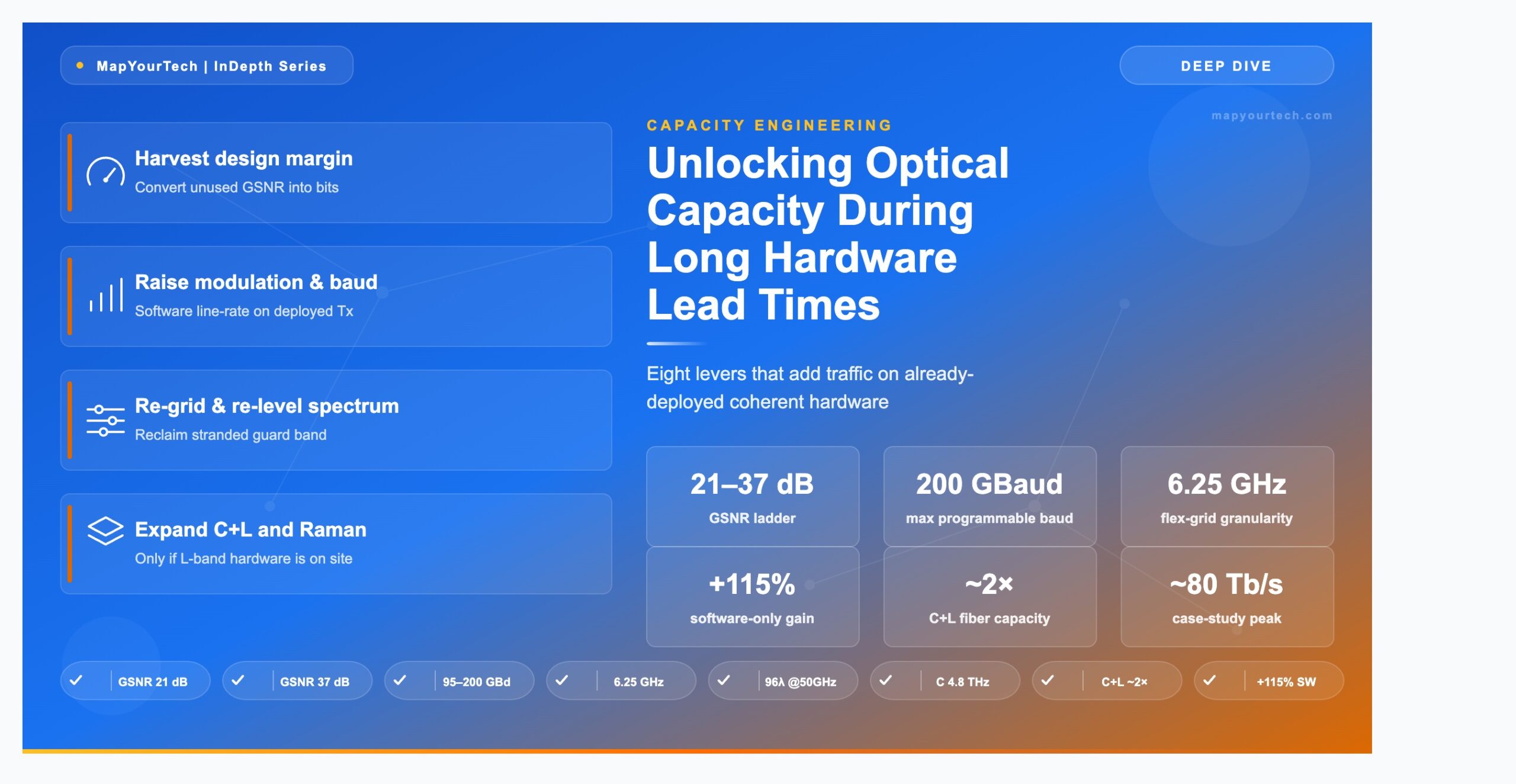
Unlocking Optical Capacity During Long Hardware Lead Times
New transponders arrive 9 to 12 months after the purchase order. This deep dive quantifies how much traffic an operator can add in the meantime — nine levers from harvesting design margin on deployed coherent hardware, through spectrum and line-system reconfiguration, to sourcing the right technology from a short-lead-time vendor when a route is finally tapped out.
1. Introduction: the lead-time gap
A purchase order for a new coherent line card today returns a delivery date 9 to 12 months out, and at the worst of the 2021–2022 component cycle that window stretched past a full year. Component lead times across the optical supply chain exploded from roughly 8–12 weeks in early 2020 to about a year by late 2022, eased through 2024, and remain volatile into 2026 because AI-cluster demand for 800G ZR/ZR+ is pulling the same wafer capacity that line-system optics depend on. The traffic curve does not wait for the supply curve. A backbone carrying 30–40% compound annual growth on a route will exhaust a provisioned wavelength plan inside the lead-time window of the hardware meant to relieve it.
The reflex response — order more transponders, light more fiber pairs — is exactly the action the lead time blocks. The question this article answers is the opposite one: how much additional traffic can a route carry before any new hardware lands, using only the transponders, amplifiers, and spectrum already deployed? The answer is larger than most capacity plans assume, because the gap between how a line system is provisioned and how it actually performs is wide, measurable, and recoverable.
Three properties of a coherent line system make this possible. Coherent transponders are software-defined: a single line card sweeps from QPSK to 64QAM, from 60 GBaud to 200 GBaud, and across a continuum of line rates set by probabilistic constellation shaping, all without a hardware change. Deployed links carry conservative margin, because a network designer who provisions for end-of-life fiber loss, worst-case temperature, and aging amplifiers leaves headroom that the link does not consume on day one. And the modern flex-grid line system can re-slice spectrum that a fixed 50 GHz plan stranded. Each of these is a lever an operator can pull from a management session, on a maintenance window, without a truck roll for new equipment.
This article covers nine levers in sequence, from the physics of recoverable headroom outward to the line system and the supply chain. The first three are transponder-level — margin harvesting, modulation order, and baud rate. The next five are spectrum-level and system-level: flex-grid re-gridding, software and license capacity activation, C-band fill and launch-power optimization, the C+L and Super-C band expansions, and Raman retrofits, wrapped in the operational discipline of a margin-recovery program. The ninth closes the ladder: when a route is genuinely tapped out, sourcing the needed technology from a short-lead-time vendor. Every number here is tied to a public standard, a peer-reviewed result, or a published vendor specification, with the source named in the same sentence.
The nine levers at a glance
The nine levers form a sequence, not a menu. The order is set by two questions asked at every step: does the lever need new hardware, and how much live traffic does applying it disturb. The cheapest, least disruptive levers run first; the supply chain is the last resort. Figure 1 maps the full decision flow before the rest of the article works through each lever in turn.
What "capacity" means on a route
Route capacity is the product of three terms: the number of wavelengths a fiber pair carries, the bits each wavelength carries per second, and the number of fiber pairs in service. A fixed 96-channel C-band plan at 50 GHz spacing running 400G per wavelength delivers 38.4 Tb/s per fiber pair. The same fiber, re-gridded and pushed to a higher modulation order where reach allows, can carry meaningfully more — and the increment is bits the operator already paid for in the transponder's silicon. The levers in this article move the second term (bits per wavelength) and the first term (wavelengths per fiber), without touching the third (new fiber or new line cards).
Read the Full Analysis with Premium
The remaining 89% of this article — the design numbers, trade-offs and field guidance — is part of MapYourTech Premium, along with the full premium library, courses and professional tools.
You May Also Like
-
Free
-
September 4, 2026
-
Premium
-
September 4, 2026
-
Premium
-
September 4, 2026