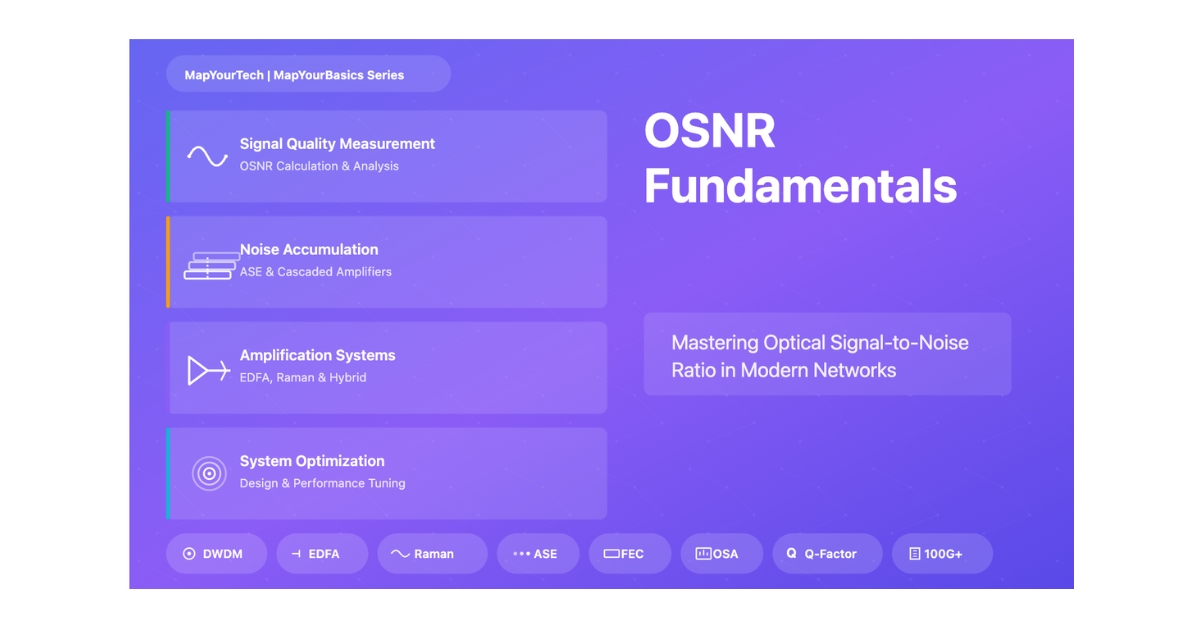
MapYourTech · MapYourBasics Series
OSNR Fundamentals
Optical signal-to-noise ratio from first principles — the physics of ASE, the 58 formula, modulation-format thresholds, and link budgeting you can run yourself.
Introduction
Optical signal-to-noise ratio is the dominant performance parameter in an amplified optical link, because it sets the bit error rate the receiver must work with and the distance a wavelength can travel before regeneration. OSNR is the ratio of optical signal power to optical noise power inside a defined reference bandwidth — conventionally 0.1 nm, about 12.5 GHz at 1550 nm, measured on an optical spectrum analyzer. This guide builds OSNR from the physics of amplified spontaneous emission, derives the planning formula engineers actually use, maps OSNR to modulation-format reach, and gives you four calculators to run link budgets directly. It is written for the engineer who has to answer a concrete question: will this wavelength close over this route, and what is the margin?
Definition: OSNR (dB) = 10·log₁₀(Psignal / Pnoise), with Pnoise the amplified-spontaneous-emission power integrated over the 0.1 nm reference bandwidth.
1. Fundamentals and Core Concepts
Why OSNR degrades
Every optical amplifier on a route injects amplified spontaneous emission alongside the signal it boosts. That noise never disappears: the next amplifier amplifies both the signal and the ASE that preceded it, then adds its own fresh ASE on top. The dominant mechanisms are:
Where OSNR is the binding constraint
- Long-haul networks spanning hundreds to thousands of kilometres with many amplifiers
- High-rate systems at 100G, 400G and beyond, which need higher OSNR for the same reach
- High-order modulation such as 16-QAM and 64-QAM, which are far more sensitive to noise than QPSK
- Dense WDM systems where many channels share the amplifier gain budget
- Submarine systems with 50 or more amplifiers, where OSNR is the reach-limiting factor
Operational consequences
OSNR sets the receiver bit error rate, and BER falls steeply as OSNR rises: roughly 20 dB OSNR can support a pre-FEC BER near 10-12 for QPSK, while 15 dB pushes it toward 10-9. It bounds how far a signal travels before regeneration, and it acts as the quality-of-service metric at the physical layer — degradation there surfaces as packet loss at higher layers. Most design decisions trace back to it: amplifier count, span spacing, modulation choice, and FEC strength.
Takeaway: No amount of receiver DSP recovers OSNR that was never delivered. ASE added in the line is permanent; the only levers are lower-noise amplifiers, shorter spans, distributed gain, or stronger FEC.
2. Mathematical Framework
Core definitions
OSNR definition
OSNR = Psignal / Pnoise
OSNR (dB) = Psignal(dBm) − Pnoise(dBm)
Where: Psignal is the per-channel optical power and Pnoise is the ASE power measured in the reference bandwidth (12.5 GHz / 0.1 nm).
The planning formula (the “58” form)
For a single amplified span where the amplifier exactly compensates the preceding loss, the per-span OSNR is:
Per-span OSNR
OSNRspan (dB) = 58 + Plaunch − Lspan − NF
Where:
- Plaunch: per-channel power launched into the span (dBm)
- Lspan: span loss the amplifier must overcome (dB)
- NF: amplifier noise figure (dB), 4–6 dB for a typical EDFA
- 58: the magnitude of 10·log₁₀(h·ν·Δf) at 193.4 THz over a 12.5 GHz (0.1 nm) reference — note the sign is +58, not −58
For N identical spans, the ASE powers add, so the receiver OSNR drops by 10·log₁₀(N):
Multi-span receiver OSNR
OSNRRX (dB) = 58 + Plaunch − Lspan − NF − 10·log₁₀(N)
The amplifier gain G does not appear: OSNR is a ratio, and gain acts equally on signal and noise, so it cancels. This is the same relation the EDFA design literature uses for first-order budgeting.
Practical Example — 400 km link with five EDFA spans.
System: launch 0 dBm/channel, fiber 0.25 dB/km, 80 km spans (5 spans), NF 5 dB.
Span loss L = 0.25 × 80 = 20 dB.
Per-span OSNR = 58 + 0 − 20 − 5 = 33 dB.
Receiver OSNR = 33 − 10·log₁₀(5) = 33 − 7.0 = 26 dB.
A 26 dB receiver OSNR closes QPSK and 8-QAM with margin and supports 16-QAM with FEC. The link is comfortably feasible — the binding constraint at this reach is nonlinear penalty from launch power, not ASE.
Common error: writing per-span OSNR as “PTX + G − L − NF” produces a near-zero or negative number and wrongly condemns a healthy link. The amplifier gain cancels; the bandwidth constant (+58) is what sets the scale. Always anchor to the 58 form.
OSNR, Q-factor and BER
Q-factor from OSNR
QdB = OSNRdB + 10·log₁₀(Bo / Be)
Where: Bo is the optical reference bandwidth and Be the electrical receiver bandwidth.
BER from Q-factor
BER = ½ · erfc(Q / √2)
The Q-factor / BER relationship is the bridge from a physical-layer OSNR number to an error rate: a Q of about 7.0 (16.9 dBQ) corresponds to a pre-FEC BER near 10-12. Modern coherent links operate at far higher pre-FEC BER and lean on strong FEC to reach an error-free post-FEC floor.
3. Noise Sources, Amplifiers and Modulation
Noise sources
| Noise source | Description | Typical impact | Mitigation |
|---|---|---|---|
| ASE | Spontaneous emission in the EDFA gain medium amplified with the signal | Primary source; sets per-span OSNR via NF | Low-NF amplifiers, optimal pump power |
| Spontaneous Raman scattering | Random scattering in Raman amplifiers from pump-phonon interaction | Distributed along the fiber | Counter-pumping, distributed gain |
| Receiver thermal noise | Electronic noise in the photodetector and front end | Fixed floor, dominant at low received power | Low-noise detectors |
| Shot noise | Quantum noise from discrete photon arrivals | Fundamental quantum limit | Cannot be removed, only minimised |
Amplifier choice and its OSNR cost
| Amplifier type | Noise figure | OSNR impact | Best use case |
|---|---|---|---|
| EDFA (single stage) | 5–6 dB | Baseline | General purpose, cost-effective |
| EDFA (dual stage) | 4–5 dB | Improved | Long-haul |
| Raman (distributed) | −2 to 0 dB (effective) | Large improvement | Ultra-long-haul, submarine |
| Hybrid (EDFA + Raman) | 2–3 dB | Best | Maximum reach |
| SOA | 6–10 dB | Higher noise | Metro, short reach |
The quantum floor on EDFA noise figure is 3 dB — one noise photon per signal photon of gain. Hybrid EDFA+Raman amplification can reach an effective NF below the EDFA-only floor because the distributed Raman gain amplifies the signal before it has fully decayed.
OSNR required by modulation format
| Format | Bits/symbol | Required OSNR | Typical application |
|---|---|---|---|
| NRZ (OOK) | 1 | 15–18 dB | 10G systems |
| DPSK | 1 | 13–15 dB | 40G improved sensitivity |
| QPSK | 2 | 11–15 dB | 100G coherent |
| 8-QAM | 3 | 17–20 dB | 200G |
| 16-QAM | 4 | 21–25 dB | 400G high capacity |
| 64-QAM | 6 | 27–30 dB | Short reach, DCI |
Takeaway: Each step up in modulation order buys spectral efficiency at a steep OSNR price — 16-QAM needs roughly 10 dB more than QPSK. The format you can run is whatever the receiver OSNR, minus FEC credit and margin, will support.
4. Effects and Impacts
| OSNR range | Level | Typical BER | System status |
|---|---|---|---|
| > 25 dB | Excellent | < 10-15 | Supports 16-QAM and higher |
| 20–25 dB | Good | 10-12–10-15 | QPSK, 8-QAM with FEC |
| 15–20 dB | Marginal | 10-9–10-12 | Strong FEC, limited reach |
| < 15 dB | Poor | > 10-9 | Regeneration needed |
Capacity follows Shannon: C = B·log₂(1 + SNR), so a 6 dB OSNR reduction roughly halves the theoretical channel capacity. The cascade limit is set directly by the 10·log₁₀(N) penalty — doubling the number of amplifiers costs 3 dB of receiver OSNR, which is the lever the next section's calculators expose.
5. Interactive Calculators
Four calculators built on the same physics: OSNR = 58 + Plaunch − Lspan − NF − 10·log₁₀(N). Adjust the sliders to see how launch power, noise figure, span loss and amplifier count trade against receiver OSNR and modulation reach. The fifteen-second test: hold everything fixed and double the span count — the receiver OSNR drops by exactly 3 dB.
6. Improvement Techniques
Reduce span length
Shorter spans mean less loss before each amplifier, raising per-span OSNR. Cost is more amplifiers and management overhead. Terrestrial systems favour 80–100 km; submarine systems use 50–60 km.
Low noise figure amplifiers
EDFAs below 4.5 dB NF cut ASE directly — a 1 dB NF improvement is about 1 dB of per-span OSNR. Dual-stage designs with 980 nm forward pumping serve the pre-amplifier and critical stages.
Distributed Raman amplification
Using the transmission fiber as the gain medium gives an effective NF of −2 to 0 dB and can extend reach 30–50%. Cost is high-power pumps (500–1000 mW) and more complex pump management; counter-propagating pumps avoid signal-pump interactions.
Hybrid EDFA + Raman
Combining distributed Raman gain with discrete EDFAs reaches an effective NF of 2–3 dB and the best overall OSNR, at the highest complexity. Reserved for ultra-long-haul and submarine routes beyond 1500 km.
Forward error correction
Hard-decision FEC gives 5–6 dB of coding gain; soft-decision FEC reaches 10–11 dB, letting the link run at a lower OSNR threshold. Overhead is 7–20% and latency rises.
Launch power management
Higher power lifts OSNR linearly until fiber nonlinearities (SPM, XPM, FWM) dominate. Per-channel power of −1 to +2 dBm is the usable window for DWDM.
| Technique | OSNR improvement | Cost | Complexity |
|---|---|---|---|
| Shorter spans | 2–3 dB/span | High | Low |
| Low-NF EDFA | 1–2 dB/amp | Medium | Low |
| Raman | 3–5 dB effective | High | High |
| Hybrid EDFA+Raman | 5–7 dB | Very high | Very high |
| Advanced FEC | 10–11 dB coding gain | Medium | Medium |
| Power optimisation | 1–3 dB | Low | Low |
7. Design Methodology
The design flow is: define requirements, set the required OSNR for the chosen format, build the loss budget, size amplifier spacing, compute end-to-end OSNR with the 58 formula, then verify margin and nonlinear limits. The full DWDM link-design parameter set adds GOSNR, PMD and PDL budgets on top.
Practical Example — 1000 km, 100G QPSK, 80 DWDM channels.
Required OSNR 15 dB; add 3 dB margin → 18 dB target; 7% HD-FEC.
Span loss = 80 × 0.25 + 2 = 22 dB; spans = ceil(1000/80) = 13; NF 5 dB; launch 0 dBm.
Receiver OSNR = 58 + 0 − 22 − 5 − 10·log₁₀(13) = 58 − 22 − 5 − 11.1 = 19.9 dB.
Margin = 19.9 − 18 = 1.9 dB. Feasible but tight — dropping NF to 4 dB or adding Raman lifts the margin above 3 dB and leaves room for aging.
| Pitfall | Impact | Prevention |
|---|---|---|
| Ignoring component losses | 2–5 dB underestimate | Include connectors, splices, ROADMs |
| No system margin | Aging causes failures | Carry 3–6 dB for aging and repairs |
| Excessive launch power | Nonlinear OSNR penalty | Cap near +2 dBm/channel in DWDM |
| Ignoring cascaded ASE | Overestimated OSNR | Apply the 10·log₁₀(N) penalty |
| Ignoring temperature | 1–2 dB variation | Test across range, add margin |
8. Applications and Case Studies
OSNR targets shift with the deployment. A metro ring with ROADM add/drop (5–8 dB per node) aims above 22 dB; a 500–1500 km long-haul link targets 18–20 dB with low-NF EDFAs and continuous OSNR monitoring; a 5000–10000 km submarine system runs 15–17 dB with hybrid amplification and SD-FEC, plus 2–3 dB of aging margin over a 25-year life.
Practical Example — 400G DCI upgrade over 120 km.
An existing 100G link delivered 22 dB OSNR; 400G 16-QAM needs about 23 dB. Switching to low-NF EDFAs (5.0 → 3.8 dB), lifting launch to +2 dBm, adding Raman pre-amplification, and deploying 20% SD-FEC raised OSNR to 25.5 dB — a 2.5 dB margin above requirement — taking the fiber pair from 10 Tb/s to 40 Tb/s without new fiber.
Practical Example — long-haul OSNR drift.
A 1200 km QPSK link operating at 15.5 dB OSNR drifted 2 dB over three years. Root causes: two EDFA pumps below spec, dirty connectors, one degraded splice. Replacing the pumps recovered 1.2 dB, cleaning connectors 0.5 dB, and a splice repair 0.3 dB — restoring OSNR to 17.5 dB and pre-FEC BER from 10-9 to 10-12. The lesson is design-time aging margin plus continuous monitoring.
| Application | Distance | Data rate | Target OSNR |
|---|---|---|---|
| Metro ring | 50–300 km | 100G–400G | > 22 dB |
| Data center interconnect | 80–120 km | 400G–800G | > 24 dB |
| Long-haul | 500–1500 km | 100G–200G | > 18 dB |
| Ultra-long-haul | 1500–3000 km | 100G | > 16 dB |
| Submarine | 5000–10000 km | 100G–200G | > 15 dB |
Main Points
References
- ITU-T, Optical interfaces for multichannel systems with optical amplifiers (G.692), ITU-T Study Group 15.
- ITU-T, Optical monitoring for dense wavelength division multiplexing systems (G.697), ITU-T Study Group 15.
- ITU-T, Forward error correction for high bit-rate DWDM submarine systems (G.975.1), ITU-T Study Group 15.
Sanjay Yadav, "Optical Network Communications: An Engineer's Perspective" — Bridge the Gap Between Theory and Practice in Optical Networking.
Developed by MapYourTech Team
For educational purposes in Optical Networking Communications Technologies
Note: This guide is based on industry standards, best practices, and real-world implementation experiences. Specific implementations may vary based on equipment vendors, network topology, and regulatory requirements. Always consult with qualified network engineers and follow vendor documentation for actual deployments.
Feedback Welcome: If you have any suggestions, corrections, or improvements to propose, please feel free to write to us at [email protected]
Related Articles on MapYourTech