Optical Network Topology: A Working Engineer's Guide to Architecture, Math, and Design
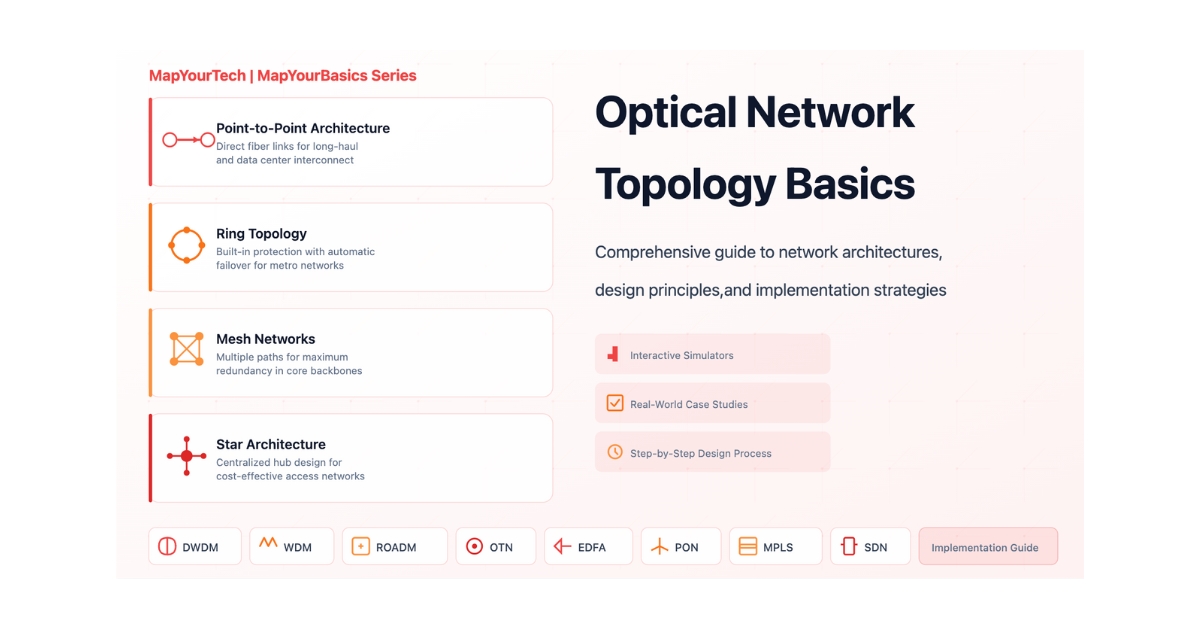
Point-to-point, ring, mesh and star are not interchangeable shapes on a slide — each one fixes a different set of failure modes, capacity ceilings and operating costs. This guide compares them the way an architect actually decides between them: with corrected capacity and link-budget math, OSNR accumulation, protection overhead, and the boundary where each topology stops paying for itself.
Introduction
A fibre cut on a single point-to-point span takes the whole circuit down until a crew splices it — hours at best, days across difficult terrain. The same cut on a two-fibre ring is invisible to traffic, because protection switching reroutes around the break in under 50 ms. That difference is the entire argument for topology: the arrangement of nodes and fibre decides not just how fast data moves, but how the network behaves the moment something breaks. This guide treats the four canonical optical topologies — point-to-point, ring, mesh and star — as engineering choices with measurable consequences, and works the capacity, optical-signal-to-noise-ratio (OSNR) and power-budget math that separates a design that passes commissioning from one that fails end-of-life.
The audience runs from a final-year student meeting these shapes for the first time to an architect sizing a national backbone. The newcomer gets the mechanism behind each number; the architect gets the boundary conditions and the failure modes that decide the call. Where the topology touches a deeper subsystem — amplifier noise, ROADM switching, coherent reach — there are links to go further.
What topology actually decides
Topology is the physical and logical arrangement of transmitters, receivers, amplifiers, multiplexers and switches, and the fibre that connects them. The arrangement is not cosmetic: it sets the number of hops a signal traverses, the spare paths available when a link fails, the fibre and equipment bill, and the way the network grows. Four properties move directly with the choice.
Performance
Path length and hop count set latency and the accumulated impairments a signal carries. A direct span adds only propagation delay — about 4.9 µs/km in standard single-mode glass, the figure behind the common 5-microsecond-per-kilometre rule of thumb for fibre latency. Every intermediate node adds switching delay and another stage of optical noise.
Reliability
Some topologies carry spare paths in their geometry. A ring survives any single break; a mesh survives several at once; a point-to-point span and a star hub survive nothing on their own and need an explicit second path. This is the property that most often forces the topology, because availability targets are contractual.
Growth
Adding a node to a mesh means connecting it to existing neighbours. Adding one to a ring means cutting the ring open and re-splicing. Adding one to a star means a free hub port, until the ports run out. The cost of the next node, not the first, is what separates an architecture that grows cheaply from one that hits a wall.
Cost
Fibre, line cards, amplifiers and operations scale differently per topology. A full mesh of N nodes needs N(N−1)/2 fibre paths; a ring needs N. The topology that looks cheapest at two nodes is rarely the one that is cheapest at twenty.
Takeaway: No topology is universally best. The optimum follows from the availability target, the traffic pattern, the geography and the budget — and most real networks use different topologies at different layers rather than forcing one shape everywhere.
The math you compute
Six calculations cover most topology and link decisions. Each is given with its variables, units and a worked case using realistic deployment values. Two of the expressions below are the ones most often gotten wrong in practice — the power budget and the OSNR estimate — so they are worked carefully.
Capacity ceiling of a fibre
SHANNON CAPACITY (DUAL POLARIZATION)
C = 2 · B · log2(1 + SNR) · N
- C — total capacity (bit/s)
- B — bandwidth per channel (Hz)
- SNR — signal-to-noise ratio (linear)
- N — number of channels
- factor 2 — two orthogonal polarizations carried by a coherent system
This is a theoretical ceiling, not a deliverable line rate. Real coherent channels reach a fraction of it after forward-error-correction and digital-signal-processing overhead.
Practical Example — per-channel ceiling at 25 dB SNR
Take B = 50 GHz, SNR = 25 dB (316 linear), N = 80, dual polarization. Spectral efficiency is log2(1+316) = 8.31 bit/s/Hz per polarization. Per channel that is 2 × 50×109 × 8.31 ≈ 831 Gb/s, and across 80 channels C ≈ 66 Tb/s.
The single-polarization ceiling here is 415 Gb/s in 50 GHz — a useful sanity bound, but a real 400G channel does not occupy 50 GHz. Standardised 400G coherent runs near 60 GBaud and occupies roughly 75 GHz at far lower required SNR, trading spectral efficiency for reach and cost. The Shannon number tells you the room you have; the modulation choice tells you how much of it you spend. The Gaussian Noise model for nonlinear interference is what turns that ceiling into the SNR a real link delivers.
OSNR accumulation across spans
OSNR — the ratio of signal power to amplified-spontaneous-emission noise in a reference bandwidth — is the number that decides whether a chosen modulation format closes over a given reach. For a chain of identical spans where each amplifier exactly recovers the span loss, the received OSNR follows a compact engineering form.
OSNR ESTIMATE (IDENTICAL-SPAN CHAIN, 0.1 nm REFERENCE)
OSNRdB ≈ 58 + Pch − Lspan − NF − 10·log10(N)
- Pch — per-channel launch power into the span (dBm)
- Lspan — per-span loss (dB)
- NF — amplifier noise figure (dB)
- N — number of amplified spans
- 58 — the −10·log10(h·ν·Bref) constant at 1550 nm for a 12.5 GHz (0.1 nm) reference bandwidth
Per-channel power is used — not composite power — and the 0.1 nm reference is already folded into the +58 constant, so no separate bandwidth term is subtracted on top of it.
Practical Example — OSNR over a 10-span long-haul link
With Pch = 0 dBm, Lspan = 22 dB (100 km at 0.22 dB/km), NF = 5 dB and N = 10 spans: OSNR ≈ 58 + 0 − 22 − 5 − 10·log10(10) = 58 − 22 − 5 − 10 = 21 dB. Modern coherent formats need roughly 12–15 dB, so this link has 6–9 dB of headroom. The 10·log10(N) term is the punchline: every doubling of span count costs 3 dB, which is the hard wall on amplified reach. Lowering NF with a Raman amplifier's near-zero effective noise figure buys back several of those decibels. You can spend the resulting margin with the help of an OSNR and required-OSNR calculator.
Link power budget and margin
The power budget answers one question: does enough light arrive at the receiver, and how much spare is left? The received power and the margin are two separate quantities — conflating them is the single most common arithmetic error in link design.
RECEIVED POWER, THEN MARGIN AS A SEPARATE CHECK
PRx = PTx − αL − ΣLconn − ΣLsplice + G
Margin = PRx − SRx
- PRx / PTx — received / transmitted power (dBm)
- αL — fibre attenuation × length (dB)
- G — total amplifier gain (dB)
- SRx — receiver sensitivity (dBm)
- Margin — spare power; target 3–6 dB for ageing, environment and repair
Margin is a comparison against sensitivity, not a term inside the received-power equation. Subtracting it from PRx double-counts and understates the link.
Practical Example — received power on a 200 km amplified link
PTx = +2 dBm, α = 0.25 dB/km over 200 km = 50 dB, connector loss 6 × 0.5 = 3 dB, splice loss 0.4 dB, and two 20 dB amplifiers = 40 dB gain. Received power is PRx = 2 − 50 − 3 − 0.4 + 40 = −11.4 dBm. Against a coherent receiver sensitivity of −20 dBm, the margin is −11.4 − (−20) = 8.6 dB — comfortable. (Folding a 3 dB margin into the received-power equation, as is sometimes done, would report −14.4 dBm and hide the real headroom; keep the two numbers separate.)
Mesh degree
MESH DEGREE
MD = 2E / [ N(N−1) ]
- MD — mesh degree, 0 to 1 (1 = full mesh)
- E — number of fibre links (edges)
- N — number of nodes
Practical Example — partial mesh of 8 nodes
With 8 nodes and 16 links, MD = (2×16) / (8×7) = 32/56 = 0.57. A full mesh of 8 nodes would need 28 links; this design uses 16 to keep multiple paths between most node pairs at roughly 57% of full-mesh connectivity — the usual sweet spot for a core network that wants resilience without the fibre bill of a full mesh.
Protection switching time
PROTECTION SWITCHING TIME
Tswitch = Tdetect + Tnotify + Tconfig
- Tdetect — fault detection, ~10 ms
- Tnotify — signalling propagation, 5–10 ms
- Tconfig — protection-path setup, 20–30 ms
Total 35–50 ms, which meets the ITU-T G.841 sub-50 ms target for ring protection.
Star hub uplink sizing
A star hub aggregates many access nodes onto a smaller uplink. Two opposite sizing rules apply depending on whether the star is active or passive, and treating them the same is a frequent mistake.
ACTIVE-STAR UPLINK (CONCURRENCY MODEL)
Cuplink = N · Cavg · u
- N — connected access nodes
- Cavg — per-node subscribed rate (Gb/s)
- u — concurrency factor, the fraction active at peak (typically 0.3–0.6)
Because not all nodes burst at once, the uplink carries less than the summed subscription. A passive optical network (PON) goes the other way and deliberately oversubscribes — see the example.
Practical Example — active aggregation vs PON
An active switch aggregating 32 nodes each subscribed at 1 Gb/s with a concurrency factor u = 0.4 needs an uplink of 32 × 1 × 0.4 = 12.8 Gb/s — a 25 GbE or higher uplink covers it with headroom. A passive PON inverts this: 32 subscribers at 1 Gb/s present 32 Gb/s of subscription against a shared feeder of 2.5 Gb/s (GPON) or 10 Gb/s (XGS-PON). That is intentional oversubscription — an oversubscription ratio near 13:1 or 3:1 respectively — sized on statistical demand, not peak sum. Multiplying the subscription up by an oversubscription factor, as is sometimes shown, sizes the hub the wrong way.
The four topologies
Each topology is described by what it is built from, where it is deployed, and the parameters that bound it. The diagram below places the four side by side; the tables that follow give the design figures.
Point-to-point
A direct fibre between two nodes, with transponders at each end and amplifiers in between for long spans. There are no intermediate add/drop points and no spare path — protection, if required, is a second physically diverse link. It carries the lowest latency and the highest usable capacity per fibre because the whole spectrum is dedicated to one pair, which is why long-haul backbones and data-centre interconnect lean on it. Coherent point-to-point links now ride 400ZR pluggables straight in router faceplates for reaches up to about 120 km amplified.
| Characteristic | Point-to-point |
|---|---|
| Complexity | Very low — minimal equipment |
| Spare path | None — needs a diverse second link for protection |
| Typical reach | 10–1000 km with amplification |
| Capacity | Up to 800G+ per wavelength on current coherent optics |
| Latency | Lowest — direct path only |
Ring
Nodes in a closed loop, with traffic able to flow both ways around it. The loop is the protection: a single break is bypassed by sending traffic the other way. Two protection styles dominate — a unidirectional path-switched ring (UPSR) sends a permanent copy both ways and the receiver picks the better one, while a bidirectional line-switched ring (BLSR) keeps the protection capacity free for extra or preemptible traffic until a failure claims it. The add/drop work is done by optical add-drop multiplexers, increasingly the reconfigurable kind. The degree and add/drop model behind those nodes is described in the OpenROADM degree and shared-risk-group model, and the per-port power control inside one is covered in ROADM-node VOA placement.
| Parameter | 2-fibre ring | 4-fibre ring |
|---|---|---|
| Working capacity | 50% | 75% |
| Protection capacity | 50% | 25% |
| Switching time | < 50 ms | < 50 ms |
| Node count | 2–16 | 2–32 |
| Complexity | Moderate | Higher |
Failure modeA ring survives one break. A second break on the same ring partitions it — the two cuts isolate a segment that neither direction can reach. Ring designs that carry availability commitments above a single ring usually interconnect two rings at two nodes so no single span sits on every path.
Mesh
Many interconnections give many paths, so a mesh routes around several simultaneous failures and engineers traffic across paths rather than one fixed route. A full mesh connects every node to every other and is rarely built — the fibre count grows as N(N−1)/2. A partial mesh at degree 0.4–0.7 keeps multiple paths between the node pairs that matter while staying affordable. The flexible wavelength routing a mesh depends on is provided by reconfigurable add-drop nodes and a control plane that computes paths on demand, and the same coherent line system can host an IP-over-DWDM converged layer directly on the router.
| Characteristic | Partial mesh | Full mesh |
|---|---|---|
| Spare paths | Several | Maximum (every pair direct) |
| Growth | Adds cheaply at the edge | Bounded by connection count |
| Fibre cost | Moderate to high | Very high |
| Management | High | Very high |
| Typical use | Backbone, metro core | Small clusters of high-value sites |
Star
Every node connects to a central hub that carries all traffic. It is the cheapest to build and manage and the hub is a single point of failure unless duplicated. A passive star — a PON — splits one feeder to many subscribers with no powered element in the field, typically at 1:32 or 1:64. An active star puts a switch or router at the centre for intelligent aggregation and longer reach. The hub concentrates both the cost saving and the risk.
| Parameter | Passive star (PON) | Active star |
|---|---|---|
| Max distance | ~20 km | ~80 km |
| Split ratio | 1:32 typical (up to 1:128) | Port-limited |
| Splitter loss | 17–20 dB at 1:32 | n/a |
| Field power | None in distribution | Powered nodes required |
| Growth | Bounded by split ratio | Adds ports until the hub fills |
Side by side
| Topology | Spare path | Complexity | Cost | Best for |
|---|---|---|---|---|
| Point-to-point | None (needs dual link) | Very low | Low–medium | Long-haul, DCI |
| Ring | One (built-in) | Medium | Medium | Metro, regional |
| Mesh | Several | High | High | Core, backbone |
| Star | Low (hub is single point of failure) | Low | Low | Access, FTTx |
Takeaway: Read the tables together with the failure modes, not as a ranking. A star is the wrong answer for a backbone and the right answer for last-mile access; the same fact — everything passes through the hub — is a liability in one role and the source of the cost advantage in the other.
Where the choice shows up
The topology decision propagates into latency, availability, growth cost, operations and traffic engineering. Each dimension behaves predictably once the geometry is fixed.
Latency
Point-to-point gives the floor — propagation plus a small processing delay, so a 100 km link runs about 0.6–1.0 ms end to end. A ring averages half its circumference per path, so an 8-node ring of 400 km circumference averages a 100 km path. A mesh can pick a near-optimal route but may traverse intermediate nodes, landing within 10–20% of the theoretical minimum with good routing. A star can double the distance, because node-to-node traffic climbs to the hub and back down.
Availability
| Topology | Availability with protection | Recovery | Limiting failure |
|---|---|---|---|
| Point-to-point | Up to 99.999% with 1+1 | < 50 ms switched; hours if unprotected | Any single cut without a diverse path |
| Ring | 99.999% | < 50 ms | Second cut partitions the ring |
| Mesh | Up to 99.9999% with good design | Milliseconds to seconds | Loss of all diverse paths between a pair |
| Star | 99.9% single-hub; higher with dual hub | Sub-second to hours by hub design | Hub failure affects every node |
Reading the nines99.9% is 8.76 hours of downtime a year; 99.99% is 52.6 minutes; 99.999% is 5.26 minutes; 99.9999% is 31.5 seconds. Each nine is a step-change in the protection scheme and in cost, not a tuning knob.
Growth cost
| Topology | Adding a node | Adding capacity | Geographic reach |
|---|---|---|---|
| Point-to-point | New link required | Add wavelengths or upgrade optics | Direct |
| Ring | Open and re-splice the ring | Bounded by ring capacity | Interconnect rings (adds complexity) |
| Mesh | Connect to existing neighbours | Flexible across paths | Grows naturally |
| Star | Free hub port until exhausted | Hub upgrade required | Add hubs |
Operations and cost
Point-to-point is the simplest to run; a star centralises management at the hub; a ring carries well-understood protection logic; a mesh demands path computation and network-wide visibility. Over a five-year horizon for a ten-node network, a ring lands around 1.3–1.5× the point-to-point baseline, a mesh around 2.0–2.5× (and earns it in core resilience), and a star sits below baseline for access but climbs once a deployment outgrows a single hub. The amplifier mix is part of that cost: an erbium-doped fibre amplifier (EDFA) line system is the economical default, with Raman added only where the OSNR budget runs out.
Traffic engineering
A mesh is the topology that rewards traffic engineering — multiple paths let label-switched routing and segment routing steer flows for utilisation and congestion control. A point-to-point link gives strong, predictable service-level guarantees by dedication; a ring shares its capacity; a star concentrates control at the hub.
Protection and routing methods
Reliability comes from the protection scheme layered onto the topology, and capacity efficiency comes from how wavelengths are assigned and traffic routed.
Protection schemes
1+1 bridges traffic permanently onto both a working and a protection path; the receiver picks the better signal, so there is no switching decision and recovery is effectively instant. It reserves a full backup, so it costs 2× the raw capacity, and the protection path cannot carry other traffic. 1:1 also dedicates a backup path — the same 2× raw cost — but the backup can carry preemptible low-priority traffic until a failure claims it, at the price of a sub-50 ms switch action. 1:N shares one backup across N working paths, dropping the overhead to (N+1)/N× raw, on the assumption that two of those N fail at once only rarely.
| Scheme | Coverage | Raw overhead | Recovery | Backup reuse |
|---|---|---|---|---|
| 1+1 | Highest | 2.0× | ~0 (hitless) | None |
| 1:1 | High | 2.0× | < 50 ms | Preemptible traffic |
| 1:N | Medium | (N+1)/N× | < 50 ms | Shared across N |
| Mesh restoration | Medium–high | ~1.1–1.3× | Seconds | Any spare path |
| Unprotected | None | 1.0× | Hours–days | n/a |
Wavelength assignment
Fixed assignment pins each service to one wavelength end to end — simple and deterministic, but it wastes spectrum and blocks in a mesh. Reconfigurable add-drop nodes assign wavelengths on demand and provision services remotely, at the cost of a more capable control plane. Flexible-grid allocation moves off the fixed 50/100 GHz grid to 12.5 GHz slots, fitting the spectrum to each channel — the right model for a high-capacity backbone mixing rates from 10G to 800G, particularly across the wider window of a C+L-band system.
Routing and hierarchy
Constraint-based label-switched routing and segment routing give a mesh explicit paths with bandwidth and delay constraints, fast reroute, and load balancing across paths. Most real networks combine topologies by layer rather than choosing one: a mesh core for resilience and any-to-any reach, rings in the metro for cost-effective protection, and stars in access for cheap last-mile reach. The diagram below shows that layering.
Design method
A repeatable design runs through five phases: gather requirements, choose the topology, close the link budget, choose the protection, and select components. The link-budget phase is where most designs pass or fail.
Phase 1 — requirements
Capacity is sized for growth, not today: required capacity = current peak × (1 + annual growth)years × safety factor. A 100 Gb/s peak at 30% annual growth over five years with a 1.4 safety factor needs 100 × 1.35 × 1.4 ≈ 520 Gb/s. Add the geographic constraints (site distances, existing fibre, rights of way) and the availability target with its recovery-time objective.
Phase 2 — topology selection
| If the network is… | Consider | Because |
|---|---|---|
| Two sites, high capacity | Point-to-point | Simplest, lowest latency, highest capacity |
| 5–15 sites in a loop | Ring | Built-in protection at moderate cost |
| Many sites, any-to-any | Mesh | Multiple paths, grows at the edge |
| Many endpoints, central traffic | Star | Lowest cost, simplest management |
Phase 3 — link budget
Practical Example — 150 km, 6-node metro ring
Transponder +1 dBm, receiver sensitivity −28 dBm, fibre 0.22 dB/km, ROADM 6 dB per node, connectors 0.3 dB (two per span), splices 0.05 dB every 2 km. Path loss adds up as fibre 150 × 0.22 = 33 dB, ROADM 6 × 6 = 36 dB, connectors 6 × 2 × 0.3 = 3.6 dB, splices 75 × 0.05 = 3.75 dB, total 76.35 dB. The transponder-to-receiver budget is 1 − (−28) = 29 dB, so the link needs 76.35 − 29 = 47.35 dB of gain. Three 16 dB EDFAs give 48 dB — leaving only 0.65 dB of margin.
That fails the 3 dB minimum. The fix is a fourth amplifier or a higher transponder launch (for example +3 dBm), recovering the missing margin. This is the value of working the budget before ordering equipment rather than discovering it at commissioning.
Phase 4 — protection
| Service | Availability target | Protection |
|---|---|---|
| Financial trading | 99.9999% | 1+1 with diverse paths |
| Mobile backhaul | 99.999% | 1:1 or ring |
| Enterprise VPN | 99.99% | 1:1 or mesh restoration |
| Internet transit | 99.9% | Best-effort restoration |
Phase 5 — components
Transceiver reach sets the technology: gray optics below 10 km, extended-reach to 40 km, long-reach or ZR to 80 km, and coherent with amplification beyond. Fibre type follows the role — the choices and their dispersion behaviour are set out in the ITU-T fibre recommendation family (G.652 through G.657). The amplifier choice trades cost against OSNR: EDFA where the budget closes, with distributed Raman amplification added on the spans where it does not.
Design checks
- Traffic matrix documented as source-destination pairs with capacities.
- Growth validated with the business, link budgets closed for worst-case paths.
- OSNR margin above 3 dB end to end, dispersion accounted for.
- Working and protection paths physically diverse — different conduits, buildings, routes.
- Single points of failure identified and removed; protection switching tested for every failure case.
- A documented path to double the capacity without a redesign.
Common design mistakes
Margin too thinDesigning with no spare lets the link fail as components age. Hold 3–6 dB of system margin for ageing, environment and repair.
Designing for todaySizing to current demand forces an early, expensive upgrade. Plan five years of growth and pick equipment and topology that expand without a rebuild.
Shared-fate pathsWorking and protection paths in the same conduit or building fail together. Force physical diversity for any protected service.
Ignoring OSNR accumulationSpans that each pass can still fail end to end once OSNR has dropped 3 dB per span doubling. Budget OSNR across the whole chain, not per span.
Interactive tools
Four calculators put the math above into play. Each updates live as you move the sliders, ships with named presets and a copy-results button, and shows results as a number, a unit and a feasibility band. The capacity tool reports a Shannon ceiling, the OSNR-driven feasibility band, the topology aggregates, the protection overhead, and the link power budget with margin computed as a separate check against receiver sensitivity.
Takeaway: The link-budget tool models margin the right way — received power first, then margin against sensitivity — and flags the case where stacking amplifier gain pushes received power above the receiver overload point, a failure that looks like a huge positive margin until the receiver clips.
Deployment examples
Three illustrative design scenarios show how the topology and protection choices combine. These are worked design targets, not measured field results.
Practical Example — metropolitan network, 12 sites
Scenario: connect 12 sites across a 200 km metro area for 5G backhaul, enterprise and broadband, to a 99.999% availability target. Design: a dual-ring of 6 nodes each, interconnected at two sites so no single span sits on every path; 100G coherent on reconfigurable add-drop nodes; BLSR protection under 50 ms; eight wavelengths per fibre pair at launch, expandable toward 80. Average span 25 km, line amplifiers at three sites, central control plane. Target outcome: single-failure transparency from ring protection, service provisioning in hours rather than weeks, and capacity headroom for several times the launch traffic before a fibre build is needed.
Practical Example — long-haul backbone upgrade
Scenario: move an existing 10G backbone to 400G over 800 km on the installed fibre, cutting cost per transported bit. Design: keep the existing 12-node partial mesh at degree 0.6; deploy 400G coherent with probabilistically shaped 64-QAM and soft-decision FEC; hybrid EDFA-plus-Raman amplification for OSNR; C+L-band operation to widen the usable spectrum; overlay the new line rate while the 10G services keep running. Target outcome: a large step in per-fibre capacity at a lower cost and power per bit, with a clear path to 800G ZR/ZR+ coherent optics on the same line system.
Practical Example — data-centre interconnect, 4 sites
Scenario: connect four data centres within a 50 km radius at sub-millisecond latency and 99.999% availability. Design: full mesh of six point-to-point links; 400G coherent pluggables in the router (ZR class, no external transponder); 1+1 protection on the paths that carry database replication; equal-cost multipath for load balancing; dense fibre counts for future growth; Layer-1 encryption for sensitive traffic. Target outcome: roughly 0.4 ms average latency on 12 km links, an aggregate near 9.6 Tb/s across the mesh, and balanced utilisation — the per-bit power advantage of router-hosted coherent optics is what makes the all-pluggable build economical.
Troubleshooting reference
| Symptom | Likely cause | First checks |
|---|---|---|
| High bit error rate | Low OSNR, dispersion, PMD, fibre damage | Received power, OSNR, dispersion compensation, fibre bends |
| Intermittent link loss | Loose connectors, environment, failing optic | Connector inspection, temperature, error counters, swap optic |
| Protection not switching | Misconfiguration, signalling, control plane | Protection config, switching signalling, protection-path continuity |
| Capacity exhaustion | Growth, inefficient routing, no free wavelengths | Traffic pattern, wavelength use, routing, bottlenecks |
| Excessive latency | Suboptimal routing, too many hops | End-to-end path trace, per-hop latency, routing loops |
Main Points
- Topology fixes performance, availability, growth cost and operations at once — it follows from the requirements, it is not a style choice.
- Point-to-point gives the lowest latency and highest per-fibre capacity, and no spare path; protection is an explicit diverse link.
- A ring carries one spare path and switches in under 50 ms, but a second cut partitions it — interconnect two rings for higher availability.
- A mesh carries several spare paths and engineers traffic across them; a partial mesh at degree 0.4–0.7 is the affordable core.
- A star is the cheapest access topology; the hub is both the cost advantage and the single point of failure.
- Compute received power and margin as two separate numbers — margin is received power minus sensitivity, never a term inside the received-power equation.
- OSNR drops 3 dB per span doubling; the 58 + Pch − Lspan − NF − 10log(N) form uses per-channel power and the 0.1 nm reference is already in the +58.
- 1+1 and 1:1 both cost 2× raw capacity; the difference is reuse and switching, not overhead. 1:N trades coverage for (N+1)/N× overhead.
- Most real networks layer topologies — mesh core, ring metro, star access — rather than forcing one shape across every tier.
References
- ITU-T G.841 — Types and characteristics of SDH network protection architectures, ITU-T Study Group 15.
- ITU-T G.694.1 — Spectral grids for WDM applications: DWDM frequency grid, ITU-T Study Group 15.
- OIF 400ZR Implementation Agreement, Optical Internetworking Forum.
Developed by MapYourTech Team
For educational purposes in Optical Networking Communications Technologies
Note: This guide is based on industry standards, best practices, and real-world implementation experiences. Specific implementations may vary based on equipment vendors, network topology, and regulatory requirements. Always consult with qualified network engineers and follow vendor documentation for actual deployments.
Feedback Welcome: If you have any suggestions, corrections, or improvements to propose, please feel free to write to us at [email protected]
Related Articles on MapYourTech