The 5-Microsecond Rule: Fiber Propagation Latency per Kilometer
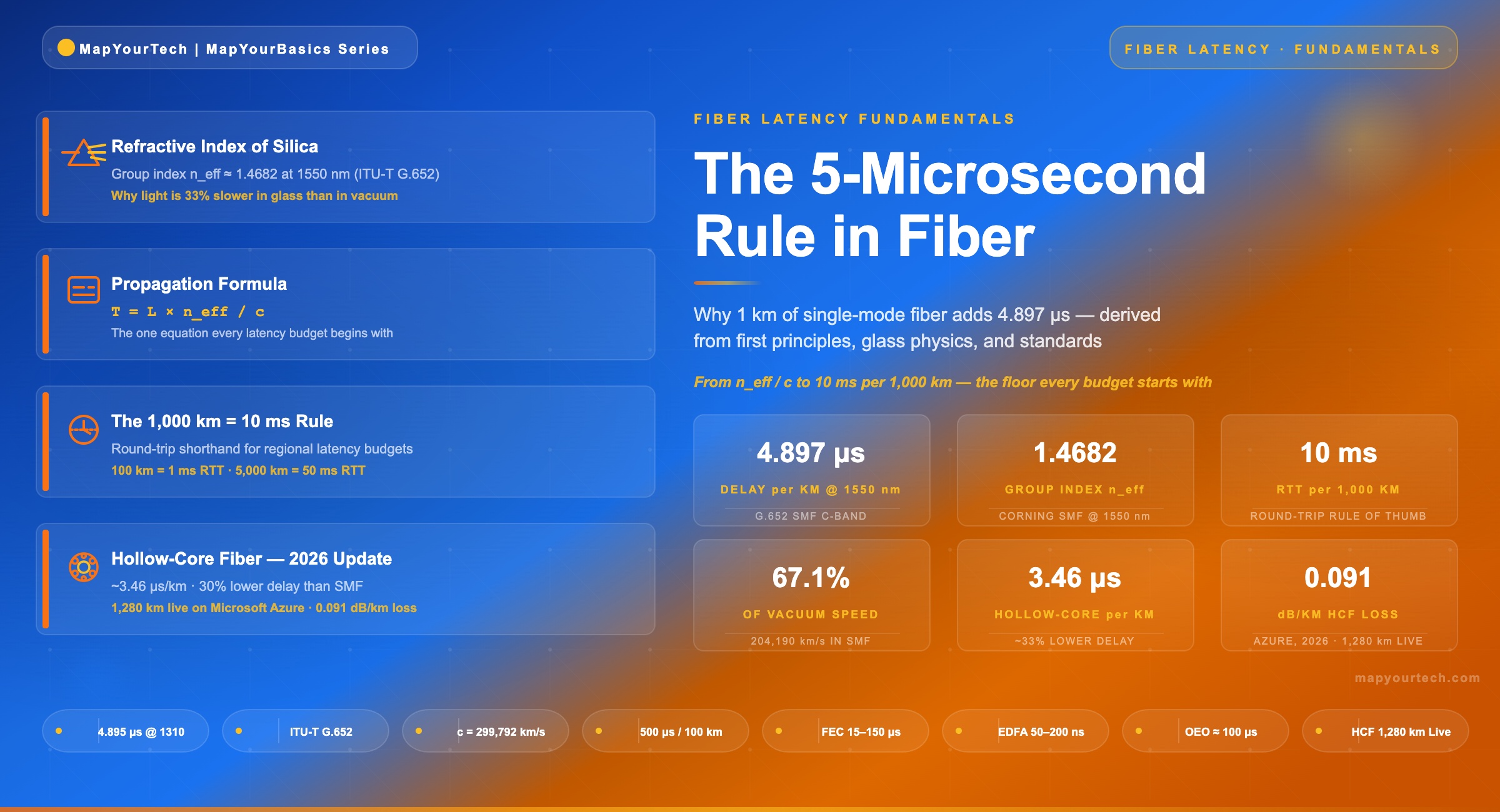
How the group refractive index of silica glass sets an unbreakable floor on optical network delay — and why engineers round 4.897 μs/km to 5 when they do budget math on a whiteboard.
Introduction
Latency has moved from a specialist concern to a first-order design parameter across optical networking. Every high-frequency trading desk, 5G transport architect, cloud operator, and teleprotection engineer eventually runs into the same physical floor: light does not travel instantaneously, and in glass it travels about a third slower than in vacuum. This produces what the industry calls the 5-microsecond rule — a practical baseline that one kilometer of single-mode fiber adds roughly 4.9 μs of one-way delay, and that 1,000 km of fiber adds roughly 10 ms of round-trip delay.
Understanding where this number comes from, why it is 4.9 rather than 5, and where it breaks down is the starting point for any serious latency budget. This article derives the rule from first principles, starting with the group refractive index of silica glass. It then converts the physics into the numbers engineers use on link budgets, covers the wavelength-dependent variation between O-band and C-band, and compares standard G.652 fiber against dispersion-shifted and hollow-core alternatives. The goal is a reference an engineer can cite in an architecture review, and that someone newer to optics can use to build sound intuition for where microseconds actually come from in real networks.
Three recurring themes thread through the discussion. First, the fiber propagation delay is deterministic and irreducible for a given fiber type and path length — no protocol or silicon trick shaves a microsecond off the physics. Second, every other latency contributor in an optical network (amplifiers, transponders, forward error correction, routing, buffering) stacks on top of this floor, so a well-designed ultra-low-latency network tries to keep total delay within a small multiple of propagation. Third, hollow-core fiber is the first technology in fifty years to change the physics itself, and as of 2026 it has moved from lab curiosity into live hyperscale deployment.[1][8]
Why light slows down in glass
In vacuum, light travels at exactly 299,792.458 km/s. This is a defined constant in the SI system. In any material medium — air, water, glass — light interacts with bound electrons in the atoms and propagates more slowly. The ratio of vacuum speed to medium speed is the refractive index of the material, usually written as n.
Phase index versus group index
For latency calculations in optical fiber, the phase refractive index is not the right number. A modulated optical signal carries information in its envelope, and the envelope moves at the group velocity, which depends on the group refractive index — usually written ng or neff. The group index is slightly higher than the phase index in silica because the phase index changes with wavelength, and the group index captures that dispersion.
For standard single-mode fiber defined by ITU-T G.652, the effective group index is approximately 1.4676 at 1310 nm and 1.4682 at 1550 nm.[2] Different Corning fiber families — SMF-28e, SMF-28 ULL, LEAF — show subtle variations in neff driven by core doping, refractive index profile shape, and the weighted split of optical power between core and cladding.
Why 1.47 is not 1.50
Bulk fused silica has a refractive index near 1.444 at 1550 nm. Telecom single-mode fiber sits higher, around 1.468, because the core is doped with germanium to raise its index relative to the cladding — that index contrast is what confines the optical mode. The group index lands higher still due to material dispersion. So when engineers say "glass has n = 1.5," they are close but not precise. The correct number for latency math is the group index of the specific fiber type, which is usually between 1.466 and 1.470.
Speed of light in fiber
With neff in hand, the speed of light in the fiber follows directly:
Both numbers sit at roughly 67% of vacuum speed — fiber is a measurably slower highway for photons than free space, which is why hollow-core fiber (where light travels mostly through air) and line-of-sight microwave links can beat fiber on pure latency per kilometer.
Standards framework
The optical transmission properties of single-mode fiber are defined by a small cluster of ITU-T recommendations. G.652 covers standard single-mode fiber, the overwhelming majority of installed plant. G.653 defines dispersion-shifted fiber with zero chromatic dispersion near 1550 nm. G.655 defines non-zero dispersion-shifted fiber aimed at WDM. G.654 covers cut-off-shifted fiber used in long-haul and submarine cables. Each variant has a slightly different refractive-index profile and therefore a slightly different group index, but all stay within roughly ±0.5% of each other, so the 4.9 μs/km baseline holds across standard glass-core fiber families.
Deriving the 5-microsecond rule
The core equation is the simplest in all of optical networking:
Practical example — 1 km at 1550 nm
Substituting the standard G.652 values for a one-kilometer span at 1550 nm:
Rounded, the number is remembered as 5 μs/km. The actual value at 1550 nm is 4.897 μs, and at 1310 nm it is 4.895 μs. Across any commercially common single-mode fiber and any commonly used telecom wavelength, the delay stays inside a narrow band of 4.87–4.92 μs/km. The 5-microsecond shorthand buries less than 2% of slop, which is fine for back-of-envelope work and absolutely unacceptable for anything that needs symmetry below 1 μs (such as line-differential protection or precision time transfer).
Practical example — a 90 km metro span
A typical metro DWDM span between two amplifier sites is 80–100 km. For a clean 90 km span of G.652 fiber at 1550 nm:
This is the unavoidable floor. No amount of expensive silicon, low-latency FEC, or cut-through switching shaves anything off this number. Every microsecond added by transponders, EDFAs, and ROADMs comes in on top of this baseline.
Why the exact number matters for some applications
In most engineering contexts, 4.9 and 5.0 are interchangeable. In a handful of cases, the precise value matters. Line-current differential protection (IEEE 87L) requires the two directions of the path to match within roughly 100–500 μs, because relays compare current samples from the two ends and a timing offset translates directly into false residual current.[4] A 100 km asymmetry of 1% in neff — possible if the two directions ride slightly different fiber types or pass through different dispersion compensators — produces 5 μs of differential delay, within the budget but measurable. Similarly, precision time protocol (PTP, IEEE 1588) and White Rabbit both assume path symmetry, and any unaccounted difference in neff propagates straight into time-transfer error.
Takeaway: The 5-microsecond rule is just neff/c, and for standard G.652 single-mode fiber that works out to 4.895–4.897 μs/km across the O-band and C-band. The rounding to 5 is harmless for most budgets but hides a real ±0.5% variation that can matter for symmetry-sensitive services such as line-differential protection and precision time transfer.
From 4.9 μs/km to the 1,000 km = 10 ms rule
The more memorable of the two shorthand forms is the round-trip version. A network engineer asked to estimate the latency of a transcontinental or regional link rarely reaches for a calculator — they reach for this:
Flipped another way: every 100 km of fiber round-trip adds roughly 1 ms of RTT. This is the number used to sanity-check a ping from a regional PoP to a metro edge, or to estimate whether synchronous replication between two data centers is even feasible. Synchronous replication typically demands under 2 ms RTT, which caps usable distance at roughly 100 km one way; asynchronous replication tolerates 10 ms or more and extends to continental scales.
Geographic intuition
Some useful distance points, using the straight-fiber 5 μs/km shorthand:
- 10 km metro leg — 50 μs one-way, 100 μs round-trip. The fiber itself is nearly invisible in the budget; transponder and switch latency dominate.
- 100 km long metro or short DCI span — 500 μs one-way, 1 ms round-trip. Enough to start pressing against synchronous replication windows.
- 1,000 km regional long-haul — 5 ms one-way, 10 ms round-trip. The practical outer edge of synchronous replication, and a common point where dispersion compensation becomes mandatory on non-coherent systems.
- 5,000 km transcontinental — 25 ms one-way, 50 ms round-trip. Cross-continental and regional submarine cables sit here, forcing asynchronous replication and substantial TCP window tuning.
- 10,000 km intercontinental — 50 ms one-way, 100 ms round-trip. Transatlantic and transpacific cables. Latency is now dominated entirely by fiber; every node in the middle is a rounding error.
Actual fiber versus geodesic distance
The rule assumes the fiber follows the geographic path between endpoints. Real fiber rarely does. Cable routes follow roads, railway corridors, power easements, and seabed topology — a "1,000 km" link between two cities often carries 1,100–1,400 km of glass. Submarine cables add landing-station detours. When a latency budget is critical, always use the actual fiber length from the carrier's route documentation, not the great-circle distance from a mapping tool. A 20–40% fiber length overhead relative to geodesic distance is normal.
What the rule does not include
The 5-microsecond rule covers only the fiber itself. Every real optical link also carries latency from active and passive components sitting between the transmitter and the receiver. These contributions stack on top of the propagation floor, and on short links they can easily dominate.
| Network element | Typical latency | Nature |
|---|---|---|
| Transparent transponder (no framing) | A few ns | Clock and data recovery only |
| Optical mux/demux, WSS, FBG-based DCM | 5–50 ns | Fixed; proportional to splice length |
| EDFA | 50–200 ns (up to ~0.15 μs) | Doped fiber length plus splices |
| Optical fiber (the subject of this article) | ~500 μs per 100 km | Fixed once route is built |
| Muxponder / OTN / SDH ADM | 10–100 μs | Framing and mapping overhead |
| Forward error correction (FEC) | 15–150 μs | Strength-dependent; hard-decision lower, soft-decision higher |
| DCF-based dispersion compensation module | 40–120 μs per DCM | Adds 15–25% of the compensated fiber length |
| OEO regeneration | ~100 μs | Add FEC and framing per regen site |
| Layer 2/3 switch or router | Up to a few ms | Queueing-dependent, highly variable |
Table 1: Typical latency contributions in an optical transport network, compiled from Optelian and MapYourTech references.[3][5]
Why DCF hurts and FBG does not
Dispersion compensation is where optical design choices make a measurable latency difference. A 100 km G.652 span accumulates roughly 1,700 ps/nm of chromatic dispersion at 1550 nm. Compensating that with a dispersion compensating fiber (DCF) module requires about 22 km of DCF, which itself contributes roughly 100 μs of additional delay per DCM — a round 20% penalty on the fiber span.[5] Substituting a fiber-Bragg-grating-based DCM eliminates that penalty: an FBG-based DCM adds 5–50 ns because the optical path through the grating is on the order of 10 cm. Any low-latency design built on pre-coherent 10G transport replaces DCF with FBG wherever budget allows.
Why coherent optics changed the conversation
Modern coherent transceivers remove the need for inline dispersion compensation entirely — the DSP in the receiver compensates chromatic dispersion electronically, so the line system can run dispersion-uncompensated. The DSP itself adds delay (typically up to 1 μs for equalization, plus whatever soft-decision FEC contributes), but the tradeoff is favorable beyond about 200 km because the DCF latency it replaces is much larger. For dedicated ultra-low-latency financial routes under 100 km, some designs still avoid coherent DSP and use simpler direct-detection 10G with FBG compensation to shave the last microseconds.
The honest answer for short spans
On a 30 km metro span, the fiber contributes about 150 μs, a pair of transponders contributes 10–20 μs, FEC contributes 30–100 μs, and the rest of the active equipment contributes tens of microseconds more. The fiber is not the dominant latency source below roughly 50 km. The 5-microsecond rule only becomes the dominant term once the path exceeds a few tens of kilometers.
Fiber type variations and hollow-core fiber
All standard glass-core single-mode fibers sit within a narrow neff band and therefore inside the 4.87–4.92 μs/km envelope. The exceptions are dispersion-shifted fibers and, more dramatically, hollow-core fibers.
| Fiber type | Standard | Typical neff | Delay per km (1550 nm) | Notes |
|---|---|---|---|---|
| Standard SMF | ITU-T G.652 | 1.4682 | ~4.897 μs | The reference. Overwhelming majority of installed plant. |
| Dispersion-shifted fiber | ITU-T G.653 | ~1.470 | ~4.903 μs | Zero dispersion at 1550; limited by FWM on WDM systems. |
| NZ-DSF (low disp.) | ITU-T G.655 | ~1.469 | ~4.900 μs | Reduces DCF need; lower compensation penalty. |
| Cut-off shifted | ITU-T G.654 | ~1.467 | ~4.893 μs | Long-haul and submarine; lower attenuation at 1550. |
| Hollow-core fiber (NANF/DNANF) | No ITU-T yet | ≈ 1.003 | ≈ 3.35 μs | Guides light through air; ~30–33% lower delay than SMF. |
Table 2: Group refractive index and per-km delay for common fiber types. Values are representative; specific products vary by roughly ±0.3%.
Hollow-core fiber and its 2026 status
Hollow-core fiber (HCF) is the first technology in fifty years to genuinely break the 5-microsecond rule. By guiding light through an air-filled core surrounded by nested antiresonant glass tubes, HCF replaces the silica propagation medium with air, dropping neff from roughly 1.47 to roughly 1.003. The resulting delay is approximately 3.46 μs/km, around 30% lower than SMF.[6] Microsoft's published figures cite up to 47% faster data transmission and approximately 33% lower latency compared with standard single-mode fiber.[7]
Through 2023 and 2024 HCF remained a niche product used for short financial trading links and specialist data-center interconnects. Two developments in 2025 moved the technology into mainstream hyperscale infrastructure. First, Microsoft published research in Nature in September 2025 reporting HCF attenuation below 0.1 dB/km, crossing a threshold that had bounded conventional fiber for decades.[8] Second, by early 2026, Microsoft has deployed over 1,280 km of live Azure HCF with zero field failures, and the Azure team has measured 0.091 dB/km transmission loss across 1,200 km of production fiber. Microsoft separately announced a plan to deploy 15,000 km of HCF across the Azure network over two years, with manufacturing partnerships extending to Corning and Heraeus Covantics to scale production.[7][8]
For network architects, the practical implication is that HCF is no longer a theoretical option only available on short specialized links. HCF-enabled spans are starting to appear in regional DCI deployments where the latency benefit justifies the premium, and the rule-of-thumb adjustment is straightforward: for a route that runs on HCF, use 3.5 μs/km instead of 5 μs/km. A 200 km HCF link contributes roughly 700 μs one-way versus about 1 ms on SMF — the 300 μs saving is meaningful to trading firms and to tightly coupled distributed databases.
Application-level latency budgets
Different industries set their budgets relative to this propagation floor. A quick tour:
High-frequency trading
In financial markets, every microsecond is money. A 10 ms disadvantage relative to a competitor can translate to roughly a 10% revenue drop on a trading desk, and some firms execute transactions within 0.35 μs end-to-end once the signal reaches their matching engine.[2] Routes between major financial centers use dark fiber, avoid any intermediate equipment they can, and — increasingly — look to HCF for the last few microseconds of advantage. The difference between a 1,000 km SMF path at roughly 10 ms RTT and a 1,000 km HCF path at roughly 6.9 ms RTT is enormous in this context.
5G and autonomous systems
URLLC (ultra-reliable low-latency communication) targets an end-to-end budget near 1 ms for the radio-access portion. Autonomous vehicle applications cite a roughly 5 ms end-to-end target, with approximately 2 ms reserved for the transport network.[2] At 2 ms of transport budget, the fiber alone constrains the base-station-to-aggregation distance to under 200 km, and in practice much less once switching and processing are counted.
Power-system teleprotection
IEEE C37.94 line-differential teleprotection relays compare current samples between two ends of a high-voltage line. The typical end-to-end budget is 5–10 ms one-way; the IEC 60834-1 standard recommends a maximum of roughly 8–10 ms.[3] Path symmetry is as important as absolute delay — the difference between the two directions must stay below about 500 μs, typically enforced by deploying MPLS-TP bidirectional paths or SDH/SONET rings that guarantee symmetric routing.
Immersive media
Virtual reality and augmented reality services target an end-to-end latency below 20 ms to avoid vertigo.[2] At the transport layer this leaves very little room for long-haul geographic separation between users and their compute resources, which is the direct driver behind edge computing architectures placing GPUs within a few hundred kilometers of every population center.
Cloud disaster recovery and intra-city DC mesh
Intra-city disaster recovery and optimal cloud desktop services typically target under 20 ms end-to-end, and synchronous storage replication typically demands under 2 ms RTT.[2] The 2 ms constraint is exactly the point where the 5-microsecond rule becomes the gating factor — it caps usable DC-to-DC distance at roughly 100 km of fiber each way, which is why "metro DCI" is always a story told in the 40–100 km range.
Practical deployment effects on the rule
Several real-world factors nudge the theoretical 4.9 μs/km upward when a link is actually built:
- Cable slack loops at every manhole and splice closure. Outside-plant cables typically carry 1–3% extra fiber length as slack, adding a few microseconds per 100 km of route.
- Splice points and connector jumpers. Each introduces a tiny fiber length (typically under 2 m) and negligible latency individually, but dozens of splices accumulate.
- Patch panels and pigtails inside the CO or data center. Typically a few meters per endpoint, contributing under 1 μs total but worth counting for very short intra-DC links.
- Dispersion compensation inserts. On legacy non-coherent systems, DCF spools add 15–25% to the effective fiber path for compensated lines. FBG-based DCMs essentially eliminate this penalty.
- Route choice. Diverse or protected paths typically take a longer physical route than the primary. A latency-optimized primary may be 30% shorter than its protection path, a factor that matters for synchronous replication where both paths must clear the budget.
For design work, a pragmatic approach is to compute theoretical fiber latency with the 4.897 μs/km number, add 2–3% for cable slack and splice overhead, then add the component latency stack (EDFA, transponder, FEC, any DCM, any OEO regen). The result is a defensible one-way link budget that rarely surprises in production.
Measurement versus calculation
In a live network, the one-way fiber latency can be measured directly using loopback testing or precision time protocol session statistics. Round-trip measurements are simpler but conceal any asymmetry. For teleprotection and precision timing deployments, the measurement should be one-way with a reference clock on both ends; the calculated number from the 5-microsecond rule is then a sanity check rather than the final value.
Future outlook
Three directions will shape how much the 5-microsecond rule still describes real networks in the next decade. The first is the continued scale-up of hollow-core fiber. Microsoft's move from specialist deployments to 15,000 km of planned Azure deployment, together with manufacturing agreements spanning Corning, Heraeus, and the original Lumenisity fabrication base, is a signal that HCF has crossed from laboratory into industrial production.[7][8] As of 2026, HCF loss figures below 0.1 dB/km have been demonstrated on spans exceeding 1,200 km, removing the historical attenuation penalty that kept HCF out of long-haul use.
The second direction is the continued flattening of component latency. Simpler transceivers (2–30 ns claimed by some vendors), lower-latency soft-decision FEC variants, and OTN-free direct bit-stream transport all chip away at the on-top-of-fiber stack. For routes above a few hundred kilometers the fiber keeps dominating, but for sub-100 km DCI the component stack is where the remaining microseconds live.
The third direction is architectural. Edge computing, disaggregated optical networks, and coherent pluggables in routers all shorten the effective optical path between user and compute. None of this changes the 5-microsecond rule — it just reduces how many kilometers any given transaction has to cross.
Skills worth building
For engineers who want to stay ahead of these shifts, three capabilities pay off disproportionately: fluency with link-budget and latency-budget math so that the physical floor is never confused with the equipment stack; familiarity with precision time protocol and White Rabbit for services where path symmetry matters more than absolute delay; and early hands-on experience with HCF splicing and mode-field adaptation, which will become a specialist skill as hyperscalers and financial firms expand deployment.
Reference summary
Key specifications
| Quantity | Value | Notes |
|---|---|---|
| Speed of light in vacuum | 299,792.458 km/s | Defined constant |
| G.652 neff at 1310 nm | 1.4676 | Corning SMF reference |
| G.652 neff at 1550 nm | 1.4682 | Corning SMF reference |
| Speed in SMF at 1310 nm | 204,271.5 km/s | 68.1% of vacuum |
| Speed in SMF at 1550 nm | 204,189.7 km/s | 67.1% of vacuum |
| Delay in SMF at 1310 nm | 4.895 μs/km | Practical floor, O-band |
| Delay in SMF at 1550 nm | 4.897 μs/km | Practical floor, C-band |
| Rule-of-thumb delay | 5 μs/km (one-way) | Used for back-of-envelope math |
| Rule-of-thumb RTT | 10 ms per 1,000 km | Round-trip equivalent |
| Hollow-core fiber delay | ~3.5 μs/km | 30–33% lower than SMF |
Glossary
- Effective group index (neff): Weighted average of the indices of refraction encountered by the optical mode across core and cladding; the correct number to use for latency calculations in fiber.
- FBG DCM: Fiber-Bragg-grating-based dispersion compensation module. Low-latency alternative to DCF-based DCMs, adds 5–50 ns.
- HCF: Hollow-core fiber. Fiber variant in which light is guided through an air-filled core, giving approximately 30% lower propagation delay than standard SMF.
- NANF / DNANF: Nested antiresonant nodeless fiber / double-nested antiresonant nodeless fiber. Two HCF structural families that have produced record-low HCF loss figures.
- OEO: Optical-electrical-optical regeneration. Converts the optical signal to electrical, processes it, and regenerates it optically. Adds approximately 100 μs per regenerator.
- PMD / CD: Polarization mode dispersion and chromatic dispersion; signal-distortion phenomena that may require compensation, with latency implications in non-coherent systems.
- RTT: Round-trip time. Twice the one-way propagation delay plus any forward/reverse component latency.
- SMF: Single-mode fiber. Standard G.652 telecom fiber, the default assumption in the 5-microsecond rule.
References
- ITU-T G.652, "Characteristics of a single-mode optical fibre and cable," ITU-T Recommendation.
- MapYourTech, "Latency in Fiber Optic Networks."
- Optelian, "A Sensible Low-Latency Strategy for Optical Transport Networks," Technical Brief.
- IEEE C37.94, "IEEE Standard for N Times 64 Kilobit Per Second Optical Fiber Interfaces Between Teleprotection and Multiplexer Equipment," IEEE Power and Energy Society.
- MapYourTech, "Latency in Copper vs Fiber, SDH/SONET, MPLS-TP, and IP/MPLS Networks."
- F. Poletti, "Nested antiresonant nodeless hollow core fiber," Optics Express.
- Fierce Network, "Microsoft strikes new deal with Corning to boost its hollow core fiber."
- MapYourTech, "Is Hollow Core Fiber Ready for Practical Deployment."
- IEC 60834-1, "Teleprotection equipment of power systems — Performance and testing," IEC.
- Sanjay Yadav, "Optical Network Communications: An Engineer's Perspective" – Bridge the Gap Between Theory and Practice in Optical Networking.
Developed by MapYourTech Team
For educational purposes in Optical Networking Communications Technologies
Note: This guide is based on industry standards, best practices, and real-world implementation experiences. Specific implementations may vary based on equipment vendors, network topology, and regulatory requirements. Always consult with qualified network engineers and follow vendor documentation for actual deployments.
Feedback Welcome: If you have any suggestions, corrections, or improvements to propose, please feel free to write to us at [email protected]
Related Articles on MapYourTech