
Single-Carrier and Multi-Carrier Coherent Optics: Architecture, Performance, and the Path to 1.6T and Beyond
A comprehensive engineering analysis of single-carrier, digital subcarrier multiplexing (DSCM), CO-OFDM, and superchannel architectures — covering DSP design, nonlinear performance, EEPN tolerance, spectral efficiency, and deployment trade-offs from metro DCI through transoceanic submarine systems.
Table of Contents
- Abstract and Executive Summary
- Introduction and Context
- Historical Context and Evolution
- Theoretical Framework
- Technical Architecture and Design
- Mathematical Models and Analysis
- Implementation Approaches
- Performance Analysis and Benchmarking
- Case Studies and Real-World Applications
- Comparative Analysis
- Challenges, Limitations, and Solutions
- Future Directions
- Conclusion and Recommendations
- References
1. Abstract and Executive Summary
Abstract
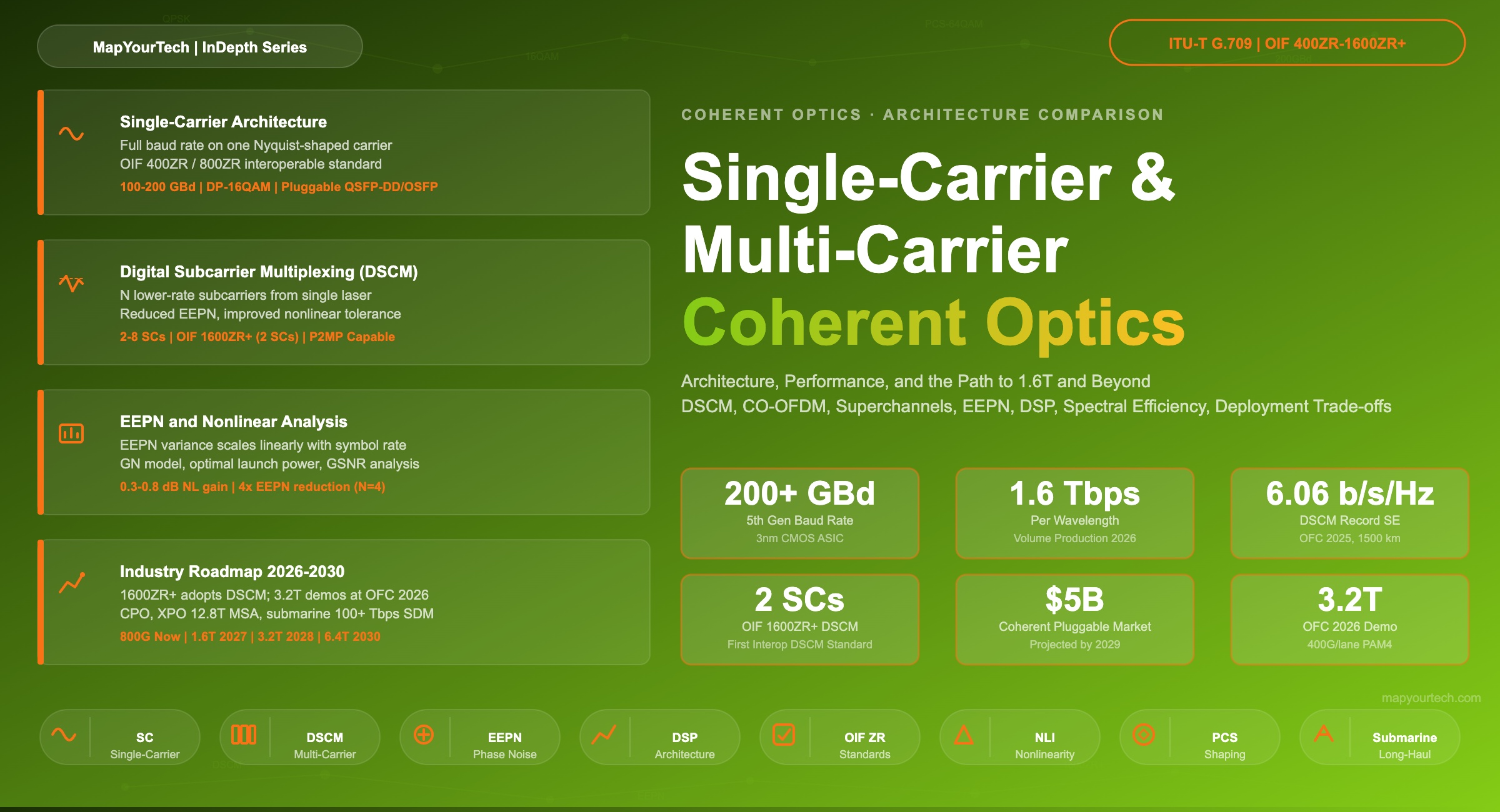
The relentless growth of global data traffic, driven by cloud computing, artificial intelligence workloads, and high-definition video streaming, places ever-increasing pressure on optical transport networks to deliver higher per-wavelength capacities over longer distances. Coherent optical transmission, underpinned by digital signal processing (DSP), has evolved through five distinct generations since its commercial introduction around 2010. A defining architectural choice in modern coherent transponder design is whether to transmit the full channel bandwidth on a single high-baud-rate carrier (single-carrier, SC) or to partition the signal into multiple lower-baud-rate digital subcarriers (multi-carrier, MC). This article provides a research-grade, in-depth analysis of both approaches, examining their respective DSP architectures, nonlinear fiber propagation behaviour, tolerance to equalization-enhanced phase noise (EEPN), spectral efficiency, flexibility, and real-world deployment considerations.
Single-carrier systems, anchored by a single high-symbol-rate signal per wavelength, dominate interoperable standards such as OIF 400ZR and 800ZR. They offer lower DSP overhead per bit, simpler transmitter-receiver architectures, and proven multi-vendor interoperability. In contrast, multi-carrier systems—particularly those based on digital subcarrier multiplexing (DSCM)—divide the channel bandwidth into two to eight (or more) lower-rate subcarriers processed entirely in the digital domain. DSCM provides improved tolerance to EEPN, reduced nonlinear interference noise (NLIN), finer-grained capacity-reach tuning, and the ability to implement point-to-multipoint (P2MP) network topologies. Coherent Optical Frequency-Division Multiplexing (CO-OFDM) represents a further variant where subcarriers are mathematically orthogonal, offering near-ideal spectral efficiency at the expense of high peak-to-average power ratio (PAPR) and greater sensitivity to fiber nonlinearities.
Through mathematical modelling, architecture comparison, performance benchmarking, and real-world case studies spanning data center interconnect (DCI), metro, long-haul terrestrial, and transoceanic submarine applications, this article equips network engineers and architects with the technical depth needed to select the optimal transmission architecture for their specific network segment and capacity requirements. As the industry transitions toward 1.6T per wavelength and beyond using 200 GBd-class DSP ASICs on 3 nm CMOS, the single-carrier versus multi-carrier decision becomes more consequential than ever.
2. Introduction and Context
2.1 The Capacity Imperative
Optical fiber remains the dominant medium for long-distance, high-capacity data transport. As of 2025, global IP traffic exceeds 5 Zettabytes per year, with submarine cables alone carrying more than 95% of intercontinental data. Dense Wavelength Division Multiplexing (DWDM) systems pack dozens to hundreds of wavelength channels onto a single fiber pair, and the capacity of each channel has grown from 2.5 Gbps in the late 1990s to 800 Gbps today, with 1.6 Tbps per wavelength demonstrated in commercial-grade systems.
Increasing per-wavelength capacity requires advancing along four primary axes simultaneously: raising the symbol rate (baud rate), increasing the number of bits encoded per symbol through higher-order modulation, expanding the usable optical bandwidth (C+L band, and emerging S-band), and optimizing the number of optical carriers per transponder module. The first two axes represent the single-carrier approach at its purest—push the baud rate as high as electro-optic components allow and use the most spectrally efficient modulation the link budget supports. The fourth axis introduces the multi-carrier dimension: rather than one very fast carrier, deploy multiple slower carriers within the same transponder, each independently processed by the DSP.
2.2 Defining the Terms
Before proceeding, precise definitions are needed. A single-carrier (SC) coherent system modulates the entire payload onto one optical carrier at a single symbol rate. The transmitter generates one Nyquist-shaped signal occupying a contiguous bandwidth roughly equal to (1 + roll-off) × baud rate. The receiver performs chromatic dispersion (CD) compensation, polarization demultiplexing, carrier phase recovery (CPR), and forward error correction (FEC) decoding across this full bandwidth in a monolithic DSP pipeline.
A multi-carrier (MC) coherent system divides the aggregate channel bandwidth into N subcarriers, each carrying a lower symbol rate. Two distinct categories exist. In optical multi-carrier (superchannel) systems, each subcarrier has its own laser source and is independently modulated and detected optically, then multiplexed onto the fiber with tight frequency spacing. In digital multi-carrier systems, a single laser source is shared and the subcarriers are created, multiplexed, and demultiplexed entirely in the electrical/digital domain. The dominant variant of the latter is Digital Subcarrier Multiplexing (DSCM), where Nyquist-shaped subcarriers are frequency-multiplexed digitally before the DAC at the transmitter and separated digitally after the ADC at the receiver. DSCM differs from CO-OFDM in that subcarriers are not orthogonal and each carries a significantly higher symbol rate (typically above 10 GBd per subcarrier) compared to the narrow subcarriers used in OFDM.
Engineering Perspective
The single-carrier vs. multi-carrier decision affects almost every block in the transponder DSP chain: pulse shaping, CD compensation complexity, carrier phase recovery, nonlinearity mitigation, and FEC framing. It also directly impacts network-level flexibility, determining whether individual subcarriers can be independently routed, dropped, or assigned different modulation formats and data rates.
2.3 The Industry Landscape: 2025–2026 and the Road to 2030
Fifth-generation coherent DSP ASICs support data rates from 400G to 1.6T per wavelength, with baud rates from approximately 100 to 200 GBd, manufactured on 3 nm FinFET CMOS. As of early 2026, 800G coherent pluggables have achieved mainstream status with over 200,000 800ZR/ZR+ units forecast for 2026, while 1.6T transceivers are now entering volume production for hyperscale and AI-driven data center applications. The coherent pluggable market generated $2 billion in revenue in 2025, with projections to reach nearly $5 billion by 2029. Over 70% of all coherent ports deployed today use pluggable form factors.
A landmark development in the SC vs. DSCM debate arrived with the OIF 1600ZR+ specification, which as of Q3 2025 has adopted two digital subcarriers with DP-16QAM and fixed hierarchical-tree probabilistic constellation shaping (PCS), using OFEC. The 1600ZR+ targets up to 1,000 km reach (with a 1200ZR+ mode extending to 2,000 km) over C+L bands in a low-power DSP implementation. This decision confirms that DSCM has won the interoperability standardization debate for extended-reach 1.6T coherent — validating the theoretical and practical advantages of multi-carrier architectures discussed throughout this article. The companion 1600ZR (short-reach DCI) specification is still under development and may adopt either single-carrier or dual-subcarrier operation. IEEE 802.3dj is working in parallel on 1.6TbE electrical and optical interface standards, expected to finalize by H2 2026.
Read the Full Analysis with Premium
The remaining 89% of this article — the design numbers, trade-offs and field guidance — is part of MapYourTech Premium, along with the full premium library, courses and professional tools.