
Optical Interconnects · Standard Article
PAM-4 IM/DD Systems for Short-Reach Data Center Interconnects
From signal theory to 400 Gb/s per-lane deployment — a complete engineering reference for intensity-modulation direct-detection links in hyperscale data centers.
1. Introduction
Inside a hyperscale data center, optical fiber carries the vast majority of traffic that moves between servers, switches, and storage systems. The distances involved — from a few meters within a rack to several hundred meters across a campus — define a distinct engineering problem that is quite different from long-haul or metro networking. These links demand extreme simplicity, very low power consumption, low cost per gigabit, and massive volume deployability. Two design choices dominate this space: intensity modulation (IM) to generate the optical signal, and direct detection (DD) to recover it. The combination, universally abbreviated as IM/DD, removes the need for a local oscillator laser and coherent receiver hardware that long-haul systems require.
Within the IM/DD family, the format of choice for links operating at 100 Gb/s per lane and above is four-level pulse amplitude modulation (PAM-4). PAM-4 encodes two bits per symbol, halving the required electrical bandwidth compared with a binary non-return-to-zero (NRZ) signal at the same bit rate. As data center capacity generations have escalated from 100G to 400G to 800G and now toward 1.6 Tb/s per module, PAM-4 IM/DD has become the single most widely deployed optical modulation format in terms of shipped lane-count globally. IEEE 802.3dj, ratified to address 200 Gb/s, 400 Gb/s, 800 Gb/s, and 1.6 Tb/s Ethernet over a variety of reach classes, enshrines PAM-4 as the mandatory modulation format for virtually all direct-detect applications.
This article provides a complete engineering reference covering the physical principles of PAM-4 IM/DD, the architecture of a production link, quantitative performance analysis including the BER–SNR relationship and chromatic dispersion budget, the evolving modulator technology landscape through the state of the art as of 2026, and the deployment considerations that translate theory into working hardware. The goal is to serve the engineer who needs to design, specify, or troubleshoot these links, not merely describe them.
2. Fundamentals of PAM-4 IM/DD
2.1 Amplitude Modulation and Direct Detection
Intensity modulation maps digital data onto the instantaneous optical power of a laser. A driver circuit translates electrical voltage levels into corresponding optical power levels at the output of the laser or external modulator. At the receiver, a photodiode converts optical power back into electrical current through the square-law relationship I = R·P, where R is the responsivity in A/W. This square-law detection is what makes IM/DD fundamentally different from coherent detection: the receiver responds only to intensity, discarding phase entirely. As a consequence, chromatic dispersion imposes a power-fading penalty in the C-band (around 1550 nm) that grows as the square of the symbol rate, which is one of the primary reasons O-band operation at approximately 1310 nm is preferred for most IM/DD data center links.
2.2 PAM-4 Signal Structure
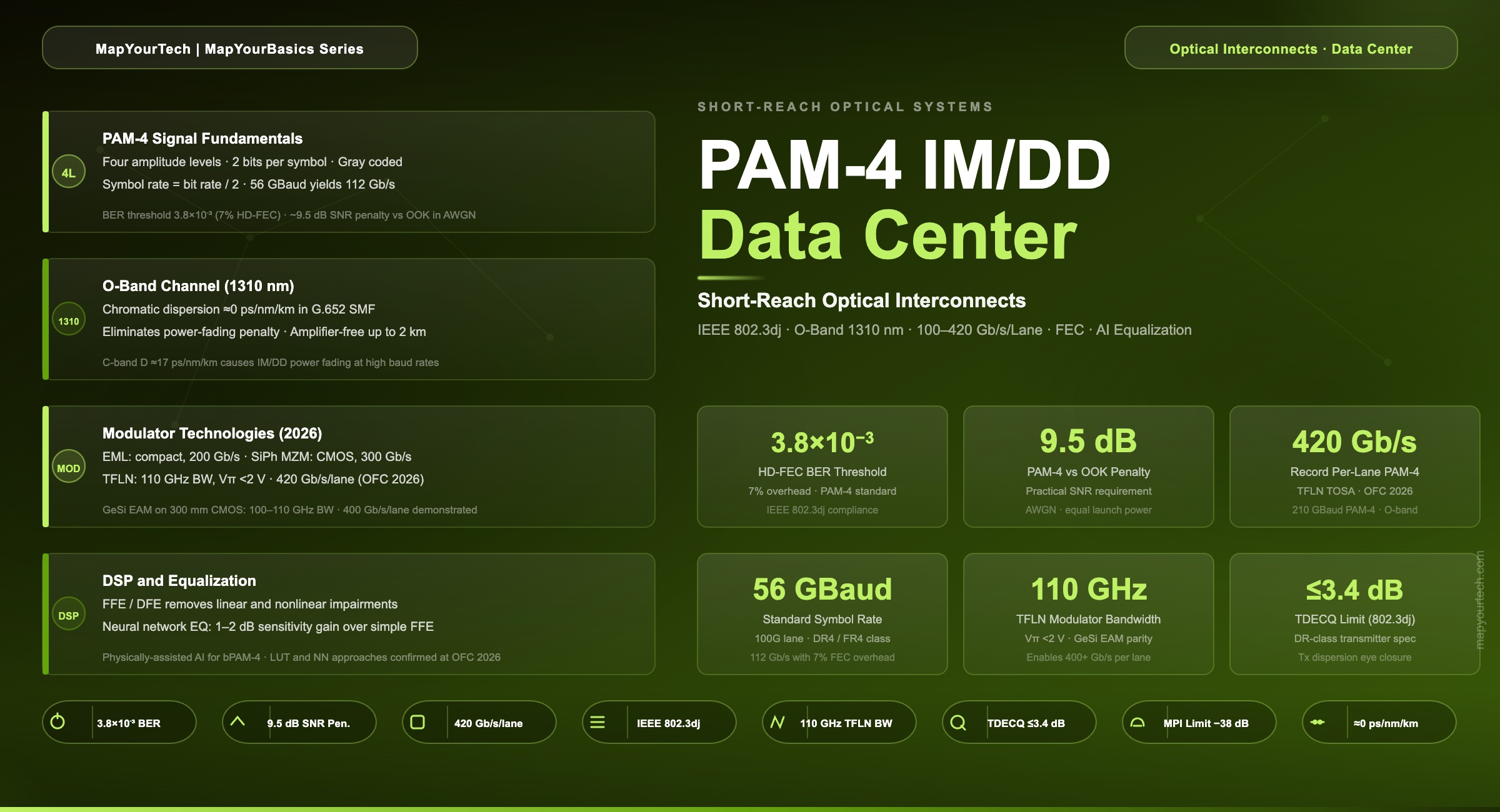
PAM-4 uses four amplitude levels — typically represented as 0, 1, 2, and 3 in normalized units, or as optical power levels P0, P1, P2, P3 — that carry two bits per symbol. Gray coding maps adjacent symbol levels to codewords differing by exactly one bit, minimizing the impact of level-to-level symbol errors on the recovered bit error ratio (BER). Because each symbol carries two bits, a 112 Gbps link requires a symbol rate of only 56 GBaud, halving the electrical bandwidth demand compared with the equivalent NRZ signal. This electrical bandwidth reduction is the core motivation for adopting PAM-4 over the simpler on-off keying (OOK) or NRZ format at high data rates.
The penalty for this bandwidth efficiency is noise tolerance. In a PAM-4 signal, the spacing between adjacent amplitude levels is one-third of the total optical swing, compared with the full swing available in a two-level (OOK) system with the same total launch power. This reduced eye opening means PAM-4 requires approximately 9.5 dB more signal-to-noise ratio (SNR) than OOK to achieve the same BER in additive white Gaussian noise — a fundamental trade-off that drives the stringent optical power budget requirements in PAM-4 link design.
2.3 Forward Error Correction and Operating Thresholds
PAM-4 IM/DD links do not operate at the raw hardware BER threshold of 10−12 or lower that older systems targeted before the receiver decision circuit. Instead, they operate above a forward error correction (FEC) threshold, relying on the FEC codec to reduce post-FEC BER to effectively zero. The industry has standardized on three primary pre-FEC BER thresholds for different FEC overhead levels. Hard-decision FEC with 7% overhead (HD-FEC) carries a pre-FEC BER threshold of 3.8×10⁻³; hard-decision FEC with 20% overhead targets approximately 1.4×10⁻²; and soft-decision FEC with 25% overhead extends to approximately 2.4×10⁻². The 7% HD-FEC threshold at 3.8×10⁻³ is the baseline for IEEE 802.3 short-reach specifications, while the higher-overhead FEC variants are adopted in research demonstrations pushing toward and beyond 400 Gb/s per lane.
Takeaway: PAM-4 halves the required electrical bandwidth compared with an NRZ signal of the same bit rate by encoding two bits per symbol, but demands approximately 9.5 dB more SNR for equivalent raw BER performance. FEC with 7% overhead (BER threshold 3.8×10⁻³) closes this gap to produce error-free output at the system level.
3. System Architecture
A PAM-4 IM/DD link consists of five functional blocks: the transmitter optoelectronic assembly, the optical fiber, any inline amplification or filtering, the receiver optoelectronic assembly, and the digital signal processing (DSP) engine shared between transmitter and receiver. The figure below shows the canonical architecture of a single-lane 112 Gbps (56 GBaud PAM-4) link as deployed in current-generation 400G/lane DR4/FR4 transceivers and the emerging 800G/lane implementations.
3.1 Transmitter Components
The transmitter DSP performs three primary functions: FEC encoding, PAM-4 Gray mapping, and pre-emphasis filtering. Pre-emphasis (also called feed-forward equalization at the transmitter, or Tx-FFE) intentionally boosts high-frequency components of the transmitted signal to compensate for the bandwidth roll-off of the driver, modulator, and fiber channel. This is especially valuable because practical modulators have bandwidths that fall well short of the Nyquist frequency at high baud rates — for example, a 56 GBaud signal has a Nyquist frequency of 28 GHz, but production EML devices typically exhibit −3 dB bandwidths in the 40–60 GHz range, and the combined electrical path including driver and interconnects typically limits effective bandwidth to 35–45 GHz at these rates. A digital-to-analog converter (DAC) with a sample rate of twice the symbol rate (or higher) generates the pre-emphasized analog waveform that drives the modulator.
The modulator converts the electrical PAM-4 waveform into optical intensity variations. Three technologies compete in this space as of 2026. Electro-absorption modulated lasers (EMLs) integrate a distributed feedback (DFB) laser with an electroabsorption section on a single chip, offering compact size and maturity for rates up to approximately 200 Gb/s per lane. Silicon photonics (SiPh) Mach-Zehnder modulators leverage standard CMOS foundry processes to deliver low-cost, high-integration transceivers, with demonstrated bandwidths above 80 GHz enabling single-lane PAM-4 rates of 256–300 Gb/s and beyond. Thin-film lithium niobate (TFLN) Mach-Zehnder modulators represent the leading edge, with electro-optic bandwidths exceeding 110 GHz, drive voltages below 2 V, and demonstrated PAM-4 transmission at 420 Gb/s per lane as presented at OFC 2026 — the highest per-lane PAM-4 rate reported without a 225 GBaud SerDes at the time of that publication.
3.2 Fiber Channel and Wavelength Selection
The fiber medium for data center IM/DD links is almost always OM4 or OM5 multimode fiber for reaches up to 100–400 m with directly modulated VCSELs at 850 nm, or single-mode fiber (G.652/G.657) for reaches from 500 m to 10 km. Within single-mode links, the O-band around 1310 nm is strongly preferred because G.652 fiber has a dispersion zero near 1310 nm, which means the chromatic dispersion coefficient D is approximately 0 ps/(nm·km) at this wavelength. This near-zero dispersion eliminates the power-fading penalty that would otherwise make high-baud-rate IM/DD impractical. For links that must use C-band wavelengths — for example, to multiplex many channels onto a single fiber using conventional DWDM multiplexers — dispersion-shifted fiber (DSF, ITU-T G.653) or optical pre-compensation at the transmitter is required.
3.3 Receiver Components
The receiver front-end converts the arriving optical signal back into an electrical waveform. A Ge-on-Si PIN photodiode — or in some implementations a Ge-on-Si avalanche photodiode (APD) — converts photons to current with a responsivity typically between 0.7 and 0.9 A/W at 1310 nm. Recent work demonstrated SiGe photodetectors supporting 170 GBaud and achieving 300 Gbps net throughput under HD-FEC and 400 Gbps under 25% soft-decision FEC. A transimpedance amplifier (TIA) converts the photocurrent to voltage and provides the first stage of electrical gain, followed by an ADC that digitizes the waveform at approximately one or two samples per symbol for digital equalization. The receiver DSP applies a feed-forward equalizer (FFE) to correct residual linear impairments, and optionally a decision-feedback equalizer (DFE) or more sophisticated neural-network-based equalizer to address nonlinear distortions from the modulator or photodetector. FEC decoding then produces the final recovered bit stream.
4. Design and Performance
4.1 BER–SNR Relationship for PAM-4
For PAM-4 in a channel dominated by additive white Gaussian noise (AWGN), the theoretical BER as a function of signal-to-noise ratio is given by a standard closed-form expression derived from the spacing between adjacent amplitude levels.
// PAM-4 BER in AWGN (Gray-coded, equal spacing)

BERPAM4  =  (3/4) · erfc( sqrt(SNR / 5) )

Where:
  SNR   = signal-to-noise ratio (linear, not dB)
         = (3 · Ppeak²) / (5 · σ²n)   [for equal-spacing PAM-4]
  erfc  = complementary error function
  σn   = rms noise amplitude (TIA thermal + shot)

// Penalty vs. OOK at same BER:
ΔSNRPAM4/OOK  ≈  10·log10(5)  =  +6.99 dB   (theory, equal power)
                                            +9.5 dB    (practical, incl. bandwidth penalty)

// For 7% HD-FEC threshold: BER = 3.8×10⁻³
// Solve: erfc(x) = 4/3 × 3.8×10⁻³ → x ≈ 1.57
SNRrequired  ≈  5 × (1.57)²  =  12.3  →  10.9 dB

// Worked example: 56 GBaud PAM-4 at HD-FEC threshold
  Target BER     = 3.8×10⁻³
  Required SNR   ≈ 10.9 dB   (electrical, at sampler)
  Launch power   ≈ +3 dBm    (typical EML, O-band)
  Fiber loss     ≈ 2.0 dB    (500 m @ 0.4 dB/km insertion loss)
  Coupling loss  ≈ 2.5 dB    (connectors + splices)
  Received power ≈ −1.5 dBm  → within sensitivity of PIN+TIA
The factor 3/4 arises because PAM-4 Gray coding means that most symbol errors involve adjacent levels, and the outer levels (0 and 3) each have only one neighbour, while the inner levels each have two — producing an average of 3/4 of the maximum symbol error probability contributing to bit errors. The factor of 5 in the denominator reflects that the level spacing is one-third of the peak swing, so the noise margin is (peak/3)² and the average power for uniform signalling contains the factor (1² + 3²)/2 = 5 relative to peak-normalised noise.
4.2 TDECQ — Transmitter Dispersion Eye Closure
IEEE 802.3 uses Transmitter and Dispersion Eye Closure Quaternary (TDECQ) as the primary compliance metric for PAM-4 optical transmitters. TDECQ quantifies how much the eye diagram closes relative to a reference receiver's noise floor, expressed in dB. A lower TDECQ indicates a higher-quality transmitter. IEEE 802.3dj specifies TDECQ ≤ 3.4 dB for 200 Gb/s per-lane DR class transceivers. Recent demonstration hardware at OFC 2026 reported TDECQ values of 2.76–3.83 dB for TOSA (Transmitter Optical Sub-Assembly) designs operating at 180–210 GBaud, confirming that TFLN-based transmitters can meet 400 Gb/s per-lane specifications.
4.3 Optical Power Budget
// PAM-4 IM/DD Optical Power Budget

Pbudget  =  Plaunch  −  Psensitivity   [dBm]

Plaunch  =  laser output − modulator insertion loss − connector loss
Psensitivity  =  minimum received power to meet BER threshold

Losses to account for:
  Fiber attenuation   : α × L           [dB]   α ≈ 0.35 dB/km at 1310 nm
  Connector loss      : N × 0.5–1.0       [dB]   per mated pair
  Splice loss         : N × 0.1–0.2       [dB]   per mechanical splice
  Dispersion penalty  : ~0 in O-band      [dB]   (≤ 0.5 dB for 10 km at 56 GBaud)
  Aging margin        : 1–2               [dB]

// Practical example: DR1 (500m, 400G per lane, O-band)
  Launch power (TFLN TOSA, typ.)  =  +6 dBm
  Fiber loss (0.5 km × 0.35)      =  0.18 dB
  2× connector pairs               =  1.0 dB
  Aging margin                     =  1.5 dB
  Total loss                       =  2.68 dB
  Received power                   =  +3.32 dBm   (well above −5 dBm sensitivity)
  Margin to sensitivity            =  8.3 dB
4.4 BER Performance Chart
The chart below illustrates BER as a function of received optical power (ROP) for a representative 56 GBaud PAM-4 IM/DD link with three different equalizer configurations: a simple 5-tap feed-forward equalizer (FFE), a 31-tap FFE plus 5-tap DFE, and a neural network equalizer. The 7% HD-FEC threshold at BER 3.8×10⁻³ and the 20% HD-FEC threshold at BER 1.4×10⁻² are marked for reference. This pattern — neural network equalization providing 1–2 dB sensitivity improvement over a simple FFE — is consistent with experimental results from OFC 2026, where physically-assisted AI equalizers demonstrated measurable gains over conventional adaptive equalizers for bPAM-4 IM/DD systems.
Takeaway: PAM-4 IM/DD link design requires balancing launch power, receiver sensitivity, and equalizer capability. In O-band links under 2 km, chromatic dispersion introduces negligible penalty, leaving thermal noise and bandwidth mismatch as the dominant impairments — both of which digital equalization can address effectively.
5. Practical Deployment
5.1 IEEE 802.3 Reach Classes
IEEE 802.3dj defines several PAM-4 IM/DD reach classes that specify maximum fiber length, minimum launch power, maximum receiver sensitivity, and TDECQ limits. The DR (Data Rate) prefix indicates O-band single-mode fiber applications. DR1 (single lane, 500 m), DR4 (four lanes WDM over a single fiber pair, 500 m), FR4 (four lanes WDM over a single fiber pair, 2 km), and LR4 (four lanes, 10 km) cover the majority of data center campus and intra-data-center needs. The table below summarises the key specifications for these classes at 400G module level.
| IEEE Class | Module Rate | Per-Lane Rate | Wavelength | Max. Reach | Min. Tx Power | Max. Rx Sensitivity |
|---|---|---|---|---|---|---|
| 400G-DR4 | 400 Gb/s | 4 × 100 Gb/s | O-band (4λ) | 500 m SMF | −6 dBm | −11 dBm |
| 400G-FR4 | 400 Gb/s | 4 × 100 Gb/s | O-band (4λ) | 2 km SMF | −2 dBm | −10 dBm |
| 400G-LR4 | 400 Gb/s | 4 × 100 Gb/s | O-band (4λ) | 10 km SMF | 0 dBm | −6 dBm |
| 800G-DR8 | 800 Gb/s | 8 × 100 Gb/s | O-band (8λ) | 500 m SMF | −6 dBm | −11 dBm |
| 800G-FR8 | 800 Gb/s | 8 × 100 Gb/s | O-band (8λ) | 2 km SMF | −2 dBm | −10 dBm |
| 1.6T-DR16 | 1.6 Tb/s | 16 × 100 Gb/s | O-band (16λ) | 500 m SMF | −6 dBm | −11 dBm |
Table 1: Summary of IEEE 802.3dj PAM-4 IM/DD reach class specifications for 400G–1.6T modules. Per-lane rate is 100 Gb/s PAM-4 (56 GBaud) for all entries; 200 Gb/s per-lane variants (112 GBaud) are defined in the same standard for next-generation module architectures. Rx sensitivity is maximum acceptable (i.e., worst-case) value.
5.2 Multi-Path Interference and Connector Quality
A practical issue in data center PAM-4 links that does not appear in coherent systems is multi-path interference (MPI). Reflections from fibre connectors, fusion splices, and end faces create delayed, attenuated copies of the signal that interfere with the main signal at the photodetector. Because PAM-4 has finely spaced amplitude levels, even small amplitude perturbations from MPI cause disproportionate BER degradation. Research at OFC 2026 demonstrated that at MPI levels above −38 dB, the BER of a 53.125 GBaud PAM-4 signal at 1310 nm begins to degrade significantly. This sets practical requirements on connector return loss (typically ≥ 26 dB for UPC, ≥ 60 dB for APC connectors) and on the use of angle-polished connectors in high-power-budget, longer-reach links.
5.3 DSP Equalizer Selection
The choice of equalizer architecture has a direct impact on both link performance and ASIC power consumption. A simple feed-forward equalizer (FFE) with 5–15 taps adds only modest power overhead and handles linear impairments from bandwidth-limited optics well. Adding a decision-feedback equalizer (DFE) of 3–5 taps provides nonlinear compensation but introduces error propagation risk at high BER — undesirable near the FEC threshold. Maximum-likelihood sequence estimation (MLSE) with a Viterbi decoder provides near-optimal detection but scales in complexity as 4m where m is the channel memory length, making it prohibitive above a few symbols of memory. Neural network equalizers — including feed-forward NN architectures, recurrent variants, and look-up table (LUT) approaches — have demonstrated 1–2 dB sensitivity gains over conventional FFE at practical complexity levels, a result confirmed experimentally at OFC 2026 using bipolar PAM-4 systems with physically-assisted AI.
| Modulator Type | 3-dB Bandwidth | Vπ / Drive V | Peak Per-Lane Rate | Reach Class Suitability | Integration |
|---|---|---|---|---|---|
| EML (EA-DFB) | 40–70 GHz | 1–2 Vpp | 200 Gb/s PAM-4 | DR4, FR4, LR4 | Compact TOSA |
| SiPh MZM (PN) | 40–82 GHz | 3–6 V·cm (Vπ·L) | 300 Gb/s PAM-4 | DR4, DR8, FR8 | CMOS monolithic |
| InP MZM | 60–80 GHz | 2–4 Vpp | 360 Gb/s PAM-4 | DR8, FR8 | Co-packaged module |
| TFLN MZM | 100–110 GHz | <2 V (low) | 420 Gb/s PAM-4 | DR8, FR8, 1.6T | CPO candidate |
| GeSi EAM (SiPh) | 100–110 GHz | ~1 Vpp swing | 400 Gb/s PAM-4 | DR8, 1.6T | 300 mm CMOS wafer |
Table 2: Comparison of modulator technologies for short-reach PAM-4 IM/DD links as of 2026. Bandwidth figures are −3 dB electro-optic bandwidth from representative published results. "Peak per-lane rate" refers to demonstrated PAM-4 transmission rates at OFC 2025–2026. CPO = co-packaged optics.
Practical Example — 800G Module Configuration
An 800G-FR8 module aggregates 8 lanes of 100 Gb/s PAM-4 over O-band wavelengths between 1271 nm and 1331 nm using a 4.5 nm channel spacing (CWDM8 grid). Each lane operates at 56 GBaud using a 7% HD-FEC codec with a pre-FEC BER budget of 3.8×10⁻³. The transmitter uses eight EML or SiPh-MZM channels multiplexed through an arrayed waveguide grating (AWG) onto a single-mode fiber. Over 2 km of G.652 fiber, the link must maintain a received optical power above −10 dBm at each photodetector. A 5-tap FFE at the receiver provides adequate equalisation for the moderate bandwidth-distance product of 56 GBaud × 2 km in the O-band.
6. Future Directions
The trajectory for IM/DD in data centers follows two parallel paths: increasing per-lane rate and increasing aggregate capacity per fiber or module. On the per-lane dimension, demonstrations at OFC 2026 showed PAM-4 links operating at 420 Gb/s per lane using TFLN modulators and at 400 Gb/s per lane using GeSi electro-absorption modulators on standard 300 mm CMOS silicon photonic platforms — both without relying on 225 GBaud SerDes chips, which represent the next electrical interface generation. Once 225 GBaud SerDes become commercially available, 448 Gb/s per lane (PAM-4 at 224 GBaud) is anticipated to enable 3.2 Tb/s per module with 8 lanes.
On the aggregate capacity dimension, wavelength-division multiplexed IM/DD systems using optical comb sources are demonstrating impressive results. A 2026 demonstration used 25 comb lines from a quantum-dot mode-locked laser at 100 GHz spacing to carry 3.2 Tbps PAM-4, 4.3 Tbps PAM-6, and 5.76 Tbps PAM-8 over 2 km using a single semiconductor optical amplifier. While PAM-8 and higher formats increase spectral efficiency, they also impose increasingly strict SNR requirements and are sensitive to received optical power variations — PAM-4 tolerates approximately 1.5 dB ROP reduction before exceeding the FEC threshold, while PAM-8 tolerates only 0.2 dB at similar symbol rates, making it fragile for production deployment without careful power management.
Artificial intelligence applied to DSP represents perhaps the most significant near-term opportunity for improving PAM-4 IM/DD link performance without hardware changes. AI equalizers trained offline and deployed as look-up tables or lightweight neural network inference engines can handle the nonlinear transfer functions of high-speed modulators and detectors more accurately than linear FFE/DFE structures, with sensitivity gains of 1–2 dB translating directly to greater link margin or longer reach. The future evolution of PAM-4 IM/DD will therefore be as much a software and DSP discipline as a photonic hardware one.
Takeaway: As of 2026, per-lane PAM-4 rates of 400–420 Gb/s are at the research frontier using TFLN and GeSi EAM modulator technologies. Commercially, 100 Gb/s per lane (56 GBaud) remains the production standard for most deployed 400G and 800G modules. The next commercial milestone is 200 Gb/s per lane enabled by 112–125 GBaud SerDes, which will power 1.6 Tb/s per module transceivers now entering qualification.
References
- IEEE P802.3dj Task Force, "200 Gb/s, 400 Gb/s, 800 Gb/s, and 1.6 Tb/s Ethernet," IEEE Standards Association.
- X. Zhou et al., "Beyond 1 Tb/s intra-data center interconnect technology: IM-DD or coherent?" Journal of Lightwave Technology, vol. 38, no. 2.
- OFC 2026 Proceedings (Optica Publishing Group) — multiple technical presentations on PAM-4 IM/DD including TFLN TOSA demonstrations, SiPh MZM results, and GeSi photodetector characterisation.
- ITU-T G.652, "Characteristics of a single-mode optical fibre and cable," ITU-T Study Group 15.
- ITU-T G.694.2, "Spectral grids for WDM applications: CWDM wavelength grid," ITU-T Study Group 15.
- S. Shekhar et al., "Roadmapping the next generation of silicon photonics," Nature Communications, vol. 15.
- L. Potì et al., "AI in performance optimization of short reach optical interconnects," OFC 2026, Optica Publishing Group.
- Sanjay Yadav, "Optical Network Communications: An Engineer's Perspective" – Bridge the Gap Between Theory and Practice in Optical Networking.
Glossary
- ADC (Analog-to-Digital Converter)
- A circuit that samples and quantises a continuous-time analog signal into a discrete digital representation, enabling DSP-based signal processing at the receiver.
- BER (Bit Error Ratio)
- The fraction of received bits in error relative to the total received bits, used as the primary metric for link quality. Pre-FEC BER is measured before FEC decoding; post-FEC BER is typically ≤10−15 for operational links.
- CD (Chromatic Dispersion)
- The frequency dependence of group velocity in optical fibre, causing different spectral components of a pulse to travel at different speeds. In IM/DD systems, CD causes a power-fading penalty that grows as the square of the symbol rate in the C-band; near-zero dispersion in O-band eliminates this effect.
- CPO (Co-Packaged Optics)
- An advanced packaging architecture that integrates optical transceivers directly alongside switch ASICs in the same package, reducing electrical interconnect length and power consumption at high data rates.
- DFE (Decision Feedback Equalizer)
- An adaptive equalizer that feeds previous symbol decisions back into the equalizer filter to cancel inter-symbol interference caused by dispersive or bandwidth-limited channels.
- EML (Electro-Absorption Modulated Laser)
- A semiconductor optical transmitter device integrating a DFB laser and an electro-absorption modulator in a single chip, widely used in short-reach data center transceivers for its compact size and direct modulation capability.
- FEC (Forward Error Correction)
- A coding technique that adds redundancy to transmitted data so that errors introduced by the channel can be detected and corrected at the receiver without retransmission. PAM-4 links standardly use HD-FEC with 7% overhead (BER threshold 3.8×10⁻³).
- FFE (Feed-Forward Equalizer)
- A digital filter that equalises a received signal by combining delayed versions of the received waveform using calculated or adaptively updated weights. Used in PAM-4 receivers to compensate for bandwidth roll-off.
- IM/DD (Intensity Modulation / Direct Detection)
- An optical transmission architecture in which data is encoded as variations in the instantaneous optical power (intensity modulation) and recovered at the receiver by a photodetector that responds to optical power without requiring a reference laser (direct detection).
- MPI (Multi-Path Interference)
- Optical interference caused by reflections at connector interfaces or discontinuities in the fibre path, producing delayed copies of the signal that degrade PAM-4 eye opening. MPI thresholds for PAM-4 systems are typically set at −38 dB or lower.
- PAM-4 (Four-Level Pulse Amplitude Modulation)
- A modulation format that encodes two bits per symbol using four distinct amplitude levels, halving the required electrical bandwidth compared with binary NRZ at the same bit rate. The standard modulation format for IEEE 802.3dj short-reach Ethernet.
- TDECQ (Transmitter Dispersion Eye Closure Quaternary)
- An IEEE 802.3 compliance metric for PAM-4 optical transmitters that quantifies transmitter-induced eye closure at the input to a standard reference receiver, expressed in dB. Lower values indicate better transmitter quality.
- TFLN (Thin-Film Lithium Niobate)
- A modulator platform using a thin wafer-bonded layer of lithium niobate on silicon or insulator substrate, enabling electro-optic bandwidths above 100 GHz with drive voltages below 2 V — the leading technology for per-lane PAM-4 rates above 400 Gb/s.
- TIA (Transimpedance Amplifier)
- An amplifier that converts the small photocurrent from a photodetector into a usable voltage signal, providing the first stage of electrical gain and bandwidth shaping in an optical receiver.

Optical Communications & Network Automation Expert | Author of 3 Books for Optical Engineers | Founder, MapYourTech
Optical networking engineer with nearly two decades of experience across DWDM, OTN, coherent optics, submarine systems, and cloud infrastructure. Founder of MapYourTech. Read full bio →
Follow on LinkedIn