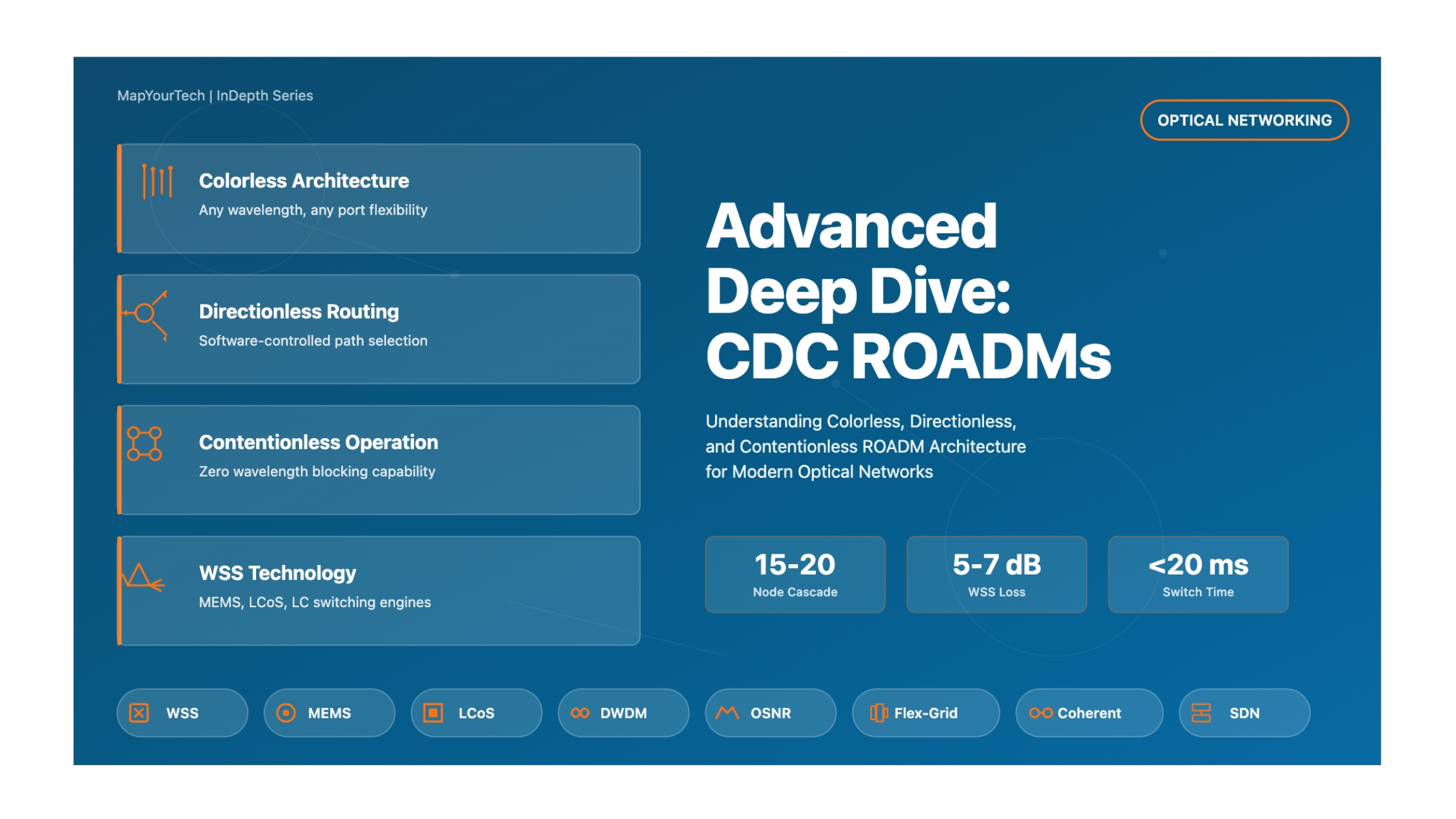

Advanced Deep Dive: CDC ROADMs
Colorless, Directionless, Contentionless: Understanding the Three C's of Modern ROADM Architecture and Their Operational Advantages
1. Introduction
The evolution of optical networks has witnessed a remarkable transformation from rigid, manually configured systems to highly flexible, software-defined infrastructures capable of adapting to dynamic traffic demands. At the heart of this transformation lies the Reconfigurable Optical Add-Drop Multiplexer (ROADM), a technology that has fundamentally altered how wavelength division multiplexing (WDM) networks are designed, deployed, and operated. Among the various ROADM architectures that have emerged over the past two decades, the CDC ROADM—featuring Colorless, Directionless, and Contentionless capabilities—represents the pinnacle of optical layer flexibility and automation.
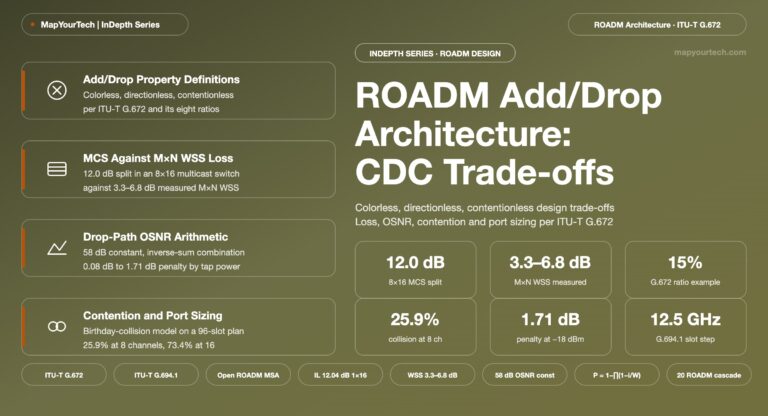
CDC ROADMs address three fundamental limitations that constrained earlier optical network architectures. Traditional fixed-grid ROADMs suffered from wavelength assignment rigidity, where specific wavelengths were permanently tied to particular add-drop ports, necessitating manual site visits for any reconfiguration. Directional constraints forced wavelengths to traverse predetermined paths through the network, limiting restoration capabilities and operational flexibility. Wavelength contention issues prevented multiple instances of the same wavelength from being simultaneously added or dropped at a single node, creating blocking scenarios that reduced network efficiency and service availability.
The importance of CDC ROADM technology extends beyond mere technical elegance. In modern optical networks supporting 100G, 400G, 800G, and emerging terabit-per-second channels, the ability to dynamically provision, reroute, and protect optical paths without physical intervention has become essential for maintaining competitive service delivery. Network operators face unprecedented pressure to reduce operational expenditure while simultaneously improving service velocity and network resilience. CDC ROADMs directly address these challenges by enabling zero-touch provisioning, automated restoration, and optimal spectrum utilization through software-controlled wavelength management.
This comprehensive analysis examines CDC ROADM architecture from both theoretical foundations and practical implementation perspectives. We explore the underlying photonic technologies that enable each CDC feature, analyze the trade-offs between different architectural approaches, and provide quantitative insights into performance characteristics that influence network design decisions. Our treatment encompasses the full spectrum from component-level analysis—including wavelength selective switches (WSS), micro-electro-mechanical systems (MEMS), and liquid crystal on silicon (LCoS) technologies—to system-level considerations such as cascadability, optical signal-to-noise ratio (OSNR) budgets, and network-wide optimization strategies.
For senior engineers and network architects, understanding CDC ROADMs requires more than familiarity with basic principles. It demands deep knowledge of the photonic layer physics that govern signal propagation, the algorithmic approaches that optimize routing and wavelength assignment, and the economic factors that drive deployment decisions. This deep dive provides that comprehensive foundation, drawing upon industry standards, peer-reviewed research, and field deployment experience to deliver actionable insights for real-world network engineering.
Figure 1: CDC ROADM Concept Overview - The Three Pillars of Flexibility
Interactive visualization showing how Colorless, Directionless, and Contentionless features work together to provide ultimate optical layer flexibility
Read the Full Analysis with Premium
The remaining 88% of this article — the design numbers, trade-offs and field guidance — is part of MapYourTech Premium, along with the full premium library, courses and professional tools.