
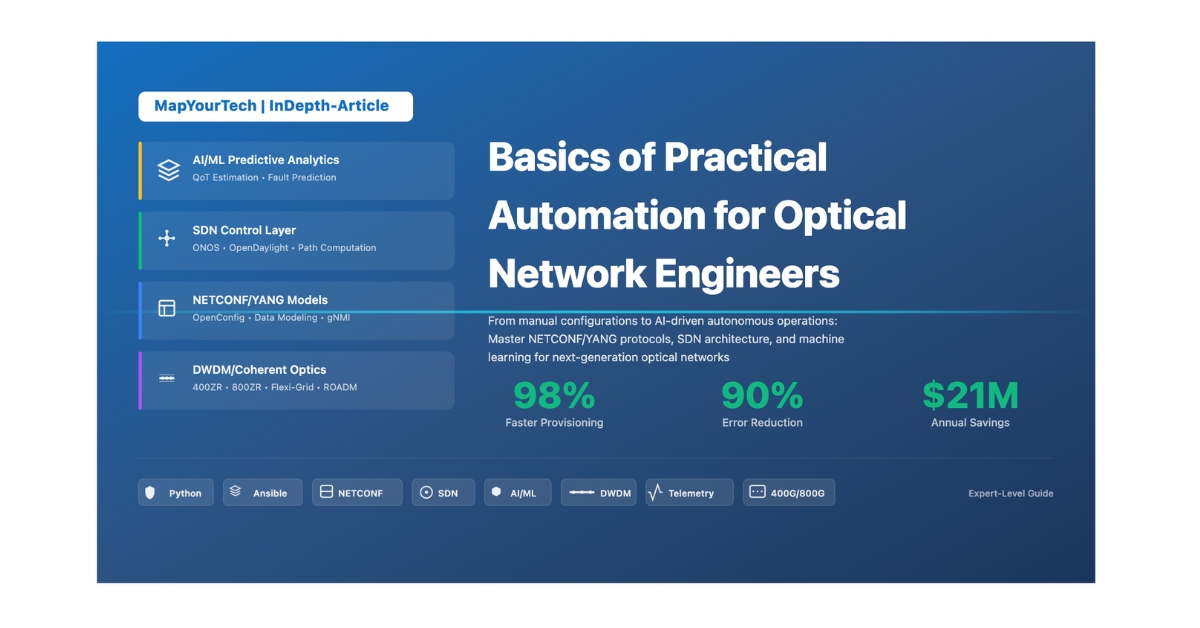
Basics of Automation for Optical Network Engineers
Part 1:Introduction
Executive Overview
Automation has transitioned from a tactical cost-optimization tool to a fundamental architectural imperative for modern optical telecommunications networks. The confluence of exponential traffic growth driven by 5G, Internet of Things (IoT), hyperscale data centers, and artificial intelligence workloads has rendered manual network management not merely inefficient but fundamentally untenable. Contemporary optical networks, characterized by Dense Wavelength Division Multiplexing (DWDM) systems operating at 400 Gbps and beyond, coherent optical technologies, and software-defined architectures, demand automation capabilities that extend far beyond configuration management to encompass predictive maintenance, autonomous healing, real-time optimization, and intelligent capacity planning.
Critical Industry Transformation
The optical networking industry is experiencing a paradigmatic shift where automation is no longer about accelerating existing manual workflows—it is about enabling entirely new operational paradigms. Modern optical networks must self-configure wavelength assignments, dynamically allocate spectral resources, predict fiber degradation before service impact, and optimize Quality of Transmission (QoT) parameters in real-time across multi-vendor, disaggregated infrastructure. This fundamental transformation elevates the optical engineer's role from device-level configuration specialist to architect of intelligent, autonomous network systems.
Key Findings and Implications
Strategic Imperatives:
- Complexity Management: Modern optical networks with hundreds of wavelengths, multi-band DWDM (C-band, L-band, S-band), space-division multiplexing, and coherent pluggable optics (400ZR/ZR+, 800ZR) generate configuration spaces with billions of possible states. Automation is the only viable approach to manage this combinatorial complexity while maintaining service quality.
- Economic Imperative: Operational expenditure (OPEX) now constitutes 60-75% of total network costs for major telecommunications service providers. Automation demonstrably reduces OPEX by 30-50% through reduced provisioning time (from days to minutes), elimination of human configuration errors (which account for 70% of network outages), and optimized resource utilization.
- Enabling Advanced Capabilities: Artificial Intelligence and Machine Learning algorithms for optical performance prediction, anomaly detection, and capacity optimization require structured, real-time telemetry data and programmatic control interfaces—both enabled exclusively through automation frameworks.
- Multi-Layer Convergence: The integration of IP routing directly over DWDM transport (IP-over-DWDM or IPoDWDM) using coherent pluggable optics eliminates traditional transponder layers, reducing both capital expenditure (CAPEX) and operational complexity. This architectural convergence mandates unified automation spanning both packet and optical domains.
- Disaggregation and Open Standards: The industry transition from monolithic, proprietary systems to disaggregated, multi-vendor architectures (separating optical line systems, transponders, and reconfigurable optical add-drop multiplexers) necessitates vendor-neutral automation based on standard data models (YANG) and protocols (NETCONF, RESTCONF, gNMI).
Primary Use Cases for Optical Network Automation
| Use Case Category | Specific Applications | Business Impact |
|---|---|---|
| Service Provisioning | Zero-touch wavelength provisioning, automated bandwidth-on-demand, dynamic spectrum allocation, end-to-end service orchestration | Provisioning time reduction from 2-3 weeks to under 1 hour; improved customer experience; enhanced service agility |
| Network Monitoring & Telemetry | Streaming telemetry collection, optical performance monitoring (OPM), coherent transceiver metrics, OTDR automation, proactive threshold monitoring | Mean Time to Detect (MTTD) reduction by 85%; real-time visibility into 1000+ parameters per optical circuit |
| Fault Management | Automated fault correlation, predictive failure analysis, self-healing path restoration, automated rollback procedures | Mean Time to Repair (MTTR) reduction from hours to minutes; 99.999% availability achievement; proactive intervention before service impact |
| Performance Optimization | Automated power balancing, chromatic dispersion compensation, polarization mode dispersion mitigation, modulation format optimization, spectral defragmentation | 20-30% capacity utilization improvement; extended system reach; enhanced spectral efficiency |
| Capacity Planning | AI-driven traffic forecasting, automated growth scenario modeling, spectral utilization analytics, fiber exhaust prediction | Optimized CAPEX allocation; prevention of over-provisioning; proactive capacity augmentation with 6-12 month lead time |
| Configuration Management | Configuration templating, version control integration, compliance validation, automated configuration backup and restoration | Elimination of 70% of configuration-related outages; standardization across multi-vendor environments; audit compliance |
| Testing & Validation | Automated acceptance testing, pre-deployment validation, regression testing, disaster recovery drills | 50% reduction in commissioning time; reduced human testing errors; comprehensive test coverage |
Document Scope and Audience
This comprehensive technical resource addresses optical network engineers at various proficiency levels—from those beginning their automation journey to experienced practitioners seeking to deepen their understanding of advanced concepts. The document assumes foundational knowledge of optical networking principles (fiber optics, DWDM, OTN, coherent modulation) and basic network engineering concepts (IP routing, protocols, network architectures). No prior programming expertise is required, as implementation approaches are described conceptually without code examples.
The material progresses systematically from foundational principles through mathematical formulations to practical deployment strategies. Engineers will gain comprehensive understanding of automation architectures, data models, control protocols, orchestration frameworks, and the integration of artificial intelligence and machine learning techniques. The content bridges theoretical foundations with real-world operational considerations, addressing the unique challenges of optical domain automation including physical layer constraints, vendor interoperability, and the management of time-variant optical impairments.
Part 2: Historical Context & Foundational Principles
The Evolution of Optical Network Automation
The journey toward automated optical networks spans over three decades, evolving from rudimentary command-line interfaces to sophisticated artificial intelligence-driven orchestration platforms. Understanding this historical progression provides essential context for contemporary automation practices and illuminates the trajectory toward future capabilities. The evolution reflects not merely technological advancement but fundamental shifts in operational philosophy—from reactive, manual intervention to proactive, intelligent autonomy.
Characteristics: Network engineers configured SONET/SDH equipment, early DWDM systems, and optical add-drop multiplexers through proprietary Command Line Interfaces (CLI) or primitive graphical management systems. Each vendor implemented unique command syntaxes, configuration paradigms, and management protocols.
Limitations: Configuration errors were endemic, with human mistakes accounting for 60-70% of network outages. Provisioning a single wavelength service required hours of manual configuration across multiple network elements. No standardization existed for data models or management protocols. Network documentation diverged from actual configurations, creating operational blind spots.
Innovation: Transaction Language 1 (TL1), developed by Bellcore (now Telcordia), provided the first standardized machine-to-machine interface for telecommunications equipment, particularly optical transport systems. While primitive by modern standards, TL1 represented the first step toward programmatic network management.
Characteristics: Element Management Systems (EMS) and Network Management Systems (NMS) consolidated device management. Simple Network Management Protocol (SNMP) became ubiquitous for monitoring. Early scripting approaches using Perl, Shell scripts, and proprietary languages enabled basic automation of repetitive tasks.
Limitations: SNMP proved inadequate for configuration management, designed primarily for monitoring rather than control. Management systems remained largely vendor-specific, creating operational silos. Scripting approaches were fragile, difficult to maintain, and lacked transaction safety—a failed configuration could leave networks in inconsistent states.
Innovation: The ITU-T developed standards for optical transport networks (OTN) and introduced Automatically Switched Optical Network (ASON) and Generalized Multi-Protocol Label Switching (GMPLS) as distributed control plane architectures, enabling dynamic path establishment without centralized controllers.
Characteristics: Software-Defined Networking (SDN) paradigms, initially developed for packet networks (OpenFlow), extended to optical domains. The separation of control plane from data plane enabled centralized network intelligence. OpenFlow was adapted for optical circuit switching. Open Network Operating System (ONOS) and OpenDaylight emerged as open-source SDN controllers.
Breakthrough: The IETF developed NETCONF (Network Configuration Protocol) in 2006, ratified as RFC 6241 in 2011, providing a transactional, XML-based protocol for network configuration. YANG (Yet Another Next Generation) data modeling language, specified in RFC 6020 (2010), enabled vendor-neutral device descriptions. These standards formed the foundation for modern model-driven automation.
Impact: Service provisioning time reduced from hours to minutes. Multi-vendor interoperability became feasible through standardized interfaces. Configuration errors decreased significantly through transactional commits and rollback capabilities.
Characteristics: The industry transitioned from integrated, vendor-locked optical systems to disaggregated architectures separating transponders, optical line systems, and reconfigurable add-drop multiplexers. OpenConfig consortium established standardized YANG models for multi-vendor configuration. OpenROADM created open specifications for disaggregated optical networks. Coherent pluggable optics (100G, 200G, 400ZR) emerged, enabling direct IP-over-DWDM integration.
Automation Evolution: REST-based interfaces (RESTCONF) complemented NETCONF. gRPC Network Management Interface (gNMI) provided high-performance telemetry streaming. Zero-Touch Provisioning (ZTP) enabled automated device onboarding. Infrastructure as Code (IaC) principles from cloud computing influenced optical network automation.
Commercial Impact: Total Cost of Ownership decreased by 40-60% through vendor competition and operational efficiency. Time-to-market for new services accelerated dramatically. Network capacity utilization improved through dynamic resource allocation.
Characteristics: Artificial Intelligence and Machine Learning integration for predictive maintenance, traffic forecasting, and autonomous optimization. Digital twins enable simulation-based network planning. Intent-Based Networking (IBN) systems translate business requirements into network configurations automatically. Closed-loop automation systems detect anomalies, predict failures, and execute remediation without human intervention.
Emerging Technologies: Large Language Models (LLMs) and AI assistants accelerate automation development, providing natural language interfaces to network operations. Reinforcement learning optimizes network parameters in real-time. Generative AI creates configuration templates and documentation automatically. Multi-agent AI systems coordinate across network domains.
Future Trajectory: Self-organizing networks that autonomously optimize performance. Quantum-ready automation frameworks. Cognitive networks that understand business context and adjust operations accordingly. Integration of sustainability metrics into automated decision-making.
Pioneering Contributions and Standards Bodies
| Organization | Key Contributions | Impact on Automation |
|---|---|---|
| IETF (Internet Engineering Task Force) | NETCONF (RFC 6241), YANG (RFC 6020/7950), RESTCONF (RFC 8040), YANG Push (RFC 8639), gNMI specifications | Established foundational protocols and data modeling standards enabling vendor-neutral, programmatic network management |
| OpenConfig | Vendor-neutral YANG models for routing, optical transport, network interfaces, and telemetry; emphasis on operational state modeling | Enabled multi-vendor automation through consistent configuration and telemetry interfaces across diverse equipment |
| Open Networking Foundation (ONF) | OpenFlow protocol, Transport API (TAPI), Core Information Model (CIM), ONOS controller platform | Pioneered SDN architectures for optical networks; provided open-source controller platforms for production deployment |
| Telecom Infra Project (TIP) | OpenROADM specifications, OOPT (Open Optical Packet Transport) initiatives, disaggregated network architectures | Accelerated industry adoption of open, disaggregated optical systems; reduced vendor lock-in through standardized interfaces |
| Metro Ethernet Forum (MEF) | Lifecycle Service Orchestration (LSO) APIs, MEF 3.0 architecture, service abstraction models | Defined service-level automation interfaces enabling end-to-end orchestration across heterogeneous networks |
| ITU-T Study Group 15 | OTN standards (G.709, G.872, G.873), ASON/GMPLS control plane (G.8080, G.7714), management interface specifications | Established international standards for optical transport protocols and management, ensuring global interoperability |
Read the Full Analysis with Premium
The remaining 88% of this article — the design numbers, trade-offs and field guidance — is part of MapYourTech Premium, along with the full premium library, courses and professional tools.
You May Also Like
-
Free
-
August 22, 2026

-
Premium
-
August 22, 2026
-
Premium
-
August 22, 2026