Last Updated: August 16, 2025
7 min read
225
Evolution to flexible grid WDM
November 26, 2013|By RANDY EISENACH
extract from:http://www.lightwaveonline.com/articles/print/volume-30/issue-6/features/evolution-to-flexible-grid-wdm.html

WDM networks operate by transmitting multiple wavelengths, or channels, over a fiber simultaneously. Each channel is assigned a slightly different wavelength, preventing interference between channels. Modern DWDM networks typically support 88 channels, with each channel spaced at 50 GHz, as defined by industry standard ITU G.694. Each channel is an independent wavelength.
The fixed 50-GHz grid pattern has served WDM networks and the industry well for many, many years. It helps carriers easily plan their services, capacity, and available spare capacity across their WDM systems. In addition, the technology used to add and drop channels on a ROADM network is based on arrayed-waveguide-grating (AWG) mux/demux technology, a simple and relatively low-cost technique particularly well suited to networks based on 50-GHz grid patterns.
 |
| FIGURE 1. The ITU’s fixed 50-GHz grid and its 100-GHz variant form the foundation for today’s optical networks. |
WDM networks currently support optical rates of 10G, 40G, and 100G per wavelength (with the occasional 2.5G still popping up), all of which fit within existing 50-GHz channels. In the future, higher-speed 400-Gbps and 1-Tbps optical rates will be deployed over optical networks. These interfaces beyond 100G require larger channel sizes than used on current WDM networks. The transition to these higher optical rates is leading to the adoption of a new, flexible grid pattern capable of supporting 100G, 400G, and 1T wavelengths.
Current generation
The fixed 50-GHz grid pattern specified by ITU standards is shown in Figure 1. Any 10G, 40G, or 100G optical service can be carried over any of the 50-GHz channels, which enables carriers to mix and match service rates and channels as needed on their networks.
A look inside each channel reveals some interesting differences between the optical rates and resulting efficiency of the optical channel (see Figure 2). A 10G optical signal easily fits within the 50-GHz-channel size, using about half the available spectrum. The remaining space within the 50-GHz channel is unused and unavailable. Meanwhile, the 40G and 100G signals use almost the entire 50-GHz spectrum.
 |
| FIGURE 2. Optical rates and their spectral efficiency. |
Spectral efficiency is one measure of how effectively or efficiently a fiber network transmits information and is calculated as the number of bits transmitted per Hz of optical spectrum. With 10G wavelengths the spectral efficiency is only 0.2 bit/Hz, while the 100G wavelength provides a 10X improvement in spectral efficiency to 2 bits/Hz. The more bits that can be transmitted per channel, the greater the improvement in spectral efficiency and increase in overall network capacity and the lower the cost per bit of optical transport.
While 100G wavelengths are becoming more common, carriers are already planning for higher-speed 400G and 1T channels on their future ROADM networks, with the expectation that spectral efficiency will at least remain the same, if not improve. New ways of allocating bandwidth will be needed to meet these expectations.
Superchannels
As mentioned, WDM networks currently transmit each 10G, 40G, and 100G optical signal as a single optical carrier that fits within a standard 50-GHz channel. At higher data rates, including 400G and 1T, the signals will be transmitted over multiple subcarrier channels (see Figure 3). The group of subcarrier wavelengths is commonly referred to as a “superchannel.” Although composed of individual subcarriers, each 400G superchannel is provisioned, transmitted, and switched across the network as a single entity or block.
 |
| FIGURE 3. 400G modulation options and superchannels. |
While 400G standards are still in preliminary definition stage, two modulation techniques are emerging as the most likely candidates: dual polarization quadrature phase-shift keying (DP-QPSK) using four subcarriers and DP-16 quadrature amplitude modulation (QAM) with two subcarriers. Due to the differences in optical signal-to-noise-ratio requirements, each modulation type is optimized for different network applications. The 4×100G DP-QPSK approach is better suited to long-haul networks because of its superior optical reach, while the 2×200G DP-16QAM method is ideal for metro distances.
Since 400G signals are treated as a single superchannel or block, the 400G signals shown in Figure 3 require 150-GHz- and 75-GHz- channel sizes, respectively. It’s this transition to higher data rates that leads to the requirement for and adoption of new flexible grid channel assignments to accommodate mixed 100G, 400G, and 1T networks (see Figure 4).
A new flexible grid pattern has been defined and adopted by ITU G694.1. While commonly referred to as “gridless” channel spacing, in reality the newly defined flexible channel plan is actually based on a 12.5-GHz grid pattern. The new standard supports mixed channel sizes, in increments of n×12.5 GHz and easily accommodates existing 100G services (4×12.5 GHz = 50 GHz) and future 400G (12×12.5 GHz) and 1T optical rates.
 |
| FIGURE 4. Flexible grid channel plan. |
One of the advantages of the flexible grid pattern is the improvement in spectral efficiency enabled by more closely matching the channel size with the signals being transported and by improved filtering that allows the subcarriers to be more closely squeezed together. As shown in Figure 5, four 100G subcarriers have been squeezed into 150-GHz spacing, as opposed to the 200 GHz (4×50 GHz) required if the subcarriers were transported as independent 50-GHz channels. The net effect of the flexible channel plan and closer subcarrier spacing is an improvement in network capacity of up to 30%.
One common “myth” in the industry is that legacy networks must be upgraded, or “flexible grid-ready,” to support 400G optical rates and superchannels. While having flexible grid-capable ROADMs can improve spectral efficiency, they’re not a requirement to support 400G or superchannels on a network. Since the subcarriers are fully tunable to any wavelength, they can simply be tuned to the existing 50-GHz grid pattern, allowing full backward compatibility with existing ROADM networks.
|
| FIGURE 5. Transmitting 400G on legacy WDM networks. |
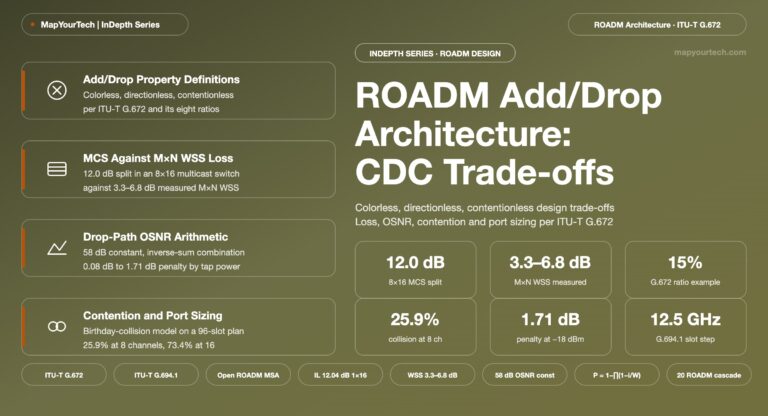
CDC ROADMs
Closely associated with flexible grid channel spacing are colorless/directionless/gridless (CDG) and colorless/directionless/contentionless/gridless (CDCG) ROADM architectures. Along with gridless channel spacing, CDC ROADMs enable a great deal of flexibility at the optical layer.
Recall that existing ROADM systems are based on fixed 50-GHz-channel spacing and AWG mux/demux technology. The mux/demux combines and separates individual wavelengths into different physical input and output ports. While the transponder and muxponder themselves are full-band tunable and can be provisioned to any transmit wavelength, they must be connected to a specific port on the mux/demux unit. A transponder connected to the west mux/demux only supports services connected in the west direction. To reassign wavelengths – either to new channels or to reroute them to a different direction – requires technician involvement to physically unplug the transponder from one port on the mux/demux and plug it into a different physical mux/demux port.
CDC ROADMs enable much greater flexibility at the optical layer. The transponders may be connected to any add/drop port and can be routed to any degree or direction. Wavelength reassignment or rerouting can be implemented automatically from a network management system, or based on a network fault, without the need for manual technician involvement. The tradeoffs with CDC ROADMs are more complex architectures and costs.
Flexing network muscles
The existing 50-GHz-channel plan based on ITU G.694 has served the industry well for many years. But as the industry plans for the introduction of even faster 400G, and eventually 1T, optical interfaces, there’s a need to adopt larger channel sizes and a more flexible WDM spacing plan.
These higher-speed optical interfaces rely on a new technique involving superchannels that comprise multiple subcarrier wavelengths. These subcarriers are provisioned, transported, and switched across a network as a single block or entity. Flexible grid systems enable the larger channel sizes required by 400G and 1T interfaces, but also allow the channel size to be closely matched to the signal being transported to optimize spectral efficiency.
No discussion of gridless ROADMs would be complete without including new next generation CDC ROADM architectures. These new ROADMs will enable a great deal more flexibility and efficiency at the optical layer.