
LR1 Optical Transceivers: Complete Technical Guide
Comprehensive exploration of Single Lambda Long Reach optical technology for 100G and 400G networks - from fundamental principles to advanced deployment strategies
Introduction to LR1 Technology
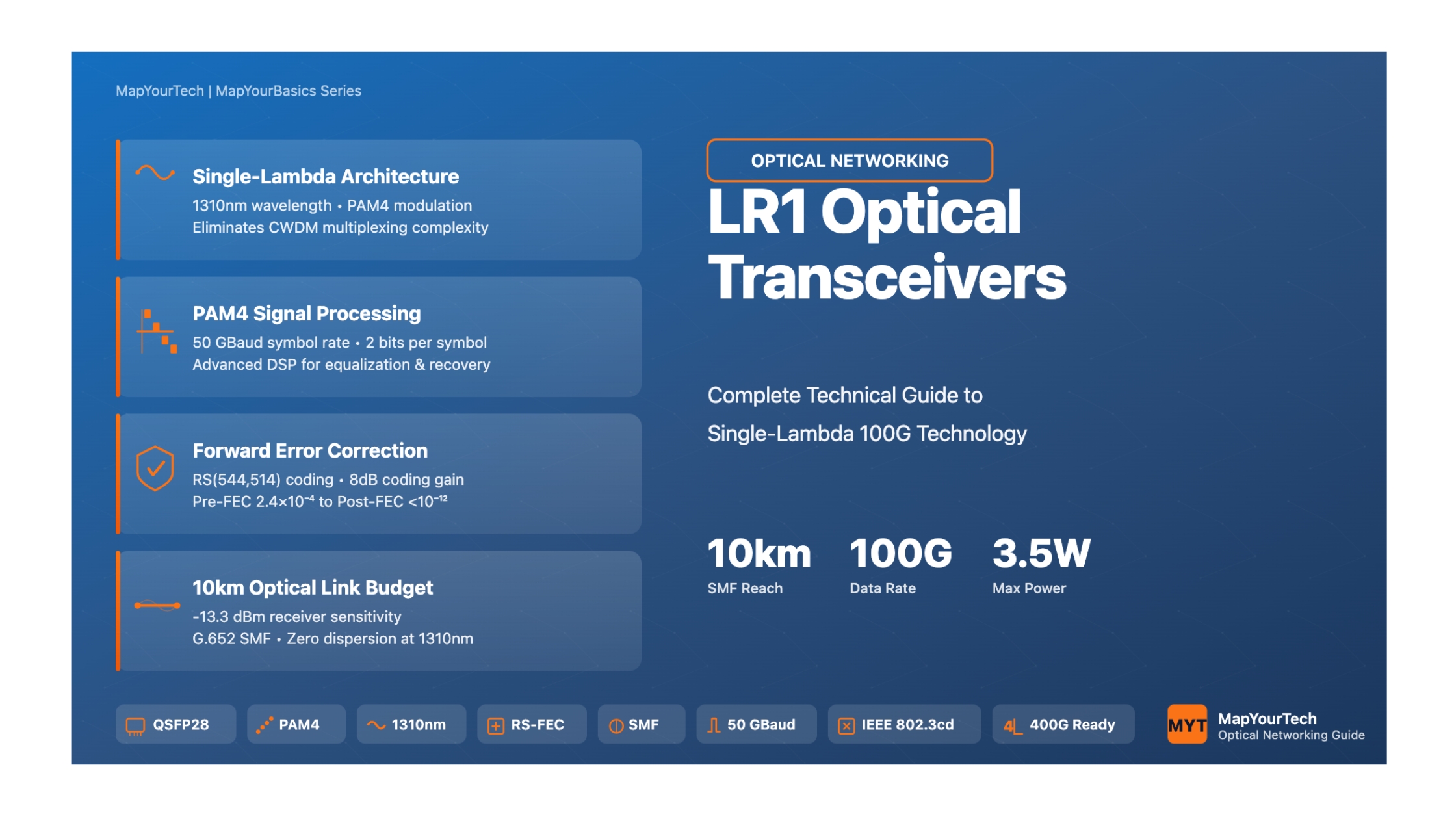
LR1 (Long Reach 1) represents a transformative advancement in optical networking technology, marking a significant shift from traditional multi-wavelength approaches to single-lambda solutions. As data centers and telecommunications networks push toward higher bandwidth densities, LR1 transceivers have emerged as a critical technology enabling efficient 10-kilometer transmission over single-mode fiber using a single optical wavelength at 1310nm.
Unlike its predecessor, the LR4 specification that employs four separate wavelengths combined through Coarse Wavelength Division Multiplexing, LR1 achieves 100 Gigabit per second transmission using a single laser source. This architectural simplification translates to reduced component count, lower manufacturing complexity, and ultimately, more cost-effective deployment at scale. The technology leverages advanced PAM4 modulation combined with sophisticated Forward Error Correction to maintain signal integrity across metropolitan-area network distances.
What is LR1?
LR1 is a single-lambda optical transceiver specification designed for 100Gbps transmission over single-mode fiber. The designation "LR1" stands for "Long Reach 1," where "Long Reach" indicates the 10km transmission distance capability, and "1" signifies the use of a single optical wavelength. This contrasts with LR4 transceivers, which utilize four distinct wavelengths multiplexed together.
Key Defining Characteristics
- Single Wavelength Operation: Utilizes 1310nm center wavelength, eliminating the need for wavelength multiplexing/demultiplexing components
- PAM4 Modulation: Four-level Pulse Amplitude Modulation doubles spectral efficiency compared to traditional NRZ encoding
- 10km Reach: Designed for metropolitan and campus network connectivity over standard G.652 single-mode fiber
- Forward Error Correction: Integrated FEC enables reliable transmission despite PAM4's increased sensitivity to noise
- QSFP28 Form Factor: Standard pluggable module design ensuring interoperability across vendor platforms
Industry Significance and Applications
The introduction of LR1 technology addresses several critical challenges in modern network infrastructure. As organizations migrate toward 400G backbone networks, the ability to interface legacy 100G equipment with next-generation platforms becomes essential. LR1 serves as an ideal bridge technology, enabling gradual network evolution without requiring wholesale infrastructure replacement.
In data center environments, LR1 transceivers facilitate inter-building connectivity and campus network designs. The 10km reach specification aligns perfectly with metropolitan-area data center architectures, where facilities are distributed across urban regions for redundancy and latency optimization. Financial services firms, cloud service providers, and telecommunications operators have rapidly adopted LR1 for its combination of reach, performance, and economic efficiency.
Real-World Implementation Scenarios
Data Center Interconnect (DCI): LR1 transceivers enable high-speed connections between co-located or metropolitan-distributed data centers. Organizations can maintain synchronous replication and load balancing across sites within a 10km radius, supporting business continuity and disaster recovery requirements.
Campus Network Backbone: Large enterprise campuses, university networks, and government facilities leverage LR1 for building-to-building connectivity. The single-fiber-pair requirement simplifies cabling infrastructure while delivering sufficient bandwidth for consolidated network traffic.
400G Migration Path: The most compelling use case involves 400G network upgrades. Using breakout cables, a single 400G QSFP-DD port can connect to four independent 100G LR1 endpoints, allowing phased migration strategies. Network operators can upgrade core switches to 400G while maintaining connectivity to existing 100G access layer equipment.
What You'll Learn
This comprehensive guide takes you through every aspect of LR1 technology, from the historical context of its development through detailed technical specifications, mathematical models, and practical deployment considerations. You'll explore:
- The evolution from multi-wavelength to single-lambda optical systems
- Physical layer architecture including transmitter, receiver, and signal processing components
- PAM4 modulation theory and its implementation challenges
- Optical link budget calculations and power penalty analysis
- Comparison with alternative transceiver technologies (LR4, FR1, DR1)
- Interactive simulators for link budget, BER analysis, dispersion effects, and network planning
- Real-world case studies from production network deployments
- Troubleshooting methodologies and best practices
Whether you're a network architect designing next-generation infrastructure, an optical engineer optimizing link performance, or a student seeking to understand modern optical networking, this guide provides the technical depth and practical insights needed to master LR1 technology.
Historical Evolution & Technology Timeline
The development of LR1 technology represents the culmination of decades of optical networking innovation, driven by the relentless demand for higher bandwidth and more efficient transmission systems. To understand LR1's significance, we must trace the evolution of 100G optical transceivers and the factors that led to single-lambda architectures.
The Pre-100G Era (1990s-2009)
Early optical networks operated primarily at 10 Megabit and 100 Megabit speeds using simple intensity modulation with direct detection. The introduction of Gigabit Ethernet in 1998 marked the first widespread deployment of optical transceivers in enterprise environments. These systems used relatively simple On-Off Keying modulation with basic optical components.
The 10 Gigabit Ethernet standard ratified in 2002 brought new challenges in terms of dispersion management and optical power budgets. Engineers developed various 10G solutions including short-reach multimode fiber options, long-reach single-mode solutions at 1310nm and 1550nm, and early wavelength division multiplexing implementations. These technologies established foundational concepts that would later influence 100G development.
First-Generation 100G Solutions (2010-2017)
100GBASE-LR4 Introduction (2010): The IEEE 802.3ba standard introduced the first widely adopted 100G interface. LR4 utilized four 25Gbps lanes, each transmitted on a separate CWDM wavelength around 1310nm. This approach required integrated wavelength multiplexers and demultiplexers within the transceiver module, adding significant complexity and cost.
The LR4 architecture emerged from practical limitations in available component technology. Achieving 100Gbps on a single wavelength required modulation formats and optoelectronic components that weren't economically viable in 2010. By parallelizing four 25G channels, engineers could leverage mature 25G laser and detector technology while meeting the 10km reach requirement.
However, LR4's success revealed inherent limitations. The requirement for four precisely controlled wavelengths, along with passive CWDM multiplexing components, constrained manufacturing yield and maintained relatively high module costs. As 100G ports became standard in data center switches, the industry recognized the need for more economical solutions.
The Path to Single Lambda (2015-2020)
PAM4 Modulation Breakthrough: The key enabling technology for single-lambda 100G came from advances in digital signal processing and multi-level modulation schemes. PAM4 (Four-Level Pulse Amplitude Modulation) encodes two bits per symbol by using four distinct amplitude levels, effectively doubling spectral efficiency compared to binary NRZ modulation.
Read the Full Analysis with Premium
The remaining 88% of this article — the design numbers, trade-offs and field guidance — is part of MapYourTech Premium, along with the full premium library, courses and professional tools.