
LR4 Optical Transceiver Technology
A Comprehensive Guide to Long-Reach 4-Lane Optical Transmission for Modern Data Centers and Enterprise Networks
Introduction to LR4 Technology
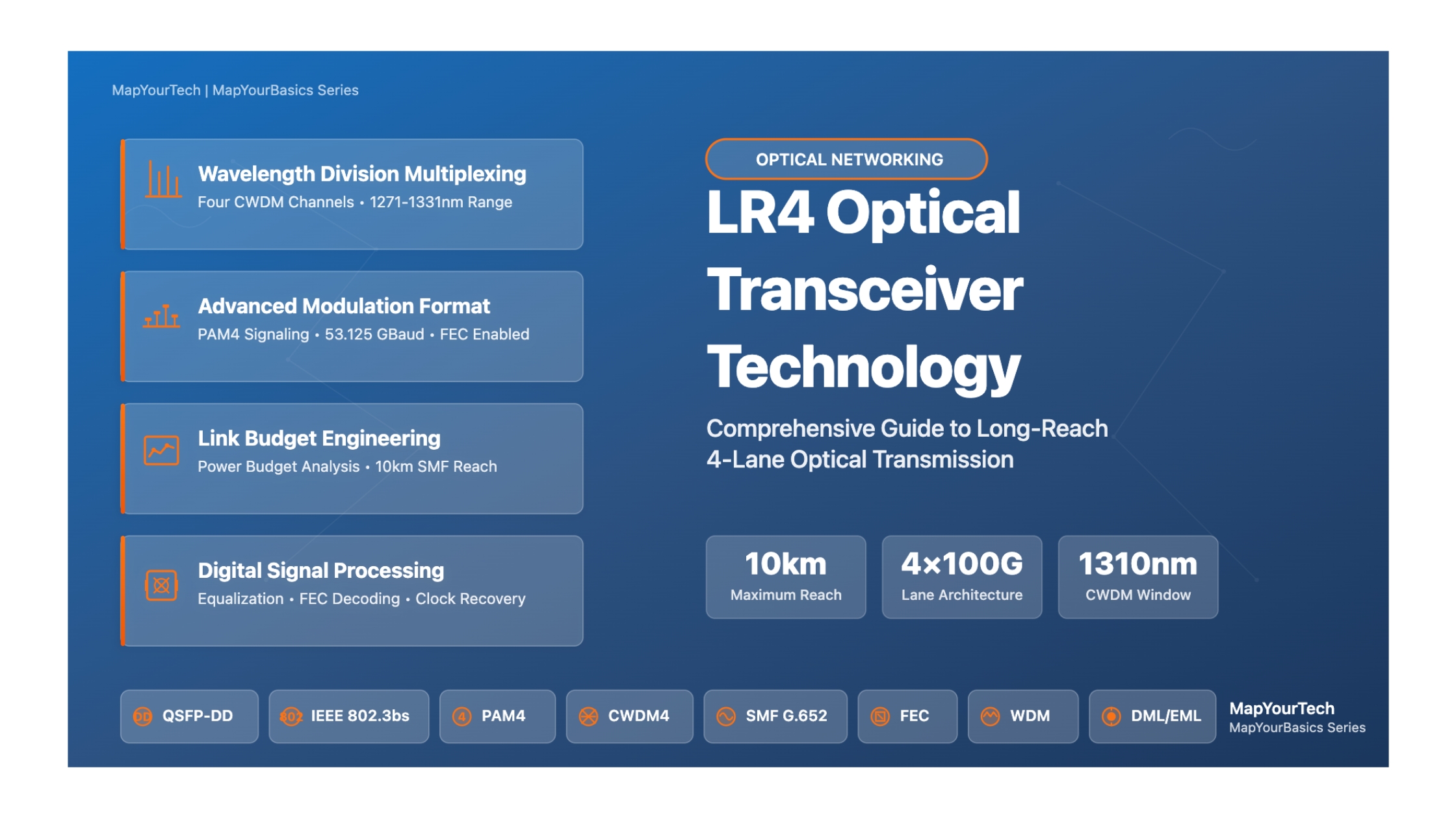
Long-Reach 4-lane (LR4) optical transceiver technology represents a cornerstone advancement in modern optical networking, enabling high-speed data transmission over extended distances using single-mode fiber infrastructure. LR4 technology has become indispensable for data center interconnects, enterprise networks, and telecommunications applications requiring reliable, high-bandwidth connectivity up to 10 kilometers.
What is LR4?
LR4 (Long Reach 4-lane) is an optical transceiver standard that utilizes wavelength division multiplexing (WDM) technology to transmit data across four distinct optical wavelengths simultaneously. This architecture enables aggregate data rates ranging from 40 Gbps to 400 Gbps and beyond, depending on the generation and per-lane signaling rate.
The LR4 designation appears across multiple speed grades in the optical networking ecosystem. At 40 Gigabit Ethernet, the 40GBASE-LR4 standard uses QSFP+ form factor modules. For 100 Gigabit Ethernet, the 100GBASE-LR4 leverages QSFP28 transceivers. The evolution continues with 400GBASE-LR4 utilizing QSFP-DD or OSFP form factors, and emerging 800G LR4 implementations pushing the boundaries even further.
Modern data centers and enterprise networks face unprecedented bandwidth demands driven by cloud computing, artificial intelligence workloads, streaming media, and the proliferation of connected devices. LR4 technology addresses these challenges by providing:
Extended Reach Capability
LR4 modules support transmission distances up to 10 kilometers over standard single-mode fiber (SMF), making them ideal for campus networks, metro area networks, and data center interconnects where fiber runs exceed the reach of short-range optics.
Fiber Infrastructure Efficiency
By using WDM technology, LR4 transceivers multiplex four channels onto a single fiber pair with duplex LC connectors, significantly reducing fiber infrastructure requirements compared to parallel optics that require 8 or 16 fiber strands.
Cost-Effective Scalability
While LR4 modules typically cost more than short-reach alternatives, they eliminate the need for expensive fiber infrastructure upgrades and provide a clear migration path for bandwidth scaling in existing single-mode fiber plants.
Standards Compliance
LR4 technology adheres to IEEE 802.3 Ethernet standards and MSA (Multi-Source Agreement) specifications, ensuring multi-vendor interoperability and reducing vendor lock-in risks for network operators.
LR4 optical transceivers have become critical components in diverse networking scenarios:
Data Center Interconnects (DCI): Hyperscale cloud providers and colocation facilities use LR4 technology to interconnect data centers within metropolitan areas, supporting disaster recovery, load balancing, and distributed application architectures. The 10km reach of LR4 perfectly aligns with typical inter-facility distances in metro regions.
Enterprise Campus Networks: Large corporate campuses, university networks, and government facilities leverage LR4 for high-speed connectivity between buildings. The extended reach eliminates the need for intermediate equipment rooms and simplifies network architecture.
Telecommunications Infrastructure: Service providers deploy LR4 modules for cell site backhaul, metro Ethernet services, and access network aggregation. The technology enables efficient bandwidth delivery while maintaining compatibility with legacy fiber infrastructure.
Financial Trading Networks: The financial services industry requires ultra-low latency connections between trading floors, data centers, and exchange co-location facilities. LR4 provides the necessary bandwidth and reach while minimizing signal processing delays.
Market Growth: The optical transceiver market, valued at approximately $13.6 billion in 2024, is projected to reach $25 billion by 2029, with a compound annual growth rate of 13%. LR4 technology represents a significant portion of this growth, particularly in the 100G and 400G segments as enterprises and telecom operators accelerate their network upgrades.
This comprehensive guide provides both foundational knowledge and advanced technical insights into LR4 optical transceiver technology:
- Historical Evolution: Trace the development of LR4 from early optical networking concepts through modern 400G and emerging 800G implementations
- Core Principles: Understand wavelength division multiplexing, modulation formats, and the physical layer architecture that enables LR4 operation
- Technical Architecture: Explore detailed component breakdowns, optical specifications, and system-level design considerations
- Mathematical Foundations: Master the link budget calculations, dispersion analysis, and power budget formulas essential for LR4 deployment
- Type Comparisons: Differentiate between 40G, 100G, 400G, and 800G LR4 variants and understand when to deploy each
- Interactive Tools: Use four specialized simulators to model performance, analyze trade-offs, and optimize LR4 implementations
- Practical Applications: Apply LR4 knowledge to real-world deployment scenarios with detailed case studies and troubleshooting guidance
Whether you're a network engineer planning infrastructure upgrades, a data center architect designing high-speed fabrics, or a student of optical networking seeking comprehensive knowledge, this guide provides the technical depth and practical insights necessary for LR4 mastery.
Historical Context and Evolution
The development of LR4 optical transceiver technology represents decades of innovation in optical communications, driven by the relentless demand for higher bandwidth and longer reach in data networks. Understanding this evolution provides context for current implementations and insights into future directions.
Read the Full Analysis with Premium
The remaining 88% of this article — the design numbers, trade-offs and field guidance — is part of MapYourTech Premium, along with the full premium library, courses and professional tools.