
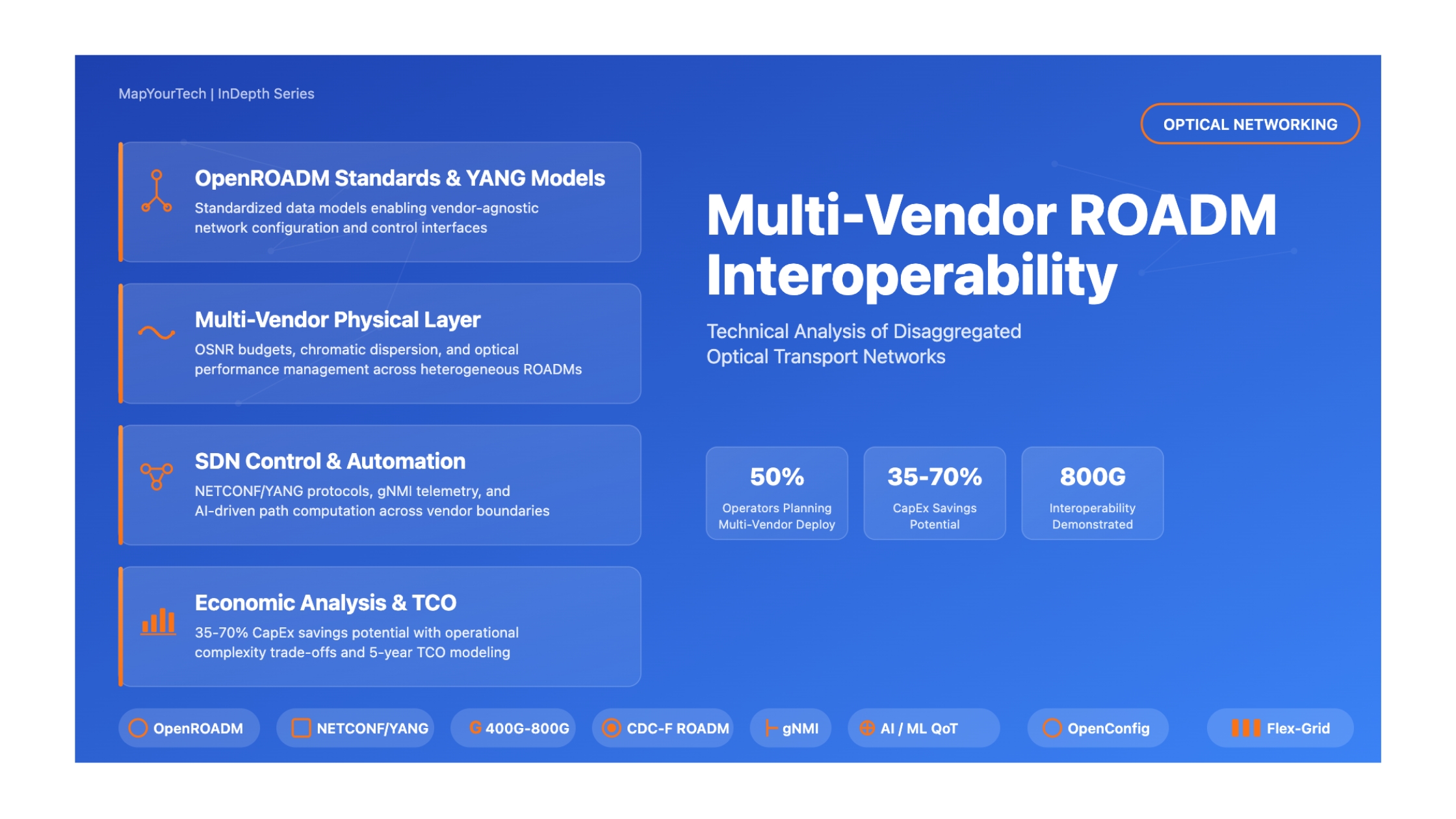
Multi-Vendor ROADM Interoperability in Optical Transport Networks
Introduction
The optical networking industry stands at a pivotal moment in its evolution. For decades, Dense Wavelength Division Multiplexing (DWDM) networks have been deployed as closed, vertically integrated systems where a single vendor supplies all components—from transponders and Reconfigurable Optical Add-Drop Multiplexers (ROADMs) to amplifiers and management software. This monolithic approach, while offering simplicity and single-vendor accountability, has increasingly constrained network operators through vendor lock-in, mismatched innovation cycles, and limited flexibility in technology adoption.
The question at the heart of this comprehensive analysis is both simple and profound: Can ROADMs from different vendors be disaggregated and used interoperably in optical transport links? This question is not merely academic—it represents a fundamental architectural shift that promises to reshape how optical networks are designed, deployed, and operated. The implications span economic considerations (capital and operational expenditure), technical challenges (physical layer compatibility and control plane integration), operational realities (troubleshooting complexity and skill requirements), and strategic positioning (vendor relationships and supply chain resilience).
The State of Multi-Vendor ROADM Interoperability in 2025
Based on comprehensive analysis of current technology, industry standards, production deployments, and market trends, this report provides a definitive answer: Yes, multi-vendor ROADM interoperability is technically feasible and commercially viable in 2025, but with important qualifications.
Technical Feasibility: Proven
Real-world production networks operate successfully with ROADMs, transponders, and optical line system components from five different vendors. Major North American carriers have deployed 75+ node networks carrying live customer traffic across multi-vendor infrastructure, demonstrating that carrier-grade reliability is achievable when proper engineering practices are applied.
Standards Maturity: Established
The OpenROADM Multi-Source Agreement (MSA) has evolved through 17 YANG model versions and 12 specification releases, supporting data rates from 100G to 800G with demonstrated backward compatibility. Industry demonstrations at OFC 2025 validated interoperability across seven vendors at cutting-edge 800G speeds, proving standards keep pace with technology evolution.
Economic Reality: Scale-Dependent
Large-scale operators (500+ ROADM nodes) can achieve 20-35% total cost of ownership (TCO) reduction over five years through competitive procurement, while mid-sized operators (100-500 nodes) see modest benefits. However, networks below 100 nodes often cannot amortize the 15-25% integration cost overhead, making single-vendor solutions more economical for smaller deployments.
Operational Complexity: Significant
Multi-vendor networks demand 2-3× higher training investment, exhibit 40-60% longer mean time to repair for cross-vendor faults, and require sophisticated AI/ML-driven automation to manage complexity effectively. This operational burden favors operators with advanced technical capabilities and automation infrastructure.
Market Momentum: Accelerating
Industry surveys indicate 50% of operators plan disaggregated optical deployments by end of 2025, up dramatically from 21% in 2022. All major Western optical equipment vendors actively support OpenROADM standards, and hyperscale cloud providers—representing 38% of major vendor revenues—are driving standardization through purchasing power.
Section 1: Historical Context and the Evolution of Optical Network Architecture
1.1 The Traditional Paradigm: Closed, Vertically Integrated Systems
Understanding the significance of multi-vendor ROADM interoperability requires examining the historical context from which the current disaggregation movement emerged. For the first three decades of commercial DWDM deployment (roughly 1995-2020), optical transport networks were architected as closed systems with tight vertical integration.
In this traditional model, a single equipment vendor provided all constituent elements:
- Transponders and Muxponders: Converting client signals (Ethernet, OTN, Fibre Channel) into wavelength-specific optical carriers
- Optical Line System: Including ROADMs for wavelength routing, optical amplifiers (EDFAs) for signal regeneration, and dispersion compensation modules
- Network Management: Proprietary Network Management System (NMS) or Element Management System (EMS) providing unified control and monitoring
- Professional Services: Design, installation, commissioning, and ongoing support from a single vendor organization
Traditional Single-Vendor Model
Benefits:
- Single point of accountability for performance
- Optimized end-to-end system integration
- Simplified operational procedures
- Unified support organization
Limitations:
- Vendor lock-in constraining choices
- Coupled component lifecycles
- Limited price competition
- Forced technology refresh cycles
Disaggregated Multi-Vendor Model
Benefits:
- Competitive procurement flexibility
- Independent component upgrades
- Best-of-breed technology selection
- Supply chain resilience
Challenges:
- Integration complexity and cost
- Multi-vendor troubleshooting
- Coordinated lifecycle management
- Higher operational skill requirements
The Vendor Lock-In Problem
The most visible limitation of the closed model was vendor lock-in. By committing to a single supplier's ecosystem, network operators became dependent on that vendor's product roadmap, pricing structure, and innovation velocity. This dependency manifested in several ways:
- Limited Negotiating Leverage: Without credible alternatives, operators faced diminished pricing pressure during technology refresh cycles
- Roadmap Dependency: Access to new capabilities (higher-speed coherent optics, advanced modulation formats, AI-driven automation) occurred only when the incumbent vendor prioritized development
- Geographic Constraints: Vendor agreements sometimes included territorial exclusivity, preventing operators from deploying competitive solutions in specific regions
- Stranded Investment Risk: Switching vendors required wholesale replacement of infrastructure, creating enormous economic barriers to change
The Innovation Cycle Mismatch: A Fundamental Driver
Perhaps the most compelling technical rationale for disaggregation stems from the fundamental mismatch in innovation cycles between digital and analog optical components. This disparity creates inefficiency in traditional vertically integrated architectures.
| Component Category | Innovation Cycle | Key Drivers | Typical Lifecycle |
|---|---|---|---|
| Coherent Transponders | ~2 years | DSP advancement, photonic integration, semiconductor scaling | 3-5 years before obsolescence |
| ROADMs & Switches | ~7-10 years | WSS technology maturation, CDC-F features, flex-grid support | 10-15 years operational life |
| Optical Amplifiers | ~7-10 years | EDFA efficiency, gain flattening, noise figure optimization | 10-15 years operational life |
| Fiber Infrastructure | ~15-20 years | Fiber quality (PMD, attenuation), route diversity, capacity | 20-30+ years operational life |
Coherent transponder technology follows a Moore's Law-like progression, with successive generations delivering exponential improvements in capacity (100G → 200G → 400G → 800G → 1.6T), spectral efficiency (bits/Hz), power consumption (watts per gigabit), and reach. Digital Signal Processor (DSP) advancement enables more complex modulation formats (QPSK → 16-QAM → 64-QAM → probabilistic constellation shaping), advanced FEC algorithms, and higher baud rates every 18-24 months.
In stark contrast, the photonic layer—fiber plant, ROADM switches, and optical amplifiers—evolves slowly. While improvements occur (MEMS WSS → LCoS WSS → silicon photonics), the fundamental physics of optical propagation and amplification hasn't changed. A ROADM deployed in 2015 remains fully functional in 2025, capable of switching wavelengths from any generation of transponder technology.
This mismatch creates economic waste in vertically integrated systems. To deploy 800G transponders with the latest low-power DSPs, operators shouldn't need to replace perfectly functional ROADMs and amplifiers. Yet in traditional architectures, vendors often bundled technology refresh, forcing operators to choose between: (1) forgoing new transponder benefits to avoid unnecessary line system replacement, or (2) accepting the cost and disruption of wholesale infrastructure upgrades. Disaggregation breaks this false dichotomy, enabling independent component evolution.
1.2 The Emergence of Network Disaggregation
The concept of network disaggregation—separating equipment into functional components sourced independently—originated in data center and enterprise networking before extending to optical transport. The Open Compute Project (OCP), founded by Facebook in 2011, pioneered hardware disaggregation for servers and top-of-rack switches. The Open Network Foundation (ONF), established in 2011, advanced Software-Defined Networking (SDN) principles that separated control planes from data planes.
Hyperscale cloud providers—Amazon Web Services, Google, Microsoft Azure, Facebook (Meta)—drove adoption of white-box networking hardware based on merchant silicon with open-source software (SONiC, OpenSwitch). These organizations demonstrated that commodity hardware with standardized interfaces could deliver equivalent or superior performance to traditional vendor-integrated solutions at dramatically lower costs.
Open Compute Project and SDN movement establish feasibility of hardware/software disaggregation in packet networking. Hyperscalers prove white-box approach at massive scale.
OpenROADM MSA founded by AT&T, Ciena, Fujitsu, and Nokia. Initial specifications target 100G alien wavelength scenarios. Telecom Infra Project (TIP) launches Open Optical & Packet Transport (OOPT) initiative.
First carrier production networks using OpenROADM-compliant multi-vendor equipment. OIF standardizes 400ZR coherent pluggables. Demonstrations validate basic interoperability at 100G-400G data rates.
OpenROADM expands to 23+ members including 13 operators. Proof-of-concept trials succeed across Europe, North America, and Asia. Market surveys show 50% of operators planning disaggregated deployments by 2025.
800G multi-vendor interoperability demonstrated at OFC 2025 with seven vendors. AI/ML integration for automated QoT prediction and fault correlation. OpenROADM v12.0 specifications supporting flex-grid and advanced features.
1.3 The Business Case for Optical Disaggregation
Read the Full Analysis with Premium
The remaining 89% of this article — the design numbers, trade-offs and field guidance — is part of MapYourTech Premium, along with the full premium library, courses and professional tools.
You May Also Like
-
Free
-
August 22, 2026

-
Premium
-
August 22, 2026
-
Premium
-
August 22, 2026