
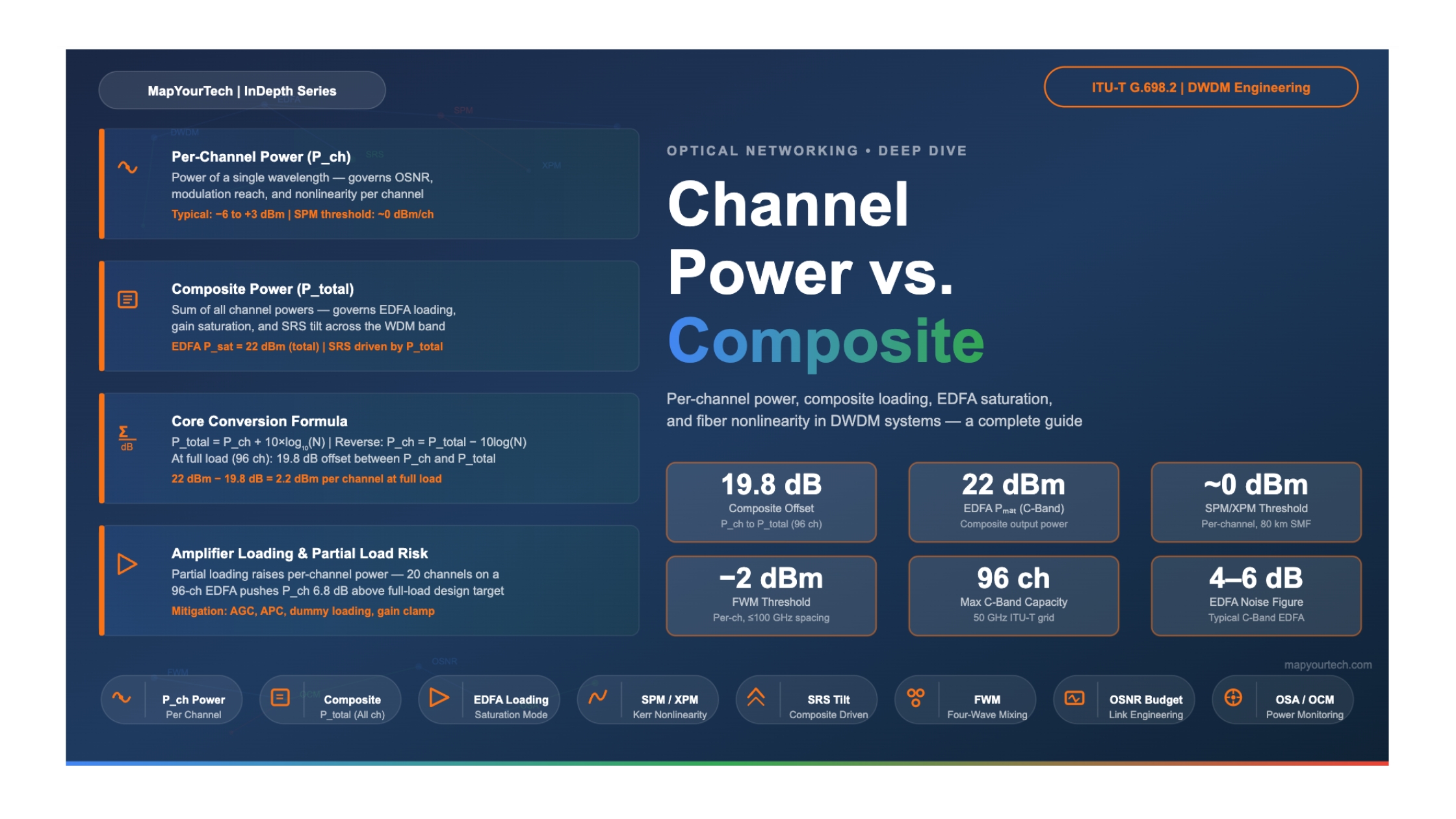

Optical Channel Power vs. Composite Power in DWDM Systems
A comprehensive engineering reference on per-channel power, total composite power, calculation methods, and their impact on amplifier loading, gain saturation, and fiber nonlinearity in modern DWDM networks.
1. Introduction
Why the distinction between per-channel and composite power is fundamental to DWDM system design
Dense Wavelength Division Multiplexing (DWDM) systems transmit multiple optical channels simultaneously over a single fiber, each occupying a distinct wavelength on the ITU-T frequency grid. This architecture introduces two fundamentally different power quantities that engineers must track, measure, and control separately: the per-channel (optical channel) power and the composite (total) power.
These two quantities are related by simple arithmetic in the logarithmic domain, yet confusing them has real consequences. Measuring composite power at an amplifier output and treating it as per-channel power leads to wildly incorrect launch conditions. Designing a system around per-channel power limits without accounting for how those limits scale with channel count leads to amplifier saturation, accelerated nonlinear degradation, and unacceptable optical signal-to-noise ratio (OSNR) penalties.
This distinction becomes especially important as networks scale from 40 to 80 to 96 channels, as operators mix 100G and 400G channels at different power levels, and as C+L band deployments push total launched power well beyond 23 dBm on the fiber. Understanding when each power quantity governs system behavior — and how to calculate one from the other — is the foundation of sound DWDM link engineering.
Scope of this Article
This article covers the fundamental definitions and relationships between per-channel and composite power, the mathematics of converting between them, how each quantity governs amplifier behavior, and how composite power loading drives fiber nonlinear impairments including Self-Phase Modulation (SPM), Cross-Phase Modulation (XPM), Four-Wave Mixing (FWM), and Stimulated Raman Scattering (SRS). Practical worked examples and design rules are provided throughout.
2. Fundamental Definitions
Precise definitions of per-channel power and composite power, and the physical meaning of each
2.1 Per-Channel (Optical Channel) Power
The per-channel power, denoted Pch (also written Pchannel or Pavg in some standards), is the optical power carried by a single wavelength channel, measured within the spectral bandwidth assigned to that channel. It is the power that a single tunable laser, after modulation, launches into the multiplexer — and it is the power that the receiver photodetector and coherent DSP must work with at the far end.
Per-channel power is the quantity that directly governs the signal quality for each individual channel. It determines the received OSNR, the susceptibility of that channel to fiber nonlinear effects, and the minimum launch power required to overcome fiber loss and amplifier noise accumulation over a long-haul span. In DWDM system design, per-channel power is typically expressed in dBm and ranges from approximately −6 dBm to +3 dBm at the booster amplifier output, depending on span loss, fiber type, and nonlinearity considerations.
2.2 Composite Power (Total Optical Power)
The composite power, denoted Ptotal (also Pcomp or Pout in amplifier specifications), is the aggregate optical power of all channels present in the fiber at any given point. When a wideband photodetector or optical power meter with no spectral filtering measures the power on the fiber, it reads the composite power — the sum of all individual channel powers, plus any amplified spontaneous emission (ASE) noise present in the band.
Composite power is the quantity that governs amplifier loading. An Erbium-Doped Fiber Amplifier (EDFA) responds to the total input power across its gain bandwidth — it cannot distinguish individual channels. Its gain saturation behavior, output power ceiling, and noise figure are all determined by the total optical power presented at its input. Similarly, fiber nonlinear effects that scale with optical intensity, particularly SRS, respond to the total power in the fiber.
Per-Channel Power (Pch)
Power of a single wavelength channel. Governs per-channel OSNR, modulation format reach, and individual channel nonlinearity thresholds. Measured with an Optical Spectrum Analyzer (OSA).
Composite Power (Ptotal)
Sum of all channel powers across the fiber. Governs EDFA saturation behavior, gain competition, SRS tilt, and total fiber intensity. Measured with a wideband power meter.
Why the Distinction Matters
Read the Full Analysis with Premium
The remaining 89% of this article — the design numbers, trade-offs and field guidance — is part of MapYourTech Premium, along with the full premium library, courses and professional tools.
Course Title
Course description and key highlights
Course Content
Course Details
Celebrating 1,000+ LinkedIn posts
3 hours of Premium Pro, free
The full Premium Pro library, unlocked with one click. The clock starts the moment you check out and runs for 3 full hours - pick a time when you can make the most of it.
- Courses
- Interview preparation content
- Career development posts
- Simulators
- Calculators
- Market research
No card, nothing to cancel. One pass per person. Sign in or create a free account at checkout.
Follow MapYourTech on LinkedIn for regular updates and future promos.
New articles, tool releases and member offers, posted as they go live.
Follow MapYourTech on LinkedIn
Enjoying MapYourTech? Follow us on LinkedIn. One click and this stops appearing.
- New technical articles and tool releases, posted as they go live
- Course launches and member offers before they reach the site
- Standards and industry updates worth an optical engineer's time
New articles, tool releases and member offers, posted as they go live.