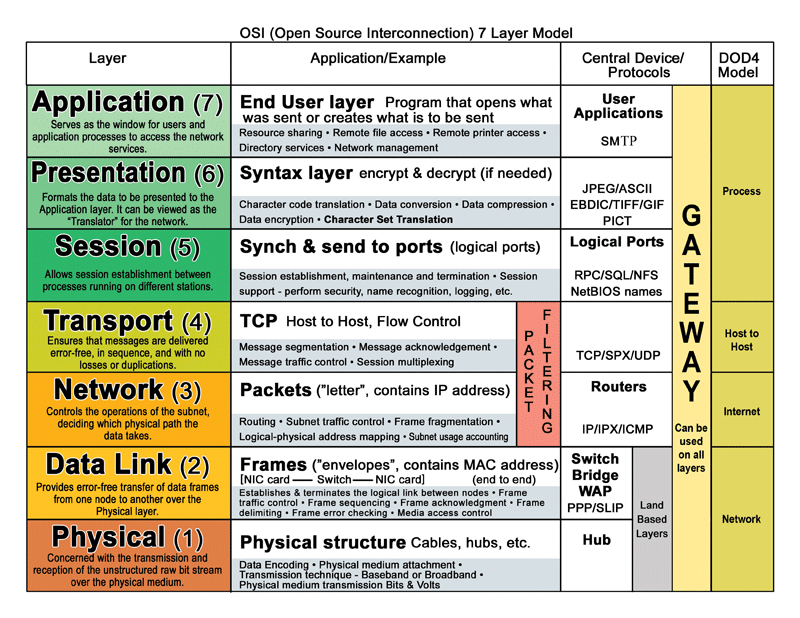
Application(Layer 7) This layer supports application and end-user processes. Communication partners are identified, quality of service is identified, user authentication and privacy are considered, and any constraints on data syntax are identified. Everything at this layer is application-specific. This layer provides application services for file transfers, e-mail, and other network software services.
Presentation(Layer 6) This layer provides independence from differences in data representation (e.g., encryption) by translating from application to network format, and vice versa. This layer formats and encrypts data to be sent across a network, providing freedom from compatibility problems. It is sometimes called the syntax layer.
Session(Layer 5) This layer establishes, manages and terminates connections between applications. The session layer sets up, coordinates, and terminates conversations, exchanges, and dialogues between the applications at each end. It deals with session and connection coordination.
Transport(Layer 4) This layer provides transparent transfer of data between end systems, or hosts, and is responsible for end-to-end error recovery and flow control. It ensures complete data transfer.
Network(Layer 3) This layer provides switching and routing technologies, creating logical paths, known as virtual circuits, for transmitting data from node to node. Routing and forwarding are functions of this layer, as well as addressing, internetworking, error handling, congestion control and packet sequencing.
Data Link(Layer 2) At this layer, data packets are encoded and decoded into bits. It furnishes transmission protocol knowledge and management and handles errors in the physical layer, flow control and frame synchronization. The data link layer is divided into two sublayers: The Media Access Control (MAC) layer and the Logical Link Control (LLC) layer. The MAC sublayer controls how a computer on the network gains access to the data and permission to transmit it. The LLC layer controls frame synchronization, flow control and error checking.
Physical(Layer 1) This layer conveys the bit stream – electrical impulse, light or radio signal — through the network at the electrical and mechanical level. It provides the hardware means of sending and receiving data on a carrier, including defining cables, cards and physical aspects.
Hubs/Repeaters are found in the Physical Layer
Switches /Bridges/Wireless Access Point are found in the Data Link Layer
Routers are found in the Network Layer
Gateway are found in All 7 of the OSI Layers
|
OSI OSI 7 Layer Model
|
| 7. Application Layer – DHCP, DNS, FTP, HTTP, IMAP4, NNTP, POP3, SMTP, SNMP, SSH, TELNET and NTPmore) |
| 6. Presentation layer – SSL, WEP, WPA, Kerberos, |
| 5. Session layer – Logical Ports 21, 22, 23, 80 etc… |
| 4. Transport – TCP, SPX and UDPmore) |
| 3. Network – IPv4, IPV6, IPX, OSPF, ICMP, IGMP and ARPMP |
| 2. Data Link- 802.11 (WLAN), Wi-Fi, WiMAX, ATM, Ethernet, Token Ring, Frame Relay, PPTP, L2TP and ISDN–ore) |
| 1. Physical-Hubs, Repeaters, Cables, Optical Fiber, SONET/SDN,Coaxial Cable, Twisted Pair Cable and Connectors (more) |