
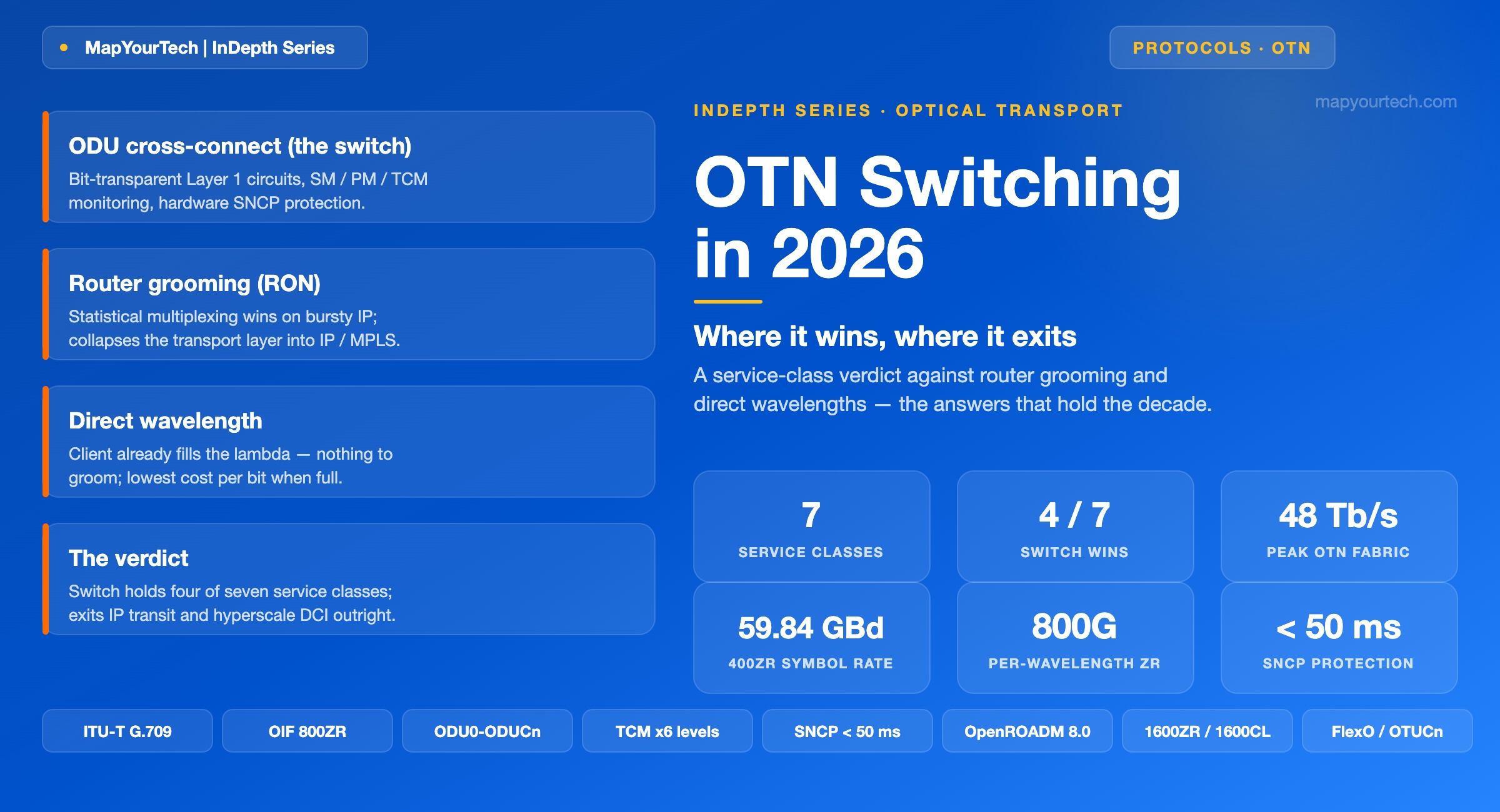
OTN Switching in 2026: Where It Wins, Where It Exits
A service-class-by-service-class assessment of OTN switching against router grooming and direct wavelengths — the grooming answer that holds, the one that is losing ground, and the deployment profiles where each survives the decade.
1. Introduction: three ways to fill a wavelength
A 400GbE client arrives at a metro edge site and has to reach a core node 300 km away. In 2026 an operator has three defensible ways to carry it, and they differ not in the fiber but in where the traffic is groomed onto the wavelength. It can be cross-connected at the Optical Data Unit (ODU) layer in an OTN switch, which aggregates it with other sub-rate clients into a shared line wavelength and hands each client a bit-transparent Layer 1 circuit. It can be groomed in a router, where the client becomes packets, rides an IP/MPLS forwarding plane, and exits through a coherent pluggable seated in the router faceplate — the architecture the industry now calls routed optical networking. Or it can ride a direct wavelength: a coherent transceiver lit end to end across an open line system with no electrical grooming layer at all, because at 400G the client already fills the pipe.
The interesting question is not which is newest. All three ship today and all three are being deployed in volume. The question this article answers is narrower and more useful: for a given class of service, which grooming answer wins on cost, determinism, and operational fit — and does that answer survive the arrival of 800G and 1.6T coherent optics, or does the ground shift under it? OTN switching is under real pressure from both sides. Router grooming pulls traffic up a layer for anything IP-native; the direct wavelength pulls it down a layer for anything already large enough to fill a lambda. The switch survives in the middle, and the middle is where most private-line revenue still lives.
The honest version of this comparison keeps the mechanism visible. An OTN switch is not a router that happens to be slower, and a router pluggable is not a transponder that happens to route. Each carries a different fault model, a different multiplexing statistic, and a different operational culture. Getting the service-class mapping right means naming those differences precisely, then testing them against how each service class actually behaves — its rate relative to the wavelength, its tolerance for contention, its timing requirements, and the contractual obligations wrapped around it.
The rest of this article builds the decision from the mechanism up. It defines what the switch does at the ODU layer, states what the two challengers do differently, reduces the choice to the few numbers that actually move it, then walks seven service classes and names the winner in each — with the boundary condition that flips it. If you want the foundational treatment of the OTN frame hierarchy the switch operates on, the comprehensive study of the Optical Transport Network covers the OTU, ODU, and OPU wrappers in detail; this piece assumes them and moves to the deployment question.
Takeaway: The grooming layer is a per-service decision, not a network-wide one. OTN switching, router grooming, and the direct wavelength each own a different region of the traffic space defined by client rate, contention tolerance, and contractual determinism. The engineering task is to draw those boundaries precisely, then place each service on the correct side.
Read the Full Analysis with Premium
The remaining 88% of this article — the design numbers, trade-offs and field guidance — is part of MapYourTech Premium, along with the full premium library, courses and professional tools.
You May Also Like

-
Free
-
September 4, 2026
-
Premium
-
September 4, 2026
-
Premium
-
September 4, 2026