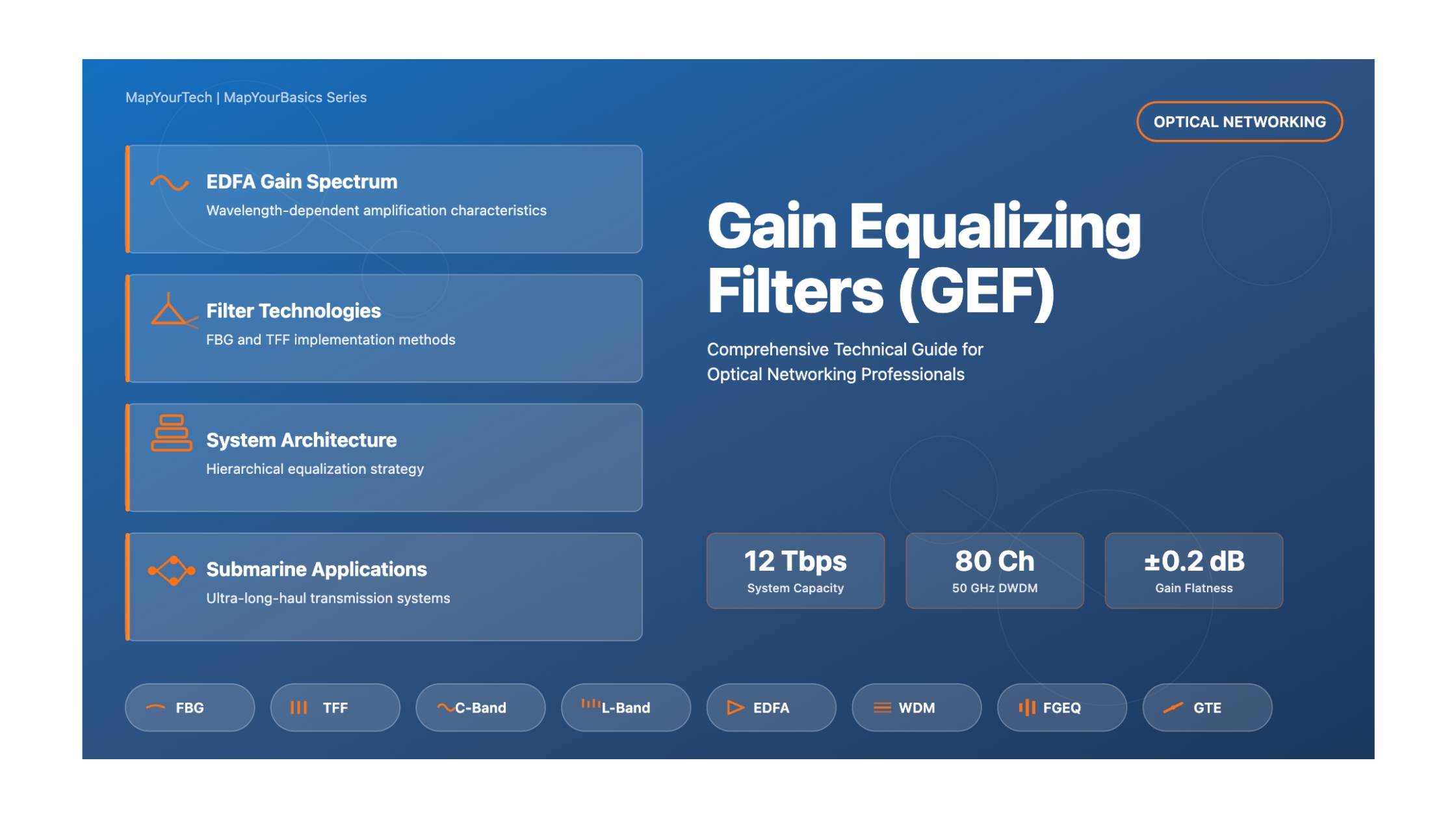

Overview of Gain Equalizing Filters (GEF)
Comprehensive Technical Guide for Optical Networking Professionals
Practical Information Based on Experience and Industry RequirementsIntroduction
Gain Equalizing Filters (GEF), also known as Gain Flattening Filters (GFF), are critical passive optical components designed to compensate for the non-uniform gain spectrum of optical amplifiers, particularly Erbium-Doped Fiber Amplifiers (EDFA) in wavelength division multiplexing (WDM) systems. These specialized filters ensure consistent signal amplification across all wavelength channels, preventing power imbalances that can severely degrade system performance over long transmission distances.
In modern high-capacity optical communication networks, especially long-haul submarine systems spanning thousands of kilometers with over 150 cascaded amplifiers, gain equalizing filters serve as the foundation for maintaining signal quality and maximizing system capacity. Without proper gain equalization, the inherent wavelength-dependent gain characteristics of optical amplifiers would accumulate through multiple amplification stages, resulting in unacceptable signal-to-noise ratio (OSNR) variations and limiting effective transmission bandwidth.
System Overview: GEF Role in Optical Amplifier Chain
Illustration showing how gain equalizing filters maintain uniform amplification across wavelength channels
Why Gain Equalizing Filters is so important?
In a typical transoceanic submarine cable system spanning 6000-10000 km with 150-200 optical amplifiers, even a small 0.25 dB gain variation per amplifier can accumulate to over 40 dB of power excursion without equalization. This would make WDM transmission impossible, as channels with lower gain would fall below the noise floor while high-gain channels would experience excessive nonlinear effects.
Key Applications:
- Long-Haul Submarine Systems: Critical for transoceanic cables with 150+ amplifier spans, supporting multi-terabit transmission with ultra-wideband S+C+L deployments
- Terrestrial WDM Networks: Essential for metro and regional networks, enabling dynamic bandwidth provisioning with SDN-controlled adaptive equalization
- Data Center Interconnects: Ensuring uniform channel performance in 400G/800G DWDM systems with integrated photonic solutions
- 5G and Beyond Transport: Supporting high-capacity fronthaul, midhaul, and backhaul links for 5G Advanced and emerging 6G infrastructure
- Quantum Communications: Precision gain equalization for quantum key distribution (QKD) systems requiring ultra-low PDL specifications
Historical Context & Evolution
The development of gain equalizing filter technology has been closely intertwined with the evolution of optical amplifiers and wavelength division multiplexing systems. Understanding this historical progression provides valuable context for appreciating current design challenges and future directions.
Early Amplifier Era (1987-1995)
The invention of the Erbium-Doped Fiber Amplifier (EDFA) in 1987 revolutionized optical communications by enabling all-optical signal amplification. However, early EDFAs exhibited significant gain ripple across their operating bandwidth, initially limiting WDM systems to just a few channels. The first generation of gain flattening solutions employed simple dielectric thin-film filters with limited spectral shaping capabilities, typically addressing only the most prominent gain peaks near 1530 nm and 1560 nm.
WDM Expansion Period (1995-2005)
As WDM channel counts increased from 8 to 40 and eventually 80+ channels, the demands on gain equalization became significantly more stringent. This period saw the development of advanced fiber Bragg grating (FBG) technologies, including long-period gratings and slanted FBG configurations. Manufacturers began targeting gain flatness specifications of better than 1 dB across 30-40 nm bandwidth. The introduction of L-band EDFAs expanded usable spectrum, requiring new equalization filter designs optimized for longer wavelengths.
Submarine System Optimization (2005-2015)
The deployment of ultra-long-haul submarine cable systems with 150+ amplifier spans drove unprecedented requirements for gain equalization accuracy. Systems began implementing hierarchical equalization architectures with multiple types of filters: in-amplifier GFFs for basic flattening, fixed gain equalizers (FGEQ) every 10-20 spans for residual correction, and gain tilt equalizers (GTE) for compensating aging effects. Gain flatness specifications improved to 0.1-0.2 dB over the C-band, achievable only through sophisticated manufacturing processes and precise characterization techniques.
Technology Evolution Timeline
Key milestones in gain equalizing filter development
Modern Era & Emerging Technologies (2015-Present)
Contemporary GEF technology focuses on several transformative areas: dynamic gain equalizers (DGE) leveraging MEMS technology that can adaptively adjust to changing network conditions in real-time, wideband solutions covering S+C+L bands (>120 nm) for increased capacity on existing fiber, and integration with software-defined networking (SDN) platforms for intelligent, automated gain management. Advanced manufacturing techniques including femtosecond laser inscription of FBGs enable improved spectral precision and reduced manufacturing time.
The global optical amplifier gain flattening market reached USD 1.38 billion in 2024 and is projected to grow at 7.1% CAGR through 2033, driven by exponential data traffic growth, 5G transport network expansion, data center interconnect demands, and cloud infrastructure proliferation requiring high-capacity optical systems. The Asia Pacific region leads market growth with substantial telecommunications infrastructure investments.
Core Concepts & Fundamentals
The Gain Ripple Problem
Erbium-doped fiber amplifiers exhibit inherently non-uniform gain as a function of wavelength due to the quantum mechanical properties of erbium ions in silica glass. The gain spectrum features characteristic peaks near 1530 nm and 1560 nm, with the exact shape depending on several factors including erbium concentration, aluminum co-doping levels, fiber length, pump power, and population inversion rate.
EDFA Gain Spectrum: Before and After Equalization
Typical C-band EDFA gain profile showing non-uniform gain and the effect of GEF compensation
The mathematical representation of EDFA gain as a function of wavelength and population inversion can be expressed as:
Gain Coefficient Formula
G(λs) = σe(λs)N2 - σa(λs)N1
Where:
- σe(λs) = emission cross-section at signal wavelength
- σa(λs) = absorption cross-section at signal wavelength
- N2 = excited state erbium ion population
- N1 = ground state erbium ion population
Cumulative Effect in Cascaded Amplifiers
When multiple amplifiers are cascaded in a long-haul transmission system, the gain variations multiply through the chain. For N identical amplifiers each with a relative gain variation g at a particular wavelength, the cumulative gain excursion grows exponentially:
Total Gain Variation = 10 × N × log10(g) dB
For example, in a 6000 km submarine system with 169 EDFAs, each having just 0.25 dB gain ripple, the theoretical cumulative gain excursion would be approximately 42 dB without equalization. Due to spectral hole burning effects, this may be somewhat reduced to around 30 dB in practice, but this remains unacceptable for WDM transmission.
Gain Accumulation Through Amplifier Chain
Demonstration of how small gain variations multiply through cascaded amplifiers
Basic Operating Principle
Gain equalizing filters function as wavelength-selective passive attenuators that introduce greater insertion loss at wavelengths where the amplifier gain is higher. The filter transfer function is designed to be approximately the inverse of the EDFA gain spectrum, creating a composite amplifier+filter system with flat net gain across the operating bandwidth.
The ideal GEF transfer function T(λ) should satisfy:
GEDFA(λ) × T(λ) = Constant
In practice, achieving this inverse relationship requires precise spectral shaping capability and stable filter characteristics over temperature variations and system aging. The placement of the GEF within the amplifier architecture significantly impacts overall performance, particularly regarding noise figure and output power.
Technical Architecture & Components
System Architecture Overview
Modern submarine cable systems employ a hierarchical gain equalization architecture consisting of multiple filter types deployed at different points along the transmission chain. This multi-tiered approach provides both coarse and fine-grained spectral control necessary for ultra-long-haul transmission.
Hierarchical Gain Equalization Architecture
Complete system showing GFF, FGEQ, and GTE placement in submarine cable
Three-Tier Equalization Strategy:
- In-Amplifier Gain Flattening Filters (GFF): Installed in every EDFA to provide basic spectral flattening, typically achieving 1-3 dB peak-to-peak variation over 30-40 nm bandwidth
- Fixed Gain Equalizers (FGEQ): Deployed every 10-20 amplifier spans to compensate for residual gain shape errors that accumulate due to manufacturing tolerances and component variations
- Gain Tilt Equalizers (GTE): Remotely tunable filters placed every 10-20 spans to compensate for spectral tilt caused by cable aging, repairs, and changes in span loss over system lifetime
Key Components and Technologies
1. Fiber Bragg Grating (FBG) Based GEF
Fiber Bragg gratings represent the most widely deployed GEF technology in submarine systems. These devices utilize periodic refractive index modulations written into the fiber core, creating wavelength-selective reflection characteristics that can be engineered to match the required equalization profile.
Fiber Bragg Grating GEF Structure and Operation
Internal structure showing periodic index modulation and spectral response
FBG GEF Advantages:
- Individual customization for each filter (averaged error when cascaded)
- Low polarization dependent loss (PDL < 0.1 dB)
- Excellent temperature stability with proper packaging
- All-fiber construction for reliability
FBG GEF Limitations:
- Manufacturing complexity for multiple gratings per filter
- Potential spectral ripple from fabrication errors in short-period designs
- Limited ability to match very steep gain slopes
2. Thin Film Filter (TFF) Based GEF
Thin film filters utilize multiple layers of dielectric materials with varying refractive indices to create precise wavelength-dependent transmission characteristics. TFF technology excels at creating filters with deep spectral features and wide bandwidths.
Thin Film Filter Structure and Multilayer Stack
Cross-section showing dielectric layer stack and optical interference
Amplifier Integration and Placement
The placement of the GEF within the amplifier architecture critically affects system performance. Three primary configurations are employed:
GEF Placement Options in EDFA Architecture
Comparison of input, inter-stage, and output GEF placement strategies
Mathematical Models & Formulas
EDFA Gain Spectrum Modeling
The wavelength-dependent gain of an EDFA can be modeled using the population inversion and cross-section parameters:
Gain Coefficient Equation
g(λ) = Γ × [σe(λ) × N2 - σa(λ) × N1]
Where:
- Γ = overlap factor between signal mode and doped region
- σe(λ) = emission cross-section (wavelength dependent)
- σa(λ) = absorption cross-section (wavelength dependent)
- N2 = excited state population density (ions/m³)
- N1 = ground state population density (ions/m³)
The total gain in dB over a length L of erbium-doped fiber is:
G(λ) [dB] = 4.343 × g(λ) × L
Gain Excursion in Cascaded Systems
For a chain of N amplifiers, the cumulative gain excursion can be calculated. Consider two wavelengths λ₁ and λ₂ with per-amplifier gains G₁ and G₂:
Gain Accumulation Mathematical Visualization
Graph showing exponential growth of gain difference through amplifier cascade
Cumulative Gain Difference
ΔGtotal(dB) = G₁ᴺ - G₂ᴺ = 10 × N × [log₁₀(G₁) - log₁₀(G₂)]
For small per-amplifier variations Δg (in dB):
ΔGtotal ≈ N × Δg
Example: For N=169 amplifiers with Δg=0.25 dB: ΔGtotal ≈ 42.25 dB
OSNR Degradation from Gain Ripple
Unequalized gain ripple degrades the optical signal-to-noise ratio (OSNR) across channels. The OSNR penalty depends on both the gain excursion and the preemphasis strategy employed:
OSNR Penalty (dB) ≈ 10 × log₁₀[1 + (ΔG/Gavg)²]
Where ΔG is the gain excursion and Gavg is the average gain. For typical submarine systems with large ΔG, power preemphasis is required, leading to additional OSNR degradation that grows with the square of the preemphasis level.
Types, Variations & Classifications
Classification by Technology
| Technology Type | Key Characteristics | Typical Applications | Performance Range |
|---|---|---|---|
| Short-Period FBG | Bragg period ~0.5 μm, precise spectral control | Submarine systems requiring ±0.1 dB flatness | Bandwidth: 30-40 nm, IL: 1-2 dB |
| Long-Period FBG | Period 100-500 μm, smooth transmission | Metro networks, less critical applications | Bandwidth: 20-30 nm, IL: 0.5-1.5 dB |
| Slanted/Blazed FBG | Tilted grating structure, reduced back-reflection | General WDM systems, balanced performance | Bandwidth: 30-40 nm, IL: 1-3 dB |
| Thin Film Filter | Multilayer dielectric stack, steep slopes | Terrestrial systems, cost-sensitive deployments | Bandwidth: 30-50 nm, IL: 2-5 dB |
| Tapered Fiber | Adiabatic mode coupling, very smooth | Low-ripple requirements, specialized apps | Bandwidth: 20-30 nm, IL: 0.5-2 dB |
| Hybrid Designs | Combination of multiple technologies | Ultra-wideband systems (S+C+L) | Bandwidth: >80 nm, IL: 3-6 dB |
Classification by Functionality
GEF Functional Classification
Hierarchy showing different GEF types and their roles in system
1. Static Gain Flattening Filters (GFF)
Fixed spectral response filters integrated into each optical amplifier. These provide the primary level of gain equalization and are designed to match the expected average gain profile of the amplifier at its nominal operating point.
2. Fixed Gain Equalizers (FGEQ)
Periodic filters deployed every 10-20 amplifier spans to compensate for accumulated manufacturing variations and residual gain shape errors. These filters are custom-designed based on measurements of the actual deployed amplifier chain.
3. Gain Tilt Equalizers (GTE)
Remotely tunable filters that compensate for spectral tilt caused by cable aging, repairs, and changes in span loss. GTE can be implemented using:
- Tunable optical filters with motorized or MEMS-based control
- Raman amplifiers with adjustable pump power for tilt control
- Wavelength selective switches (WSS) in reconfigurable systems
4. Dynamic Gain Equalizers (DGE)
Advanced equalization systems capable of real-time adjustment to changing network conditions. DGE technologies enable adaptive gain management in flexible networks with varying channel counts and dynamic routing.
Visual Demonstrations & Technical Animations
This section provides detailed visual representations of key GEF concepts, operation principles, and system implementations to enhance understanding through interactive diagrams.
Practical Applications & Case Studies
Real-World Deployment Scenarios
Case Study 1: Transoceanic Submarine Cable System
System Parameters
- Link Length: 6,700 km
- Number of Amplifiers: 169 (approximately 40 km span length)
- Operating Bandwidth: 32 nm (C-band, 1533-1565 nm)
- Channel Count: 80 channels at 50 GHz spacing
- Target Capacity: 12 Tbps (150 Gbps per channel)
Challenge: Without gain equalization, 0.25 dB per-amplifier gain ripple would accumulate to 42 dB theoretical excursion. This makes WDM transmission impossible.
Solution Implementation:
- Tier 1: Slanted FBG deployed in all 169 EDFAs
- Tier 2: 13 FGEQ modules every 513 km
- Tier 3: Wavelength-dependent preemphasis
Results: OSNR variation reduced from 30 dB to <1.5 dB, enabling successful 80-channel transmission.
Case Study 2: Metro WDM Network
400 km metro ring with C+L band coverage achieved 2.5 dB gain flatness across 75 nm using hybrid TFF approach with MEMS-based dynamic equalization for flexible channel provisioning.
Implementation Best Practices
Key Design Considerations
- Conservative design margins (±0.05 dB extra flatness)
- Temperature-compensated packaging for submarine applications
- Mix FBG and TFF technologies to average manufacturing errors
- Deploy periodic FGEQ modules every 10-20 spans
- Include remotely tunable GTE for aging compensation
- Maintain 2+ dB system margin for repairs and upgrades
Future Trends and Market Outlook
The global optical amplifier gain flattening market reached USD 1.38 billion in 2024 and is projected to grow at 7.1% CAGR through 2033, driven by increasing bandwidth demands and network modernization initiatives worldwide.
- Ultra-Wideband Systems: S+C+L band equalization covering >120 nm enables capacity expansion on existing fiber infrastructure, with commercial deployments supporting 400+ channels per fiber pair
- AI/ML-Driven Adaptive Control: Software-defined networking (SDN) integrated with machine learning algorithms enables real-time gain optimization and predictive maintenance, reducing operational costs by 15-20%
- Integrated Photonics: Silicon photonics platforms enabling on-chip GEF implementation with 50% footprint reduction and improved power efficiency for data center interconnects
- Space Division Multiplexing: Multi-core and multi-mode fiber systems requiring advanced equalization techniques across spatial dimensions
- Quantum-Dot Amplifier Integration: Emerging quantum-dot semiconductor optical amplifiers (QD-SOAs) with 60 nm bandwidth requiring novel equalization approaches for next-generation systems
- Dynamic Gain Equalizers: MEMS-based DGE technology enabling flexible channel provisioning and network reconfigurability for 5G transport and metro applications
- Quantum Communications: Ultra-low PDL (<0.05 dB) requirements for quantum key distribution (QKD) systems driving precision manufacturing advancements
References
- ITU-T G.973.1, "Submarine digital systems utilizing EDFA," September 2009
- ITU-T G.973.2, "Submarine systems with DRA/REDFA," April 2024
- ITU-T G.972, "Optical fibre submarine cable systems definitions," August 2024
- Bayart, D., "Optical Amplification," Undersea Fiber Communication Systems, 2016
- Antona, J.C., "Ultralong Haul Submarine Transmission," Chapter 5, 2016
- Pecci, P., "Submerged Plant Equipment," Chapter 12, 2016
- RP Photonics Encyclopedia, "Gain Equalization," accessed 2024
- "Optical Amplifier Gain Flattening Market Report," Data Intelo, 2024
- "Wideband Optical Transmission Systems," Optical Fiber Communication Conference (OFC), 2024-2025
- Sanjay Yadav, "Optical Network Communications: An Engineer's Perspective" - Bridge the Gap Between Theory and Practice in Optical Networking
Key Takeaways
1. Critical Role
GEF is essential for managing EDFA gain non-uniformity in WDM systems, preventing power imbalances over long distances.
2. Multi-Tier Architecture
Three-tier equalization achieves ±0.2 dB flatness: in-amplifier GFF, periodic FGEQ, and dynamic GTE.
3. Technology Trade-offs
FBG offers superior submarine performance; TFF provides manufacturing speed for terrestrial systems.
4. Temperature Stability
Submarine GEF requires <0.1 dB spectral shift across -5°C to +70°C temperature range.
5. Polarization Effects
Low PDL (<0.1 dB) and PMD (<0.1 ps) critical for coherent transmission quality.
6. Placement Strategy
Inter-stage placement offers best NF/power balance; output placement is simpler but reduces power.
7. Manufacturing Precision
Submarine systems require <0.1 dB GFF tolerance to prevent error accumulation.
8. Dynamic Equalization
DGE enables adaptive systems for flexible capacity and dynamic provisioning.
9. Spectral Hole Burning
Strong channels create local gain depletion, reducing but not eliminating cumulative excursion.
10. Future Direction
Wideband S+C+L systems, SDN integration, and quantum communication applications drive innovation.
Note: This guide is based on industry standards, best practices, and real-world implementation experiences in submarine and terrestrial optical networks. Specific implementations may vary based on equipment vendors, network topology, regulatory requirements, and system design goals. Always consult with qualified network engineers and follow vendor documentation for actual deployments.
Related Articles on MapYourTech


Continue Reading This Article
Sign in with a free account to unlock the full article and access the complete MapYourTech knowledge base.