Overview of Submarine Cable Repair Operations
Technical Guide Based on Industry Standards & Real-World Experience1. Introduction
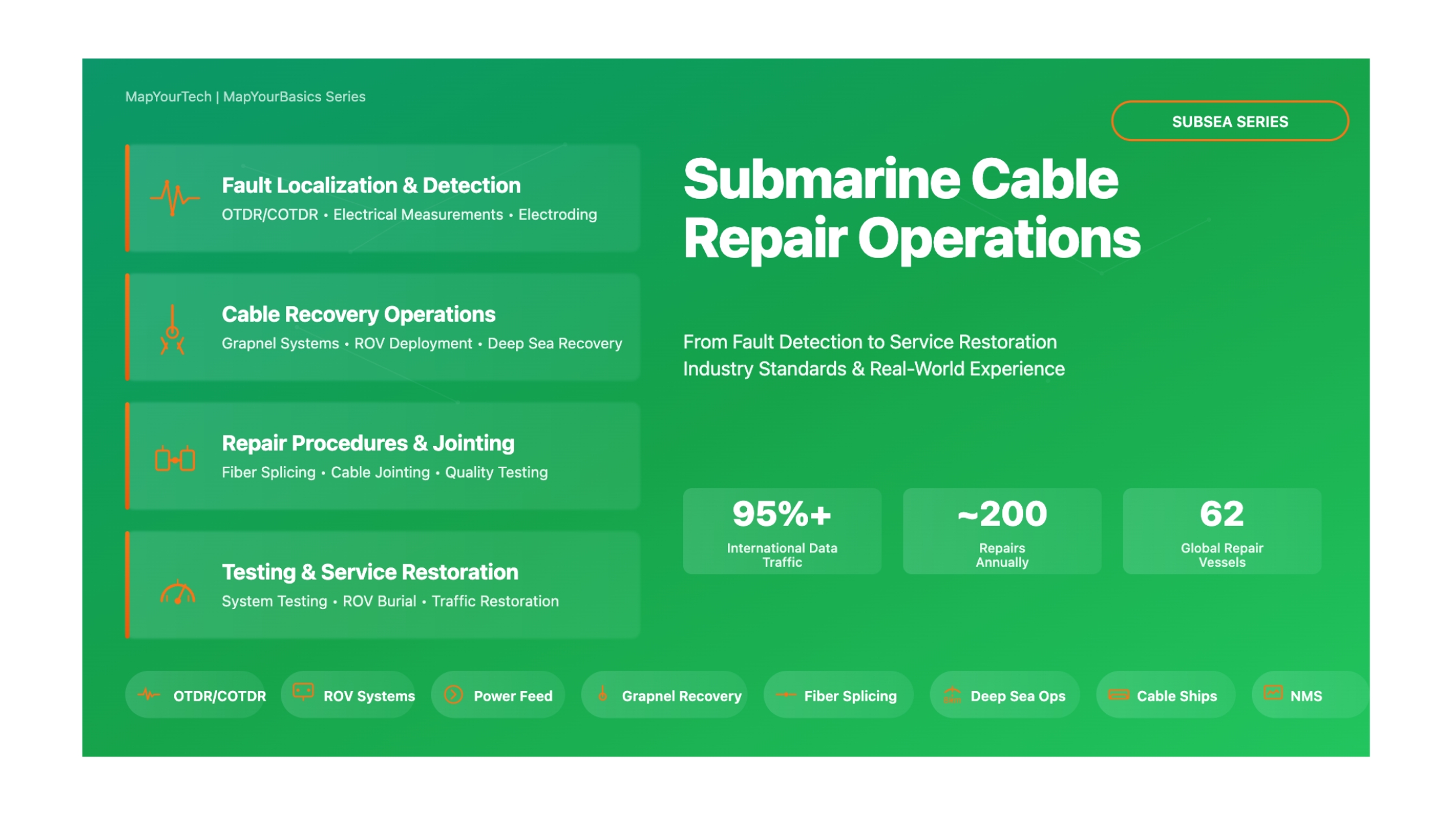
Submarine cable repair operations represent one of the most critical and technically challenging aspects of maintaining global telecommunications infrastructure. With over 95% of international data traffic passing through undersea fiber optic cables, the ability to quickly and effectively repair damaged cables is essential for maintaining global connectivity, financial systems, military communications, and internet services.
Submarine cable systems, spanning thousands of kilometers across ocean floors at depths reaching up to 8,000 meters, are subject to various forms of damage including fishing activities, ship anchors, seismic events, underwater landslides, and increasingly, potential sabotage. Recent incidents in 2024-2025, including multiple cable cuts in the Baltic Sea and Red Sea, have highlighted the critical importance of robust repair capabilities and rapid response infrastructure.
Global Submarine Cable Network Overview
Submarine cables connect continents and carry 95%+ of international data traffic
The repair process involves sophisticated fault localization techniques, specialized cable ships equipped with remotely operated vehicles (ROVs), precise cable recovery operations using various types of grapnels, and complex jointing procedures that must maintain the cable's optical and electrical integrity. Modern repair operations can take anywhere from a few days for shallow water faults near repair bases, to several weeks for deep-sea repairs in remote locations or adverse weather conditions.
Why Submarine Cable Repair Operations Matter
In 2024-2025, the submarine cable industry faced unprecedented challenges with multiple high-profile cable cuts in the Baltic Sea and Red Sea, some taking up to 5 months to repair. With the global cable network expected to grow 48% by 2040 while nearly 50% of repair vessels approach end-of-life, investment in repair infrastructure and operational excellence has become a critical national security and economic priority for nations worldwide.
2. Historical Context & Evolution
2.1 Telegraph Era to Fiber Optics
The need for submarine cable repair operations dates back to the first transatlantic telegraph cable of 1858, which failed after just three weeks of operation. The evolution of repair capabilities paralleled the development of submarine cable technology itself:
Evolution of Submarine Cable Repair Technology
From manual grapnels to ROV-assisted operations
2.2 Major Technological Breakthroughs
- 1960s - Diesel-Electric Cable Ships: Replaced steam engines, providing more power and maneuverability with transversal propellers for precise positioning
- 1970s - Electronic Positioning Systems: Introduction of Decca, Transit, and Omega navigation systems for continuous cable route tracking
- 1980s - Sea Plows and Early ROVs: Cable burial equipment and first remotely operated vehicles for shallow water operations
- 1990s - OTDR Technology: Optical Time Domain Reflectometry enabled precise fault location without physical cable access
- 2000s - Advanced ROVs: Deep-sea ROVs capable of operations beyond 2000 meters with burial capabilities over 3 meters depth
- 2010s - COTDR Systems: Coherent OTDR provided unprecedented accuracy in fault localization for long-distance amplified systems
- 2020s - Rapid Response Infrastructure: Regional maintenance agreements with pre-positioned vessels and spare equipment for 24-hour mobilization
2.3 Modern Challenges (2024-2025)
The submarine cable industry faces significant challenges in 2024-2025:
Critical Infrastructure Crisis
With submarine cable networks expected to grow 48% by 2040, the global repair fleet of 62 vessels is aging rapidly. Nearly 50% of cable repair ships will reach end-of-life by 2040, while investment in new vessels has not kept pace. Recent incidents including multiple Baltic Sea cable cuts and Red Sea disruptions (some repairs taking up to 5 months) have exposed the fragility of repair infrastructure. The industry needs immediate investment in new specialized vessels and repair capacity expansion.
3. Core Concepts & Fundamentals
3.1 Types of Cable Faults
Submarine cable faults are classified into three primary categories, each requiring different repair approaches:
Three Main Types of Cable Faults
Shunt faults, open faults, and complete cable breaks
3.2 Fault Localization Techniques
Accurate fault localization is critical for efficient repair operations. Multiple complementary techniques are employed:
3.2.1 Supervisory System Localization
For systems with optical submarine repeaters, the supervisory system provides initial fault localization to within one supervisory section (typically 40-80 km between repeaters). This narrows the search area significantly but requires additional precision techniques for exact location.
3.2.2 Electrical Measurement Methods
Power feeding equipment (PFE) measurements provide distance-to-fault calculations based on DC resistance, capacitance, or voltage drop measurements. For shunt faults, the voltage drop to the fault point allows calculation of cable distance. For open faults, capacitance measurements determine the distance to the break.
3.2.3 Optical Time Domain Reflectometry (OTDR)
OTDR systems inject optical pulses into the fiber and analyze backscattered light to detect breaks, bends, or high-loss points. Standard OTDR is effective up to the first repeater but cannot penetrate through optical amplifiers in long-haul systems.
3.2.4 Coherent OTDR (COTDR)
COTDR provides higher sensitivity and frequency selectivity, enabling fault location beyond optical amplifiers in long-distance systems. This technology revolutionized fault localization in modern DWDM submarine systems with optical amplifier chains.
3.2.5 Electroding
For shunt faults where the cable can still be powered, a modulated tone (typically 16.667 Hz or 25 Hz) is applied to the power feeding current. The cable ship deploys electromagnetic sensors to detect this tone and follow the cable route, even if it has moved from the as-laid position. The tone disappears or greatly reduces at the fault location.
Fault Localization Workflow
Sequential process from initial alarm to precise location
3.3 Cable Ship Equipment
Modern cable repair ships are highly specialized vessels equipped with sophisticated systems for cable handling, location, recovery, and repair operations. Key equipment includes:
Cable Ship Essential Equipment
Specialized systems for deep-sea cable repair operations
- Cable Tanks: Large holds for storing spare cable (typically several hundred kilometers) and spare repeaters/branching units in controlled environments
- Cable Engine & Handling: Linear engines capable of paying out and recovering cable with precise tension control, critical for preventing fiber damage
- Stern Sheaves: Specially designed wheels (minimum 3m diameter) over which the cable passes when entering/exiting the vessel
- Grapnel Systems: Various types including cut-and-hold, holding-only, and detrenching grapnels for different recovery scenarios
- ROV Systems: Remotely operated vehicles capable of operations beyond 2000m depth, equipped with cameras, cable detection systems, cutting tools, and burial capabilities
- Power Feeding Equipment (PFE): For electrical testing, powering submarine equipment, and fault measurements
- Test Equipment: OTDR/COTDR systems, electrical measurement instruments, and fiber splice loss testers
- Jointing Facilities: Climate-controlled rooms for fiber splicing and cable jointing, including X-ray equipment for joint inspection
- Navigation & Positioning: GPS, dynamic positioning systems, and multibeam bathymetry for precise location control
4. Technical Architecture & Repair Process Components
4.1 Complete Repair Operation Workflow
A typical submarine cable repair operation follows a well-defined sequence of steps, from initial fault detection through final cable reinstatement. The entire process can take anywhere from 3-5 days for accessible shallow water faults to several weeks for deep-sea repairs in remote locations or adverse weather.
Complete Repair Operation Process
End-to-end workflow from fault detection to service restoration
4.2 Cable Recovery Techniques
Cable recovery is one of the most critical and challenging aspects of repair operations. Different techniques are employed based on water depth, cable type, and whether the cable is buried.
Grapnel Recovery Operations
Step-by-step cable recovery using grapnels at various depths
4.3 Types of Grapnels
Different grapnel designs are employed based on the recovery scenario:
- Rennie Chain Grapnel: Traditional chain design for softer seabeds, allows cable to slide through until hooked
- Gifford Chain Grapnel: Heavier chain variant for rockier conditions, more aggressive hooking action
- Flatfish Grapnel: Flat plate with prongs and cutting insert for surface-laid cables requiring cutting
- Cut & Hold Grapnel: Combined cutting and holding mechanism, allows single-pass recovery of intact cables
- Active Cutting Grapnel: Sensor-equipped with hydraulic cutting mechanism for heavily armored cables
- Detrenching Grapnel: Specialized design for recovering buried cables, "peels" cable from trench
5. Mathematical Models & Fault Location Calculations
5.1 Capacitance-Based Fault Location
For open faults where the center conductor is not exposed to seawater, capacitance measurements determine the distance to the fault:
Capacitance Fault Location Formula
L (km) = (Cx - n × Cr) / Cc
Where:
- L = Cable length from terminal station to open fault point (km)
- Cx = Measured capacitance (μF)
- Cc = Cable capacitance per kilometer (μF/km) - factory data
- Cr = Capacitance per repeater (μF) - factory data
- n = Number of repeaters (where n(Cs + Cr) ≤ Cx < (n+1)Cs + nCr)
- Cs = Theoretical capacitance of one cable span = Cc × Lspan
5.2 DC Resistance Fault Location
For shunt faults where the power conductor is exposed to seawater, DC resistance measurements from both ends allow triangulation of the fault position:
DC Resistance Fault Localization Method
Triangulation from both terminal stations using Ohm's law
5.3 OTDR Distance Calculation
Optical Time Domain Reflectometry calculates distance based on the two-way travel time of light pulses and the speed of light in the fiber:
OTDR Distance Formula
Distance (km) = (c × t × n) / (2 × 10⁹)
Where:
- c = Speed of light in vacuum = 3 × 10⁸ m/s
- t = Two-way travel time of optical pulse (nanoseconds)
- n = Refractive index of fiber core (typically 1.4677 for standard SMF)
- Factor of 2 accounts for round-trip (pulse travels to fault and back)
Effective velocity: v = c/n ≈ 2.04 × 10⁸ m/s in fiber
Simplified formula: Distance (km) ≈ 0.102 × t (ns) for standard fiber
6. Repair Operation Classifications & Variations
6.1 Shallow Water vs Deep Sea Repairs
| Characteristic | Shallow Water Repair (<1000m) | Deep Sea Repair (>1000m) |
|---|---|---|
| Typical Duration | 3-7 days | 7-21 days |
| Cable Recovery | Relatively straightforward | Complex, requires careful tension management |
| Grapnel Type | Standard cut & hold or holding grapnel | Specialized deep-sea grapnels |
| ROV Usage | Commonly used for location and burial | Essential for depths >500-1000m |
| Repair Cable | May not require repeater addition | Often requires repeater to compensate loss |
| Burial Requirement | Usually required (3m typical) | Not required in abyssal plains |
| Weather Sensitivity | Moderate - can work in rougher seas | High - requires calm conditions |
| External Aggression Risk | High (fishing, anchors) | Low (component failures primary cause) |
| Typical Fault Causes | 86% anchor/fishing damage | Component aging, manufacturing defects |
| Cable Cut-out Length | Several hundred meters | Can be extensive if multiple issues |
6.2 Special Repair Scenarios
6.2.1 Buried Cable Repairs
Cables buried for protection (typically 1-3 meters depth in shallow water) require detrenching before repair. This involves multiple grapnel runs with specialized detrenching grapnels or ROV operations. In some cases where burial exceeds 3 meters, it may not be possible to recover the cable without excessive damage, requiring abandonment of the buried section and laying a longer repair cable segment.
6.2.2 Repeater Replacement
When a fault involves a submarine repeater or branching unit, the operation becomes significantly more complex, typically requiring system supplier involvement. The faulty repeater must be recovered, and a replacement (or "mini system" containing multiple repeaters and cable sections) installed. This requires specialized equipment and expertise for high-voltage handling, optical connections, and testing.
6.2.3 Branching Unit Repairs
Repairs involving branching units add complexity due to the need to isolate the damaged branch while maintaining service on undamaged branches. Power relays in the BU are switched to isolate the branch under repair, but extra precautions are required aboard the cable ship during jointing activities while other parts of the network remain powered.
6.2.4 Mini System Replacement
When a fault is localized to within one supervisory section but cannot be precisely located, or when multiple issues exist in a section, the entire supervisory section may be replaced with a "mini system" - a pre-configured length of cable with repeaters. This saves time on precise localization but requires more extensive spare equipment inventory.
7. Visual Demonstrations of Repair Procedures
7.1 Complete Shunt Fault Repair Sequence
Shunt Fault Repair - Complete Process Overview
Most common repair type (86% of faults) from detection to restoration
7.2 ROV Operations for Cable Burial
ROV Cable Burial Operations
Post-repair burial to protect cable from future external aggression
8. Practical Applications & Real-World Case Studies
8.1 Case Study: 2024 Baltic Sea Cable Cuts
In November 2024, two submarine cables in the Baltic Sea were damaged within days of each other: the C-Lion1 cable between Finland and Germany (1,170 km) and the BCS East-West Interlink between Lithuania and Sweden (218 km). Both cables were restored on November 28, 2024, demonstrating effective repair coordination.
Key Lessons from Baltic Sea Incidents
Challenges Encountered:
- Multiple simultaneous faults stressed regional repair capacity
- Complex international coordination required (Finnish, German, Swedish, Lithuanian authorities)
- ROV deployment in challenging winter Baltic Sea conditions
- Suspected sabotage required detailed forensic investigation alongside repair
Success Factors:
- Pre-positioned repair vessels under regional maintenance agreements (MECMA)
- Rapid fault localization using COTDR systems
- Coordinated multi-national response and information sharing
- Both cables restored within ~10 days of initial damage
8.2 Case Study: 2024 Red Sea Cable Disruptions
In early 2024, multiple submarine cables in the Red Sea were damaged, including AAE-1, SEACOM, and EIG cables. The AAE-1 cable experienced an outage of almost 5 months (February to July 2024) before being fully restored, highlighting the challenges of repairs in geopolitically sensitive regions.
Extended Repair Duration Factors
The prolonged AAE-1 repair illustrates how non-technical factors can significantly impact repair timelines:
- Security Concerns: Heightened tensions in the Red Sea region delayed cable ship access
- Permit Acquisition: Complex international maritime law compliance in disputed waters
- Weather Windows: Limited seasonal weather windows for safe operations
- Spare Availability: Logistics challenges in transporting specialized equipment to the region
- Multiple Damage Points: More extensive damage than initially assessed
In contrast, the PEACE Cable repair in March 2025 was completed in approximately 3 weeks, demonstrating the capability when conditions allow rapid response.
8.3 Maintenance Agreement Structures
The global submarine cable industry operates under various maintenance agreement models:
8.3.1 Regional Zone Maintenance Agreements
- Atlantic Cable Maintenance Agreement (ACMA): Covers Atlantic region with pre-positioned vessels
- Mediterranean Cable Maintenance Agreement (MECMA): Serves Mediterranean and nearby waters
- Pacific Ocean Cable Maintenance Agreement (PIOCMA): Divided into sub-zones (Yokohama, North America, etc.)
- South East Asia Indian Ocean CMA (SEAIOCMA): Major hub for Asia-Pacific cables
These agreements feature standing charges for vessel availability (24-hour response capability) plus running costs for actual repair operations. Cable owners sign agreements based on geographic zones, with priority systems when multiple faults occur.
8.3.2 Private Maintenance Agreements
Some cable owners enter direct contracts with ship operators for dedicated capacity. This provides guaranteed availability but at higher cost, and is typically chosen by operators with critical infrastructure needs or unique system requirements.
8.4 Future Trends & Challenges
Critical Infrastructure Gap (2024-2040)
The Capacity Crisis:
- Global cable network expected to grow 48% by 2040
- Current repair fleet: 62 vessels worldwide
- Nearly 50% of repair ships will reach end-of-life by 2040
- Investment in new vessels has not kept pace with network growth
- Some repairs now taking months instead of weeks due to vessel unavailability
Required Actions:
- Significant investment in new cable repair vessel construction
- Development of more efficient repair procedures and automation
- Regional capacity expansion to reduce transit times
- Cross-training and workforce development for specialized roles
8.5 Best Practices Summary
Top 10 Critical Success Factors for Submarine Cable Repairs
- Rapid Fault Localization: Invest in COTDR and automated monitoring for quick, accurate fault location
- Pre-positioned Assets: Maintain spare cable, repeaters, and equipment near system routes
- 24-Hour Response Capability: Ensure maintenance agreements provide rapid mobilization
- Comprehensive Documentation: Maintain detailed as-laid route position logs and system documentation
- Qualified Personnel: Continuous training for cable jointing, fiber splicing, and ROV operations
- Weather Planning: Build weather delays into project timelines and budgets
- Safety Protocols: Strict adherence to power safety procedures (grounding, isolation)
- Testing Procedures: Thorough electrical and optical testing at each stage
- Route Engineering: Design cable access points in deeply buried sections
- Backup Communications: Maintain alternative connectivity during repairs (satellite, alternate cables)
Key Takeaways
Essential Points for Optical Networking Professionals
- Submarine cable repair operations are critical infrastructure capabilities supporting 95%+ of international data traffic
- Three main fault types (shunt, open, break) require different localization and repair approaches
- Multiple fault localization techniques (electrical, OTDR, COTDR, electroding) are used in combination for accuracy
- Repair durations vary from 3-5 days (shallow, accessible) to weeks (deep sea, remote)
- Cable ships and ROVs are highly specialized vessels with precision equipment for depths >2000m
- Grapnel recovery requires careful technique to avoid fiber damage during cable retrieval
- Fiber splicing and cable jointing take 24+ hours per splice for quality assurance
- Regional maintenance agreements provide 24-hour response capability through pre-positioned vessels
- 2024-2025 incidents (Baltic Sea, Red Sea) highlight both system resilience and repair infrastructure gaps
- Industry faces capacity crisis: 48% cable growth vs. 50% of repair fleet aging out by 2040
For educational purposes in optical networking and DWDM systems
Note: This guide is based on industry standards, best practices, and real-world implementation experiences. Specific implementations may vary based on equipment vendors, network topology, and regulatory requirements. Always consult with qualified network engineers and follow vendor documentation for actual deployments.