
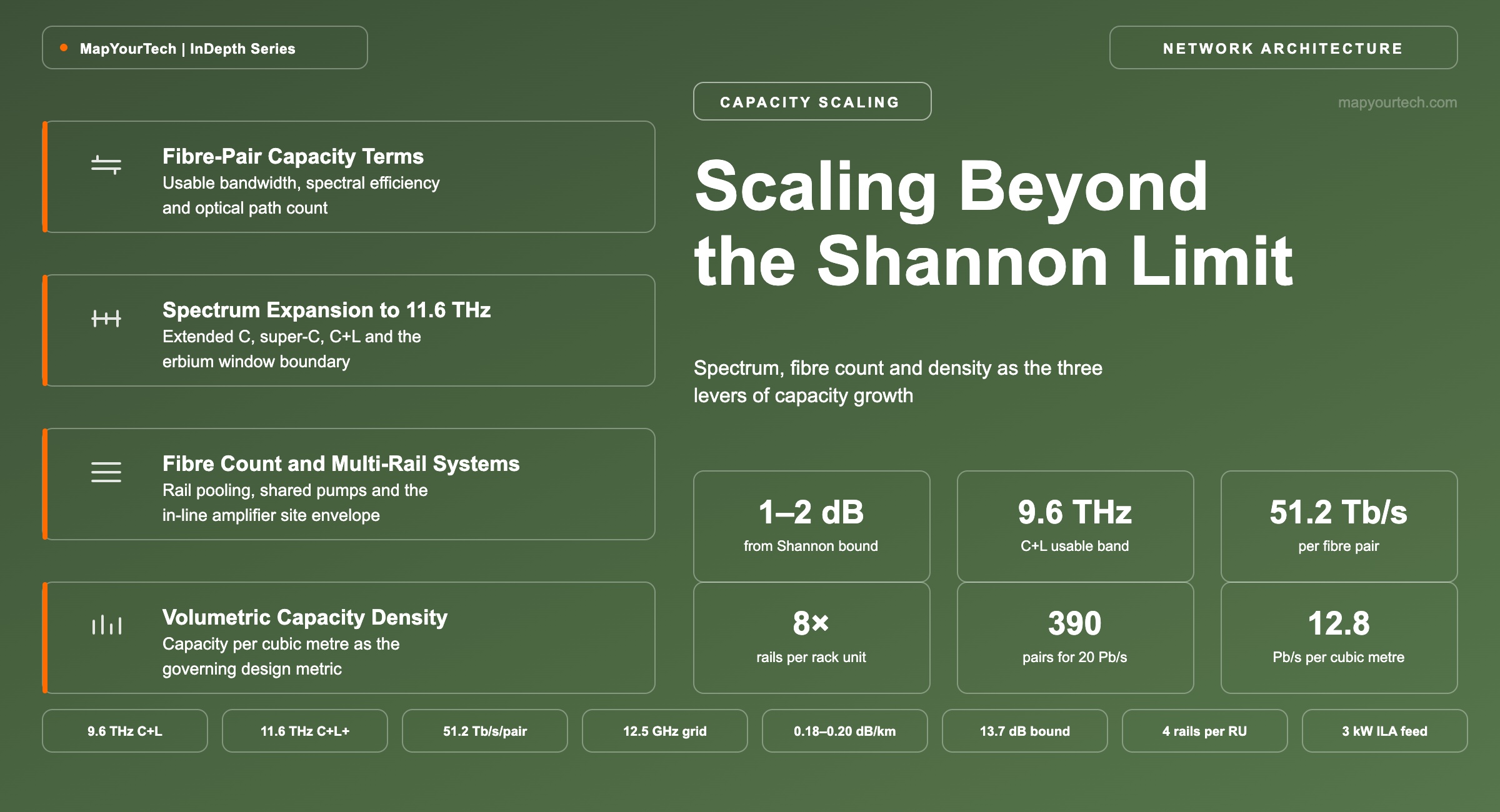
Scaling Beyond the Shannon Limit: Spectrum, Fibre Count and Density as the Three Levers of Capacity Growth
Coherent engines now operate within 1–2 dB of the linear Shannon bound, so the arithmetic of capacity growth has moved from bits per hertz to hertz, fibre pairs and cubic metres.
Spectral efficiency is a ratio, so name both of its terms.
What You Will Learn
- Define fibre-pair capacity as the product of usable bandwidth, spectral efficiency and optical path count, using the anatomy of Figure 1 and the 9.6 THz C+L reference case of Section 2.
- Separate occupied bandwidth, slot width and channel spacing, and convert a 130 GBd carrier into the 150 GHz slot it occupies per ITU-T G.694.1.
- Compute required SNR from the complete Shannon form C = 2 · B · log2(1 + SNR), reproducing the 13.7 dB bound and 23.9 dB OSNR of the 1.2 Tb/s worked case in Section 4.
- Quantify the spectrum lever from the band table of Section 5: 4.8 THz extended C, 6.1 THz super-C, 9.6 THz C+L and 11.6 THz super-C plus super-L.
- Place the amplifier, dispersion and SRS tilt constraints that bound O, E, S and U band operation, using the loss and conversion-efficiency figures of Table 2.
- Convert a 20 Pb/s inter-site requirement into 390 fibre pairs at 51.2 Tb/s per pair, and into the rack count each amplification architecture needs (Section 6, Table 4).
- Derive volumetric density in Pb/s per cubic metre from 4 in-line amplifiers per rack unit against 0.5, and reproduce the 8× figure of Section 7 and Figure 7.
- Select and order the three levers for a given route using the condition ladder of Figure 9 and the comparison matrix of Table 6.
1. Introduction
Current-generation embedded coherent optical engines operate between 1 dB and 2 dB from the linear Shannon bound (vendor-published system analysis). That single figure sets the agenda for the rest of this decade of optical transport engineering. It says that the mechanism which delivered every capacity increase from 2.5 Gb/s to 1.2 Tb/s per wavelength — raising spectral efficiency by moving to denser constellations and stronger forward error correction (FEC) — has approximately 1–2 dB of headroom left, and that the remaining headroom converts into a fraction of a bit per second per hertz rather than a doubling.
Demand is not slowing to match. A Bell Labs traffic study places non-artificial-intelligence consumer and enterprise traffic growth at a 16% compound annual growth rate (CAGR) and AI-related consumer and enterprise traffic at 24% CAGR through 2034 (forecast). The same study projects total wide area network traffic reaching 2,277–4,878 EB/month by 2034 across its conservative and aggressive scenarios, a 13–22% CAGR (forecast). One hyperscale internet content provider reported core network traffic growing at a 100% CAGR at optical conferences in 2024 and 2025 (operator statement). Machine-to-machine traffic generated by agentic AI is forecast separately to rise from 66 EB/month in 2025 to 537 EB/month in 2034, a 26% CAGR (forecast).
The gap between a capacity mechanism that has run out of range and a demand curve that has not is the engineering problem this article addresses. It has exactly three answers, and every product announcement, standards project and field trial of the current cycle falls into one of them.
Widen the spectrum. A fibre pair carrying only the extended C-band leaves more than half of the erbium-accessible low-loss window unlit. Lighting the L-band takes usable bandwidth from 4.8 THz to 9.6 THz. Widening both bands takes it to 11.6 THz. Bands outside the erbium window — O, E, S and U — carry another 30 THz of nominal fibre transparency and a set of amplifier, dispersion and stimulated Raman scattering (SRS) constraints that currently bound how much of it is reachable.
Add fibre pairs. Capacity scales linearly with the number of independent optical paths, with no Shannon term involved at all. Regional data centre interconnection has typically required 16 to 48 fibre pairs, while AI-driven regional interconnection requires 128 or more (operator statement, OFC 2026). The constraint moves from photonics to civil works and to the electrical and thermal envelope of the in-line amplifier (ILA) site, which was built decades ago for a single fibre pair.
Raise equipment density. If a site cannot grow, the equipment inside it has to shrink. Multi-rail in-line amplifiers place bidirectional amplification for several fibre pairs on one line card, sharing the optical time-domain reflectometer (OTDR), optical channel monitor (OCM), dynamic gain equalizer (DGE) and pump lasers across all of them. Full-spectrum transponders apply the same logic at the terminal, filling an entire band or an entire fibre from one card.
These three levers are not alternatives to be ranked once. They are multiplicative terms in the same expression, they are bounded by different physics, and they carry different unit costs, so the engineering question on any given route is which term is furthest from its ceiling and what the next increment of it costs. This article derives that expression from first principles, quantifies each lever against verifiable figures, and gives an ordered selection rule for combining them.
Scope and boundary conditions: the analysis covers terrestrial long-haul, regional and data centre interconnect (DCI) applications on installed ITU-T G.652 and G.654 single-mode fibre, using coherent transmission with erbium-doped fibre amplifier (EDFA) and hybrid EDFA/Raman line systems. Submarine wet-plant design, intra-data-centre optics below 2 km, and free-space links fall outside it. Hollow-core and multi-core fibre appear in Section 14 as media that change the bounds on all three levers rather than as a fourth lever, because neither is yet a general-purpose substitute for installed single-mode plant.
Takeaway: With coherent engines 1–2 dB from the linear Shannon bound, spectral efficiency has stopped being the growth term. Capacity growth now comes from usable bandwidth, optical path count and the volumetric density of the equipment that lights them, and the three are bounded by amplifier physics, civil works and site power respectively.
2. Fibre-Pair Capacity and Its Component Terms
Fibre-pair capacity is the total information rate a single bidirectional pair of optical fibres carries between two terminals, measured in bits per second. It is the product of three independent quantities: the usable optical bandwidth in hertz, the delivered spectral efficiency in bits per second per hertz, and the number of independent optical paths the pair provides. Each quantity has its own physical ceiling and its own unit cost.
That product is the reason the three levers exist, and the reason they multiply rather than add. Figure 1 shows the anatomy of each term against the deployed C+L reference case.
2.1 Distinctions From the Adjacent Quantities
Read the Full Analysis with Premium
The remaining 89% of this article — the design numbers, trade-offs and field guidance — is part of MapYourTech Premium, along with the full premium library, courses and professional tools.
You May Also Like
-
Free
-
September 4, 2026
-
Premium
-
September 4, 2026
-
Premium
-
September 4, 2026