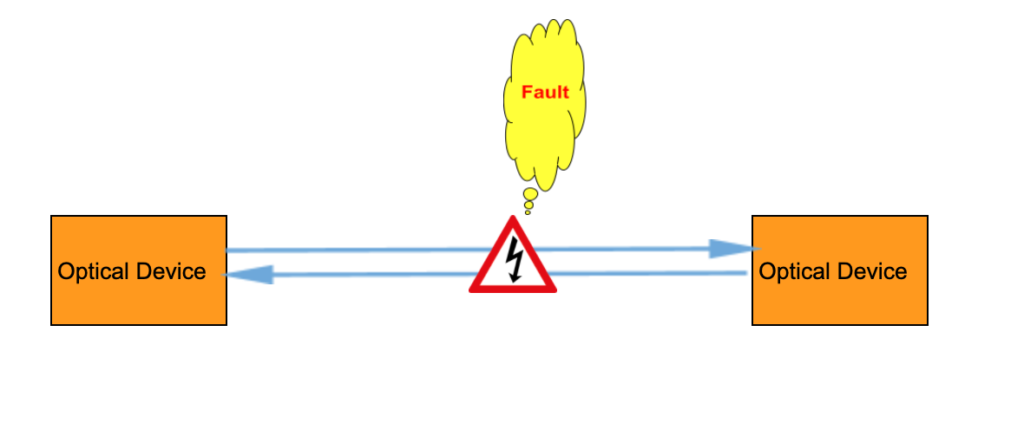
To detect a failure that occurs at the source (e.g., laser failure) or the transmission facility (e.g., fiber cut), all incoming SONET signals are monitored for loss of physical-layer signal (optical or electrical). The detection of an LOS defect must take place within a reasonably short period of time for timely restoration of the transported payloads.
A SONET NE shall monitor all incoming SONET signals (before descrambling) for an “all-zeros patterns,” where an all-zeros pattern corresponds to no light pulses for OC-N optical interfaces and no voltage transitions for STS-1 and STS-3 electrical interfaces. An LOS defect shall be detected when an all-zeros pattern on the incoming SONET signal lasts 100 μs or longer. If an all-zeros pattern lasts 2.3 μs or less, an LOS defect shall not be detected. The treatment of all-zeros patterns lasting between 2.3 μs and 100 μs for the purpose of LOS defect detection is not specified and is therefore left to the choice of the equipment designer. For testing conformance to the LOS detection requirement, it is sufficient to apply an all-zeros pattern lasting at most 2.3 μs, and to apply an all-zeros pattern lasting at least 100 μs.
Note that although an all-zeros pattern that lasts for less than 2.3 μs must not cause the detection of an LOS defect, an NE that receives a relatively long (in terms of the number of bit periods) all-zeros pattern of less than 2.3 μs is not necessarily expected to continue to operate error-free through that pattern.For example, in such cases it is possible that the NE’s clock recovery circuitry may drift off frequency due to the lack of incoming pulses, and therefore the NE may be “looking in the wrong bit positions” for the SONET framing pattern after the all-zeros pattern ends. If this occurs, it will continue for approximately 500 μs, at which point the NE will detect an SEF defect. The NE would then perform the actions associated with SEF defect detection (e.g., initiate a search for the “new” framing pattern position),rather than the actions associated with LOS defect detection (e.g., AIS and RDI insertion, possible protection switch initiation). In addition to monitoring for all-zeros patterns a SONET NE may also detect an LOS defect if the received signal level (e.g., the incoming optical power) drops below an implementation-determined threshold.